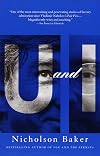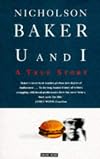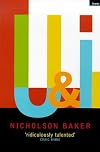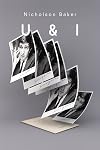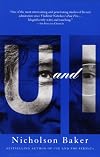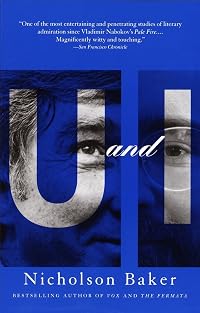
U and I: A True Story
by Nicholson Baker
On This Page
Description
Baker muses on the creative process via his obsession with John Updike.Tags
Recommendations










Member Reviews
‘It has done me a favour, that review, because it’s a review like few others. It’s an act of homage, isn’t it? Nicholson Baker
If ever there was a book that begged to be discussed prematurely, a book that pleads to be mocked in what I believe is the goodreads catchphrase 'a parody homage', this is it. And yet, maybe it has already been done? Could one live down the embarrassment? Firstly to have done what's been done before, secondly to have one's friends know that you don't even read their work - or worse, do read it and can't remember a thing about it. Checks friends' lists. Why no. Neither MJ or Paul has done this. (Thinks to self, this paragraph is Baker.) ((Thinks to self, I only wrote that last thought because it is what show more Baker would do.))
But if I do this, read part of the book and then write, and Nicholson Baker himself reads it, what will he think? That I'm being rude? Obsequious? Arrogant? Lazy?! (Thinks to self, and this paragraph.) ((Ditto.)) (((Thinks to self, fuck, how do I get out of this loop?)))
I could go on, but you get the point. This is only my second Baker book, but being Baker is easier than being John Malkovich is....for John Malkovich. That makes me somewhat suspicious of him.
Despite his wanking sentences, his smart-arsed cleverness, his careful self-mocking – careful to make sure that his audience is sympathetic rather than repelled – I still like it. Right now I am particularly taken by his distinction between considered and spontaneous memories. I could not help, as I read this over breakfast this morning, considering the very prospect of what my spontaneous memory of this book will be in the future, the one that comes to me from nothing. It will be this. Reading You and I over breakfast, considering the very prospect of what my spontaneous memory of this book will be. The rest will be as flotsam and jetsam, some vague idea he is the Updike guy. The reason, in fact, that I probably will never now read Updike. How can I? I know he will be utterly spoilt by the fantasy of Baker’s reverie. And now I’m being fucking Baker again, aren’t I?
Written 9am at p. 55.
Added after reading to the end. On the neuroses of writers this is great, but he lost me towards the end when he decides that homosexuals and women make the best novelists. One would assume that means homosexual women rule, but actually, in a rather sexist act if ever there was one, he seems to be referring to male homosexuals, whereas the sexuality of women is evidently not relevant. They got dem words sorta like black people have dat rhythm seems to be the gist of it. NOT happy with this, Mr Baker. show less
If ever there was a book that begged to be discussed prematurely, a book that pleads to be mocked in what I believe is the goodreads catchphrase 'a parody homage', this is it. And yet, maybe it has already been done? Could one live down the embarrassment? Firstly to have done what's been done before, secondly to have one's friends know that you don't even read their work - or worse, do read it and can't remember a thing about it. Checks friends' lists. Why no. Neither MJ or Paul has done this. (Thinks to self, this paragraph is Baker.) ((Thinks to self, I only wrote that last thought because it is what show more Baker would do.))
But if I do this, read part of the book and then write, and Nicholson Baker himself reads it, what will he think? That I'm being rude? Obsequious? Arrogant? Lazy?! (Thinks to self, and this paragraph.) ((Ditto.)) (((Thinks to self, fuck, how do I get out of this loop?)))
I could go on, but you get the point. This is only my second Baker book, but being Baker is easier than being John Malkovich is....for John Malkovich. That makes me somewhat suspicious of him.
Despite his wanking sentences, his smart-arsed cleverness, his careful self-mocking – careful to make sure that his audience is sympathetic rather than repelled – I still like it. Right now I am particularly taken by his distinction between considered and spontaneous memories. I could not help, as I read this over breakfast this morning, considering the very prospect of what my spontaneous memory of this book will be in the future, the one that comes to me from nothing. It will be this. Reading You and I over breakfast, considering the very prospect of what my spontaneous memory of this book will be. The rest will be as flotsam and jetsam, some vague idea he is the Updike guy. The reason, in fact, that I probably will never now read Updike. How can I? I know he will be utterly spoilt by the fantasy of Baker’s reverie. And now I’m being fucking Baker again, aren’t I?
Written 9am at p. 55.
Added after reading to the end. On the neuroses of writers this is great, but he lost me towards the end when he decides that homosexuals and women make the best novelists. One would assume that means homosexual women rule, but actually, in a rather sexist act if ever there was one, he seems to be referring to male homosexuals, whereas the sexuality of women is evidently not relevant. They got dem words sorta like black people have dat rhythm seems to be the gist of it. NOT happy with this, Mr Baker. show less
‘It has done me a favour, that review, because it’s a review like few others. It’s an act of homage, isn’t it? Nicholson Baker
If ever there was a book that begged to be discussed prematurely, a book that pleads to be mocked in what I believe is the goodreads catchphrase 'a parody homage', this is it. And yet, maybe it has already been done? Could one live down the embarrassment? Firstly to have done what's been done before, secondly to have one's friends know that you don't even read their work - or worse, do read it and can't remember a thing about it. Checks friends' lists. Why no. Neither MJ or Paul has done this. (Thinks to self, this paragraph is Baker.) ((Thinks to self, I only wrote that last thought because it is what show more Baker would do.))
But if I do this, read part of the book and then write, and Nicholson Baker himself reads it, what will he think? That I'm being rude? Obsequious? Arrogant? Lazy?! (Thinks to self, and this paragraph.) ((Ditto.)) (((Thinks to self, fuck, how do I get out of this loop?)))
I could go on, but you get the point. This is only my second Baker book, but being Baker is easier than being John Malkovich is....for John Malkovich. That makes me somewhat suspicious of him.
Despite his wanking sentences, his smart-arsed cleverness, his careful self-mocking – careful to make sure that his audience is sympathetic rather than repelled – I still like it. Right now I am particularly taken by his distinction between considered and spontaneous memories. I could not help, as I read this over breakfast this morning, considering the very prospect of what my spontaneous memory of this book will be in the future, the one that comes to me from nothing. It will be this. Reading You and I over breakfast, considering the very prospect of what my spontaneous memory of this book will be. The rest will be as flotsam and jetsam, some vague idea he is the Updike guy. The reason, in fact, that I probably will never now read Updike. How can I? I know he will be utterly spoilt by the fantasy of Baker’s reverie. And now I’m being fucking Baker again, aren’t I?
Written 9am at p. 55.
Added after reading to the end. On the neuroses of writers this is great, but he lost me towards the end when he decides that homosexuals and women make the best novelists. One would assume that means homosexual women rule, but actually, in a rather sexist act if ever there was one, he seems to be referring to male homosexuals, whereas the sexuality of women is evidently not relevant. They got dem words sorta like black people have dat rhythm seems to be the gist of it. NOT happy with this, Mr Baker. show less
If ever there was a book that begged to be discussed prematurely, a book that pleads to be mocked in what I believe is the goodreads catchphrase 'a parody homage', this is it. And yet, maybe it has already been done? Could one live down the embarrassment? Firstly to have done what's been done before, secondly to have one's friends know that you don't even read their work - or worse, do read it and can't remember a thing about it. Checks friends' lists. Why no. Neither MJ or Paul has done this. (Thinks to self, this paragraph is Baker.) ((Thinks to self, I only wrote that last thought because it is what show more Baker would do.))
But if I do this, read part of the book and then write, and Nicholson Baker himself reads it, what will he think? That I'm being rude? Obsequious? Arrogant? Lazy?! (Thinks to self, and this paragraph.) ((Ditto.)) (((Thinks to self, fuck, how do I get out of this loop?)))
I could go on, but you get the point. This is only my second Baker book, but being Baker is easier than being John Malkovich is....for John Malkovich. That makes me somewhat suspicious of him.
Despite his wanking sentences, his smart-arsed cleverness, his careful self-mocking – careful to make sure that his audience is sympathetic rather than repelled – I still like it. Right now I am particularly taken by his distinction between considered and spontaneous memories. I could not help, as I read this over breakfast this morning, considering the very prospect of what my spontaneous memory of this book will be in the future, the one that comes to me from nothing. It will be this. Reading You and I over breakfast, considering the very prospect of what my spontaneous memory of this book will be. The rest will be as flotsam and jetsam, some vague idea he is the Updike guy. The reason, in fact, that I probably will never now read Updike. How can I? I know he will be utterly spoilt by the fantasy of Baker’s reverie. And now I’m being fucking Baker again, aren’t I?
Written 9am at p. 55.
Added after reading to the end. On the neuroses of writers this is great, but he lost me towards the end when he decides that homosexuals and women make the best novelists. One would assume that means homosexual women rule, but actually, in a rather sexist act if ever there was one, he seems to be referring to male homosexuals, whereas the sexuality of women is evidently not relevant. They got dem words sorta like black people have dat rhythm seems to be the gist of it. NOT happy with this, Mr Baker. show less
I'm only reviewing this book a little late (it was published in 1991): but I'd like to make the case that it should be required reading for writers and readers who care about the sort of thing David Foster Wallace was also trying to do, beginning in the early 1990s.
For me, the book splits into two "model authors" (that's Eco's formulation, in "Six Walks in the Fictional Woods).
First is the self-absorbed, insecure, hyperbolically self-interrogating ingenue author, the one who fawns and obsesses and preens over his hero Updike, and then chastises himself for preening, and then finds a reason to credit Updike for his capacity to chastise himself, and then bemoans the fact that his awareness of the fact that Updike gets the credit for a show more quality he'd thought was his means that his estimation of Updike unexpectedly decreases rather than increases, sending him into a spiral of nested second- and third thoughts, expressed four or five asides and illustrated by non sequiturs, arranged in parentheses, square brackets, and em-dashes, and ending several pages later on some unrelated topic.
The second is the model author who would really love to capture as much of his articulateness as he possibly can, even if it means sentences several pages long, or strings of subordinate clauses, or multiple interruptions. This author is concerned with putting what Baker calls his "intelligence" on the page. The topic--a young author's obsession with a famous author--doesn't really matter for this second model author. The book could have been about anything.
In "U and I," the first of these is nicely captured in Baker's meditations on the elusiveness of genius, on the anxiety of influence, and the intemperate behaviors elicited by proximity to fame. The second is well captured by Baker's thoughts on "intelligence," which he contrasts, late in the book, with "genius."
I have a different way of thinking about these two model authors. For me, the first is fun, but trivial and trivializing. If I want depthless insecurity coupled (inevitably) with hyperbolic self-aggrandizement, I would rather read Salvador Dali. Or if I'm after a tortured imagination that bores into itself, guts itself, feeds off the guts, heals itself, and starts all over, I'd read "Notes from the Underground." By contrast with texts like those this is playful, and of course it's meant to be: but it's also meant to do a decent job of capturing most of what a youthful ambition and literary devotion is about.
The second model author is much more interesting. There is an uncanny parallel, at times, between this book and the almost contemporaneous "Infinite Jest." Both are partly about pushing language so it is at once impeccable vernacular (faithful to what counts as spoken, or thought, language) and outlandishly technical (faithful to the microscopic discriminations that the authors see as their plague and their talent). Wallace was seven or eight years younger than Baker, but the authors who occupied his imagination (initially DeLillo, and then Markson and many others) were a good generation younger than the ones that concern Baker (aside from Updike, that's mainly Nabokov and James). Nevertheless the strain both Baker and Wallace put on vernacular language is amazing. If Baker is less impressive -- and even now, 25 years after Baker's book, and in this very obscure venue tucked away among the thousands of anonymous internet reviews, I still hesitate to write this, because the narrator of "U and I" is so tensile with fear of criticism -- it's because his prosody has more to do with older writers, from Updike and Gass (who goes unmentioned) to White and Trilling and Wilson and Nabokov back to James. He behaves himself better on the page; his periods are long and well-tempered, and so a little less of his "intelligence" gets out there on the page.
It is a problem that is very much still current. There is still no limit to this sort of search, and Baker is still one of the best practitioners. show less
For me, the book splits into two "model authors" (that's Eco's formulation, in "Six Walks in the Fictional Woods).
First is the self-absorbed, insecure, hyperbolically self-interrogating ingenue author, the one who fawns and obsesses and preens over his hero Updike, and then chastises himself for preening, and then finds a reason to credit Updike for his capacity to chastise himself, and then bemoans the fact that his awareness of the fact that Updike gets the credit for a show more quality he'd thought was his means that his estimation of Updike unexpectedly decreases rather than increases, sending him into a spiral of nested second- and third thoughts, expressed four or five asides and illustrated by non sequiturs, arranged in parentheses, square brackets, and em-dashes, and ending several pages later on some unrelated topic.
The second is the model author who would really love to capture as much of his articulateness as he possibly can, even if it means sentences several pages long, or strings of subordinate clauses, or multiple interruptions. This author is concerned with putting what Baker calls his "intelligence" on the page. The topic--a young author's obsession with a famous author--doesn't really matter for this second model author. The book could have been about anything.
In "U and I," the first of these is nicely captured in Baker's meditations on the elusiveness of genius, on the anxiety of influence, and the intemperate behaviors elicited by proximity to fame. The second is well captured by Baker's thoughts on "intelligence," which he contrasts, late in the book, with "genius."
I have a different way of thinking about these two model authors. For me, the first is fun, but trivial and trivializing. If I want depthless insecurity coupled (inevitably) with hyperbolic self-aggrandizement, I would rather read Salvador Dali. Or if I'm after a tortured imagination that bores into itself, guts itself, feeds off the guts, heals itself, and starts all over, I'd read "Notes from the Underground." By contrast with texts like those this is playful, and of course it's meant to be: but it's also meant to do a decent job of capturing most of what a youthful ambition and literary devotion is about.
The second model author is much more interesting. There is an uncanny parallel, at times, between this book and the almost contemporaneous "Infinite Jest." Both are partly about pushing language so it is at once impeccable vernacular (faithful to what counts as spoken, or thought, language) and outlandishly technical (faithful to the microscopic discriminations that the authors see as their plague and their talent). Wallace was seven or eight years younger than Baker, but the authors who occupied his imagination (initially DeLillo, and then Markson and many others) were a good generation younger than the ones that concern Baker (aside from Updike, that's mainly Nabokov and James). Nevertheless the strain both Baker and Wallace put on vernacular language is amazing. If Baker is less impressive -- and even now, 25 years after Baker's book, and in this very obscure venue tucked away among the thousands of anonymous internet reviews, I still hesitate to write this, because the narrator of "U and I" is so tensile with fear of criticism -- it's because his prosody has more to do with older writers, from Updike and Gass (who goes unmentioned) to White and Trilling and Wilson and Nabokov back to James. He behaves himself better on the page; his periods are long and well-tempered, and so a little less of his "intelligence" gets out there on the page.
It is a problem that is very much still current. There is still no limit to this sort of search, and Baker is still one of the best practitioners. show less
‘It has done me a favour, that review, because it’s a review like few others. It’s an act of homage, isn’t it? Nicholson Baker
If ever there was a book that begged to be discussed prematurely, a book that pleads to be mocked in what I believe is the goodreads catchphrase 'a parody homage', this is it. And yet, maybe it has already been done? Could one live down the embarrassment? Firstly to have done what's been done before, secondly to have one's friends know that you don't even read their work - or worse, do read it and can't remember a thing about it. Checks friends' lists. Why no. Neither MJ or Paul has done this. (Thinks to self, this paragraph is Baker.) ((Thinks to self, I only wrote that last thought because it is what show more Baker would do.))
But if I do this, read part of the book and then write, and Nicholson Baker himself reads it, what will he think? That I'm being rude? Obsequious? Arrogant? Lazy?! (Thinks to self, and this paragraph.) ((Ditto.)) (((Thinks to self, fuck, how do I get out of this loop?)))
I could go on, but you get the point. This is only my second Baker book, but being Baker is easier than being John Malkovich is....for John Malkovich. That makes me somewhat suspicious of him.
Despite his wanking sentences, his smart-arsed cleverness, his careful self-mocking – careful to make sure that his audience is sympathetic rather than repelled – I still like it. Right now I am particularly taken by his distinction between considered and spontaneous memories. I could not help, as I read this over breakfast this morning, considering the very prospect of what my spontaneous memory of this book will be in the future, the one that comes to me from nothing. It will be this. Reading You and I over breakfast, considering the very prospect of what my spontaneous memory of this book will be. The rest will be as flotsam and jetsam, some vague idea he is the Updike guy. The reason, in fact, that I probably will never now read Updike. How can I? I know he will be utterly spoilt by the fantasy of Baker’s reverie. And now I’m being fucking Baker again, aren’t I?
Written 9am at p. 55.
Added after reading to the end. On the neuroses of writers this is great, but he lost me towards the end when he decides that homosexuals and women make the best novelists. One would assume that means homosexual women rule, but actually, in a rather sexist act if ever there was one, he seems to be referring to male homosexuals, whereas the sexuality of women is evidently not relevant. They got dem words sorta like black people have dat rhythm seems to be the gist of it. NOT happy with this, Mr Baker. show less
If ever there was a book that begged to be discussed prematurely, a book that pleads to be mocked in what I believe is the goodreads catchphrase 'a parody homage', this is it. And yet, maybe it has already been done? Could one live down the embarrassment? Firstly to have done what's been done before, secondly to have one's friends know that you don't even read their work - or worse, do read it and can't remember a thing about it. Checks friends' lists. Why no. Neither MJ or Paul has done this. (Thinks to self, this paragraph is Baker.) ((Thinks to self, I only wrote that last thought because it is what show more Baker would do.))
But if I do this, read part of the book and then write, and Nicholson Baker himself reads it, what will he think? That I'm being rude? Obsequious? Arrogant? Lazy?! (Thinks to self, and this paragraph.) ((Ditto.)) (((Thinks to self, fuck, how do I get out of this loop?)))
I could go on, but you get the point. This is only my second Baker book, but being Baker is easier than being John Malkovich is....for John Malkovich. That makes me somewhat suspicious of him.
Despite his wanking sentences, his smart-arsed cleverness, his careful self-mocking – careful to make sure that his audience is sympathetic rather than repelled – I still like it. Right now I am particularly taken by his distinction between considered and spontaneous memories. I could not help, as I read this over breakfast this morning, considering the very prospect of what my spontaneous memory of this book will be in the future, the one that comes to me from nothing. It will be this. Reading You and I over breakfast, considering the very prospect of what my spontaneous memory of this book will be. The rest will be as flotsam and jetsam, some vague idea he is the Updike guy. The reason, in fact, that I probably will never now read Updike. How can I? I know he will be utterly spoilt by the fantasy of Baker’s reverie. And now I’m being fucking Baker again, aren’t I?
Written 9am at p. 55.
Added after reading to the end. On the neuroses of writers this is great, but he lost me towards the end when he decides that homosexuals and women make the best novelists. One would assume that means homosexual women rule, but actually, in a rather sexist act if ever there was one, he seems to be referring to male homosexuals, whereas the sexuality of women is evidently not relevant. They got dem words sorta like black people have dat rhythm seems to be the gist of it. NOT happy with this, Mr Baker. show less
Little did I know before reading this gem that Baker had already treated fiction and literary criticism in as original and hilarious way as he did poetry in "The Anthologist". Not only that, but now I have to go back and read as much John Updike as I can--Updike lost me after "The Coup", although I did briefly attempt to read "Brazil". Thanks, Nicholson Baker, because now I also have to read those of your books I have not yet read, and I owe it to you to review those I already have read...
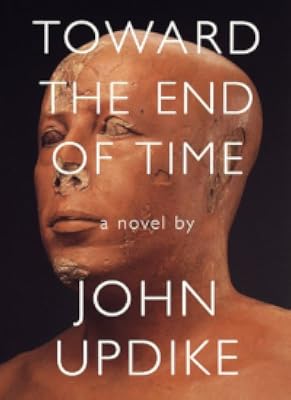
[a:Nicholson Baker|15882|Nicholson Baker|https://images.gr-assets.com/authors/1580973983p2/15882.jpg] explores his creative process through his obsession with [a:John Updike|6878|John Updike|https://images.gr-assets.com/authors/1419249254p2/6878.jpg] as he recalls a lifetime of reading [a:John Updike|6878|John Updike|https://images.gr-assets.com/authors/1419249254p2/6878.jpg] and what he remembers without opening a book for reference. Wonderfully witty and charming and sending me back to read his idol and his idol's idols: e.g. [a:Harold Bloom|236|Harold Bloom|https://images.gr-assets.com/authors/1212940902p2/236.jpg]'s [b:The Anxiety of Influence: A Theory of Poetry|165081|The Anxiety of Influence A Theory of Poetry|Harold show more Bloom|https://i.gr-assets.com/images/S/compressed.photo.goodreads.com/books/1347691941l/165081._SY75_.jpg|159391], [b:Selected Writings of Walter Pater|129203186|Selected Writings of Walter Pater|Harold Bloom|https://i.gr-assets.com/images/S/compressed.photo.goodreads.com/books/1697955774l/129203186._SY75_.jpg|149260877], [a:Henry James|159|Henry James|https://images.gr-assets.com/authors/1693104678p2/159.jpg] ("The Figure in the Carpet"), [a:Frederick Exley|23394|Frederick Exley|https://images.gr-assets.com/authors/1280717714p2/23394.jpg]'s [b:A Fan's Notes|774032|A Fan's Notes (A Fan's Notes, #1)|Frederick Exley|https://i.gr-assets.com/images/S/compressed.photo.goodreads.com/books/1403181682l/774032._SY75_.jpg|2466791] and [b:Pages from a Cold Island|117468|Pages from a Cold Island (A Fan's Notes, #2)|Frederick Exley|https://i.gr-assets.com/images/S/compressed.photo.goodreads.com/books/1229538193l/117468._SX50_.jpg|113096], [a:Edmund Wilson|4173|Edmund Wilson|https://images.gr-assets.com/authors/1235801530p2/4173.jpg], [a:BARTHELME DONALD|32164573|BARTHELME DONALD|https://s.gr-assets.com/assets/nophoto/user/u_50x66-632230dc9882b4352d753eedf9396530.png], [a:Nabokov Vladimir|19423645|Nabokov Vladimir|https://s.gr-assets.com/assets/nophoto/user/u_50x66-632230dc9882b4352d753eedf9396530.png] and his 3x5 cards for his fiction ([b:Pnin|30593|Pnin|Vladimir Nabokov|https://i.gr-assets.com/images/S/compressed.photo.goodreads.com/books/1657567547l/30593._SY75_.jpg|1153252], [b:Glory|54995|Glory|Vladimir Nabokov|https://i.gr-assets.com/images/S/compressed.photo.goodreads.com/books/1657568253l/54995._SY75_.jpg|14933835]).
Opening sentence: "On August 6, 1989, a Sunday, I lay back as usual with my feet up in a reclining aluminum deck chair padded with blood-dotted pillows in my father-in-law's study in Berkeley (we were house-sitting) and arranged my keyboard, resting on an abridged dictionary, on my lap."
A favorite quote:
"Most good novelists have been women or homosexuals." 135
"With dawning amazement, as the results of our various informal surveys come in, we realize how staggeringly disproportionate our debt is to gaydom, in every possible area of literary deportment, but especially in the novel; and we mingle this knowledge with the long recognized preeminence of women in the invention and perfection of the form, and we begin to get the uncomfortable sense, if we aren't gay or female, that we may have chosen a field we can't quite master. Heterosexual male novelists don't for the most part really get it, instinctively: they agree with Jane Austen that the novel is a magnificent thing, toward whose comprehension all other forms of writing and indeed of art, aspre, and this big time grandeur attracts them, but they find much to their perplexity, that they can't internalize and refine upon its ways with quite the unstraining unconscious directness they displayed when thrashing happily through earlier intellectual challenges."
"They stretch the stretchiest of all forms so that it embraces what they do well. And finally they produce things that are, though great, oddities: [b:Ulysses by James Joyce|124942779|Ulysses by James Joyce|James Joyce|https://i.gr-assets.com/images/S/compressed.photo.goodreads.com/books/1680487364l/124942779._SY75_.jpg|146377472], [b:War and Peace|656|War and Peace|Leo Tolstoy|https://i.gr-assets.com/images/S/compressed.photo.goodreads.com/books/1413215930l/656._SY75_.jpg|4912783], [b:Pnin|30593|Pnin|Vladimir Nabokov|https://i.gr-assets.com/images/S/compressed.photo.goodreads.com/books/1657567547l/30593._SY75_.jpg|1153252]." show less
Opening sentence: "On August 6, 1989, a Sunday, I lay back as usual with my feet up in a reclining aluminum deck chair padded with blood-dotted pillows in my father-in-law's study in Berkeley (we were house-sitting) and arranged my keyboard, resting on an abridged dictionary, on my lap."
A favorite quote:
"Most good novelists have been women or homosexuals." 135
"With dawning amazement, as the results of our various informal surveys come in, we realize how staggeringly disproportionate our debt is to gaydom, in every possible area of literary deportment, but especially in the novel; and we mingle this knowledge with the long recognized preeminence of women in the invention and perfection of the form, and we begin to get the uncomfortable sense, if we aren't gay or female, that we may have chosen a field we can't quite master. Heterosexual male novelists don't for the most part really get it, instinctively: they agree with Jane Austen that the novel is a magnificent thing, toward whose comprehension all other forms of writing and indeed of art, aspre, and this big time grandeur attracts them, but they find much to their perplexity, that they can't internalize and refine upon its ways with quite the unstraining unconscious directness they displayed when thrashing happily through earlier intellectual challenges."
"They stretch the stretchiest of all forms so that it embraces what they do well. And finally they produce things that are, though great, oddities: [b:Ulysses by James Joyce|124942779|Ulysses by James Joyce|James Joyce|https://i.gr-assets.com/images/S/compressed.photo.goodreads.com/books/1680487364l/124942779._SY75_.jpg|146377472], [b:War and Peace|656|War and Peace|Leo Tolstoy|https://i.gr-assets.com/images/S/compressed.photo.goodreads.com/books/1413215930l/656._SY75_.jpg|4912783], [b:Pnin|30593|Pnin|Vladimir Nabokov|https://i.gr-assets.com/images/S/compressed.photo.goodreads.com/books/1657567547l/30593._SY75_.jpg|1153252]." show less
A little too much for my tastes. Is it possible the dude has low self-esteem? That he is a bit of a poseur? I write about the book here and I would love for you to read about it:
http://mewlhouse.hubpages.com/hub/A-Story-of-Love-Between-Updike-and-Baker
http://mewlhouse.hubpages.com/hub/A-Story-of-Love-Between-Updike-and-Baker
Members
- Recently Added By
Lists

On Books
70 works; 1 member
Author Information

30+ Works 14,338 Members
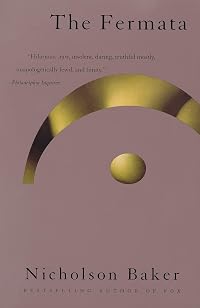
Nicholson Baker lives in Maine. Nicholson Baker was born in New York City on January 7, 1957. He briefly attended the Eastman School of Music before receiving a B.A. in philosophy from Haverford College. He is the author of both fiction and nonfiction works including The Mezzanine (1988); Room Temperature (1990); Vox (1992); The Fermata (1994); show more The Everlasting Story of Nory (1998); Checkpoint (2004); and The Anthologist (2009). His nonfiction work, Double Fold: Libraries and the Assault on Paper, won a National Book Critics Circle Award in 2001. (Bowker Author Biography) show less
Common Knowledge
- Canonical title
- U and I: A True Story
- Original publication date
- 1991-04-03
- People/Characters
- John Updike; Nicholson Baker
- Epigraph
- It may be us they wish to meet but it's themselves they want to talk about.
Cyril Connolly - First words
- On August 6, 1989, a Sunday, I lay back as usual with my feet up in a reclining aluminum deck chair padded with blood-dotted pillows in my father-in-law's study in Berkeley (we were house sitting) and arranged my keyboard, re... (show all)sting on an abridged dictionary, on my lap.
- Last words
- (Click to show. Warning: May contain spoilers.)And that's all the imaginary friendship I need.
Classifications
Statistics
- Members
- 567
- Popularity
- 52,041
- Reviews
- 9
- Rating
- (3.72)
- Languages
- English, French, German
- Media
- Paper, Ebook
- ISBNs
- 10
- ASINs
- 2