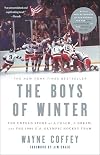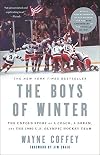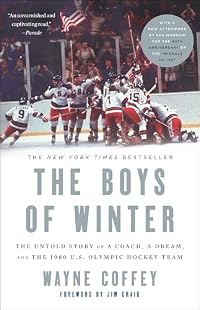
The Boys of Winter: The Untold Story of a Coach, a Dream, and the 1980 U.S. Olympic Hockey Team
by Wayne Coffey
On This Page
Description
Once upon a time, they taught us to believe. They were the 1980 U.S. Olympic hockey team, a blue-collar bunch led by an unconventional coach, and they engineered perhaps the greatest sports moment of the twentieth century. Their "Miracle on Ice" has become a national fairy tale, but the real Cinderella story is even more remarkable. It is a legacy of hope, hard work, and homegrown triumph. It is a chronicle of everyday heroes who just wanted to play hockey happily ever after. It is still show more unbelievable. The Boys of Winter is an evocative account of the improbable American adventure in Lake Placid, New York. Drawing on hundreds of hours of interviews, Wayne Coffey explores the untold stories of the U.S. upstarts, their Soviet opponents, and the forces that brought them together. show lessTags
Recommendations










Member Reviews
I grew up an avid hockey fan and occasional player. I don’t remember a time before I could skate and my fondest childhood memories are flying across the ice and knocking the puck around on the frozen lake on the edge of the backyard of my dad’s house. I’d curse the toe picks I was stuck with on the goofy figure skates and longed for a real pair of hockey skates to live out my goalie dreams. On non-frozen-water, I was a goalie in floor hockey, and later, with the right skates, on ice. And in college I taught my cat how to shoot a street hockey puck on a net. It’s my long time sporting love.
Which meant, every time an new hockey book is published, I read it. Especially in the summer during the agonizing wait between the end of the show more Stanley Cup finals and the start of pre-season on or around my September birthday. (For years I really thought hockey season was my own personal birthday present.) The more hockey, the better. And a few days ago I finished A Team of Their Own about the Korean women’s team at the 2018 Olympics, and almost swapped it this week for this one, but I couldn’t let the 40th anniversary pass unmarked. The Boys of Winter is my first hockey book love.
I read it in college during a rare semester not full of assigned reading. When it first published I was in high school and hockey or not, I wasn’t a big nonfiction reader. It was while I was in high school that the movie of the team and game, Miracle, was released. It was my comfort movie when I missed home, and the ice, while at the University of Pittsburgh (the only school of the 10 I applied to not to have an NCAA ice hockey team… but how I ended up at Pitt is a whole other story).
I remember finding The Boys of Winter on the shelf of the Barnes & Noble on the Waterfront (the only bookstore I knew the bus route for) with a blurb marking that it was the 30th anniversary of the game. I could already recite all of the players by name and thought I understood Herb Brooks’ coaching philosophy, but I realized I really didn’t have a great understanding of what went through everyone’s heads leading up to the game. Miracle‘s a great movie, but it’s only a two hour window into a very busy and crazy cross-section of recent world history.
In 1960, Herb Brooks was cut from the Olympic hockey team and sent home (he played on the ’64 and ’68 teams). Twenty years later, in 1980 when he returned to the world stage as its coach, the world had changed significantly in terms of technology (we landed on the moon and had early computers) but very little in geopolitical terms. The Cold War was still in full swing. The 1980 Winter Olympics were set to be a peaceful battleground to assert dominance on the global scale. And the ice hockey game between the USSR and the USA was to be the greatest sporting showdown of the century. If the Americans could make it that far.
The team Brooks assembled was a microcosm of the US hockey world at the time, which reflected various cultural differences around the country. The boys from the midwest and the boys from the northeast had to not only put their college rivalries aside, but learn how to play and get along with people who had different values and personalities off the ice as well. Craig and Eruzione, goalie and captain and lifelong New Englanders, have parlayed their roles in the game into lengthy public speaking and income-generating careers long after their retirement as players, where many of the midwestern players went home after their hockey careers to quiet lives in the woods.
And yet. These twenty young men fresh out of college put their personal differences aside to play hockey for a stormy and impassioned coach, and for the opportunity to beat the USSR. While The Boys of Winter is not overly political, it’s impossible to ignore the giant Cold War sized elephant in the room. The match up between the USA and the USSR was never going to be “just a game,” Olympics level pressures aside.
Wayne Coffey’s book is a chronological account of the game, with player bios and world events sprinkled in along the way. Even for those who think they know the game, the players, and the coach, it’s a great read and a wonderful collection of interviews with the players after the fact. (And up next on my hockey TBR list is Mike Eruzione’s The Making of a Miracle.) show less
Which meant, every time an new hockey book is published, I read it. Especially in the summer during the agonizing wait between the end of the show more Stanley Cup finals and the start of pre-season on or around my September birthday. (For years I really thought hockey season was my own personal birthday present.) The more hockey, the better. And a few days ago I finished A Team of Their Own about the Korean women’s team at the 2018 Olympics, and almost swapped it this week for this one, but I couldn’t let the 40th anniversary pass unmarked. The Boys of Winter is my first hockey book love.
I read it in college during a rare semester not full of assigned reading. When it first published I was in high school and hockey or not, I wasn’t a big nonfiction reader. It was while I was in high school that the movie of the team and game, Miracle, was released. It was my comfort movie when I missed home, and the ice, while at the University of Pittsburgh (the only school of the 10 I applied to not to have an NCAA ice hockey team… but how I ended up at Pitt is a whole other story).
I remember finding The Boys of Winter on the shelf of the Barnes & Noble on the Waterfront (the only bookstore I knew the bus route for) with a blurb marking that it was the 30th anniversary of the game. I could already recite all of the players by name and thought I understood Herb Brooks’ coaching philosophy, but I realized I really didn’t have a great understanding of what went through everyone’s heads leading up to the game. Miracle‘s a great movie, but it’s only a two hour window into a very busy and crazy cross-section of recent world history.
In 1960, Herb Brooks was cut from the Olympic hockey team and sent home (he played on the ’64 and ’68 teams). Twenty years later, in 1980 when he returned to the world stage as its coach, the world had changed significantly in terms of technology (we landed on the moon and had early computers) but very little in geopolitical terms. The Cold War was still in full swing. The 1980 Winter Olympics were set to be a peaceful battleground to assert dominance on the global scale. And the ice hockey game between the USSR and the USA was to be the greatest sporting showdown of the century. If the Americans could make it that far.
The team Brooks assembled was a microcosm of the US hockey world at the time, which reflected various cultural differences around the country. The boys from the midwest and the boys from the northeast had to not only put their college rivalries aside, but learn how to play and get along with people who had different values and personalities off the ice as well. Craig and Eruzione, goalie and captain and lifelong New Englanders, have parlayed their roles in the game into lengthy public speaking and income-generating careers long after their retirement as players, where many of the midwestern players went home after their hockey careers to quiet lives in the woods.
And yet. These twenty young men fresh out of college put their personal differences aside to play hockey for a stormy and impassioned coach, and for the opportunity to beat the USSR. While The Boys of Winter is not overly political, it’s impossible to ignore the giant Cold War sized elephant in the room. The match up between the USA and the USSR was never going to be “just a game,” Olympics level pressures aside.
Wayne Coffey’s book is a chronological account of the game, with player bios and world events sprinkled in along the way. Even for those who think they know the game, the players, and the coach, it’s a great read and a wonderful collection of interviews with the players after the fact. (And up next on my hockey TBR list is Mike Eruzione’s The Making of a Miracle.) show less
Winter Olympics, 1980. The games were held at Lake Placid, NY, a tiny little town in the middle of nowhere. The hockey team was made up of amateurs, college kids who hadn't yet played pro, and wasn't expected to go far. But the pivotal game against the Soviet Union captured everyone's attention on the world stage. Starting with the first puck drop to the end of the third period, journalist Wayne Coffey gives a play-by-play account of the game known as the "Miracle on Ice," interspersed with short biographies of players and coaches loaded with interviews with the players and their families and friends.
I've read a few sports books in this format of play-by-play mixed with interviews and history. It gives a sort of edge-of-your-seat feel, show more and this book has this in spades, not only for where Coffey chooses to jump from one to the other but also in the way he chooses to end each paragraph with cliffhangers that rival fast-paced fiction reads. It's also very tough to "pause" a hockey game, which by its very nature has few natural stopping points. In this case, since I hadn't seen the game itself I found it very difficult to visualize and stop and start, so it had mixed results for me. I did enjoy getting the information about the players, some of whom went on to play for the pros with mixed results, and get a "where are they now" kind of update (at least as far as when the book was written in 2004). Recommended for hockey fans and anyone who enjoys this type of sports writing. show less
I've read a few sports books in this format of play-by-play mixed with interviews and history. It gives a sort of edge-of-your-seat feel, show more and this book has this in spades, not only for where Coffey chooses to jump from one to the other but also in the way he chooses to end each paragraph with cliffhangers that rival fast-paced fiction reads. It's also very tough to "pause" a hockey game, which by its very nature has few natural stopping points. In this case, since I hadn't seen the game itself I found it very difficult to visualize and stop and start, so it had mixed results for me. I did enjoy getting the information about the players, some of whom went on to play for the pros with mixed results, and get a "where are they now" kind of update (at least as far as when the book was written in 2004). Recommended for hockey fans and anyone who enjoys this type of sports writing. show less
This was both an enjoyable book to read while being simultaneously frustrating as well. It was enjoyable because it gave the story of the miracle on ice, the 1980 US Olympic Hockey Team's triumph over the big, bad USSR team which always won gold medals and which had just crushed the US 10-3 10 days before the game. You also get to read about the coaches and players and that's cool. However, it's frustrating because of the way the author chose to construct the book. I realize I'm in the minority here, as many reviewers have expressed admiration for this style, but it annoyed the hell out of me. He starts with the game. People are skating, the puck is being passed. Several minutes into it, a particular US player gets the puck and then you show more immediately are torn from the game and given a lengthy story on the player, beginning with his birth, his upbringing playing hockey, his pee wee days, his middle school days, his high school playing, his college playing and stats, his status on the Olympic team, who he married, how many kids he had, what career he had after the Olympics were over, and everything up to the present, which is 2005, when the book was published. These breaks last probably 10 pages or more and break up the continuity of the game endlessly. It happens all the time. It's so damned annoying. Just as you're about to get into a rush to the goal by the US, the author breaks away for one of these long profiles and you forget about the game. Or not. But by the time you return to the game, you're so ticked, you no longer care. I have no idea why he chose to do it this way. If I had been writing it, I would have had profiles of all the players in one location, either in the front, the middle, or at the end, and then the game in its entirety.
So the Russians score first, of course. A lot of attention is given to goalie Jim Craig in this book, but deservedly so, because in my opinion, he single handedly won the game for the Americans. He stopped dozens of shots. He had an amazing night. We tied the game. They scored again. We tied it again. Then in the third period, another tie -- 3-3. With 10 minutes left in the game, US captain Mike Eruzione, a household name back then, came down the ice and got one past Russia's world class goalie to put the US up 4-3 and all the US had to do was hang on. And they did. Game over, America wins, stuns the world. And this was a semi-final. We still had to win the gold medal, which we did against Finland a couple of days later. Our coach, Herb Brooks, was a royal jerk to his guys, but he motivated them to win. The Soviets were stunned, but many drank congratulatory cocktails to the Americans later that night, which was classy of them.
It's kind of funny how the day after I finished reading this book, I read how Jim Craig is putting all of his Olympic stuff up for auction for about $6 million. Weird how things work out. Brooks died in a car crash a few years ago. The team was at the funeral. It was good to catch up on guys whose names I had forgotten and to relive an event I watched on TV so long ago. It has a special memory for me. Aside from my criticism, this is a good book and the author is a good writer, so it's recommended. show less
So the Russians score first, of course. A lot of attention is given to goalie Jim Craig in this book, but deservedly so, because in my opinion, he single handedly won the game for the Americans. He stopped dozens of shots. He had an amazing night. We tied the game. They scored again. We tied it again. Then in the third period, another tie -- 3-3. With 10 minutes left in the game, US captain Mike Eruzione, a household name back then, came down the ice and got one past Russia's world class goalie to put the US up 4-3 and all the US had to do was hang on. And they did. Game over, America wins, stuns the world. And this was a semi-final. We still had to win the gold medal, which we did against Finland a couple of days later. Our coach, Herb Brooks, was a royal jerk to his guys, but he motivated them to win. The Soviets were stunned, but many drank congratulatory cocktails to the Americans later that night, which was classy of them.
It's kind of funny how the day after I finished reading this book, I read how Jim Craig is putting all of his Olympic stuff up for auction for about $6 million. Weird how things work out. Brooks died in a car crash a few years ago. The team was at the funeral. It was good to catch up on guys whose names I had forgotten and to relive an event I watched on TV so long ago. It has a special memory for me. Aside from my criticism, this is a good book and the author is a good writer, so it's recommended. show less
The Boys of Winter is a pretty good book for what it is. What it isn't, however, is "The Untold Story of a Coach, a Dream, and the 1980 U.S. Olympic Hockey Team." The stories of Herb Brooks have been told before; the stories of the players are known. If you're reading this book, I certainly imagine you know what happened at the 1980 Olympics. There are no big surprises or even especially hard-hitting journalism. No players are interrogated past their comfort level, no dirt is dug up.
This book also does not tell the story of the building of the team, although it is of course mentioned; it is not the written version of the movie Miracle. I had expected it to be that, and was honestly disappointed to not have more - I wanted show more journalist-checked facts about how the team was built, to check the movie-built myths. There are some tidbits scattered throughout the book, but it isn't written as a narrative of the team's journey.
This book is essentially a biography of each of the players on the team, with an update on how they were when the book was published (as told by them, and those closest to them who would be interviewed). The information is framed by a play-by-play of the action of the game - which was an interesting and fine device, although I would have preferred if Coffey had included what times each play described had happened; it was hard to know how much time had passed between plays described and how much time was left in the period, which is essential to understanding the flow of the game! There is incredibly interesting information if you are a hockey nerd (I was very excited to find out that the Christian on the team was the son of one of the Christian *Brothers*! I toured that plant when I was a kid! We had awesome summer vacations; we also visited the much-discussed-in-book Eveleth Hippodrome, and the Hockey Hall of Fame), but that is what this book is about.
The best parts of this book, to me, were the interviews with and opinions of the Russian players and coach. I had never heard their opinions or perspectives before and I found that incredibly enlightening.
This is a solid read if you are interested in hockey history, but be clear on what it is and what it isn't - I spent half the book waiting for it to be something it wasn't, and liked it more once I figured out what it was. show less
This book also does not tell the story of the building of the team, although it is of course mentioned; it is not the written version of the movie Miracle. I had expected it to be that, and was honestly disappointed to not have more - I wanted show more journalist-checked facts about how the team was built, to check the movie-built myths. There are some tidbits scattered throughout the book, but it isn't written as a narrative of the team's journey.
This book is essentially a biography of each of the players on the team, with an update on how they were when the book was published (as told by them, and those closest to them who would be interviewed). The information is framed by a play-by-play of the action of the game - which was an interesting and fine device, although I would have preferred if Coffey had included what times each play described had happened; it was hard to know how much time had passed between plays described and how much time was left in the period, which is essential to understanding the flow of the game! There is incredibly interesting information if you are a hockey nerd (I was very excited to find out that the Christian on the team was the son of one of the Christian *Brothers*! I toured that plant when I was a kid! We had awesome summer vacations; we also visited the much-discussed-in-book Eveleth Hippodrome, and the Hockey Hall of Fame), but that is what this book is about.
The best parts of this book, to me, were the interviews with and opinions of the Russian players and coach. I had never heard their opinions or perspectives before and I found that incredibly enlightening.
This is a solid read if you are interested in hockey history, but be clear on what it is and what it isn't - I spent half the book waiting for it to be something it wasn't, and liked it more once I figured out what it was. show less
Just when you think you know the story inside and out, Wayne Coffey surprises you. This story never gets old, and Coffey's uniquely structured narrative weaves brief endearing biographies of the players with play-by-play action of the USA-Soviet game on February 22, 1980 in Lake Placid, the world's last small-scale Olympics. The story retold in this book catches your heart all over again, and Coffey's dynamic, entertaining, knowledgeable, and endearing style of writing grip the reader from start to finish. He captures the soul of the team and eloquently verbalizes the team's path to success and the reasons behind it. I strongly recommend this timeless account of the ultimate national sporting triumph to, not only hockey fans, but show more readers of all interests. show less
Good book, certainly a great story. I didn't care for the way the author mixed action from the game with flashbacks to tell the personal stories of the players. Thought it made for kind of disjointed reading. But the stories were worth the telling. I also liked the way the author told the stories of the Soviets alongside the Americans.
[The Boys of Winter] by [Wayne Coffey] tells of one of the greatest sporting events ever (I will not say THE greatest since the US Women's Soccer team did pretty well this year.) For those of you who think you know everything there is to know about the 1980 Gold Medal 'Miracle' team, trust me you don't and should read this book.
[Coffey] does a great job in telling what made the players and coach tick. The unknown backstory. The flips in the story from telling of the players history or interviews interspersed with telling of the game works very well in this book.
[Coffey] does a great job in telling what made the players and coach tick. The unknown backstory. The flips in the story from telling of the players history or interviews interspersed with telling of the game works very well in this book.
Members
- Recently Added By
Author Information
30+ Works 732 Members
Wayne Coffey is a sportswriter for the New York Daily News. He wrote The Closer, with Mariano Rivera, as well as, Wherever I Wind Up, with R. A. Dickey, and The Boys of Winter: The Untold Story of a Coach, a Dream, and the 1980 U. S. Olympic Hockey Team. (Bowker Author Biography)
All Editions
Work Relationships
Reference guide/companion to
Common Knowledge
- Canonical title
- The Boys of Winter: The Untold Story of a Coach, a Dream, and the 1980 U.S. Olympic Hockey Team
- Original title
- The Boys of Winter: The Untold Story of a Coach, a Dream, and the 1980 U.S. Olympic Hockey Team
- Important places
- Lake Placid, New York, USA
- Important events
- Olympic Games (1980)
- First words
- Morning broke hot in St. Paul, Minnesota, on August 16, 2003.
- Original language
- English
Classifications
- Genres
- Sports and Leisure, Nonfiction, General Nonfiction, History, Biography & Memoir
- DDC/MDS
- 796.962 — Arts & recreation Recreation, sports, and performing arts Sports Winter sports Ice games and sports Ice hockey
- LCC
- GV848.4 .U6 .C65 — Geography, Anthropology and Recreation Recreation. Leisure Recreation. Leisure Sports
- BISAC
Statistics
- Members
- 397
- Popularity
- 78,164
- Reviews
- 13
- Rating
- (4.13)
- Languages
- English
- Media
- Paper, Audiobook, Ebook
- ISBNs
- 9
- ASINs
- 2