When in Rome
by Robert J. Hutchinson
On This Page
Description
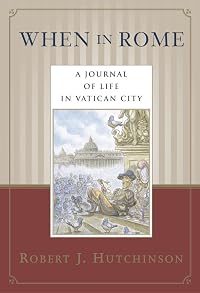
Discerning journalist and Catholic, Robert Hutchinson decided in 1996 to take his family to live in Rome for a year so he could explore the secrets of the Vatican. This book is the journal of his Roman sojourn.Tags
Recommendations







Member Recommendations

Member Reviews
“Like most Catholics, I spent most of my life knowing practically nothing about the Vatican, despite twenty years writing, off and on, about religion in general and the Catholic Church in particular.” When in Rome is Hutchinson's remedy to that deficiency, a delightful romp through the mores and politics of the Holy See.
It's ironic that being a Catholic you get to see a lot of beautiful naked women. "It's true. You may never have realized it before. I never could understand why thickheaded, drooling Protestants would accuse us of being prudes when they gave the world the Puritans and the Moral Majority and we gave the world Rodin's The Kiss.'The fact is that everywhere you go in the Vatican you find nudity. From the Sistine Chapel show more to the papal apartments are busty young women and tumescent young men in murals and paintings that would cause an immense ruckus if found on the walls of any university or public library.
Hutchinson set out to write a book about the Vatican that would answer the kinds of questions that tourists might ask, e.g. How much do cardinals make? or Where do prelates buy their clothes? He soon learned that the Vatican is still very tight lipped and secretive. In fact, they distrust book writers more than magazine journalists, because threatening to deny them future access can control those who write for periodicals. Book writers, on the other hand, often write only one. And "reporters are trained to expect politicians to lie to them, but even politicians will tell you something, if only so they don't look as though they are covering things up. But avoid expressing an opinion about any person, place, or thing, unless absolutely necessary to further one's own interests. This timidity breeds an atmosphere of secrecy and paranoia that outsiders find pathological but which curial insiders believe to be the noblest kind of discretion." This means a reluctance to respond concretely to questions leading to this type of fictitious response from a cardinal who has been asked if the sky is really blue. 'The issue is not perception as such, but whether the apparent blueness of the sky to some people, at certain times and under certain conditions, reflects what they are actually perceiving or merely what they appear to be perceiving. You can't, on this basis alone, simply make the bare assertion that the sky is blue. It's a very complex question, one on which many experts disagree." At this point, you begin to develop a throbbing headache at the base of the skull.
The Vatican State as we know it today is of very recent origin. Until the mid-nineteenth century, the Papal States covered territory in Italy the size of Denmark. Rome and the Vatican were protected by foreign nations, notably France, until the Franco-Prussian War, when all the French troops were withdrawn from Italy and the Italian nationalists attacked and conquered Rome, in effect, imprisoning the pope in the Vatican. In 1929, Mussolini codified the uneasy truce, and Vatican City became recognized by international law. A second treaty was formalized only as late as 1985. Despite the pope's perpetual support for democratic nations, the church is a highly structured monarchy. The pope's the boss, no doubt about it. He answers to no one - at least no one who's willing to show him/herself politically. Still, every day at noon, a cannon is fired to celebrate the Italian victory over Rome and the pope.
Hutchinson's book is filled with delightful little pieces of information such as how the Swiss guard uniforms were designed, how many uniforms have to be tailored, the contents of the Vatican library, and most interestingly his tour through the secret archives that contain documents of extraordinary historical value. "The dominant trait [of the Curia and Vatican staff] is circumspection - the ability to documents of extraordinary historical value. "The Secret Archives is also responsible for the Vatican's overseas diplomatic missions as well as the staggering amount of material that is received directly from the 2,700 metropolitan sees, 212,000 individual parishes, heads of states, scientific organizations, non-Catholic religious bodies, cultural leaders, and so on. The sheer amount of paper that washes over the Vatican. . . boggles the mind."
The Vatican has been responsible for many scientific discoveries and we owe our calendar to Pope Gregory who- in order to correct errors of the Sosigenean calendar that was off by eleven minutes and fourteen seconds per year- simply declared in a 1582 Papal bull that the day after October 5 would officially become October 15 and that the year would now be 365.2422 days long, making the calendar off only 3.12 days every 400 years. Hence leap years. It was from the Meridian Room (more naked cherubs on the ceiling) atop the tall Tower of the Winds built by Gregory that the astronomical observations were made to provide the corrections.
The story of Queen Christina of Sweden, her abdication and conversion to Catholicism, is fascinating. Particularly as she scandalized Rome by her licentious behavior - she was a flagrant lesbian, and the story of how she came to be buried with the popes reveals a great deal about how attitudes have shifted in the past few centuries.
This is a delightful little volume that makes want to grab the next flight to Rome to indulge in the majesty and glory of living history. show less
It's ironic that being a Catholic you get to see a lot of beautiful naked women. "It's true. You may never have realized it before. I never could understand why thickheaded, drooling Protestants would accuse us of being prudes when they gave the world the Puritans and the Moral Majority and we gave the world Rodin's The Kiss.'The fact is that everywhere you go in the Vatican you find nudity. From the Sistine Chapel show more to the papal apartments are busty young women and tumescent young men in murals and paintings that would cause an immense ruckus if found on the walls of any university or public library.
Hutchinson set out to write a book about the Vatican that would answer the kinds of questions that tourists might ask, e.g. How much do cardinals make? or Where do prelates buy their clothes? He soon learned that the Vatican is still very tight lipped and secretive. In fact, they distrust book writers more than magazine journalists, because threatening to deny them future access can control those who write for periodicals. Book writers, on the other hand, often write only one. And "reporters are trained to expect politicians to lie to them, but even politicians will tell you something, if only so they don't look as though they are covering things up. But avoid expressing an opinion about any person, place, or thing, unless absolutely necessary to further one's own interests. This timidity breeds an atmosphere of secrecy and paranoia that outsiders find pathological but which curial insiders believe to be the noblest kind of discretion." This means a reluctance to respond concretely to questions leading to this type of fictitious response from a cardinal who has been asked if the sky is really blue. 'The issue is not perception as such, but whether the apparent blueness of the sky to some people, at certain times and under certain conditions, reflects what they are actually perceiving or merely what they appear to be perceiving. You can't, on this basis alone, simply make the bare assertion that the sky is blue. It's a very complex question, one on which many experts disagree." At this point, you begin to develop a throbbing headache at the base of the skull.
The Vatican State as we know it today is of very recent origin. Until the mid-nineteenth century, the Papal States covered territory in Italy the size of Denmark. Rome and the Vatican were protected by foreign nations, notably France, until the Franco-Prussian War, when all the French troops were withdrawn from Italy and the Italian nationalists attacked and conquered Rome, in effect, imprisoning the pope in the Vatican. In 1929, Mussolini codified the uneasy truce, and Vatican City became recognized by international law. A second treaty was formalized only as late as 1985. Despite the pope's perpetual support for democratic nations, the church is a highly structured monarchy. The pope's the boss, no doubt about it. He answers to no one - at least no one who's willing to show him/herself politically. Still, every day at noon, a cannon is fired to celebrate the Italian victory over Rome and the pope.
Hutchinson's book is filled with delightful little pieces of information such as how the Swiss guard uniforms were designed, how many uniforms have to be tailored, the contents of the Vatican library, and most interestingly his tour through the secret archives that contain documents of extraordinary historical value. "The dominant trait [of the Curia and Vatican staff] is circumspection - the ability to documents of extraordinary historical value. "The Secret Archives is also responsible for the Vatican's overseas diplomatic missions as well as the staggering amount of material that is received directly from the 2,700 metropolitan sees, 212,000 individual parishes, heads of states, scientific organizations, non-Catholic religious bodies, cultural leaders, and so on. The sheer amount of paper that washes over the Vatican. . . boggles the mind."
The Vatican has been responsible for many scientific discoveries and we owe our calendar to Pope Gregory who- in order to correct errors of the Sosigenean calendar that was off by eleven minutes and fourteen seconds per year- simply declared in a 1582 Papal bull that the day after October 5 would officially become October 15 and that the year would now be 365.2422 days long, making the calendar off only 3.12 days every 400 years. Hence leap years. It was from the Meridian Room (more naked cherubs on the ceiling) atop the tall Tower of the Winds built by Gregory that the astronomical observations were made to provide the corrections.
The story of Queen Christina of Sweden, her abdication and conversion to Catholicism, is fascinating. Particularly as she scandalized Rome by her licentious behavior - she was a flagrant lesbian, and the story of how she came to be buried with the popes reveals a great deal about how attitudes have shifted in the past few centuries.
This is a delightful little volume that makes want to grab the next flight to Rome to indulge in the majesty and glory of living history. show less
Long overdue in resuming my Around the World for a Book project, I had trouble settling on what to read for the independent nation of the Holy See. Do I read something issued by a pope or bishop from the Vatican? Do I read a fictional work composed by a high-ranking Catholic leader while he was in the Vatican, and if I do does it really represent the culture of Vatican City or is it a product of the homeland that man comes from? Does the Holy See have a literary culture it can call its own at all? Eventually I settled on Hutchinson’s book, a non-fiction work by an American, yes, but it appealed to me because he spent a year living in Rome to learn about the daily life in the Vatican. Thus he writes about the Pope and high-ranking show more bishops, but also about the Swiss Guards, the Vatican Bank, the library and secret archives, the tailors who make all the holy garb, the only man who speaks Latin, and the sampietrini who clean and maintain St. Peter’s basilica. In amongst the day-in-the-life of the Vatican vignettes are historical bits about papal scandals, relics, Queen Christina of Sweeden, and the bones of St. Peter. Hutchinson encounters a lot of red-tape, scowls, and silence along the way that hamper his admittedly not-so-investigative journalism, but he still manages to write a fun book.
“What non-Catholics sometimes don’t understand is that most ordinary Catholics usually have a kind of familial concern for the pope, as though he were a grandfather. Theology is beside the point. You might disagree with the pope on some issue but still worry about his health, enjoy his company, listen respectfully to what he has to say – as you would to your own grandfather. You might also ignore your grandfather’s advice, of course, but that doesn’t mean you want him to stop giving it. You understand that he’s telling it to you for your own good and that even when you ignore the advice, he’s probably right.” (p. 41)
“The Holy See is merely an outward symbol – a unifying symbol, to be sure, but a symbol nonetheless – for a faith that is somewhat larger that what is found in the 108 acres of the Vatican. Whenever I was put off by some particularly ill-mannered Vatican bureaucrat, I would go visit one the major pilgrim centers, with tour buses parked outside, and be instantly cheered up.” (p 199)
“I’d like to be able to say that my explorartions of the Vatican strengthened my faith as a Catholic in the way, say, that touring the United States Capitol makes you proud to be an American. But that’s not a good comparison. The monuments of Washington, D.C. – or even those of London or Paris – convey a grandeur that the Vatican, despite the glories of St. Peter’s, really does not. If anything, spending time in the Vatican is a humbling experience. There is a lot less there than meets the eye.
A religion with a history as checkered as that of Christianity – inexctricably tied with Borgia popes, the Inquisition, and the Crusades – must speak its truth quietly. Like the people of Israel in the Old Testament – who continually broke their promises, abandoned or murdered their brothers, and worshipped the golden calf – Christians are, in the end, just as St. Paul said, hypocritical sinners. The Vatican teaches you that.” (p. 285) show less
“What non-Catholics sometimes don’t understand is that most ordinary Catholics usually have a kind of familial concern for the pope, as though he were a grandfather. Theology is beside the point. You might disagree with the pope on some issue but still worry about his health, enjoy his company, listen respectfully to what he has to say – as you would to your own grandfather. You might also ignore your grandfather’s advice, of course, but that doesn’t mean you want him to stop giving it. You understand that he’s telling it to you for your own good and that even when you ignore the advice, he’s probably right.” (p. 41)
“The Holy See is merely an outward symbol – a unifying symbol, to be sure, but a symbol nonetheless – for a faith that is somewhat larger that what is found in the 108 acres of the Vatican. Whenever I was put off by some particularly ill-mannered Vatican bureaucrat, I would go visit one the major pilgrim centers, with tour buses parked outside, and be instantly cheered up.” (p 199)
“I’d like to be able to say that my explorartions of the Vatican strengthened my faith as a Catholic in the way, say, that touring the United States Capitol makes you proud to be an American. But that’s not a good comparison. The monuments of Washington, D.C. – or even those of London or Paris – convey a grandeur that the Vatican, despite the glories of St. Peter’s, really does not. If anything, spending time in the Vatican is a humbling experience. There is a lot less there than meets the eye.
A religion with a history as checkered as that of Christianity – inexctricably tied with Borgia popes, the Inquisition, and the Crusades – must speak its truth quietly. Like the people of Israel in the Old Testament – who continually broke their promises, abandoned or murdered their brothers, and worshipped the golden calf – Christians are, in the end, just as St. Paul said, hypocritical sinners. The Vatican teaches you that.” (p. 285) show less
Enjoyable, mostly irreverent recounting of a Catholic journalist's exploration of the Vatican. Laugh out loud funny in some parts.
delightful, pleasant, amusing, entertaining, informative -- a pleasure to read and reread; one family's year living in Vatican City
3.5 - Very interesting and informative.
Read 5.2025
Ratings
Members
- Recently Added By
Author Information

13 Works 618 Members
Robert J. Hutchinson is an award-winning writer, speaker, and author of numerous books of popular history, including The Dawn of Christianity, When in Rome, and The Politically Incorrect Guide to the Bible. The general editor of the What Really Happened series, he gives talks on historical topics to groups throughout the U.S. and Europe. He blogs show more at www.RobertHutchinson.com. show less
Common Knowledge
- Important places
- Vatican City
Classifications
- Genres
- Travel, Nonfiction, Religion & Spirituality, General Nonfiction, Biography & Memoir
- DDC/MDS
- 945.634 — History & geography History of Europe Italy Marches, Umbria, Lazio; Vatican City Rome And Vatican City Vatican City
- LCC
- DG794 .H87 — History of Europe, Asia, Africa and Oceania City History of Italy Central Italy Papal States (States of the Church). Holy See. Vatican
- BISAC
Statistics
- Members
- 166
- Popularity
- 197,751
- Reviews
- 6
- Rating
- (3.77)
- Languages
- English
- Media
- Paper
- ISBNs
- 4