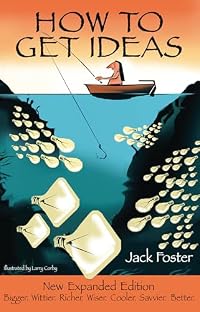
How to Get Ideas
by Jack Foster
On This Page
Description
A revised and expanded edition of a bestselling classic--more than 90,000 copies sold of the first editionThis new edition includes to completely new chaptersCleverly weaves together exercises, stories, quotations, and illustrations to offer a fun and practical guide to idea generationHow to Get Ideas shows you--no matter your age or skill, your job or training--how to come up with more ideas, faster and easier. You'll learn to condition your mind to become ""idea-prone,"" utilize your sense show more of humor, develop your curiosity, visualize your goals, rethink your thinking, and overcome your fear o show lessTags
Recommendations

Member Reviews
This is a fun book to read and I’m sure was a fun book to write.
Jack Foster confesses in the opening pages that there is no rocket science enclosed within its pages, and perhaps nothing new. In one sense he is correct, and his liberal use of quotation, some of which span the centuries, underline the timeless nature of the principles he describes. Indeed like much good advice, he is telling us much that we already know, if only we take the time to stop and realise it. Sadly the reality is that we seldom do.
Here is perhaps the secret of the book. Jack writes in an engaging style which invites the reader to take a moment out from continuously doing what they do. The style of the book and its length, you will read it easily in two show more evenings, invite the reader to allow themselves to be reminded that they already know how to have ideas, and have simply lost the habit, and need to refine their skill.
In essence the book outlines five steps. Define the problem; Gather the information; Search for the idea; Forget about it; Put the idea into action. As I said, no rocket science, but the book explores each step in concise and inviting chapters which bring focus to the process without labouring the points.
Among other things you’ll learn how to be courageous and curious, how Einstein equated his ability to being mentally retarded and thinking like a child, and the importance of fun.
The careful use of quotations expands the imagery of the ideas as do the personal anecdotes and gathered stories. In addition there are lists of prompts to get each of the steps of the process working for you.
Some of the anecdotes naturally relate to Jack’s background in advertising, but don’t be put off. These do nothing to diminish their value to all of us who seek to see in new ways and do new things.
As a taster, think of the question “What is half of thirteen?
How many answers have you got? The book stops at 23 answers, but having read it, I guarantee you’ll double this and know that you can double it again.
This is a good fun read and will remind you of all you know about having ideas, and help make these magical events less infrequent. show less
Jack Foster confesses in the opening pages that there is no rocket science enclosed within its pages, and perhaps nothing new. In one sense he is correct, and his liberal use of quotation, some of which span the centuries, underline the timeless nature of the principles he describes. Indeed like much good advice, he is telling us much that we already know, if only we take the time to stop and realise it. Sadly the reality is that we seldom do.
Here is perhaps the secret of the book. Jack writes in an engaging style which invites the reader to take a moment out from continuously doing what they do. The style of the book and its length, you will read it easily in two show more evenings, invite the reader to allow themselves to be reminded that they already know how to have ideas, and have simply lost the habit, and need to refine their skill.
In essence the book outlines five steps. Define the problem; Gather the information; Search for the idea; Forget about it; Put the idea into action. As I said, no rocket science, but the book explores each step in concise and inviting chapters which bring focus to the process without labouring the points.
Among other things you’ll learn how to be courageous and curious, how Einstein equated his ability to being mentally retarded and thinking like a child, and the importance of fun.
The careful use of quotations expands the imagery of the ideas as do the personal anecdotes and gathered stories. In addition there are lists of prompts to get each of the steps of the process working for you.
Some of the anecdotes naturally relate to Jack’s background in advertising, but don’t be put off. These do nothing to diminish their value to all of us who seek to see in new ways and do new things.
As a taster, think of the question “What is half of thirteen?
How many answers have you got? The book stops at 23 answers, but having read it, I guarantee you’ll double this and know that you can double it again.
This is a good fun read and will remind you of all you know about having ideas, and help make these magical events less infrequent. show less
A good, short book on the creative process, from an advertising person (although the examples as well as applicability are much broader). Essentially condenses the knowledge from a lot of other books and sources, and uses quotes liberally throughout to reference other work. Volume of ideas, use of constraints while avoiding being constrained, and the flow of the creative process are all described.
Quick read and well worth it.
Ratings
Members
- Recently Added By
Author Information
4 Works 322 Members
Jack Foster is author of the bestselling How to Get Ideas. For thirty-five years he worked in the creative departments of major advertising agencies -- the first ten as a writer, the last twenty-five as a creative director
Classifications
- Genres
- Business, Fiction and Literature
- DDC/MDS
- 808.066659 — Literature & rhetoric Literature, rhetoric & criticism Rhetoric and collections of literary texts from more than two literatures Rhetoric and anthologies By Type Of Writing Writing non-fiction (by topic) Writing about applied sciences and technology
- LCC
- PN147 .F66 — Language and Literature Literature (General) Literature (General) Authorship
- BISAC
Statistics
- Members
- 291
- Popularity
- 109,968
- Reviews
- 3
- Rating
- (3.79)
- Languages
- 5 — Dutch, English, German, Spanish, Swedish
- Media
- Paper, Ebook
- ISBNs
- 16
- ASINs
- 2