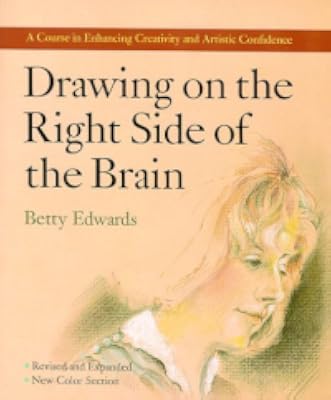
Drawing on the Right Side of the Brain
by Betty Edwards
On This Page
Description
This book is designed to help the reader gain access to right-brain functions, which affect artistic and creative abilities, by teaching drawing through unusual exercises designed to increase visual skills. It includes updates based on recent research about the brain's plasticity and the emerging significance of right-brain functioning. It offers new tools for identifying and solving life problems with the visual-thinking skills acquired through drawing. It shows how new emphasis on how the show more ability to use the strengths of the brain's right hemisphere can serve as an antidote to the increasing left-brain emphasis in American life, the worship of all that is linear, analytic, and digital. show lessTags
Recommendations












Member Recommendations
Member Reviews
"The purpose of this book is not to teach you to express yourself, but instead to provide you with the skills which will release you from stereotypic expression," declares Edwards. Just as Updike taught me to look at a painting and see everything in it, Edwards taught me to look at what I sought to draw. Citing research on differences in right brain and left brain function, Edwards bases her teaching method on the premise "that developing a new way of seeing by tapping the spatial functions of the right hemisphere of your brain can help you learn to draw." The exercises presented are designed to train the student to process visual information through the right brain, the side that sees things as they are, rather than the left brain, show more where human beings store symbols for what they see. The results of working with Edwards's exercises were surprising and satisfying for me. By following the book's instructions, reasonable, realistic representations of people and objects began to emerge from my pencil.
I was working from Edwards's 1979 edition when I learned to draw in 1997. There is a lot of new information in the 1989 edition. She has a greater emphasis on what she calls drawing as a "global skill." Global skills, such as reading, become automatic over time. Thus, by learning the four basic skills Edwards teaches, you will eventually (sooner, rather than later, she claims) draw just as automatically as you read. She has also expanded and improved the skill of sighting and the skill of the perception of lights and shadows. And to aid those who plan on going into painting, she has added a chapter on drawing with color. show less
I was working from Edwards's 1979 edition when I learned to draw in 1997. There is a lot of new information in the 1989 edition. She has a greater emphasis on what she calls drawing as a "global skill." Global skills, such as reading, become automatic over time. Thus, by learning the four basic skills Edwards teaches, you will eventually (sooner, rather than later, she claims) draw just as automatically as you read. She has also expanded and improved the skill of sighting and the skill of the perception of lights and shadows. And to aid those who plan on going into painting, she has added a chapter on drawing with color. show less
I’m reading Drawing on the Right Side of the Brain right now, and I’m finding it fascinating. I’ve always been intrigued by the influence of the right versus the left brain. This method of learning to draw is supposed to help those like me, who are left-brainers, let the right side of the brain take over to do the drawing. I’ve done a few exercises in it already, one of which was drawing one of those profiles that looks like a vase picture. The other was an upside-down drawing (a Picasso, no less!). The purpose of this is to influence your left brain to turn this task down: it won’t like drawing something it can’t name. Once your right brain gets the opportunity to express itself, drawing becomes easier. The chapter I show more thought was very interesting was about how most of us get stuck in the artistic stage of a 10 to 12 year old. Verbal development causes us to name everything and assign symbols to things. Every time we draw, therefore, we use symbols, such as a sun drawn in the corner of the page. It is hard to draw what we really see when we are so used to letting our left brain interpret and express the symbol. I’m looking forward to seeing some artistic development as I work my way through this book. MLM Jan 1/12 show less
Most art books give you instruction to improve your technique, building on what you already know. This book taught me how to draw. Literally. This is the book to read if you don't know the first thing about drawing but would really like to learn.
Excellent (so far); succeeds in leading you to being confident and to draw what you actually see.
This book takes me back to when I was 15, studying for Art GCSE. The teacher made us read and study this book from beginning to end. It taught us to draw what we saw, not what we thought we saw - something that transformed our work. I would highly recommend this for anyone who would like to 'learn' how to draw.
One of the best...NO...THE Best book for learning how to draw...
It is clear and easy to read... it will take you step by step through the process of learning how to see and force your logical brain to let go so you can draw the forms as they really are
...everytime the Book was revised I bought the newer copy for my reference shelf
It is clear and easy to read... it will take you step by step through the process of learning how to see and force your logical brain to let go so you can draw the forms as they really are
...everytime the Book was revised I bought the newer copy for my reference shelf
This book is a classic and will help anyone improve their skills. I had read it on my own, and we used it in drawing class. Was the first popular book I know to differentiate right and left brain information processing. Another I need to re-read.
Members
- Recently Added By
Lists

Just Make Art
17 works; 1 member

Books recommended by Calgary Public Library staff
1,588 works; 4 members
Author Information

16 Works 9,268 Members
Dr. Betty Edwards is professor emeritus of art at California State University in Long Beach. She received her doctorate from UCLA in art, education, and the psychology of perception.
Some Editions
Awards and Honors
Notable Lists
Common Knowledge
- Canonical title
- Drawing on the Right Side of the Brain
- Original publication date
- 1979
- Dedication
- For their loving help and support, I dedicate this edition to be daughter, Anne Bomeisler Farrell, and to my son, Brian Evans Bomeisler.
- First words
- Drawing is a curious process, so intertwined with seeing that the two can hardly be separated.
- Publisher's editor
- Tarcher, Jeremy P.
- Disambiguation notice
- Please note that "Drawing on the right side of the brain", "The new drawing on the right side of the brain" and "The new drawing on the right side of the brain workbook" are three separate works, keep in mind when combining.
Video. Do not combine with the book.
Classifications
Statistics
- Members
- 4,144
- Popularity
- 3,727
- Reviews
- 24
- Rating
- (4.13)
- Languages
- 17 — Chinese, Czech, Danish, Dutch, English, Finnish, French, German, Italian, Japanese, Korean, Norwegian (Bokmål), Russian, Spanish, Swedish, Turkish, Portuguese (Portugal)
- Media
- Paper, Ebook
- ISBNs
- 56
- UPCs
- 3
- ASINs
- 14