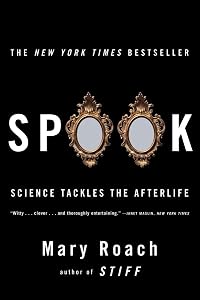
Spook: Science Tackles the Afterlife
by Mary Roach
On This Page
Description
"What happens when we die? Does the light just go out and that's that, the million-year nap? Or will some part of my personality, my me-ness persist? What will that feel like? What will I do all day? Is there a place to plug in my lap-top?" In an attempt to find out, the author brings her curiosity to bear on an array of contemporary and historical soul-searchers: scientists, schemers, engineers, mediums, all trying to prove (or disprove) that life goes on after we die. She begins the show more journey in rural India with a reincarnation researcher and ends up in a University of Virginia operating room where cardiologists have installed equipment near the ceiling to study out-of-body near-death experiences. Along the way, she enrolls in an English medium school, gets electromagnetically haunted at a university in Ontario, and visits a Duke University professor with a plan to weigh the consciousness of a leech. Her historical wanderings unearth soul-seeking philosophers who rummaged through cadavers and calves' heads, a North Carolina lawsuit that established legal precedence for ghosts, and the last surviving sample of "ectoplasm" in a Cambridge University archive. show lessTags
Recommendations











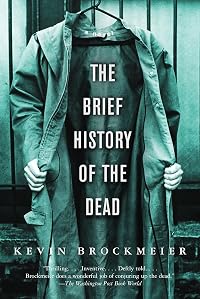
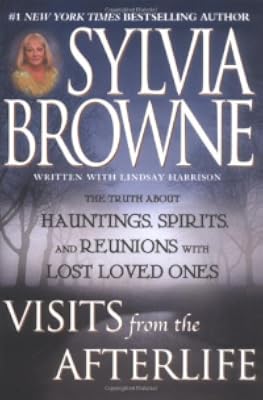
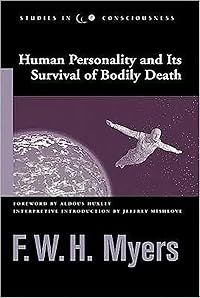

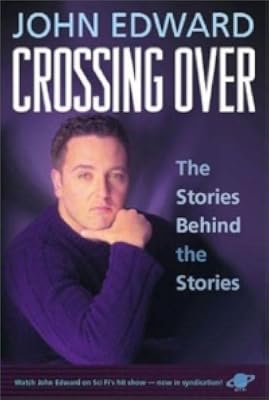

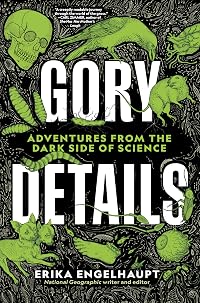
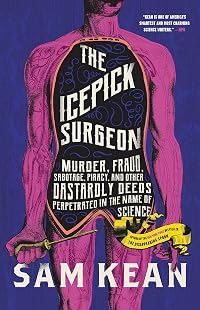
Member Recommendations
Member Reviews
Summary: In Spook, Mary Roach sets out to examine what science - both historical and modern - has to tell us about what happens to us after we die. In a series of chapters that read somewhat like extended travelogue-esque magazine articles, she examines a variety of areas of paranormal research, starting with reincarnation and the question of ensoulment, moving through soul weighing, soul visualization, ectoplasm, mediums, electronic communication with ghosts (i.e. voices of ghosts appearing on tape recordings), some non-paranormal explanations for paranormal phenomena (i.e. infrasound), a legal case in which instructions from a ghost led a family to a revised version of their father's will, and current research into near-death show more experiences.
Review: Mary Roach writes this book with a bias - for a subject as open to personal interpretation as life after death, it's impossible not to. However she's up-front about her biases: she's an agnostic, but tending to lean more towards the skeptical side. To quote: "I wasn't saying these things [biblical miracles] didn't happen. I was just saying I'd feel better with some proof." I trust it's not a huge spoiler to say that she doesn't find proof of anything one way or another. However, she sets out to examine the currently available scientific evidence (or lack thereof) regarding what happens to our us-ness after we die, and offers her interpretation as to whether or not its credible. As any scientist will know, it is damn near impossible to prove a negative: finding no evidence for something is NOT the same as finding evidence against it. Therefore, her ultimate conclusion is: maybe? She doesn't turn up anything she considers to be a smoking-gun example that our consciousness exists after death, but there remain things that she can't quite explain away, either.
Roach clearly set out to write a book with as popular of an appeal as possible; however, by sheer dint of her subject matter and inherent personal bias, she's already alienated a large chunk of her potential audience. Anyone who already "knows" what happens to people after they die is going to be disappointed - hard-line atheists will take issue with the fact that she presupposes the existance of a soul, and will dismiss the rest as twaddle and delusion; hard-line theists of every flavor will be offended that her fall-back position is to dismiss the supernatural/religious aspect out of hand. Luckily for me, I fall smack in the middle, happily in line with Roach's viewpoint: it's possible, although I think it's unlikely... but either way, where's the proof? Roach - and I - tend to view science as the best possible way of getting that proof, but when the subject is one that modern science has by-and-large declared ineffable, we're left looking at the fringe cases, where every piece of evidence is going to be colored by personal interpretation.
Okay, philosophical ramblings aside, I mostly enjoyed this book. I thought the chapters on modern paranormal research were the most interesting, while the material covered in the historical chapters have been done better in other books, and tended to drag on. Similarly, I was more interested in the chapters that looked for non-paranormal explanations for hauntings - infrasound triggering feelings of unease, fear, and the flight-or-fight response; tiny electromagnetic pulses that mimic temporal lobe epilepsy producing the feeling of being surrounded by invisible people - and less interested in the chapters that presupposed paranormal phenomena to be real, and went looking for causes. Overall, though, I found it to be interesting, easy, and frequently funny (at one point during a class on becoming a medium, Roach strikes out for the bar, "to commune with spirits I know how to relate to"), although it is ultimately (and unsurprisingly) somewhat light when it comes to answering the questions it set out to ask. 4 out of 5 stars.
Recommendation: If you've already made your mind up beyond a shadow of a doubt about the afterlife (or are saying "what afterlife?), this book is probably not for you. If you don't know what happens after we die, aren't sure, or don't think it's possible to know, this book is not going to provide you with any answers, or even any strong hints, but it will provide you with plenty of interesting tidbits about the sometimes ingenious, sometimes extremely silly ways that scientists are going about trying to find out. show less
Review: Mary Roach writes this book with a bias - for a subject as open to personal interpretation as life after death, it's impossible not to. However she's up-front about her biases: she's an agnostic, but tending to lean more towards the skeptical side. To quote: "I wasn't saying these things [biblical miracles] didn't happen. I was just saying I'd feel better with some proof." I trust it's not a huge spoiler to say that she doesn't find proof of anything one way or another. However, she sets out to examine the currently available scientific evidence (or lack thereof) regarding what happens to our us-ness after we die, and offers her interpretation as to whether or not its credible. As any scientist will know, it is damn near impossible to prove a negative: finding no evidence for something is NOT the same as finding evidence against it. Therefore, her ultimate conclusion is: maybe? She doesn't turn up anything she considers to be a smoking-gun example that our consciousness exists after death, but there remain things that she can't quite explain away, either.
Roach clearly set out to write a book with as popular of an appeal as possible; however, by sheer dint of her subject matter and inherent personal bias, she's already alienated a large chunk of her potential audience. Anyone who already "knows" what happens to people after they die is going to be disappointed - hard-line atheists will take issue with the fact that she presupposes the existance of a soul, and will dismiss the rest as twaddle and delusion; hard-line theists of every flavor will be offended that her fall-back position is to dismiss the supernatural/religious aspect out of hand. Luckily for me, I fall smack in the middle, happily in line with Roach's viewpoint: it's possible, although I think it's unlikely... but either way, where's the proof? Roach - and I - tend to view science as the best possible way of getting that proof, but when the subject is one that modern science has by-and-large declared ineffable, we're left looking at the fringe cases, where every piece of evidence is going to be colored by personal interpretation.
Okay, philosophical ramblings aside, I mostly enjoyed this book. I thought the chapters on modern paranormal research were the most interesting, while the material covered in the historical chapters have been done better in other books, and tended to drag on. Similarly, I was more interested in the chapters that looked for non-paranormal explanations for hauntings - infrasound triggering feelings of unease, fear, and the flight-or-fight response; tiny electromagnetic pulses that mimic temporal lobe epilepsy producing the feeling of being surrounded by invisible people - and less interested in the chapters that presupposed paranormal phenomena to be real, and went looking for causes. Overall, though, I found it to be interesting, easy, and frequently funny (at one point during a class on becoming a medium, Roach strikes out for the bar, "to commune with spirits I know how to relate to"), although it is ultimately (and unsurprisingly) somewhat light when it comes to answering the questions it set out to ask. 4 out of 5 stars.
Recommendation: If you've already made your mind up beyond a shadow of a doubt about the afterlife (or are saying "what afterlife?), this book is probably not for you. If you don't know what happens after we die, aren't sure, or don't think it's possible to know, this book is not going to provide you with any answers, or even any strong hints, but it will provide you with plenty of interesting tidbits about the sometimes ingenious, sometimes extremely silly ways that scientists are going about trying to find out. show less
I enjoyed this book far more than I expected to. I decided to read it because it seemed like a natural sequel to the excellent "Stiff." I feared that since the most likely results of the research in the book would be entirely negative or at best offering some narrow wiggle-room for their most optimistic interpretors. Which is exactly what the experiments produced. But Mary Roach knows how to keep her writing interesting and moving at an energetic pace despite the mundane results produced by those searching for proof that people outlast their corporal bodies. Highlights include a trip to meet a North Carolina family whose great-grandfather returned from the grave to make changes to his will, descriptions of the various contraptions show more invented to weigh the human (or animal) soul, scientists investigating the possibility that electro-magnetic fields and infrasound might cause feelings of being haunted, and descriptions of mediums from the spiritualism movement of the late 19th and early 20th centuries with their methods of producing "ectoplasm" from a variety of bodily orifices. I would definitely read more of her books. show less
Mary Roach is the Dave Barry of popular science writing. Her text is funny, her chapter titles are funny, her footnotes are funny, even her page numbers are funny.* Spook explores the history of “scientific” studies of the afterlife. This is, of course, a subject that lends itself to cheap laughs, but all of Roach’s are earned.
I can do no better than just describe some of the issues covered: reincarnation; ovism vs. spermism; the soul’s weight (apparently about 20 grams), volume (about 0.3 quarts) and color (greenish-purple), leading one researcher to conclude that leprechauns are discarnate human souls; attempts to X-ray the soul; the Carrington Soul Box, which incorporated hermetic seals, anesthetics, “ionization rays”, show more and a live monkey; ectoplasm (including an actual sample in the Cambridge University Library, which, strangely, appears to be cotton cloth); various communications with the spirit world (including a claim that Heaven is full of sailboats); Ms. Roach’s experience in a medium school (“There are moments, listening to the conversations going on around me, when I feel I am going to lose my mind”); attempt to get in touch with the dead using tape recorders (conducted, ominously, at the USFS Donner Party Picnic Ground); using EMF and infrasound to induce hallucinations; a note from a dead man settling a law case; and NDE experiments.
Extremely recommended
* “17”. See? show less
I can do no better than just describe some of the issues covered: reincarnation; ovism vs. spermism; the soul’s weight (apparently about 20 grams), volume (about 0.3 quarts) and color (greenish-purple), leading one researcher to conclude that leprechauns are discarnate human souls; attempts to X-ray the soul; the Carrington Soul Box, which incorporated hermetic seals, anesthetics, “ionization rays”, show more and a live monkey; ectoplasm (including an actual sample in the Cambridge University Library, which, strangely, appears to be cotton cloth); various communications with the spirit world (including a claim that Heaven is full of sailboats); Ms. Roach’s experience in a medium school (“There are moments, listening to the conversations going on around me, when I feel I am going to lose my mind”); attempt to get in touch with the dead using tape recorders (conducted, ominously, at the USFS Donner Party Picnic Ground); using EMF and infrasound to induce hallucinations; a note from a dead man settling a law case; and NDE experiments.
Extremely recommended
* “17”. See? show less
I enjoyed this one, but I suppose I have to say, with some regret, that I didn't enjoy it quite as much as her breakthrough, "Stiff", which traced the possible paths that our bodies, not our souls might take after we depart this mortal coil. One of the reasons why is that Stiff's slant-rhyme twin, "Spook", isn't quite as good as its predecessor is that it lacks the delightful element of surprise that made "Stiff" so entertaining: Roach seemed to have started writing "Stiff" with the intention of publishing a fairly standard, if fun, book about what happens to people's bodies after they died and then plunged into the deep end of weird without any idea of where she might have been headed. About three hundred pages later, we ended up in show more plastic surgery practice rooms, disreputable Chinese crematoriums, and early-modern Scottish graveyards, all while reviewing the most unfathomably odd bits of history imaginable. That book wasn't just a revelation to many of its readers; it also seemed to be a revelation of sorts to Mary Roach herself.
But the author's a few books past that one now, and her style's a bit more burnished: she's still funny, but the jokes don't really shock you when they arrive. She seems to know the kind of book she's expected to write, which is, in a sense, okay. There is a lot of interesting stuff in "Spook," from a short history of attempts to weigh the soul to courtroom squabbles over ghosts who might have have changed their wills. Roach takes a trip to India to talk things over with a man who tries to track reincarnations from one village to another, and while she highlights the social utility of this belief, she mostly comes away with the impression that India is both incredibly strange and highly dangerous. It's a shame, then, that Roach, for all of her trouble, only seems to have found two scientists doing real research on what happens to the soul after death. The first, who teaches at the University of North Carolina, is a brilliant polymath attempting to weigh the soul — or at least consciousness — in the same way that other scientists weigh information. The other is a scientist who studies near-death experiences and believes that similarities among them suggest that the brain might go into a sort of "full reboot" mode in the long moments before the body expires. Neither scientist can say what comes after that, of course, which may annoy some of Roach's more scientific-minded readers. (Of course, it must be admitted that the afterlife isn't a particularly scientific subject, which is, of course, part of the fun of "Spook.") But I still found this one highly interesting and thoroughly enjoyable. And that, come to think of it, is exactly what I expect from a book written by Mary Roach. show less
But the author's a few books past that one now, and her style's a bit more burnished: she's still funny, but the jokes don't really shock you when they arrive. She seems to know the kind of book she's expected to write, which is, in a sense, okay. There is a lot of interesting stuff in "Spook," from a short history of attempts to weigh the soul to courtroom squabbles over ghosts who might have have changed their wills. Roach takes a trip to India to talk things over with a man who tries to track reincarnations from one village to another, and while she highlights the social utility of this belief, she mostly comes away with the impression that India is both incredibly strange and highly dangerous. It's a shame, then, that Roach, for all of her trouble, only seems to have found two scientists doing real research on what happens to the soul after death. The first, who teaches at the University of North Carolina, is a brilliant polymath attempting to weigh the soul — or at least consciousness — in the same way that other scientists weigh information. The other is a scientist who studies near-death experiences and believes that similarities among them suggest that the brain might go into a sort of "full reboot" mode in the long moments before the body expires. Neither scientist can say what comes after that, of course, which may annoy some of Roach's more scientific-minded readers. (Of course, it must be admitted that the afterlife isn't a particularly scientific subject, which is, of course, part of the fun of "Spook.") But I still found this one highly interesting and thoroughly enjoyable. And that, come to think of it, is exactly what I expect from a book written by Mary Roach. show less
A “dogmatic scientist”, I came to this book after a difficult loss. It's about several kinds of investigations relevant to whether we survive death in some way. What I found was a series of plunges down rabbit holes, such as claims of children being reincarnates, old attempts to locate a soul pattern in eggs or embryos, measuring weight loss or invisible emanations immediately after death, seances, and audio recordings of invisible ghosts.
The author makes a sincere effort to being open-minded about all these possibilities, but she also is a specialist in clever ironic quips when an investigation takes a nose dive. She has consulted a lot of primary written sources, but the most entertaining bits are when she shows up to actually show more talk to investigators, or to their descendants, or to people involved in an anomalous case. The best story was one in which a ghost revealed where an updated will was located, causing a big change in a fractured family.
I was hoping to learn something that might change my own mind, but halfway through it was clear that there was nothing new here. Roach ends with a sort of agnosticism, yet at the last minute puts emphasis on the theory of the brain as a radio receiver of different consciousness channels. To me, that's a tired old trope, and I have written about why it is at least paradoxical and probably absurd ("Against Outsourcing the Mind to a Soul") on my Substack. show less
The author makes a sincere effort to being open-minded about all these possibilities, but she also is a specialist in clever ironic quips when an investigation takes a nose dive. She has consulted a lot of primary written sources, but the most entertaining bits are when she shows up to actually show more talk to investigators, or to their descendants, or to people involved in an anomalous case. The best story was one in which a ghost revealed where an updated will was located, causing a big change in a fractured family.
I was hoping to learn something that might change my own mind, but halfway through it was clear that there was nothing new here. Roach ends with a sort of agnosticism, yet at the last minute puts emphasis on the theory of the brain as a radio receiver of different consciousness channels. To me, that's a tired old trope, and I have written about why it is at least paradoxical and probably absurd ("Against Outsourcing the Mind to a Soul") on my Substack. show less
I have fallen in love with Roach's writing style. She makes science and all the ins and outs very approachable, and has this humorous twist that helps to keep you engaged. I love how wholeheartedly she throws herself into all the different avenues of research from witnessing interviews with children in India who remember their past lives to attending a class for mediums Roach does it all. She also does a great job of presenting all the information, and does not make it difficult to understand what bias she might have that colors her interpretation of facts.
Most people who read Mary Roach’s books are readers of several of them. That’s me. I’m a Mary Roach fan mainly because her books are about really interesting subjects, they’re highly researched and reported, and they’re funny as hell. What more can you ask about academic topics? So why is my rating four stars out of five instead of five out of five? I thought parts of this book were what I call a bit “weedy.” In other words, parts of “Spook” were more technical than I wanted to spend time reading and digesting. I know her credibility as a writer of serious topics requires that she include serious information. I just felt as I read “Spook” that she could have dispensed with some of the technical information and show more still gotten the point across. As I often say in my reviews of books, that’s probably more on me than on the author. I’ll end my review of “Spook” with this tag line: like all Mary Roach books, if you pick this one up, you’re in for a good time and you’ll learn something really interesting at the same time. show less
Members
- Recently Added By
Published Reviews
Roach ranges far and wide in "Spook," traveling to India to look into reincarnation and England to take a course in how to be a medium. She is a skeptic, but comes to some surprising conclusions in "Spook."
added by John_Vaughan
Lists

Research/Inquiry - mentor texts
43 works; 2 members

Books Read in 2013
1,630 works; 51 members

Books Read in 2016
4,666 works; 199 members

W. W. Norton & Company
47 works; 2 members
Author Information

24+ Works 33,654 Members
Mary Roach was born and raised in Etna, New Hampshire. She has a BA degree in psychology from Wesleyan University. She spent a few years as a free-lance copy editor before she landed a job at the San Francisco Zoological Society turning out press releases. She then moved on to write humor pieces for such periodicals as The New York Times Magazine, show more The San Francisco Chronicle and Sports Illustrated. Her article "How to Win at Germ Warfare" was a National Magazine Award Finalist, in 1995. In 1996, her article on earthquake-proof bamboo houses took the Engineering Journalism Award. She published several books such as Stiff: The Curious Lives of Human Cadavers (2003) and Packing for Mars (2010). Mary's title Grunt: The Curious Science of Humans at War, made the New York Times Bestseller list in 2016. (Bowker Author Biography) show less
Some Editions
Awards and Honors
Awards
Distinctions
Common Knowledge
- Alternate titles
- Six feet over : adventures in the afterlife
- Original publication date
- 2005-10-10
- Dedication
- For my parents, wherever they are or aren't.
- First words
- Introduction
My mother worked hard to instill faith in me.
I don’t recall my mood the morning I was born, but I imagine I felt a bit out of sorts. - Last words
- (Click to show. Warning: May contain spoilers.)I believe in ghosts.
- Original language
- English
- Disambiguation notice
- Also published under the title of "Six Feet Over".
Classifications
- Genres
- General Nonfiction, Science & Nature, Nonfiction, Religion & Spirituality, Philosophy
- DDC/MDS
- 129 — Philosophy & psychology Epistemology (how do you know what you know?) Origin and destiny of individual souls
- LCC
- BL535 .R63 — Philosophy, Psychology and Religion Religions. Mythology. Rationalism Religions. Mythology. Rationalism Eschatology
- BISAC
Statistics
- Members
- 4,486
- Popularity
- 3,295
- Reviews
- 156
- Rating
- (3.53)
- Languages
- 5 — English, Italian, Polish, Portuguese, Spanish
- Media
- Paper, Audiobook, Ebook
- ISBNs
- 26
- ASINs
- 14