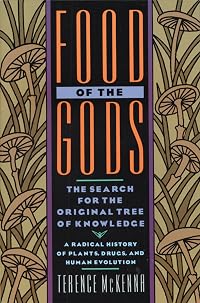
Food of the Gods: The Search for the Original Tree of Knowledge: A Radical History of Plants, Drugs, and Human Evolution
by Terence McKenna
On This Page
Description
Terence McKenna hypothesizes that as the North African jungles receded, giving way to savannas and grasslands near the end of the most recent ice age, a branch of our arboreal primate ancestors left the forest canopy and began living in the open areas beyond. There they experimented with new varieties of foods as they adapted, physically and mentally, to the environment. Among the new foods found in this environment were psilocybin-containing mushrooms growing near dung of ungulate herds show more occupying the savannas and grasslands. Referencing the research of Roland L. Fisher, McKenna claims the enhancement of visual acuity was an effect of psilocybin at low doses and suggests this would confer adaptive advantage. He argues that the effects of slightly larger doses, including sexual arousal, and in larger doses, ecstatic hallucinations & glossolalia-gave selective evolutionary advantages to members of those tribes who partook of it. There were many changes caused by the introduction of this psychoactive to primate diets. He hypothesizes, for instance, that synesthesia (the blurring of sensory boundaries) caused by psilocybin led to the development of spoken language: the ability to form pictures in another person's mind through the use of vocal sounds. About 12,000 years ago, further climate changes removed psilocybin-containing mushrooms from human diets. He argues that this event resulted in a new set of profound changes in our species as we reverted to the previous brutal primate social structures that had been modified and/or repressed by frequent consumption of psilocybin. show lessTags
Recommendations



























Member Reviews
Though the main subject of this book is the psychedelic mushroom, he elaborates extensively on modern culture and its "Dominator" mindset. He mentions the book "The Chalice and the Blade" by Riane Eisler, which describes how there was a culture that existed around the area of Greece that was a Matriarchal society. This society lived without war or poverty for around a thousand years. McKenna uses this culture as an example of how humans can and did live in perpetual peace, while at the same time not having a hierarchical system like our culture has now, which is of course Patriarchal.
The mushroom, he explains, helps humans really "see" reality for what it is, and in that state is able to both communicate with the environment and with show more our fellow humans, in harmony. He also puts forth a theory that psychedelic mushrooms contributed directly to human cognitive evolution, that they changed our brains to what they are now. The mushroom gave us an edge in our survival hundreds of thousands of years ago by being able to, like I said before, "see" the real world better, and therefore giving us an advantage in survival and changing our brain structure in the process.
All this leads to the idea of how the "Tree of Knowledge" was actually the mushroom. Since the downfall of the Matriarchal mindset, or true harmony, we have become the violent, Patriarchal, God-fearing, we-are-above-nature-so-therefore-it's-ours, system. Mentioning, of course, how the mushroom and all the other mind-altering compounds like LSD, DMT, and the like, are extremely illegal in our society. How these ideas of harmony, the sacred feminine aspects, have been and still are being suppressed, and that a return to these more ideal ideas will save us from future violence and destruction. show less
The mushroom, he explains, helps humans really "see" reality for what it is, and in that state is able to both communicate with the environment and with show more our fellow humans, in harmony. He also puts forth a theory that psychedelic mushrooms contributed directly to human cognitive evolution, that they changed our brains to what they are now. The mushroom gave us an edge in our survival hundreds of thousands of years ago by being able to, like I said before, "see" the real world better, and therefore giving us an advantage in survival and changing our brain structure in the process.
All this leads to the idea of how the "Tree of Knowledge" was actually the mushroom. Since the downfall of the Matriarchal mindset, or true harmony, we have become the violent, Patriarchal, God-fearing, we-are-above-nature-so-therefore-it's-ours, system. Mentioning, of course, how the mushroom and all the other mind-altering compounds like LSD, DMT, and the like, are extremely illegal in our society. How these ideas of harmony, the sacred feminine aspects, have been and still are being suppressed, and that a return to these more ideal ideas will save us from future violence and destruction. show less
An interesting look at the relationship between plants and human evolution, both past and future. I especially enjoyed the idea that as wild plants became less important parts of our lives, the more patriarchal, and controlling, human cultures became. There is a relationship between the foods cultures consume and the amount of equality between the sexes.
It is past time for us to work to create healthy human cultures, and perhaps the foods we consume is a more important part of that work than I thought.
It is past time for us to work to create healthy human cultures, and perhaps the foods we consume is a more important part of that work than I thought.
Terrence McKenna weaves a new kind of story about the human adventure, out of a collection of facts that he has gleaned from his prodigious research into the hidden history of human psychedelic use. He makes a strong case that psychedelic use played a role in the evolution of spiritual consciousness as well as perhaps even human language. He also argues persuasively about the roles that various kinds of drugs and foods have played within societies of the past and present, correlating the chemicals we ingest and have ingested, with apparent changes in our individual and collective consciousness.
Good history of drug use and McKenna's theories of how it shaped human evolution in fundamental ways -- essentially that mushroom or psychedelic drugs were part of cooperative culture (found among hunter gatherers, initially in Africa), and that grain, fermentation, and alcohol (and sugar) were the tools of a competing "dominator culture" which out-competed and destroyed them, while also being self-destructive and possibly unsustainable. He is making a case for a return to the earlier way of being.
This would have been an easy 5-star audiobook if Terence McKenna had narrated it himself. Sadly he passed away a few years ago, so this isn't possible, but I have some mp3s of earlier books/speeches of his which wonderful (and often end up set show more to music). show less
This would have been an easy 5-star audiobook if Terence McKenna had narrated it himself. Sadly he passed away a few years ago, so this isn't possible, but I have some mp3s of earlier books/speeches of his which wonderful (and often end up set show more to music). show less
An eye-popping history of mind-altering plants.
McKenna eloquently advocates a new type of relationship with psychedelics: one of wonder, mystery and discovery. I was profoundly inspired and changed by this book.
McKenna eloquently advocates a new type of relationship with psychedelics: one of wonder, mystery and discovery. I was profoundly inspired and changed by this book.
Dated - good review - too much agenda
Picked up this book after a friend's advice. Since I've got no interest in drugs, and am skeptical of any claims that aren't supported by data, this book didn't keep me for long. Verdict: lost me. Sorry, friend interested in psychedelics.
Members
- Recently Added By
Lists

Nonordinary States of Consciousness
184 works; 7 members

Books
85 works; 1 member

Books I've Read
40 works; 2 members

substances
14 works; 1 member

current
52 works; 1 member

spirituality & consciousness
22 works; 1 member
Author Information

53+ Works 3,642 Members
Some Editions
Common Knowledge
- Canonical title
- Food of the Gods: The Search for the Original Tree of Knowledge: A Radical History of Plants, Drugs, and Human Evolution
- Original publication date
- 1992
- People/Characters
- Albert Hofmann; Fitz Hugh Ludlow; Gordon Wasson
- Important places
- Tassili n'Ajjer Plateau, Algeria
Classifications
- Genres
- Anthropology, Nonfiction, General Nonfiction, Science & Nature, History, Religion & Spirituality, Philosophy
- DDC/MDS
- 362.29 — Society, government, & culture Social problems and social services Social Welfare Mental illness Substance abuse
- LCC
- HV5801 .M35 — Social sciences Social pathology. Social and public welfare. Criminology Social pathology. Social and public welfare. Drug habits. Drug abuse
- BISAC
Statistics
- Members
- 1,392
- Popularity
- 17,029
- Reviews
- 13
- Rating
- (3.93)
- Languages
- 7 — Dutch, English, French, German, Italian, Polish, Spanish
- Media
- Paper, Audiobook, Ebook
- ISBNs
- 18
- ASINs
- 9