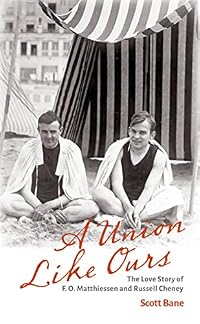
A Union Like Ours: The Love Story of F. O. Matthiessen and Russell Cheney
by Scott Bane
On This Page
Description
"After a chance meeting aboard the ocean liner Paris in 1924, Harvard University scholar and activist F. O. Matthiessen and artist Russell Cheney fell in love and remained inseparable until Cheney's death in 1945. During the intervening years, the men traveled throughout Europe and the United States, achieving great professional success while contending with serious personal challenges, including addiction, chronic disease, and severe depression. During a hospital stay, years into their show more relationship, Matthiessen confessed to Cheney that "never once has the freshness of your life lost any trace of its magic for me. Every day is a new discovery of your wealth." Situating the couple's private correspondence alongside other sources, Scott Bane tells the remarkable story of their relationship in the context of shifting social dynamics in the United States. From the vantage point of the present day, with marriage equality enacted into law, Bane provides a window into the realities faced by same-sex couples in the early twentieth century, as they maintained relationships in the face of overt discrimination and the absence of legal protections"-- show lessTags
Member Reviews
The Publisher Says: After a chance meeting aboard the ocean liner Paris in 1924, Harvard University scholar and activist F. O. Matthiessen and artist Russell Cheney fell in love and remained inseparable until Cheney’s death in 1945. During the intervening years, the men traveled throughout Europe and the United States, achieving great professional success while contending with serious personal challenges, including addiction, chronic disease, and severe depression.
During a hospital stay, years into their relationship, Matthiessen confessed to Cheney that “never once has the freshness of your life lost any trace of its magic for me. Every day is a new discovery of your wealth.” Situating the couple’s private correspondence show more alongside other sources, Scott Bane tells the remarkable story of their relationship in the context of shifting social dynamics in the United States. From the vantage point of the present day, with marriage equality enacted into law, Bane provides a window into the realities faced by same-sex couples in the early twentieth century, as they maintained relationships in the face of overt discrimination and the absence of legal protections.
I RECEIVED A DRC FROM THE PUBLISHER VIA EDELWEISS+. THANK YOU.
My Review: Never have the words "it takes one to know one" been put to a more positive, more constructive use than in Scott Bane's double biography of F.O. Matthiessen and Russell Cheney. Bane and his husband, journalist David Dunlap, are the same generational distance apart...fifteen years as opposed to twenty...that F.O. and Russell were, and face some of the same cultural mismatches that they did. Like them, the author and his husband are in it for the long haul. It grounds this work in a shared lived experience, then, and explains the recognition that Bane brings to the delight and the toil of building a life together. Romance is about passion and excitement, discovery and laughter; marriage is about farts and morning breath, balancing the checkbook...and laughter. Can't laugh together? Won't last. These men loved the same things, art and culture and their upper-class life; but they always stayed in touch with the interpersonal fundamentals that provide a rock to build on.
From their providential meeting aboard the ocean liner Paris, F.O. and Russell were companions. F.O.'s youth, the fourth of four children of divorced parents, was spent in Tarrytown, a short train trip from Manhattan and its gay-sex paradise that he took full advantage of. He was a boarder at the Hackley School, a Unitarian-run college prep organization that gave him the freedom from his (slightly neglectful, it sounded to me) mother to come and go as he would within curfews. It was also a more-or-less accepted thing that boarding schools would have sexual experimentation in them. It's not different now, but it was more laissez-faire then, so long as it didn't transgress limits. Russell's life, as he was from an even-wealthier family, was less structured around upper-middle-class concerns; he was eleventh of eleven children, and accordingly largely left to his own devices. Like F.O., Russell went to Yale and was brought into Skull and Bones; unlike F.O., he was not focused or driven. The artistic urge that Russell pursued wasn't driving him, the way F.O.'s ambitions were driving him; the direction F.O. would take wasn't set but the passion for reading, literature, was there and the organizational zeal was too, yet to be married. They were equally well matched in their shared passion for men, though again at ends of a spectrum: F.O. loved sex and sexuality, with men; Russell loved men, and expressed it through sex.
This 1926 portrait from RussellCheney.com of F.O. in Florence shows how tenderly Russell regarded his "Matty"
These men, then, were perfectly suited to each other, their union fated and destined to be one that was harmonious. Though it certainly faced challenges...Russell's alcoholism and health issues, F.O.'s political convictions drew unwanted attention, the pair swapped places as the financial backer of their life together...it was an enduring institution in their lives. F.O.'s tender care for Russell as his alcoholism took over his life was exemplary. Author Bane and his husband have faced down other health challenges together, which really informs the way he writes about the frailty of the person you love overtaking all other concerns. As the love of my life died of AIDS 30 years ago this past May, I am very clear about this cost and the willingness the committed spouse has to bear it. I felt so...validated...by this multilayered reflection of my own life.
The ending of the book was hard to read. It's a given that people will die; it's not a given that this will ever be easy, will ever be quantifiably manageable. F.O.'s ultimate inability to save Russell from the consequences of his alcoholism felt so tragic to me. It's always true that an addict loves their addiction, but we always hope they'll love us more. Sadly for F.O., Russell couldn't love him more than the booze. After Russell's 1945 death at the then-venerable age of sixty-three, F.O. entered the long-term partner's decline. It was exacerbated by his ongoing conflicts with a severely conservatizing society, his employers' attitude towards his politics, and the vast shoreless ocean of survivorhood.
In the end, F.O. Matthiessen, a monadnock of literary theory and a champion of modernist literary products, could not face the world without his center and mainstay. He took his own life on (appropriately) April Fool's Day, 1950, at forty-eight. We are much the poorer for his absence from our cultural conversation far too soon.
I hope you'll read this fascinating, well-made and thoroughly sourced life of two fine gay men. In #PrideMonth, how can you resist? show less
During a hospital stay, years into their relationship, Matthiessen confessed to Cheney that “never once has the freshness of your life lost any trace of its magic for me. Every day is a new discovery of your wealth.” Situating the couple’s private correspondence show more alongside other sources, Scott Bane tells the remarkable story of their relationship in the context of shifting social dynamics in the United States. From the vantage point of the present day, with marriage equality enacted into law, Bane provides a window into the realities faced by same-sex couples in the early twentieth century, as they maintained relationships in the face of overt discrimination and the absence of legal protections.
I RECEIVED A DRC FROM THE PUBLISHER VIA EDELWEISS+. THANK YOU.
My Review: Never have the words "it takes one to know one" been put to a more positive, more constructive use than in Scott Bane's double biography of F.O. Matthiessen and Russell Cheney. Bane and his husband, journalist David Dunlap, are the same generational distance apart...fifteen years as opposed to twenty...that F.O. and Russell were, and face some of the same cultural mismatches that they did. Like them, the author and his husband are in it for the long haul. It grounds this work in a shared lived experience, then, and explains the recognition that Bane brings to the delight and the toil of building a life together. Romance is about passion and excitement, discovery and laughter; marriage is about farts and morning breath, balancing the checkbook...and laughter. Can't laugh together? Won't last. These men loved the same things, art and culture and their upper-class life; but they always stayed in touch with the interpersonal fundamentals that provide a rock to build on.
From their providential meeting aboard the ocean liner Paris, F.O. and Russell were companions. F.O.'s youth, the fourth of four children of divorced parents, was spent in Tarrytown, a short train trip from Manhattan and its gay-sex paradise that he took full advantage of. He was a boarder at the Hackley School, a Unitarian-run college prep organization that gave him the freedom from his (slightly neglectful, it sounded to me) mother to come and go as he would within curfews. It was also a more-or-less accepted thing that boarding schools would have sexual experimentation in them. It's not different now, but it was more laissez-faire then, so long as it didn't transgress limits. Russell's life, as he was from an even-wealthier family, was less structured around upper-middle-class concerns; he was eleventh of eleven children, and accordingly largely left to his own devices. Like F.O., Russell went to Yale and was brought into Skull and Bones; unlike F.O., he was not focused or driven. The artistic urge that Russell pursued wasn't driving him, the way F.O.'s ambitions were driving him; the direction F.O. would take wasn't set but the passion for reading, literature, was there and the organizational zeal was too, yet to be married. They were equally well matched in their shared passion for men, though again at ends of a spectrum: F.O. loved sex and sexuality, with men; Russell loved men, and expressed it through sex.
This 1926 portrait from RussellCheney.com of F.O. in Florence shows how tenderly Russell regarded his "Matty"
These men, then, were perfectly suited to each other, their union fated and destined to be one that was harmonious. Though it certainly faced challenges...Russell's alcoholism and health issues, F.O.'s political convictions drew unwanted attention, the pair swapped places as the financial backer of their life together...it was an enduring institution in their lives. F.O.'s tender care for Russell as his alcoholism took over his life was exemplary. Author Bane and his husband have faced down other health challenges together, which really informs the way he writes about the frailty of the person you love overtaking all other concerns. As the love of my life died of AIDS 30 years ago this past May, I am very clear about this cost and the willingness the committed spouse has to bear it. I felt so...validated...by this multilayered reflection of my own life.
The ending of the book was hard to read. It's a given that people will die; it's not a given that this will ever be easy, will ever be quantifiably manageable. F.O.'s ultimate inability to save Russell from the consequences of his alcoholism felt so tragic to me. It's always true that an addict loves their addiction, but we always hope they'll love us more. Sadly for F.O., Russell couldn't love him more than the booze. After Russell's 1945 death at the then-venerable age of sixty-three, F.O. entered the long-term partner's decline. It was exacerbated by his ongoing conflicts with a severely conservatizing society, his employers' attitude towards his politics, and the vast shoreless ocean of survivorhood.
In the end, F.O. Matthiessen, a monadnock of literary theory and a champion of modernist literary products, could not face the world without his center and mainstay. He took his own life on (appropriately) April Fool's Day, 1950, at forty-eight. We are much the poorer for his absence from our cultural conversation far too soon.
I hope you'll read this fascinating, well-made and thoroughly sourced life of two fine gay men. In #PrideMonth, how can you resist? show less
Literary critic and professor F.O. Matthiessen and painter Russell Cheney met by chance on a transatlantic crossing in the 1920s. They fell in love pretty much at first sight and were inseparable until Cheney's death in the 1940s, making a home together in Maine and living about as openly as a couple as it was possible to do during that time. In A Union Like Ours, Scott Bane provides a dual portrait of Matthiessen and Cheney which gives the reader a clear yet empathetic sense of both men as individuals, which also teases out what their relationship can tell us about the broader social and intellectual currents of the time. Bane bookends his work with a discussion of what drew him, as a gay man, to write this biography, and the care that show more he and his now-husband provided one another during their respective battles with cancer. A lucid and thoughtful biography. show less
This was one my list for awhile after I saw it on Libro.fm. I gave it a shot and ended up not liking it that much. Parts of it were interesting but most felt dry.
Members
- Recently Added By
Author Information
1 Work 17 Members
Scott Bane is a program officer at The John A. Hartford Foundation.
Awards and Honors
Classifications
- Genres
- Literature Studies and Criticism, Fiction and Literature, Biography & Memoir, LGBTQ+
- DDC/MDS
- 810.9 — Literature & rhetoric American literature in English American literature in English History and criticism of American literature
- LCC
- PS29 .M35 .B36 — Language and Literature American literature American literature
- BISAC
Statistics
- Members
- 17
- Popularity
- 1,445,891
- Reviews
- 3
- Rating
- (3.75)
- Languages
- English
- Media
- Paper, Ebook
- ISBNs
- 4
- ASINs
- 1