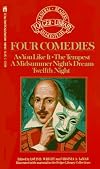
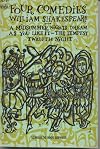
4 Plays: As You Like It; A Midsummer Night's Dream; The Tempest; Twelfth Night
by William Shakespeare
On This Page
Description
The four comedies collected in this text were written between 1595 and 1602, and demonstrate the evolution of Shakespearean comic form. The collective triumph of these plays lies in their mingling of humourous stage business and word-play with a more serious consideration ofissues of identity, gender, dreaming, the meaning of love and even theatre itself.Tags
Recommendations
















Member Reviews
This is an old paperback from the 1960s (although apparently reprinted from a 1950s edition) featuring four Shakespeare plays: A Midsummer Night's Dream, As You Like It, Twelfth Night, and The Tempest. It's not a great edition. The introduction to each play, and the introduction to the volume as a whole, seem, if I'm interpreting the copyright page correctly, to be lifted from some Shakespeare scholar's book from decades earlier, and not lifted with any great care. I mostly found them really annoying and over-written, and completely unhelpful in understanding or preparing to approach the plays, so I mostly ended up skimming them or skipping them entirely. The brief, scene-by-scene plot summaries that are also included were a lot more show more welcome, though.
Also, this is the first time I'd read Shakespeare in an edition that didn't feature annotations to explain some of the archaic words and cultural references. I didn't find this a problem at all with A Midsummer Night's Dream, which was perfectly clear and comprehensible all the way through, but there were a few moments in the other plays where I would have appreciated some translation. There is a glossary in the back, but I found it inconvenient and not particularly helpful.
As for the plays themselves, well, I'm hardly going to add anything to 400 years' worth of Shakespeare scholarship here, but I'll say a few words about my own reactions to them, keeping in mind that I hadn't read any of these or seen them performed before:
A Midsummer Night's Dream: Honestly, I was surprised by how slight this was, with both the plot and the characters feeling paper-thin. Which isn't to say that it's entirely shallow. There is, underneath all the wacky love potion hijinks, a sardonic sense of just how absurd human love relationships are. There's a good reason, after all, why "What fools these mortals be!" is probably its most famous line. There's also some real darkness in among all the silliness, too. I mean, it starts off with a woman being told, in no uncertain terms, that she must marry the man her father has decided to give her to because she is his property to do with as he sees fit and to mold into whatever shape he likes, and if she fails to cooperate, he'll have her locked up or killed. Admittedly, that probably didn't feel quite as unthinkably horrific to the sensibilities of Shakespeare's time as it does today, but there's no way that's happy, not in any context., All that notwithstanding, though, it's still pretty much fluff. High-quality, Shakespearian fluff, but still. Pretty fluffy. Which feels a little bit startling when your previous experiences of Shakespeare have involved things like Hamlet and Julius Caesar.
As You Like It: I found this one a lot more satisfying than A Midsummer Night's Dream. The plot's a bit more substantial, with some nice, clever touches, and the characters are great, especially the very appealing and memorable Rosalind. (Although I have a bit of a soft spot for the melancholy Jaques, too.) I'd really like to watch a good version of this performed sometime.
Twelfth Night: It seems a bit of a disservice to read this one immediately after As You Like It, because they share enough story elements to make it start to feel a bit same-y. Of the two, I think I liked As You Like It better; it certainly has the better characters. But I maybe found the humor in this one a bit more amusing. Which is odd, because it mostly consists of really awful people playing awful, nasty practical jokes, which is not something I usually find funny at all. But Shakespeare was a man of many talents, and apparently making that sort of thing actually entertaining to me is one of them.
The Tempest: This... is not a comedy. It's not a tragedy, either, and it does have some moments of humor. But it's definitely not a comedy, and it seems very, very strange to include it in a book that calls itself "Four Comedies." Whatever it is, though, I liked it a lot. The fantasy elements hold considerable appeal for me, and several of the characters seem interestingly complex in ways that the play hints at but never really pins down, which I find fascinating. Hard to believe it took me this long to get to this one, when I've known for ages that other stories I love have been directly inspired by it. I'm thinking mostly of the classic SF movie Forbidden Planet here, which I have an almost overwhelming urge to re-watch now.
Rating: 4/5. Yes, that's a good-but-not-perfect rating. Because Shakespeare is Shakespeare, but this is not an especially great presentation of it. Plus, I have definitely decided that I prefer the tragedies to the comedies. show less
Also, this is the first time I'd read Shakespeare in an edition that didn't feature annotations to explain some of the archaic words and cultural references. I didn't find this a problem at all with A Midsummer Night's Dream, which was perfectly clear and comprehensible all the way through, but there were a few moments in the other plays where I would have appreciated some translation. There is a glossary in the back, but I found it inconvenient and not particularly helpful.
As for the plays themselves, well, I'm hardly going to add anything to 400 years' worth of Shakespeare scholarship here, but I'll say a few words about my own reactions to them, keeping in mind that I hadn't read any of these or seen them performed before:
A Midsummer Night's Dream: Honestly, I was surprised by how slight this was, with both the plot and the characters feeling paper-thin. Which isn't to say that it's entirely shallow. There is, underneath all the wacky love potion hijinks, a sardonic sense of just how absurd human love relationships are. There's a good reason, after all, why "What fools these mortals be!" is probably its most famous line. There's also some real darkness in among all the silliness, too. I mean, it starts off with a woman being told, in no uncertain terms, that she must marry the man her father has decided to give her to because she is his property to do with as he sees fit and to mold into whatever shape he likes, and if she fails to cooperate, he'll have her locked up or killed. Admittedly, that probably didn't feel quite as unthinkably horrific to the sensibilities of Shakespeare's time as it does today, but there's no way that's happy, not in any context., All that notwithstanding, though, it's still pretty much fluff. High-quality, Shakespearian fluff, but still. Pretty fluffy. Which feels a little bit startling when your previous experiences of Shakespeare have involved things like Hamlet and Julius Caesar.
As You Like It: I found this one a lot more satisfying than A Midsummer Night's Dream. The plot's a bit more substantial, with some nice, clever touches, and the characters are great, especially the very appealing and memorable Rosalind. (Although I have a bit of a soft spot for the melancholy Jaques, too.) I'd really like to watch a good version of this performed sometime.
Twelfth Night: It seems a bit of a disservice to read this one immediately after As You Like It, because they share enough story elements to make it start to feel a bit same-y. Of the two, I think I liked As You Like It better; it certainly has the better characters. But I maybe found the humor in this one a bit more amusing. Which is odd, because it mostly consists of really awful people playing awful, nasty practical jokes, which is not something I usually find funny at all. But Shakespeare was a man of many talents, and apparently making that sort of thing actually entertaining to me is one of them.
The Tempest: This... is not a comedy. It's not a tragedy, either, and it does have some moments of humor. But it's definitely not a comedy, and it seems very, very strange to include it in a book that calls itself "Four Comedies." Whatever it is, though, I liked it a lot. The fantasy elements hold considerable appeal for me, and several of the characters seem interestingly complex in ways that the play hints at but never really pins down, which I find fascinating. Hard to believe it took me this long to get to this one, when I've known for ages that other stories I love have been directly inspired by it. I'm thinking mostly of the classic SF movie Forbidden Planet here, which I have an almost overwhelming urge to re-watch now.
Rating: 4/5. Yes, that's a good-but-not-perfect rating. Because Shakespeare is Shakespeare, but this is not an especially great presentation of it. Plus, I have definitely decided that I prefer the tragedies to the comedies. show less
Ratings
Members
- Recently Added By
Author Information

6,088+ Works 441,976 Members
William Shakespeare, 1564 - 1616 Although there are many myths and mysteries surrounding William Shakespeare, a great deal is actually known about his life. He was born in Stratford-Upon-Avon, son of John Shakespeare, a prosperous merchant and local politician and Mary Arden, who had the wealth to send their oldest son to Stratford Grammar School. show more At 18, Shakespeare married Anne Hathaway, the 27-year-old daughter of a local farmer, and they had their first daughter six months later. He probably developed an interest in theatre by watching plays performed by traveling players in Stratford while still in his youth. Some time before 1592, he left his family to take up residence in London, where he began acting and writing plays and poetry. By 1594 Shakespeare had become a member and part owner of an acting company called The Lord Chamberlain's Men, where he soon became the company's principal playwright. His plays enjoyed great popularity and high critical acclaim in the newly built Globe Theatre. It was through his popularity that the troupe gained the attention of the new king, James I, who appointed them the King's Players in 1603. Before retiring to Stratford in 1613, after the Globe burned down, he wrote more than three dozen plays (that we are sure of) and more than 150 sonnets. He was celebrated by Ben Jonson, one of the leading playwrights of the day, as a writer who would be "not for an age, but for all time," a prediction that has proved to be true. Today, Shakespeare towers over all other English writers and has few rivals in any language. His genius and creativity continue to astound scholars, and his plays continue to delight audiences. Many have served as the basis for operas, ballets, musical compositions, and films. While Jonson and other writers labored over their plays, Shakespeare seems to have had the ability to turn out work of exceptionally high caliber at an amazing speed. At the height of his career, he wrote an average of two plays a year as well as dozens of poems, songs, and possibly even verses for tombstones and heraldic shields, all while he continued to act in the plays performed by the Lord Chamberlain's Men. This staggering output is even more impressive when one considers its variety. Except for the English history plays, he never wrote the same kind of play twice. He seems to have had a good deal of fun in trying his hand at every kind of play. Shakespeare wrote 154 sonnets, all published on 1609, most of which were dedicated to his patron Henry Wriothsley, The Earl of Southhampton. He also wrote 13 comedies, 13 histories, 6 tragedies, and 4 tragecomedies. He died at Stratford-upon-Avon April 23, 1616, and was buried two days later on the grounds of Holy Trinity Church in Stratford. His cause of death was unknown, but it is surmised that he knew he was dying. (Bowker Author Biography) show less
Some Editions
Series
Belongs to Publisher Series
The Pocket Library (PL-31)
Work Relationships
Contains
Common Knowledge
- Canonical title
- 4 Plays: As You Like It; A Midsummer Night's Dream; The Tempest; Twelfth Night
- Original publication date
- 1599
Classifications
Statistics
- Members
- 299
- Popularity
- 107,241
- Reviews
- 1
- Rating
- (4.50)
- Languages
- English, Finnish
- Media
- Paper
- ISBNs
- 9
- ASINs
- 31