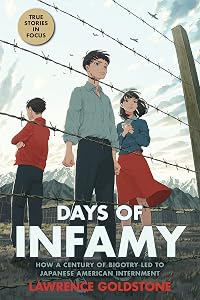
Days of Infamy: How a Century of Bigotry Led to Japanese American Internment (Scholastic Focus)
by Lawrence Goldstone
On This Page
Description
"On December 7, 1941 -- "a date which will live in infamy" -- the Japanese navy launched an attack on the American military bases at Pearl Harbor, Hawaii. The next day, President Franklin Roosevelt declared war on Japan, and the US Army officially entered the Second World War. Three years later, on December 18, 1944, President Roosevelt signed Executive Order 9066, which enabled the Secretary of War to enforce a mass deportation of more than 100,000 Americans to what government officials show more themselves called "concentration camps." None of these citizens had been accused of a real crime. All of them were torn from their homes, jobs, schools, and communities, and deposited in tawdry, makeshift housing behind barbed wire, solely for the crime of being of Japanese descent. President Roosevelt declared this community "alien," -- whether they were citizens or not, native-born or not -- accusing them of being potential spies and saboteurs for Japan who deserved to have their Constitutional rights stripped away. In doing so, the president set in motion another date which would live in infamy, the day when the US joined the ranks of those Fascist nations that had forcibly deported innocents solely on the basis of the circumstance of their birth. In 1944 the US Supreme Court ruled, in Korematsu v. United States, that the forcible deportation and detention of Japanese Americans on the basis of race was a "military necessity." Today it is widely considered one of the worst Supreme Court decisions of all time. But Korematsu was not an isolated event. In fact, the Court's racist ruling was the result of a deep-seated anti-Japanese, anti-Asian sentiment running all the way back to the California Gold Rush of the mid-1800s. Starting from this pivotal moment, Constitutional law scholar Lawrence Goldstone will take young readers through the key events of the 19th and 20th centuries leading up to the fundamental injustice of Japanese American internment. Tracing the history of Japanese immigration to America and the growing fear whites had of losing power, Goldstone will raise deeply resonant questions of what makes an American an American, and what it means for the Supreme Court to stand as the "people's" branch of government"-- show lessTags
Recommendations




















Member Reviews
Synergy: Bigotry
Bigotry is the unreasonable attachment to or intolerance of a belief or opinion. Specifically, bigotry is prejudice against a person based on their membership in a particular group such as a race or religion.
Read the recently published nonfiction book, then learn more at the website:
DAYS OF INFAMY: HOW A CENTURY OF BIGOTRY LED TO JAPANESE AMERICAN INTERNMENT by Lawrence Goldstone is part of the True Stories in Focus series. This title examines iniquities of the American justice system and the history of racism. Although the emphasis is on the deportation and detention of Japanese Americans during World War II, this work of nonfiction also explores other key events in Japanese American history. ARC courtesy of Scholastic show more Focus.
The NATIONAL JAPANESE AMERICAN MEMORIAL FOUNDATION website provides resources related to Japanese American history. The LEARN section explores the history of forced removal and incarceration, the American soldiers, discrimination, and the American Civil Liberties Act of 1988. The PROGRAMS area provides educational resources.
To visit the website, go to https://www.njamemorial.org/ show less
Bigotry is the unreasonable attachment to or intolerance of a belief or opinion. Specifically, bigotry is prejudice against a person based on their membership in a particular group such as a race or religion.
Read the recently published nonfiction book, then learn more at the website:
DAYS OF INFAMY: HOW A CENTURY OF BIGOTRY LED TO JAPANESE AMERICAN INTERNMENT by Lawrence Goldstone is part of the True Stories in Focus series. This title examines iniquities of the American justice system and the history of racism. Although the emphasis is on the deportation and detention of Japanese Americans during World War II, this work of nonfiction also explores other key events in Japanese American history. ARC courtesy of Scholastic show more Focus.
The NATIONAL JAPANESE AMERICAN MEMORIAL FOUNDATION website provides resources related to Japanese American history. The LEARN section explores the history of forced removal and incarceration, the American soldiers, discrimination, and the American Civil Liberties Act of 1988. The PROGRAMS area provides educational resources.
To visit the website, go to https://www.njamemorial.org/ show less
Ratings
Members
- Recently Added By
Lists

Japanese Internment after Pearl Harbor
14 works; 1 member
Author Information

26 Works 5,652 Members
Lawrence Goldstone is the author or co-author of more than a dozen books, including two other innovation histories: Drive!: Henry Ford, George Selden, and the Race to Invent the Auto Age and Birdmen: The Wright Brothers, Glenn Curtiss, and the Battle to Control the Skies. He has written for the Wall Street Journal, Los Angeles Times, Boston Globe, show more New Republic, Chicago Tribune, and Miami Herald. He and his wife, author Nancy Goldstone, live in Sagaponack, New York. show less
Awards and Honors
Classifications
Statistics
- Members
- 72
- Popularity
- 437,612
- Reviews
- 1
- Rating
- (4.17)
- Languages
- English
- Media
- Paper, Audiobook, Ebook
- ISBNs
- 5
- ASINs
- 1