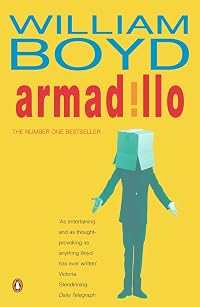
Armadillo
by William Boyd
On This Page
Description
A social satire on Britain, featuring an insurance claims adjustor who descends from East European gypsies. He navigates the shoals of class with an invented past, matching wits with executives trying to diddle his company.Tags
Recommendations




































Member Recommendations
Member Reviews
Last week I read a blog post that articulates my response to ‘Armadillo’ better than I can. I’m just so angry and tired. The only possible way to enjoy this book is to overlook the fact that every male character is an arsehole who treats women like shit and every female character (barring one) is a sexy body with no personality who exists to please men. The one female exception is an elderly lady who says practically nothing other than that she’s ready to die, presumably because she is no longer sexually attractive to men and therefore has no reason to exist in the world. Whenever a woman appears in the narrative, not just her general attractiveness but specifically her breasts must be judged. This is by no means every example, show more just those I found with a quick flick through:
Page 14.
Page 110.
Page 151.
Page 177.
Even when breasts aren’t the focus, there’s this garbage (page 189):
The main character, Lorimer Black, could possibly have been interesting if I hadn’t viscerally hated him for his constant cruelty, disdain, and objectification of women. He cheats on his girlfriend and leers at her teenage daughter. He treats every girl and woman he meets as a sexual object. He claims to fall in love with a woman he glimpses in a taxi, then proceeds to stalk her in a profoundly creepy way. He uses work contacts to find her phone number, drops in unannounced at her place of work, lies to her, lurks around outside her home, follows her around, ignores her saying that she's not interested & married, and generally acts like a predator. Choice quote: “You do know, you must be aware, that I’m passionately in love with you. I’ll never take no for an answer.” That is not fucking acceptable! What is worse, and I’m spoiling the ending for your own good, this profoundly wrong and indeed illegal behaviour is rewarded by the object of Lorimer's affections leaving her husband, turning up naked in his bed, and inviting him to run away with her. Given that earlier in the book she does briefly call what he's doing stalking, I can only hope in vain that the final scene is a prelude to her having him arrested. Or perhaps murdered. Every other male character is portrayed as even worse towards women than Lorimer, seemingly to make him seem sympathetic by comparison. It doesn't work, but naturally I hated all of them too. It was exhausting.
This review is intended mainly as a warning. I cannot assess the merits of the plot, setting, and writing of ‘Armadillo’ as I couldn’t get past how profoundly, unremittingly, relentlessly sexist it was. This is some Hemingway-level shit. The idea that male novelists might actually think women are this far from being people absolutely horrifies me. My initial hopes of satirical intent were crushed long before I got through all 370 pages. For fuck’s sake, men, stop it. show less
Page 14.
Dymphna’s breasts were momentarily visible as she stooped to stub out her cigarette. Small with pale pointy nipples, he noticed. She really shouldn’t wear such low-
Page 110.
She was an ungainly girl, made more lumpy by pubescence, with dark hair and a sly, pointy face. Her small, sharp breasts caused her huge embarrassment.
Page 151.
A cheerful-looking matronly young woman bounced out of the French windows that gave onto the croquet lawn. She had a big shapeless bosom beneath a baggy bright jumper…
Page 177.
Finally she removed her jacket and scarf and finally he was able to look, guardedly this time, at her breasts. From the pleasing convexities and concavities of her vermilion polo-neck he calculated they were of perfectly average size but flattish, more grapefruit-halves than anything particularly conic.
Even when breasts aren’t the focus, there’s this garbage (page 189):
There was something grubbily attractive about the sullen girl who opened the door to him at DW Management Ltd in Charlotte Street, Lorimer had to admit. Perhaps it was her extreme youth - eighteen or nineteen - perhaps it was the deliberately botched peroxide job on her short hair, or the tightness of the leopard print t-shirt she was wearing, or the three brass rings piercing her left eyebrow, or the fact that she was simultaneously smoking and chewing gum?
The main character, Lorimer Black, could possibly have been interesting if I hadn’t viscerally hated him for his constant cruelty, disdain, and objectification of women. He cheats on his girlfriend and leers at her teenage daughter. He treats every girl and woman he meets as a sexual object. He claims to fall in love with a woman he glimpses in a taxi, then proceeds to stalk her in a profoundly creepy way. He uses work contacts to find her phone number, drops in unannounced at her place of work, lies to her, lurks around outside her home, follows her around, ignores her saying that she's not interested & married, and generally acts like a predator. Choice quote: “You do know, you must be aware, that I’m passionately in love with you. I’ll never take no for an answer.” That is not fucking acceptable! What is worse, and I’m spoiling the ending for your own good, this profoundly wrong and indeed illegal behaviour is rewarded by the object of Lorimer's affections leaving her husband, turning up naked in his bed, and inviting him to run away with her. Given that earlier in the book she does briefly call what he's doing stalking, I can only hope in vain that the final scene is a prelude to her having him arrested. Or perhaps murdered. Every other male character is portrayed as even worse towards women than Lorimer, seemingly to make him seem sympathetic by comparison. It doesn't work, but naturally I hated all of them too. It was exhausting.
This review is intended mainly as a warning. I cannot assess the merits of the plot, setting, and writing of ‘Armadillo’ as I couldn’t get past how profoundly, unremittingly, relentlessly sexist it was. This is some Hemingway-level shit. The idea that male novelists might actually think women are this far from being people absolutely horrifies me. My initial hopes of satirical intent were crushed long before I got through all 370 pages. For fuck’s sake, men, stop it. show less
This is one of those books that's more of a 'what can happen next' variety than a story with a specific purpose. Because of that it is more interesting than compelling and leans more heavily on character and characterization than with action. It also has an ensemble cast sort of feel to it, similar to the supporting cast in Boyd's later book Ordinary Thunderstorms. Most of them are caricatures; the sage, the buffoon, the evil boss, the feckless brother. Lorimer Black has to deal with all of them and try to keep his head above water at the same time. Most of them don't make it easy to do so.
Lorimer is quirky and mysterious enough to drive the story well, but isn't cartoon-y. I loved the Book of Transfiguration device. It seemed fresh; show more not quite a journal, but since it's written by Lorimer it gives us a lot of insight into his past, opinions and state of mind. A recurring subject in the Book of Transfiguration is sleep. Lorimer doesn't get much and throughout the novel attends a sleep clinic to try to harness his lucid dreams so he can sleep better. As many other things in his life, this doesn't work out quite as well as he'd hoped. Another frequent subject in the BoT is armor. Lorimer collects armor, well he collects helmets. Sort of. In the beginning he has 3 ancient helms which get traded in on a 4th, much more expensive item, the fate of which is amusing. Other subjects in the BoT are a partial history of his family, key to understanding his relationship and new name; George Hogg, Lorimer's boss and chief tormenter; the incident of Sinbad Fingleton, the shepherd's pie and the television which culminated in L's flight from Scotland and immediate name change.
As you can see, this is a really difficult book to describe. If you like modern farce, societal send-ups and just plain whackiness, The Armadillo is perfect. show less
Lorimer is quirky and mysterious enough to drive the story well, but isn't cartoon-y. I loved the Book of Transfiguration device. It seemed fresh; show more not quite a journal, but since it's written by Lorimer it gives us a lot of insight into his past, opinions and state of mind. A recurring subject in the Book of Transfiguration is sleep. Lorimer doesn't get much and throughout the novel attends a sleep clinic to try to harness his lucid dreams so he can sleep better. As many other things in his life, this doesn't work out quite as well as he'd hoped. Another frequent subject in the BoT is armor. Lorimer collects armor, well he collects helmets. Sort of. In the beginning he has 3 ancient helms which get traded in on a 4th, much more expensive item, the fate of which is amusing. Other subjects in the BoT are a partial history of his family, key to understanding his relationship and new name; George Hogg, Lorimer's boss and chief tormenter; the incident of Sinbad Fingleton, the shepherd's pie and the television which culminated in L's flight from Scotland and immediate name change.
As you can see, this is a really difficult book to describe. If you like modern farce, societal send-ups and just plain whackiness, The Armadillo is perfect. show less
"Mud doesn't stick to people like us" says the chief executive of a successful insurance firm. He has all the right connections of course and probably the underlying theme in Boyd's novel is the class system when "Britain was on the make" in the late 1990's under the new Labour Government. Boyd's novel uses substantial doses of irony to make his points, but his irony is whimsical never straying into satire and so at the end of the novel one is left with the feeling that "it all worked out well enough in the end". A biting satire of the class system it is not.
Lorimer Black is an insurance loss adjuster and the novel opens with a routine visit to the owner of a factory who has made an insurance claim. Black is a little put out to find the show more owner has hung himself from a beam in his office. The police are called and Black feels himself under suspicion. From this moment on Black is playing catch-up as the mystery deepens: why had his boss sent him to this meeting when he had done all the preliminary work himself and why was his next job; a £27million claim way above his normal price bracket? Black's world begins to fall apart as he seems to be being manoeuvred into being some sort of fall guy. Along the way he has to deal with physical assaults from enraged customers and from the husband of a mysterious woman with whom he has fallen in love. His upper class colleague at work is sacked perhaps because of his part in the 27million deal and clings to Lorimer like a leech when he is thrown out by his wife. Lorimer has stretched himself financially and bought an ancient Greek helm for more money than he has in his bank account, just at the time when he has fallen out with his boss at work and is due to be sacked. Oh! and for good measure one of his clients is a famous rock star who is being sued for cancelling a string of concerts. London in the late nineties, when there is money to be made and those in the know are manoeuvring to grab what they can.
Lorimer Black is an honest hard working likeable guy, relative to most of the people around him and this is the hook that Boyd uses to draw his readers into the story. Lorimer Black is a sympathetic character, he is good to his family, he helps his friends when he can, but is hard enough to play the game in order to make himself rich. The mystery surrounding him and his own upbringing becomes more clear as the novel progresses and Boyd does a good job of explaining the work of a loss adjuster and the value of the insurance business in the modern world. It is the nefarious goings on around Lorimer that keep the pages turning and the light touch of the author who introduces a series of characters who are larger than life: the femme fatal, the overbearing boss, the upper class twit, the crazy rock star. If all this wasn't enough, Lorimer suffers from sleep deprivation and is undergoing some sort of dream therapy treatment. There is a lot going on, and it would take a far larger book than this one to resolve all the loose ends and Boyd is not interested in doing this. Boyd is playing it all for laughs and it is amusing enough. Nothing too deep, but Boyd does not insult his readers intelligence and has written a fast paced novel that revels in its South London locations. A good entertainment even if it feels a little old fashioned and so 3.5 stars. show less
Lorimer Black is an insurance loss adjuster and the novel opens with a routine visit to the owner of a factory who has made an insurance claim. Black is a little put out to find the show more owner has hung himself from a beam in his office. The police are called and Black feels himself under suspicion. From this moment on Black is playing catch-up as the mystery deepens: why had his boss sent him to this meeting when he had done all the preliminary work himself and why was his next job; a £27million claim way above his normal price bracket? Black's world begins to fall apart as he seems to be being manoeuvred into being some sort of fall guy. Along the way he has to deal with physical assaults from enraged customers and from the husband of a mysterious woman with whom he has fallen in love. His upper class colleague at work is sacked perhaps because of his part in the 27million deal and clings to Lorimer like a leech when he is thrown out by his wife. Lorimer has stretched himself financially and bought an ancient Greek helm for more money than he has in his bank account, just at the time when he has fallen out with his boss at work and is due to be sacked. Oh! and for good measure one of his clients is a famous rock star who is being sued for cancelling a string of concerts. London in the late nineties, when there is money to be made and those in the know are manoeuvring to grab what they can.
Lorimer Black is an honest hard working likeable guy, relative to most of the people around him and this is the hook that Boyd uses to draw his readers into the story. Lorimer Black is a sympathetic character, he is good to his family, he helps his friends when he can, but is hard enough to play the game in order to make himself rich. The mystery surrounding him and his own upbringing becomes more clear as the novel progresses and Boyd does a good job of explaining the work of a loss adjuster and the value of the insurance business in the modern world. It is the nefarious goings on around Lorimer that keep the pages turning and the light touch of the author who introduces a series of characters who are larger than life: the femme fatal, the overbearing boss, the upper class twit, the crazy rock star. If all this wasn't enough, Lorimer suffers from sleep deprivation and is undergoing some sort of dream therapy treatment. There is a lot going on, and it would take a far larger book than this one to resolve all the loose ends and Boyd is not interested in doing this. Boyd is playing it all for laughs and it is amusing enough. Nothing too deep, but Boyd does not insult his readers intelligence and has written a fast paced novel that revels in its South London locations. A good entertainment even if it feels a little old fashioned and so 3.5 stars. show less
To his colleagues Lorimer Black is a young, good-looking and successful insurance loss adjuster who seems to be in control of his life.But when one morning he goes on a perfectly routine business appointment only to find a hanged man. Not a great way to start any day. Whilst this experience was upsetting when his next assignment, to investigate a fire in a hotel under construction, he finds his life buffeted by forces over which will turn his life upside down.
Nothing is quite as it seems in this book including Lorimer Black's name, he was born Milomre Blocj, the youngest son of a large family of immigrants from Eastern Europe. Lorimer wants to blend in to English society and distance himself from his true identity. He is still close to show more his family and helps to support them but is trying to furnish himself with some added protective armour by collecting antique helmets.
Lorimer excels at his job, he is able to recognize when people are lying and have inflated their insurance claim but when one for 27 million pound claim is successfully reduced to 10 million pound payout his professional life begins to unravel.
His personal life is no less confused. He has trouble sleeping and spends nights studied and analysed at the 'Institute of Lucid Dreams'. He is having a casual affair with one of his former clients but becomes obsessed with an actress whom he tracks down and tries to win over.
The plot is meandering and whilst Lorimer isn't completely hapless he isn't a superhero either. 'Armadillo' is loosely a thriller but Boyd only allows Lorimer to see glimpses of the bigger picture. This vagueness is quite deliberate as Boyd tries to show that there are few easy answers here just as there are none in life.
There are touches of humour sprinkled throughout this book (Boyd certainly seemed to take pleasure in some of his characters' names). It is also a book with a message, you can never truly escape your past and mud rarely sticks to the wealthy, it's only the little men who get trod underfoot. But whilst I always enjoy his writing style (this is the fourth of his works that I've read) I can't help thinking that in this particular case he overplayed his hand. It ended up reading rather laddish and, for that reason alone, missed its mark. show less
Nothing is quite as it seems in this book including Lorimer Black's name, he was born Milomre Blocj, the youngest son of a large family of immigrants from Eastern Europe. Lorimer wants to blend in to English society and distance himself from his true identity. He is still close to show more his family and helps to support them but is trying to furnish himself with some added protective armour by collecting antique helmets.
Lorimer excels at his job, he is able to recognize when people are lying and have inflated their insurance claim but when one for 27 million pound claim is successfully reduced to 10 million pound payout his professional life begins to unravel.
His personal life is no less confused. He has trouble sleeping and spends nights studied and analysed at the 'Institute of Lucid Dreams'. He is having a casual affair with one of his former clients but becomes obsessed with an actress whom he tracks down and tries to win over.
The plot is meandering and whilst Lorimer isn't completely hapless he isn't a superhero either. 'Armadillo' is loosely a thriller but Boyd only allows Lorimer to see glimpses of the bigger picture. This vagueness is quite deliberate as Boyd tries to show that there are few easy answers here just as there are none in life.
There are touches of humour sprinkled throughout this book (Boyd certainly seemed to take pleasure in some of his characters' names). It is also a book with a message, you can never truly escape your past and mud rarely sticks to the wealthy, it's only the little men who get trod underfoot. But whilst I always enjoy his writing style (this is the fourth of his works that I've read) I can't help thinking that in this particular case he overplayed his hand. It ended up reading rather laddish and, for that reason alone, missed its mark. show less
This book, released a couple of years ago, will undergo something of a re-discovery as a result of the excellent series running on BBC Prime.
Aficionados of William Boyd will recognise the style - Its similarity to Brazzaville Beach is that the real significance of the book can only be understood once the whole is read, which adds to the enjoyment – not only an excellent read in itself, but the after-frisson of thought provocation.
On the face of it, the book is a bit of a “whodunit”, featuring the travails of Lorimer Black. By day a loss adjuster working in the City of London, by night an unremitting insomniac taking part in a sleep study that reveals his darker side.
As we all know, societal rules and norms in most societies show more tend mainly to apply to the underlings with the aristocracy marching to their own drumbeat impervious to such trivia as laws. Here it is the same – the rich and the powerful seeking to make a killing; but the loose ends start to unravel as Lorimer intuitively and intelligently investigates an insurance loss that leads to darker world and a side of business life, where greed, corruption hold sway.
Boyd writs fluidly and the characters are exquisitely drawn, immensely recognisable, and great fun. From the boorish, misogynist Torquil Helvoir, the archetypal modern-day Hooray-Henry, to the ethereal and mysterious Flavia, the book cuts a swathe through the pretensions of British mores and manners.
The central theme is that of identity, the human need to “fit in” and the inner struggle when some of the corner stones of our need for acceptability start to fray. Peculiarly British in some regard, where the class system still prevails, but universally prevalent even in the apparently classless USA, and in many ways holding stronger sway today than in the last century. After all is not “class” the cornerstone of branding?
Lorimer, following a life-changing experience in Scotland, seeks the anonymity of conformity, with the trappings of success that it brings, masking the insecurities and fragility prevalent in us all.
As the story unravels, as the truth outs, the weight of the armour we all carry – Lorimer is an expert on armoury – becomes too much to bear, and the man beneath is revealed.
Armadillo, literally meaning the “little armed man”, now pared bare, the layers of disguise slowly stripped away. All William Boyd is worth reading – and this is certainly no exception. show less
Aficionados of William Boyd will recognise the style - Its similarity to Brazzaville Beach is that the real significance of the book can only be understood once the whole is read, which adds to the enjoyment – not only an excellent read in itself, but the after-frisson of thought provocation.
On the face of it, the book is a bit of a “whodunit”, featuring the travails of Lorimer Black. By day a loss adjuster working in the City of London, by night an unremitting insomniac taking part in a sleep study that reveals his darker side.
As we all know, societal rules and norms in most societies show more tend mainly to apply to the underlings with the aristocracy marching to their own drumbeat impervious to such trivia as laws. Here it is the same – the rich and the powerful seeking to make a killing; but the loose ends start to unravel as Lorimer intuitively and intelligently investigates an insurance loss that leads to darker world and a side of business life, where greed, corruption hold sway.
Boyd writs fluidly and the characters are exquisitely drawn, immensely recognisable, and great fun. From the boorish, misogynist Torquil Helvoir, the archetypal modern-day Hooray-Henry, to the ethereal and mysterious Flavia, the book cuts a swathe through the pretensions of British mores and manners.
The central theme is that of identity, the human need to “fit in” and the inner struggle when some of the corner stones of our need for acceptability start to fray. Peculiarly British in some regard, where the class system still prevails, but universally prevalent even in the apparently classless USA, and in many ways holding stronger sway today than in the last century. After all is not “class” the cornerstone of branding?
Lorimer, following a life-changing experience in Scotland, seeks the anonymity of conformity, with the trappings of success that it brings, masking the insecurities and fragility prevalent in us all.
As the story unravels, as the truth outs, the weight of the armour we all carry – Lorimer is an expert on armoury – becomes too much to bear, and the man beneath is revealed.
Armadillo, literally meaning the “little armed man”, now pared bare, the layers of disguise slowly stripped away. All William Boyd is worth reading – and this is certainly no exception. show less
I seem to be in the wrong state of mind to enjoy this book. I did read it and I did enjoy some parts. It is clear that Boyd is intelligent and witty and uses language well. So it's surprising that I couldn't really get into this.
Lorimer Black is a young insurance claims adjuster. This means he tries to pay out less than the client expects on claims, using whatever means he can. He's a decent person at heart and tends to read people well enough to get them to respond to him. He's doing well in his line of work until he comes across an odd case. Something's off about it and he can't figure out what. He manages to bring the claim down considerably with very little effort and that alone makes him wonder.
But that isn't all. There are other show more cases that raise questions. And he has to deal with a boss who is not a nice person.
Complicating his life is Flavia. He sees a billboard with a beautiful woman on it and immediately he must get to know her. He discovers who she is and where to find her and he pursues her. His obsession takes him well into the book, and was one of the reasons I did not like him as much as I might otherwise have. I felt he was incapable of paying attention to her preferences. He just had to have her.
Meanwhile, he visits his dying father and remembers where he came from. He changed his name to avoid ridicule about where he came from, and seeing his father reminds him of this change.
Toward the end he questions what brought him to where he is, after tumultuous changes, and what he needs to do.
I have to admit that I did not follow the financial finagling that went on, that led to Lorimer's sending letters charging corruption to various news sources. I tried to understand what had happened and could only make out that people or companies were cheated and some people made out big. I may just have not been in the mood to focus on it.
I hope the next reader gets more from this book than I did. show less
Lorimer Black is a young insurance claims adjuster. This means he tries to pay out less than the client expects on claims, using whatever means he can. He's a decent person at heart and tends to read people well enough to get them to respond to him. He's doing well in his line of work until he comes across an odd case. Something's off about it and he can't figure out what. He manages to bring the claim down considerably with very little effort and that alone makes him wonder.
But that isn't all. There are other show more cases that raise questions. And he has to deal with a boss who is not a nice person.
Complicating his life is Flavia. He sees a billboard with a beautiful woman on it and immediately he must get to know her. He discovers who she is and where to find her and he pursues her. His obsession takes him well into the book, and was one of the reasons I did not like him as much as I might otherwise have. I felt he was incapable of paying attention to her preferences. He just had to have her.
Meanwhile, he visits his dying father and remembers where he came from. He changed his name to avoid ridicule about where he came from, and seeing his father reminds him of this change.
Toward the end he questions what brought him to where he is, after tumultuous changes, and what he needs to do.
I have to admit that I did not follow the financial finagling that went on, that led to Lorimer's sending letters charging corruption to various news sources. I tried to understand what had happened and could only make out that people or companies were cheated and some people made out big. I may just have not been in the mood to focus on it.
I hope the next reader gets more from this book than I did. show less
Bought this on a whim, took a little while to get into it, but once it got into its stride, wow!! Torquil Helvoir-Jayne is possibly the best comedy character I have encountered in fiction. Some fantastic writing here, definitely left me wanting to read more of Boyd's work
Members
- Recently Added By
Lists

Books Read in 2015
3,299 works; 126 members

Animals in the Title
498 works; 11 members
Author Information

78+ Works 20,468 Members
William Boyd is a writer who was born in Ghana on March 7, 1952. He was educated at Gordonstoun school; and then the University of Nice, France, the University of Glasgow, and finally Jesus College, Oxford. Between 1980 and 1983 he was a lecturer in English at St Hilda's College, Oxford, and it was while he was there that his first novel, A Good show more Man in Africa (1981), was published. He was appointed Commander of the Order of the British Empire in 2005. Boyd was selected in 1983 as one of the 20 "Best of Young British Novelists" in a promotion run by Granta magazine and the Book Marketing Council. His novels include: A Good Man in Africa, for which he won the Whitbread Book award and Somerset Maugham Award in 1981; An Ice-Cream War, which won the John Llewellyn Rhys Prize and was nominated for the Booker Prize for Fiction in 1982; Brazzaville Beach, published in 1991, and Any Human Heart, which was long-listed for the Booker Prize in 2002. Restless, the tale of a young woman who discovers that her mother had been recruited as a spy during World War II, was published in 2006 and won the Novel Award in the 2006 Costa Book Awards. Boyd published Waiting for Sunrise: A Novel in early 2012. In 2015 his title, Sweet Caress: The Many Lives of Clay, Amory made the new Zealand Best Seller List. (Bowker Author Biography) show less
Some Editions
Awards and Honors
Awards
Common Knowledge
- Original publication date
- 1998
- Important places
- London, England, UK
- Related movies
- Armadillo (2001 | TV mini-series | IMDb)
- Epigraph
- We and other animals notice what goes on around us. This helps us by suggesting what we might expect and even how to prevent it, and thus fosters survival. However, the expedient works only imperfectly. There are surprises, a... (show all)nd they are unsettling. How can we tell when we are right? We are faced with the problem of error.
W. V. Quine, From Stimulus to Science - Dedication
- for Susan
- First words
- In these times of ours - and we don't need to be precise about the exact date - but, anyway, very early in the year, a young man not much over thirty, tall - six feet plus an inch or two - with ink-dark hair and a serious-loo... (show all)king, fine featured but pallid face, went to keep a business appointment and discovered a hanged man.
Classifications
Statistics
- Members
- 1,008
- Popularity
- 25,829
- Reviews
- 11
- Rating
- (3.47)
- Languages
- 6 — Danish, Dutch, English, French, German, Spanish
- Media
- Paper, Audiobook, Ebook
- ISBNs
- 36
- ASINs
- 13