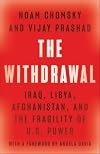
The Withdrawal: Iraq, Libya, Afghanistan, and the Fragility of U.S. Power
by Noam Chomsky
On This Page
Description
"Not since the last American troops left Vietnam have we faced such a sudden vacuum in our foreign policy--not only of authority, but also of explanations of what happened, and what the future holds. Few analysts are better poised to address this moment than Noam Chomsky and Vijay Prashad, intellectuals and critics whose work spans generations and continents. Called "the most widely read voice on foreign policy on the planet" by the New York Times Book Review, Noam Chomsky is the guiding show more light of dissidents around the world. In The Withdrawal, Chomsky joins with noted scholar Vijay Prashad--who "helps to uncover the shining worlds hidden under official history and dominant media" (Eduardo Galeano)--to get at the roots of this unprecedented time of peril and change. Chomsky and Prashad interrogate key inflection points in America's downward spiral: from the disastrous Iraq War to the failed Libyan intervention to the descent into chaos in Afghanistan. As the final moments of American power in Afghanistan fade from view, this crucial book argues that we must not take our eyes off the wreckage--and that we need, above all, an unsentimental view of the new world we must build together." -- show lessTags
Recommendations















Member Reviews
The Withdrawal: Iraq, Libya, Afghanistan, and the Fragility of U.S. Power, from Noam Chomsky and Vijay Prashad, is an insightful and nuanced analysis of the many failures of US foreign policy over the past half century or so.
In case you missed the subtitle, this is not simply a rehash of the withdrawal from Afghanistan, this is broader and far more about overall policy failure than about one instance in isolation. If you read the introduction, you will understand what the objectives are, from the withdrawals mentioned to coup reversals and losing control of events in places the US thought they were in control. In other words, withdrawal in the bigger picture, not a sensationalized account of the most recent episode.
This is taken from show more many discussions between the authors as well as interviews. While there is a lot that will be familiar to readers of either writer, it isn't about always finding something brand new to say. It is about connecting the dots between previous analyses and more recent events; it is about applying ideas rather than trying to create shiny new ideas for those too lazy to do the work of making connections. Passive readers may well feel like they heard it all before. Active readers will find that what they heard before is just as important to say today as it was yesterday.
I would recommend this to readers who are concerned about what is happening globally as well as within a very polarized US. You don't have to agree with everything, no one is inside your head while you read, so just read to understand what they are saying, then if you disagree with some parts, you will be actually disagreeing, not just repeating the mantra your handlers have driven into your mind.
Reviewed from a copy made available by the publisher via NetGalley. show less
In case you missed the subtitle, this is not simply a rehash of the withdrawal from Afghanistan, this is broader and far more about overall policy failure than about one instance in isolation. If you read the introduction, you will understand what the objectives are, from the withdrawals mentioned to coup reversals and losing control of events in places the US thought they were in control. In other words, withdrawal in the bigger picture, not a sensationalized account of the most recent episode.
This is taken from show more many discussions between the authors as well as interviews. While there is a lot that will be familiar to readers of either writer, it isn't about always finding something brand new to say. It is about connecting the dots between previous analyses and more recent events; it is about applying ideas rather than trying to create shiny new ideas for those too lazy to do the work of making connections. Passive readers may well feel like they heard it all before. Active readers will find that what they heard before is just as important to say today as it was yesterday.
I would recommend this to readers who are concerned about what is happening globally as well as within a very polarized US. You don't have to agree with everything, no one is inside your head while you read, so just read to understand what they are saying, then if you disagree with some parts, you will be actually disagreeing, not just repeating the mantra your handlers have driven into your mind.
Reviewed from a copy made available by the publisher via NetGalley. show less
Ratings
Members
- Recently Added By
Author Information

580+ Works 47,462 Members
Noam Chomsky was born in Philadelphia, Pennsylvania on December 7, 1928. Son of a Russian emigrant who was a Hebrew scholar, Chomsky was exposed at a young age to the study of language and principles of grammar. During the 1940s, he began developing socialist political leanings through his encounters with the New York Jewish intellectual show more community. Chomsky received his Ph.D. from the University of Pennsylvania, where he studied linguistics, mathematics, and philosophy. He conducted much of his research at Harvard University. In 1955, he began teaching at MIT, eventually holding the Ferrari P. Ward Chair of Modern Language and Linguistics. Today Chomsky is highly regarded as both one of America's most prominent linguists and most notorious social critics and political activists. His academic reputation began with the publication of Syntactic Structures in 1957. Within a decade, he became known as an outspoken intellectual opponent of the Vietnam War. Chomsky has written many books on the links between language, human creativity, and intelligence, including Language and Mind (1967) and Knowledge of Language: Its Nature, Origin, and Use (1985). He also has written dozens of political analyses, including Manufacturing Consent: The Political Economy of the Mass Media (1988), Chronicles of Dissent (1992), and The Prosperous Few and the Restless Many (1993). (Bowker Author Biography) show less
Classifications
Statistics
- Members
- 57
- Popularity
- 537,145
- Reviews
- 1
- Rating
- (4.00)
- Languages
- English, Portuguese
- Media
- Paper, Audiobook, Ebook
- ISBNs
- 6
- ASINs
- 1