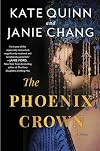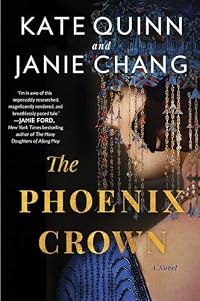
The Phoenix Crown
by Kate Quinn, Janie Chang
On This Page
Description
From bestselling authors Janie Chang and Kate Quinn, a thrilling and unforgettable narrative about the intertwined lives of two wronged women, spanning from the chaos of the San Francisco earthquake to the glittering palaces of Versailles.San Francisco, 1906. In a city bustling with newly minted millionaires and scheming upstarts, two very different women hope to change their fortunes: Gemma, a golden-haired, silver-voiced soprano whose career desperately needs rekindling, and Suling, a show more petite and resolute Chinatown embroideress who is determined to escape an arranged marriage. Their paths cross when they are drawn into the orbit of Henry Thornton, a charming railroad magnate whose extraordinary collection of Chinese antiques includes the fabled Phoenix Crown, a legendary relic of Beijing's fallen Summer Palace.
His patronage offers Gemma and Suling the chance of a lifetime, but their lives are thrown into turmoil when a devastating earthquake rips San Francisco apart and Thornton disappears, leaving behind a mystery reaching further than anyone could have imagined . . . until the Phoenix Crown reappears five years later at a sumptuous Paris costume ball, drawing Gemma and Suling together in one last desperate quest for justice.
. show less
Tags
Recommendations









Member Recommendations
Member Reviews
The Phoenix Crown by Kate Quinn and Janie Chang is a well-researched historical fiction mystery with suspense woven seamlessly throughout the story.
Set in booming pre-1906 San Francisco before the devastating earthquake and fire, the novel follows the lives — and ultimately the escape — of two very different women as they navigate survival, ambition, and uncertainty. Gemma, an opera singer, and Suling, a talented Chinese embroiderer, are compelling protagonists whose journeys gradually intertwine in fascinating ways.
Quinn and Chang create richly layered characters and bring the era vividly to life through strong cultural detail and atmosphere. The novel thoughtfully explores themes of friendship, resilience, identity, and the hidden show more power of art and history, making it both an engaging mystery and an emotionally rewarding read. show less
Set in booming pre-1906 San Francisco before the devastating earthquake and fire, the novel follows the lives — and ultimately the escape — of two very different women as they navigate survival, ambition, and uncertainty. Gemma, an opera singer, and Suling, a talented Chinese embroiderer, are compelling protagonists whose journeys gradually intertwine in fascinating ways.
Quinn and Chang create richly layered characters and bring the era vividly to life through strong cultural detail and atmosphere. The novel thoughtfully explores themes of friendship, resilience, identity, and the hidden show more power of art and history, making it both an engaging mystery and an emotionally rewarding read. show less
This begins in San Francisco in the weeks before the 1906 earthquake, about two women who cross paths because of their connections to ambitious businessman Henry Thornton. When Gemma arrives for a role with the Metropolitan Opera (still only in the chorus, despite her glorious voice), she’s looking forward to catching-up with her old roommate but Nellie has already moved on, without leaving an address. Suling’s family run a laundry in San Francisco's Chinatown, but Suling picks up extra work where she can, desperately determined to save money so she can avoid the marriage Third Uncle has arranged for her.
I don’t think the pacing, with the final act of the story taking place some years later, worked as well as a similar structure show more did in Quinn’s novel The Rose Code, but on the whole, this was compelling! I liked the insight into the lives of women who are somewhat unconventional, and their (eventual) teamwork. I enjoyed the way Gemma and Suling’s stories converged, with increasing tension (and not just because the chapter headings are counting down to the earthquake).
The historical details are fascinating and vividly described, and as always, there were moments where I found Quinn’s prose particularly evocative (but I didn’t bookmark any of those because I was listening to the audiobook).
I don’t think the pacing, with the final act of the story taking place some years later, worked as well as a similar structure show more did in Quinn’s novel The Rose Code, but on the whole, this was compelling! I liked the insight into the lives of women who are somewhat unconventional, and their (eventual) teamwork. I enjoyed the way Gemma and Suling’s stories converged, with increasing tension (and not just because the chapter headings are counting down to the earthquake).
The historical details are fascinating and vividly described, and as always, there were moments where I found Quinn’s prose particularly evocative (but I didn’t bookmark any of those because I was listening to the audiobook).
[...] she took her birdcage in one hand and the strap of her trunk in the other and began hauling everything down the street.show less
She made it almost as far as Third and Mission, gritting her teeth as her trunk’s end bounced on the cobbles behind her. In an opera, a gallant young tenor would have offered to carry it for her and they’d be singing a passionate duet by the top of Nob Hill, but life wasn’t as accommodating as an opera.
Disclaimer: I received a copy of this book in a giveaway.
One of my favorite things about Quinn's books is the eccentric cast of characters with a variety of backgrounds who come together to eventually achieve a common goal. The Phoenix Crown, co-written by Quinn and Janie Chang, features an older opera singer with migraines but the voice of an angel, an American-born Chinese seamstress dying to get out of San Francisco, a zealous botanist, and a missing painter. The story is told primarily from the perspective of two women: the opera singer Gemma and the seamstress Suling, but their stories illuminate a world long gone. Their writing is evocative in a way that you can't help but keep reading in order to capture the magic of the past. show more
As mentioned, the two protagonists Gemma and Suling, although initially from separate worlds, are very alike. They're both trying escape their orphaned pasts and make themselves anew in a big city. The difference is Gemma sees her flight to San Francisco as her last shot, being a 32 year old opera singer still stuck in the chorus while Suling is barely 20 and looking to escape her neglectful uncle and an unsatisfying arranged marriage so she can make her mark. Both women are equal parts jaded and hopeful. They both go through a transformation where they feel like they have to sacrifice a part of themselves to get to who and where they want to be, only to realize that was the best, most meaningful part of them all along. At its core, The Phoenix Crown is a story about friendship, how it ebbs and flows but ultimately endures. Personally, I would argue Gemma goes through a bigger change here, from a downtrodden singer determined to only look out for herself from now on to realizing fame isn't worth having when she realizes what it's cost her. Suling, while a strong, capable, admirable woman, grows through opportunities being presented to her through the advocacy of her friends. She becomes more daring in her approach to life throughout the book, but that's more a product of her gaining confidence in her abilities as she receives external validation. Doesn't make me like her any less, just saying her transformation is more external while Gemma's is more internal.
As much fun as I had, there were a few drawbacks. The villain, while present, is as much a part of the backdrop as San Francisco is. It's the women's own desires and fears that threaten their relationships and futures. While Thornton is certainly devious, he doesn't cause a lot of bad things to happen to the girls (there are 2 very bad things, but those almost happen by accident to the heroines). If anything, the earthquake is more of a villain in that it forces the heroines to confront their inner selves and to decide what kind of person they are. It literally makes or breaks them while Thornton, who is definitely bad, is like the icing on a villain cake. That said, he is definitely villainous. Throughout the story, it is clear that Thornton is ruthless and will do anything to achieve his goals, which is why the ending scene when the women confront him is honestly a bit underwhelming. All of his resources and strategizing evaporate in the presence of girl power. The ending climax felt cliche and pandering: look at women getting stuff done! Who needs men? Men could never! Now, I'm sure a lot of people will love the ending simply for those reasons. To me, it seemed off tonally and too neatly wrapped up, where I'm used to more complex endings in Quinn's books in the past.
For a book with two authors, the writing was very consistent and flowed well. You cannot tell who wrote what, though there were times I spotted Quinn's distinctive style, as she tends to lean more into scene-setting prose, such as how things smell and taste, which I love and missed a bit in this book. Overall, I very much enjoyed this story about a time and place that I know very little about while examining the different types of people in this world who all ultimately want the same thing: a place where they belong. show less
One of my favorite things about Quinn's books is the eccentric cast of characters with a variety of backgrounds who come together to eventually achieve a common goal. The Phoenix Crown, co-written by Quinn and Janie Chang, features an older opera singer with migraines but the voice of an angel, an American-born Chinese seamstress dying to get out of San Francisco, a zealous botanist, and a missing painter. The story is told primarily from the perspective of two women: the opera singer Gemma and the seamstress Suling, but their stories illuminate a world long gone. Their writing is evocative in a way that you can't help but keep reading in order to capture the magic of the past. show more
As mentioned, the two protagonists Gemma and Suling, although initially from separate worlds, are very alike. They're both trying escape their orphaned pasts and make themselves anew in a big city. The difference is Gemma sees her flight to San Francisco as her last shot, being a 32 year old opera singer still stuck in the chorus while Suling is barely 20 and looking to escape her neglectful uncle and an unsatisfying arranged marriage so she can make her mark. Both women are equal parts jaded and hopeful. They both go through a transformation where they feel like they have to sacrifice a part of themselves to get to who and where they want to be, only to realize that was the best, most meaningful part of them all along. At its core, The Phoenix Crown is a story about friendship, how it ebbs and flows but ultimately endures. Personally, I would argue Gemma goes through a bigger change here, from a downtrodden singer determined to only look out for herself from now on to realizing fame isn't worth having when she realizes what it's cost her. Suling, while a strong, capable, admirable woman, grows through opportunities being presented to her through the advocacy of her friends. She becomes more daring in her approach to life throughout the book, but that's more a product of her gaining confidence in her abilities as she receives external validation. Doesn't make me like her any less, just saying her transformation is more external while Gemma's is more internal.
As much fun as I had, there were a few drawbacks. The villain, while present, is as much a part of the backdrop as San Francisco is. It's the women's own desires and fears that threaten their relationships and futures. While Thornton is certainly devious, he doesn't cause a lot of bad things to happen to the girls (there are 2 very bad things, but those almost happen by accident to the heroines). If anything, the earthquake is more of a villain in that it forces the heroines to confront their inner selves and to decide what kind of person they are. It literally makes or breaks them while Thornton, who is definitely bad, is like the icing on a villain cake. That said, he is definitely villainous. Throughout the story, it is clear that Thornton is ruthless and will do anything to achieve his goals, which is why the ending scene when the women confront him is honestly a bit underwhelming. All of his resources and strategizing evaporate in the presence of girl power. The ending climax felt cliche and pandering: look at women getting stuff done! Who needs men? Men could never! Now, I'm sure a lot of people will love the ending simply for those reasons. To me, it seemed off tonally and too neatly wrapped up, where I'm used to more complex endings in Quinn's books in the past.
For a book with two authors, the writing was very consistent and flowed well. You cannot tell who wrote what, though there were times I spotted Quinn's distinctive style, as she tends to lean more into scene-setting prose, such as how things smell and taste, which I love and missed a bit in this book. Overall, I very much enjoyed this story about a time and place that I know very little about while examining the different types of people in this world who all ultimately want the same thing: a place where they belong. show less
This was a fun and interesting historical novel set mainly during the days immediately before, during, and after the San Francisco earthquake of 1906. An unlikely foursome of women are brought together by a complicated series of events in the days leading up to the earthquake. After the quake and the traumatic events surrounding it, the women separate to try to continue their lives—only to be called back together to find revenge and closure.
I enjoyed the story. The individual experiences of the women were all interesting and enlightening, and the plot was fast-moving. The writing was excellent. My only criticism is that perhaps it tried to do a bit too much—an historical, action, feminist, caper novel? It was a bit show more overwhelming—but in a good way. I loved it and highly recommend it.
I received a complimentary copy of this book. Opinions expressed in this review are completely my own. show less
I enjoyed the story. The individual experiences of the women were all interesting and enlightening, and the plot was fast-moving. The writing was excellent. My only criticism is that perhaps it tried to do a bit too much—an historical, action, feminist, caper novel? It was a bit show more overwhelming—but in a good way. I loved it and highly recommend it.
I received a complimentary copy of this book. Opinions expressed in this review are completely my own. show less
Two authors, four main characters, locales as diverse as San Francisco, Paris, London and Buenos Aires, and murder and other skulduggery--what's not to like?
Gemma is an opera singer in New York down to her last few dollars when she is offered a role singing with the Metropolitan Opera when it opens in San Francisco with Enrico Caruso as the main attraction. Of course she jumps at the chance and tells her good friend Nellie (aka Reggie) who is now living in San Francisco. Nellie is supposed to be at the train station to meet her but doesn't show up. Gemma makes her way to Nellie's address where she meets botanist Alice Eastwood but no Nellie. Alice tells her that Nellie abruptly left their shared accommodations and hasn't been seen show more since. Nellie, a painter, left a message for Gemma saying she had been given a chance to paint in Colorado and couldn't pass it up. Gemma is hurt but determined to make good on her chance with the Met. She goes to the Opera House where she meet accompanist George originally from Brazil. She is also approached by tycoon Henry Thornton who is very complimentary about her voice. Thornton wants to promote Gemma and offers to host a party where she can sing for all the best people of San Francisco. Little does Gemma know that Thornton proposed a similar deal for Nellie/Reggie but as she spends more time with Thornton some details slip out. Gemma also gets to know seamstress and embroiderer Suling and finds out that Suling knows Reggie; in fact, she was in love with Reggie and is also very hurt by her disappearance. The lavish party for Gemma is scheduled for the night the opera opens which is just a few hours before the massive earthquake of 1906 hits San Francisco. Suling takes advantage of Thornton's absence to attend the opera to break into his office. She discovers a clue to what happened to Reggie and takes off across town instead of staying to tell Gemma. Gemma was to wear the rare Phoenix Crown which Thornton owns but she refuses at the last moment. She sings and impresses Caruso and the rest of the guests. And, then, all hell breaks loose when the earthquake hits. Suling finds Reggie and they make their way back to Thornton's house. Gemma and Alice are also there. Thornton locks them all in the conservatory and sets fire to the house as he flees with the Phoenix Crown. That's not the end of the story but you really don't want me to spoil the ending. Read the book.
I haven't read anything by Janie Chang before but after reading this book and looking at her website I am anxious to further my acquaintance with her. After all, she's Canadian. show less
Gemma is an opera singer in New York down to her last few dollars when she is offered a role singing with the Metropolitan Opera when it opens in San Francisco with Enrico Caruso as the main attraction. Of course she jumps at the chance and tells her good friend Nellie (aka Reggie) who is now living in San Francisco. Nellie is supposed to be at the train station to meet her but doesn't show up. Gemma makes her way to Nellie's address where she meets botanist Alice Eastwood but no Nellie. Alice tells her that Nellie abruptly left their shared accommodations and hasn't been seen show more since. Nellie, a painter, left a message for Gemma saying she had been given a chance to paint in Colorado and couldn't pass it up. Gemma is hurt but determined to make good on her chance with the Met. She goes to the Opera House where she meet accompanist George originally from Brazil. She is also approached by tycoon Henry Thornton who is very complimentary about her voice. Thornton wants to promote Gemma and offers to host a party where she can sing for all the best people of San Francisco. Little does Gemma know that Thornton proposed a similar deal for Nellie/Reggie but as she spends more time with Thornton some details slip out. Gemma also gets to know seamstress and embroiderer Suling and finds out that Suling knows Reggie; in fact, she was in love with Reggie and is also very hurt by her disappearance. The lavish party for Gemma is scheduled for the night the opera opens which is just a few hours before the massive earthquake of 1906 hits San Francisco. Suling takes advantage of Thornton's absence to attend the opera to break into his office. She discovers a clue to what happened to Reggie and takes off across town instead of staying to tell Gemma. Gemma was to wear the rare Phoenix Crown which Thornton owns but she refuses at the last moment. She sings and impresses Caruso and the rest of the guests. And, then, all hell breaks loose when the earthquake hits. Suling finds Reggie and they make their way back to Thornton's house. Gemma and Alice are also there. Thornton locks them all in the conservatory and sets fire to the house as he flees with the Phoenix Crown. That's not the end of the story but you really don't want me to spoil the ending. Read the book.
I haven't read anything by Janie Chang before but after reading this book and looking at her website I am anxious to further my acquaintance with her. After all, she's Canadian. show less
What stands out in The Phoenix Crown by Kate Quinn and Janie Chang is the fulsome character development. Four women - a soprano, a painter, an ornamental bead-worker, and a botanist - band together to stand up to a manipulative sociopath, after all four cross his path. Each woman is strong in her own way, but, together, they are formidable.
What keeps The Phoenix Crown from being an all around great read is the story itself, which is so slow at times that this reviewer found herself skimming the text. You'd think this wouldn't be possible when the novel is set before, during, and after the 1906 San Francisco earthquake that took thousands of lives and nearly burnt the entire city to the ground.
Still, the novel is well worth readers' show more time as it explores such topics as Post Traumatic Stress Syndrome (PTSD), long before doctors got around to identifying it, as well as what one woman calls the red silk thread that the gods use to tie the fate of one character to another.
Read and enjoy. show less
What keeps The Phoenix Crown from being an all around great read is the story itself, which is so slow at times that this reviewer found herself skimming the text. You'd think this wouldn't be possible when the novel is set before, during, and after the 1906 San Francisco earthquake that took thousands of lives and nearly burnt the entire city to the ground.
Still, the novel is well worth readers' show more time as it explores such topics as Post Traumatic Stress Syndrome (PTSD), long before doctors got around to identifying it, as well as what one woman calls the red silk thread that the gods use to tie the fate of one character to another.
Read and enjoy. show less
I’ll cut straight to the chase… The Phoenix Crown is a must–read for historical fiction lovers and, really, just about anyone who loves reading strong female characters.
From this novel’s opening page, I was captivated by Kate Quinn and Janie Chang’s strikingly evocative narrative.
The fictional tapestry within which the authors have woven real historical people and events is vivid and alive; the folly and decadence of high society against a backdrop of racial tension reaching fever pitch in San Francisco’s Chinatown at the turn of the 1900s.
The feisty women centre stage are barely contained by this novel’s pages. Continue reading: https://www.bookloverbookreviews.com/2024/02/the-phoenix-crown-kate-quinn-janie-...
From this novel’s opening page, I was captivated by Kate Quinn and Janie Chang’s strikingly evocative narrative.
The fictional tapestry within which the authors have woven real historical people and events is vivid and alive; the folly and decadence of high society against a backdrop of racial tension reaching fever pitch in San Francisco’s Chinatown at the turn of the 1900s.
The feisty women centre stage are barely contained by this novel’s pages. Continue reading: https://www.bookloverbookreviews.com/2024/02/the-phoenix-crown-kate-quinn-janie-...
Members
- Recently Added By
Lists

LoanStars | Adult List: February 2024
10 works; 1 member

Globe and Mail | Canadian Fiction: February 24, 2024
10 works; 1 member
Globe and Mail | Canadian Fiction: March 2, 2024
10 works; 1 member

Globe and Mail | Canadian Fiction: March 9, 2024
10 works; 1 member
Globe and Mail | Canadian Fiction: March 16, 2024
10 works; 1 member
Globe and Mail | Canadian Fiction: March 23, 2024
10 works; 1 member
Globe and Mail | Canadian Fiction: March 30, 2024
10 works; 1 member

Globe and Mail | Canadian Fiction: April 6, 2024
10 works; 1 member

Globe and Mail | Canadian Fiction: April 13, 2024
10 works; 1 member

Globe and Mail | Canadian Fiction: April 20, 2024
10 works; 1 member
Globe and Mail | Canadian Fiction: April 27, 2024
10 works; 1 member
Globe and Mail | Canadian Fiction: May 4, 2024
10 works; 1 member

Globe and Mail | Canadian Fiction: May 11, 2024
10 works; 1 member
Globe and Mail | Canadian Fiction: May 18, 2024
10 works; 1 member
Globe and Mail | Canadian Fiction: Year End, 2024
10 works; 1 member
Author Information

25+ Works 19,167 Members
Kate Quinn was born and raised in southern California. She attended Boston University, where she earned a Bachelor¿s and later a Master¿s degree in Classical Voice. She has always been a lifelong history buff. She put that love of history to work when she wrote four novels in the Empress of Rome Saga, and two books in the Italian Renaissance. show more She then moved on to the 20th century with "The Alice Network". (Bowker Author Biography) show less

6 Works 2,077 Members
Awards and Honors
Common Knowledge
- Canonical title
- The Phoenix Crown
- Original title
- The Phoenix Crown
- Original publication date
- 2024
- People/Characters
- Sally Gunderson aka Gemma Garland Serrano; Suling Feng; Nellie Doyle aka Regina “Reggie” Reynolds; Alice Eastwood; Henry Thornton aka Willian van Doren; George Serrano (show all 11); Nina Ning; Third Uncle; Michael Clarkson; Cecelia Arenburg von Loxen; Enrico Caruso
- Important places
- San Francisco, California, USA; Tahoe region, California, USA; Paris, France; Buenos Aires, Argentina; London, England, UK; Versailles, France
- Important events
- 1906 San Francisco Earthquake
- Dedication
- To Stephen and Geoffrey
- First words
- A rose by any other name, “ someone quoted, and Alice Eastwood was hard-pressed not to roll her eyes. When it came to Shakespearean quotes about flowers, hang Romeo and Juliet. She preferred Julius Caesar: "Na... (show all)ture must obey necessity." -Prologue, Summer 1911, London
April 4, 1906
Thirteen days, fourteen hours, fifty-two minutes before the San Francisco earthquake.
The birdcage was starting to squawk and vibrate indignantly on the seat, so Gemma Garland lifted the cover ... (show all)a crack and spoke down into it. "Almost there, I promise." The woman who had just settled into the seat opposite shot her a look, but Gemma had been traveling all the way from New York in a third-class compartment - she was travel-stained, weary, feeling every one of her thirty-two years, and certainly well beyond caring about censorious looks. Especially looks from hatchet-faced schoolmarms in navy bombazine and mouse-colored toques. Women like that had been giving Gemma looks since she was twelve years old. -Chapter 1 - Last words
- (Click to show. Warning: May contain spoilers.)Like San Francisco itself, and the men and women who survived that terrible day, it rose again: a phoenix reborn from the ashes.
- Blurbers
- Ford, Jamie; Benedict, Marie; Murray, Victoria Christopher
- Canonical DDC/MDS
- 813.6
- Canonical LCC
- PS3617.U578
Classifications
Statistics
- Members
- 564
- Popularity
- 52,122
- Reviews
- 28
- Rating
- (3.88)
- Languages
- English, Norwegian, Swedish
- Media
- Paper, Audiobook, Ebook
- ISBNs
- 19
- ASINs
- 6