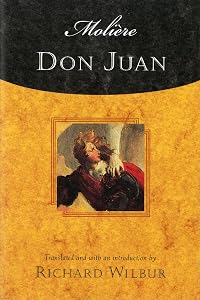
Don Juan
by Molière
On This Page
Description
Don Juan, the "Seducer of Seville," originated as a hero-villain of Spanish folk legend, is a famous lover and scoundrel who has made more than a thousand sexual conquests. One of Molière's best-known plays, Don Juan was written while Tartuffe was still banned on the stages of Paris, and shared much with the outlawed play. Modern directors transform Don Juan in every new era, as each director finds something new to highlight in this timeless classic. Richard Wilbur's flawless translation show more will be the standard for generations to come, as have his translations of Molière's other plays. Witty, urbane, and poetic in its prose, Don Juan is, most importantly, as funny now as it was for audiences when it was first presented. show lessTags
Recommendations
























Member Reviews
A classic play, Don Juan is at once a morality tale in which the libertine anti-hero is haunted by a former victim and finally ends in his rightful place in Hell--which is what let Moliere get away with producing it in the first place--and a delightfully subversive comedy in which the devil gets all the best lines (well, in truth, the best lines go to Don Juan's servant, the role which Moliere wrote for himself) and we find ourselves rooting for the deliciously amoral, womanizing Don Juan the whole time despite ourselves. There are plenty of plays from this period which attempt this balance--titilating but ultimately at least ostensibly supportive of the sexually repressive status quo--and fail, but in Moliere's hands the play never show more once hits a sour note. Instead, we are provided with some of the most crackling, wittiest dialogue to be found in French literature of this era, and a closing monologue which is nothing less than a work of genius. show less
Sadly, with Don Juan, I believe that I have now read all of Richard Wilbur's translations of French drama. Then again, I had thought that years ago and they recently started republishing ones I hadn't read. So maybe I will be pleasantly surprised by some more translations.
Sadly also, this is the only Wilbur translation that has any false notes, specifically the dialogue of the rustic peasants in Act II sounds anachronistic and tinny, with phrases like "Hell's bells." Clearly an artistic choice on Wilbur's part but not one that worked for me.
But, of course, Don Juan is spectacular. It is in prose, like other versions of Don Juan a strange combination of comedy, romance, tragedy, moral fable, and other genres. The prose has the same grace show more as Wilbur's versions of Moliere's rhyming verse. And Don Juan's depiction is complex and multi-faceted. show less
Sadly also, this is the only Wilbur translation that has any false notes, specifically the dialogue of the rustic peasants in Act II sounds anachronistic and tinny, with phrases like "Hell's bells." Clearly an artistic choice on Wilbur's part but not one that worked for me.
But, of course, Don Juan is spectacular. It is in prose, like other versions of Don Juan a strange combination of comedy, romance, tragedy, moral fable, and other genres. The prose has the same grace show more as Wilbur's versions of Moliere's rhyming verse. And Don Juan's depiction is complex and multi-faceted. show less
A sarcastic bit of comedy that takes on a number of French conventions of the time in the guise of the libertine character, Don Juan. I found the play more interesting than enjoyable, but I would like to see it in production, because I find that I often like viewing a play much more than reading one.
Sadly, with Don Juan, I believe that I have now read all of Richard Wilbur's translations of French drama. Then again, I had thought that years ago and they recently started republishing ones I hadn't read. So maybe I will be pleasantly surprised by some more translations.
Sadly also, this is the only Wilbur translation that has any false notes, specifically the dialogue of the rustic peasants in Act II sounds anachronistic and tinny, with phrases like "Hell's bells." Clearly an artistic choice on Wilbur's part but not one that worked for me.
But, of course, Don Juan is spectacular. It is in prose, like other versions of Don Juan a strange combination of comedy, romance, tragedy, moral fable, and other genres. The prose has the same grace show more as Wilbur's versions of Moliere's rhyming verse. And Don Juan's depiction is complex and multi-faceted. show less
Sadly also, this is the only Wilbur translation that has any false notes, specifically the dialogue of the rustic peasants in Act II sounds anachronistic and tinny, with phrases like "Hell's bells." Clearly an artistic choice on Wilbur's part but not one that worked for me.
But, of course, Don Juan is spectacular. It is in prose, like other versions of Don Juan a strange combination of comedy, romance, tragedy, moral fable, and other genres. The prose has the same grace show more as Wilbur's versions of Moliere's rhyming verse. And Don Juan's depiction is complex and multi-faceted. show less
I regret that I have not read this before now. This was entertaining, erudite, and funny. Why didn't I get to read this in high school rather than some of the more boring stuff?
843203861X
Members
- Recently Added By
Lists

Lovecraft's 'Supernatural Horror in Literature' Reading List
216 works; 8 members

1001 Books You Must Read Before You Die
1,448 works; 1,136 members

Harold Bloom - The Western Canon: B. The Aristocratic Age
231 works; 13 members

Favourite Books
1,820 works; 311 members

Books Read in 2016
4,666 works; 197 members

100 Books to Read in a Lifetime (That Are Older Than 200 Years)
415 works; 174 members

Greatest Books, allegedly
484 works; 9 members
Author Information

1,112+ Works 22,756 Members
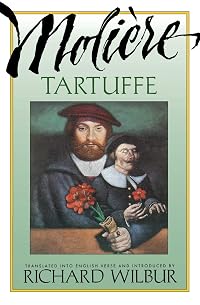
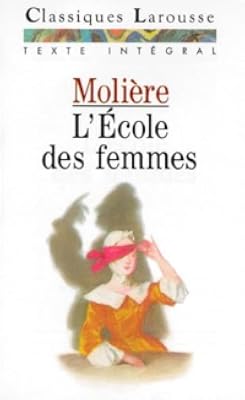
The French dramatist Moliere was born Jean-Baptiste Poquelin on January 15, 1622, in Paris. The son of a wealthy tapestry merchant, he had a penchant for the theater from childhood. In 1636, he was sent off to school at the Jesuit College of Claremont and in 1643, he embarked upon a 13-year career touring in provincial theater as a troupe member show more of Illustre Theatre, a group established by the family Bejarts. He married a daughter of the troupe, Armande Bejart, in 1662 and changed his name to Moliere. The French King Louis XIV, becoming entranced with the troupe after seeing a performance of The Would-Be Gentleman, lent his support and charged Moliere with the production of comedy ballets in which he often used real-life human qualities as backdrops rather than settings from church or state. Soon, Moliere secured a position at the Palais-Royal and committed himself to the comic theater as a dramatist, actor, producer, and director. Moliere is considered to be one of the preeminent French dramatists and writers of comedies; his work continues to delight audiences today. With L'Ecole des Femmes (The School for Wives) Moliere broke with the farce tradition, and the play, about the role played by women in society and their preparation for it, is regarded by many as the first great seriocomic work of French literature. In Tartuffe (1664), Moliere invented one of his famous comic types, that of a religious hypocrite, a character so realistic that the king forbade public performance of the play for five years. Moliere gave psychological depth to his characters, engaging them in facial antics and slapstick comedy, but with an underlying pathos. Jean Baptiste Moliere died in 1673. (Bowker Author Biography) show less
Some Editions
Series
Belongs to Publisher Series
Work Relationships
Is contained in
Bourgeois Gentleman / Dom Juan / Imaginary Invalid / Learned Ladies / Misanthrope / Miser / Tartuffe by Molière
Amphitryon / Bourgeois Gentleman / Dom Juan / Imaginary Invalid / Misanthrope / Miser / Tartuffe by Molière
The Affected Misses / Don Juan / Tartuffe / The Misanthrope / the Doctor by Compulsion / The Miser / The Tradesman Turned Gentleman / The Learned Ladies by Molière
Tartuffe and Other Plays: Tartuffe; The Ridiculous Precieuses; The School for Husbands; The School for Wives; Don Juan; The Versailles Impromptu; The Critique of the School for Wives by Molière
Dom Juan (notices de Paul Arbelet) - L'ecole des femmes (notices de G. Sablayrolles) - Le Misanthrope (notices de Felix Guirand) by Molière
Has the adaptation
Common Knowledge
- Canonical title*
- Don Juan
- Original title
- Dom Juan
- Original publication date
- 1665
- People/Characters*
- Dom Juan; Sganarelle; Done Elvire
- Important places*
- Sicile, Italie
- Original language*
- Français
*Some information comes from Common Knowledge in other languages. Click "Edit" for more information.
Classifications
Statistics
- Members
- 1,205
- Popularity
- 20,722
- Reviews
- 14
- Rating
- (3.67)
- Languages
- 16 — Catalan, French-based Creoles and Pidgins, Czech, Danish, Dutch, English, Finnish, French, German, Italian, Polish, Portuguese, Russian, Serbian, Spanish, Swedish
- Media
- Paper, Audiobook, Ebook
- ISBNs
- 117
- ASINs
- 23