On This Page
Description
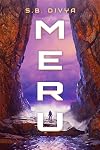
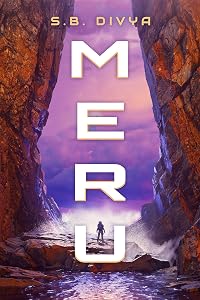
In a future where human life has been restricted to Earth, while posthuman descendants called alloys freely explore the galaxy, Jayanthi, the adopted human child alloys, and her alloy pilot Vaha are sent to test the habitability of an Earthlike planet called Meru, an unoccupied new world, and the future of human-alloy relations.Tags
Recommendations











Member Reviews
Humans and Alloys are both highly genetically engineered beings. Alloys are several centuries post-human, and mainly live in space as explorers and couriers between planets, though some have humanoid avatars that they use to live among humans: they also take care of Earth’s biosphere after the terrible destruction previously wreaked on it by humans, and a disastrous terraforming attempt on Mars. For these reasons humans are confined to Earth and excluded from entering the illustrious bio-engineering sphere which the alloys appropriate to themselves alone.
This is the story of a young human who’s desire to become a genetic engineer and live off-planet lead her to propose an experiment whereby if she can live on the planet Meru for a show more year without damaging it or causing any pollution the alloys will consider being more accommodating towards human needs and desires for travel and resettlement.
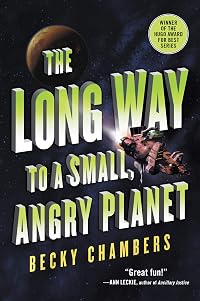
The style of writing gives me a Becky Chambers type vibe – especially in the way the various characters interact with each other and the blossoming relationship between human Jaya and alloy Vaha as they struggle to fulfil the strict terms of the Meru experiment.
There are a couple of niggles. The use of the term “consciousness” to describe planets and stars is a bit jarring, but seems to be used symbolically in-story to remind people that every environment must be respected whether there is life there or not; also the use of pronouns “zie” and “zir” for gender neutral Vaha were too close the “she” and “her” so I ended up thinking of zir as female – might have been better using “they” and “them”.
In any case, the niggles are minor and I will definitely be picking up the second book, and looking for more by this author. show less
This is the story of a young human who’s desire to become a genetic engineer and live off-planet lead her to propose an experiment whereby if she can live on the planet Meru for a show more year without damaging it or causing any pollution the alloys will consider being more accommodating towards human needs and desires for travel and resettlement.
The style of writing gives me a Becky Chambers type vibe – especially in the way the various characters interact with each other and the blossoming relationship between human Jaya and alloy Vaha as they struggle to fulfil the strict terms of the Meru experiment.
There are a couple of niggles. The use of the term “consciousness” to describe planets and stars is a bit jarring, but seems to be used symbolically in-story to remind people that every environment must be respected whether there is life there or not; also the use of pronouns “zie” and “zir” for gender neutral Vaha were too close the “she” and “her” so I ended up thinking of zir as female – might have been better using “they” and “them”.
In any case, the niggles are minor and I will definitely be picking up the second book, and looking for more by this author. show less
Firstly, I have to say that the creativity in Meru blew me away. This has to be the most creative sci-fi story I've read in a long, long time. Secondly, I think that if you like Becky Chambers's novels, you have a good chance of falling in love with this one, too. That's probably a reason why I didn't end up loving it, though, unfortunately.
Content warnings:
- futuristic "gene therapy"/eugenics in the world building (even if the protagonist helps to turn this on its head by being disabled)
Representation:
- the protagonist is Indian and has sickle-cell anemia
- the love interest is Black (in appearance) and uses zie/zir pronouns
- a secondary protagonist is Black and non-binary, using they/them pronouns
- the entire cast is very diverse
It's show more the era of the alloys: for five centuries, humans have been confined to planet Earth as punishment for destroying the climate of both Earth and Mars. Meanwhile, the post-human descendents called alloys—beings large enough to travel in space while carrying human passengers—are free to travel where they please. But when an earthlike planet named Meru is discovered, the discussion to allow humans onto other planets is reopened. And Jaya, a human raised by alloy parents, is uniquely suited to be the one to test if humans are able to survive and live responsibly on Meru. Her pilot, the alloy Vaha, also has something to prove, but those who oppose humanity's freedom are powerful, and Vaha and Jaya's project might be doomed from the start.
Meru is another science fiction book exploring the opposite of terraforming: instead of trying to alter a planet to suit humanity, humans are altered to fit a planet's climate and atmosphere. I've read a few of these before, and I think they're gaining popularity just as the theory itself is gaining popularity (although I don't keep up with space-related news enough to know for sure … I'm definitely not a scientist). I always find the theories and books fascinating, and here you can really tell that the author has done the work. There is a lot of technical language, but it never quite verges onto technobabble and everything makes sense (or S.B. Divya is really good at making it believable).
I also really love what they do with Jaya's disability, even if there are a few things that make me a little uncomfortable. Still, the fact that they do so much work in trying to include a disabled protagonist into a futuristic earth that has "eradicated all diseases" is to be celebrated. If you've read any of my reviews before, you'll know that humanity getting rid of all sicknesses is a trope I particularly despise, and in this book it's something that is dealt with, although one of the main reasons for Jaya being disabled is still something I'm not sure I can agree with (her pain and suffering from her sickle-cell being something that could perhaps benefit the rest of humanity). In the acknowledgments section, I found out that the author got complications from covid and was able to sympathize a lot with Jaya's experiences, which gave me a new understanding—and also made me a little more sympathetic as well.
Unfortunately, there was so much about this book that made reading it more work than pleasure sometimes. A very large chunk of the beginning was dedicated to clunky and awkward exposition, and except for the fact that Jaya gets pregnant halfway through, preceded by a wildly strange conversation ending with, "Okay, let's make a baby!" , the book feels like it would fit better in the young adult section: the main characters feel a lot more like teenagers rather than adults in their early 20s, and their dialogue especially backs that up. The author also takes moral stances in the prose, telling us when to know we're not supposed to sympathize with a character's actions, even when it's in their POV. It almost feels like this was written as a young adult book, but got feedback that it wouldn't be a good fit or something, and nothing much was changed for the adult market. Of course, these critiques don't make it a book bad (YA books =/= bad books), but it made reading a strange experience, bouncing back from adult themes to childish dialogue and awkward prose.
I will say that the book ended in a satisfying way, though, and I appreciate the author's takes on disability representation so much that I'm very interested in what else they've written in the science fiction genre. This book also leans heavily on the romance, so if you're a Becky Chambers fan and love diverse sci-fi with a heavy dose of romance, check this one out. show less
Content warnings:
- futuristic "gene therapy"/eugenics in the world building (even if the protagonist helps to turn this on its head by being disabled)
Representation:
- the protagonist is Indian and has sickle-cell anemia
- the love interest is Black (in appearance) and uses zie/zir pronouns
- a secondary protagonist is Black and non-binary, using they/them pronouns
- the entire cast is very diverse
It's show more the era of the alloys: for five centuries, humans have been confined to planet Earth as punishment for destroying the climate of both Earth and Mars. Meanwhile, the post-human descendents called alloys—beings large enough to travel in space while carrying human passengers—are free to travel where they please. But when an earthlike planet named Meru is discovered, the discussion to allow humans onto other planets is reopened. And Jaya, a human raised by alloy parents, is uniquely suited to be the one to test if humans are able to survive and live responsibly on Meru. Her pilot, the alloy Vaha, also has something to prove, but those who oppose humanity's freedom are powerful, and Vaha and Jaya's project might be doomed from the start.
Meru is another science fiction book exploring the opposite of terraforming: instead of trying to alter a planet to suit humanity, humans are altered to fit a planet's climate and atmosphere. I've read a few of these before, and I think they're gaining popularity just as the theory itself is gaining popularity (although I don't keep up with space-related news enough to know for sure … I'm definitely not a scientist). I always find the theories and books fascinating, and here you can really tell that the author has done the work. There is a lot of technical language, but it never quite verges onto technobabble and everything makes sense (or S.B. Divya is really good at making it believable).
I also really love what they do with Jaya's disability, even if there are a few things that make me a little uncomfortable. Still, the fact that they do so much work in trying to include a disabled protagonist into a futuristic earth that has "eradicated all diseases" is to be celebrated. If you've read any of my reviews before, you'll know that humanity getting rid of all sicknesses is a trope I particularly despise, and in this book it's something that is dealt with, although one of the main reasons for Jaya being disabled is still something I'm not sure I can agree with (her pain and suffering from her sickle-cell being something that could perhaps benefit the rest of humanity). In the acknowledgments section, I found out that the author got complications from covid and was able to sympathize a lot with Jaya's experiences, which gave me a new understanding—and also made me a little more sympathetic as well.
Unfortunately, there was so much about this book that made reading it more work than pleasure sometimes. A very large chunk of the beginning was dedicated to clunky and awkward exposition, and except for the fact that Jaya
I will say that the book ended in a satisfying way, though, and I appreciate the author's takes on disability representation so much that I'm very interested in what else they've written in the science fiction genre. This book also leans heavily on the romance, so if you're a Becky Chambers fan and love diverse sci-fi with a heavy dose of romance, check this one out. show less
Enough futuristic strangeness that is just friendly enough to be believable. A story that moves along with twists and turns. Some surprise. Some delight. Some dismay. Characters to love or despise, the latter sometimes redeemed. All the emotions are there.
Divya does an interesting thing with gender, inventing (I presume) new replacements for he/she pronouns. It’s necessary if a bit annoying, but after a few dozen pages, it begins to work. I look forward to reading more of her work.
Divya does an interesting thing with gender, inventing (I presume) new replacements for he/she pronouns. It’s necessary if a bit annoying, but after a few dozen pages, it begins to work. I look forward to reading more of her work.
Pros: interesting characters, compelling drama
Cons: takes several chapters to learn necessary vocabulary
Centuries ago humanity nearly destroyed earth and made a hash of terraforming Mars. Since then, they’ve been confined to earth while their distant offspring, alloys, exploring the universe. When a human habitable planet is discovered, a vote to decide whether humans should be allowed to expand into the universe again is proposed. Jayanthi wants to be more than a human raised by alloys, confined to earth. When she discovers that her sickle cell disease makes her suitable to live in the higher oxygenated air of Meru, she petitions to be allowed to live there for a year as an experiment. Only a newly graduated alloy pilot agrees to show more bring her there. But some alloys remember what humans did the last time they were allowed to expand past Earth. And they’ve got plans to make sure this experiment fails and the vote goes their way.
There’s quite a learning curve as the book throws a lot of new vocabulary and concepts at you with no info dumps. It takes a few chapters to get a real grip on this future world and how humans and alloys co-exist. It can feel overwhelming, but once you understand the background and have been introduced to the characters, the plot kicks in and the story moves on to the titular planet. The world-building is astonishing.
The plot centres around the personalities of Jayanthi and Vaha and their developing relationship. It’s a forbidden romance that faces a lot of complications. Though young and full of self-doubt, they’re both delightful and I thoroughly enjoyed seeing them try to solve various problems.
According to the acknowledgements, the story is based on the Indian epic, the Mahabharata. I’ve never read it and so cannot comment on how the author handled the source material, but I did appreciate all of the Indian inspired names, scents and foods used throughout the book. Each chapter is named after a Sanskrit word.
There are variously gendered entities, which can take some getting used to and adds to the alienness of the alloys.
After the first few chapters, I found this a quick, compelling read. show less
Cons: takes several chapters to learn necessary vocabulary
Centuries ago humanity nearly destroyed earth and made a hash of terraforming Mars. Since then, they’ve been confined to earth while their distant offspring, alloys, exploring the universe. When a human habitable planet is discovered, a vote to decide whether humans should be allowed to expand into the universe again is proposed. Jayanthi wants to be more than a human raised by alloys, confined to earth. When she discovers that her sickle cell disease makes her suitable to live in the higher oxygenated air of Meru, she petitions to be allowed to live there for a year as an experiment. Only a newly graduated alloy pilot agrees to show more bring her there. But some alloys remember what humans did the last time they were allowed to expand past Earth. And they’ve got plans to make sure this experiment fails and the vote goes their way.
There’s quite a learning curve as the book throws a lot of new vocabulary and concepts at you with no info dumps. It takes a few chapters to get a real grip on this future world and how humans and alloys co-exist. It can feel overwhelming, but once you understand the background and have been introduced to the characters, the plot kicks in and the story moves on to the titular planet. The world-building is astonishing.
The plot centres around the personalities of Jayanthi and Vaha and their developing relationship. It’s a forbidden romance that faces a lot of complications. Though young and full of self-doubt, they’re both delightful and I thoroughly enjoyed seeing them try to solve various problems.
According to the acknowledgements, the story is based on the Indian epic, the Mahabharata. I’ve never read it and so cannot comment on how the author handled the source material, but I did appreciate all of the Indian inspired names, scents and foods used throughout the book. Each chapter is named after a Sanskrit word.
There are variously gendered entities, which can take some getting used to and adds to the alienness of the alloys.
After the first few chapters, I found this a quick, compelling read. show less
had to think about this one awhile after i finished it. the writing style was stiff and all too stately. but the characters and the sf story had lots to say. quite looking forward to the conclusion, but i hope the style gets a bit looser.
Wow, what a fantastic book. Science fiction that delves deep into far-future politics, intrigues, and love. I thought I knew where the book was going, but nope, it twisted and turned every which way, leaving me pleasantly surprised all the way through the end.
Series Info/Source: I got a copy of this on ebook through Amazon First Reads. This is the first book in The Alloy Era series. The second book in the series will be titled "Loka" and is expected to release in July of 2024.
Thoughts: I enjoyed the first part of this book but thought the second part was a bit slow and too politically motivated for me. The dialogue throughout sounded a bit awkward, which threw me off at times. I did enjoy the themes of humanity being protected by a more intelligent life-form (like children) and the adventure we got to go on to another planet.
The story follows Jayanthi who is the adopted human child of two alloy (post-human descendant) parents. Jaya wants nothing more than to be allowed to become a genetic show more scientist and explore worlds beyond her own. Her ambitions to become a genetic scientist are thwarted because humans are not allowed that profession. However, when aan Earth-like planet called Meru is discovered she desperately wants to be allowed to explore it. Unfortunately, humans almost destroyed Earth and the alloy are loath to let a humans on to another planet, despite the fact that literally centuries have passed since humans harmed Earth. Jaya teams up with a pro-human alloy political figure in order to be given a chance to go to Meru.
We also hear from Vaha, the alloy pilot that will take Jaya to Meru. Vaha is a living alloy birthed as a spaceship. The relationship that develops between Vaya and Jaya is intriguing. I enjoyed watching the two navigate their differences and learn about each others speech patterns, lifestyles, and habits.
What I thought was initially going to be about space exploration, quickly turns into a sort of romance between Vaha and Jaya, then just as quickly turns into a political mess. The bulk of the second half of the book is spent with Jaya trying to navigate the messy political situation unfolding because of her actions on Meru, which I didn't enjoy that much.
I thought the book was lacking in a couple of areas. Divya doesn't do a great job describing the alien surroundings for the reader, they remain hard to picture. Also the dialogue between characters feels unnatural and stilted throughout the book. Lastly, I just didn't find either Vaha or Jaya that engaging as characters. There isn't a lot riding on Jaya's success on Meru, at least not from a survival perspective. Jaya has a perfectly wonderful situation back on Earth and Vaha is in a fine situation as well. Jaya just wants more and the main driving point behind the book is that she should be allowed to want more and not be overprotected by alloys to protect her from her own bad decisions.
My Summary (3.5/5): Overall this was a decent space opera that had some creative elements that were intriguing. The awkward dialogue and lack of engagement with the worlds and characters dampened my enthusiasm some. I was eager to read a space exploration adventure but a bit disappointed in how much romance and politics diverted the story. I don't plan on reading future books in this series, the writing style just wasn't for me. show less
Thoughts: I enjoyed the first part of this book but thought the second part was a bit slow and too politically motivated for me. The dialogue throughout sounded a bit awkward, which threw me off at times. I did enjoy the themes of humanity being protected by a more intelligent life-form (like children) and the adventure we got to go on to another planet.
The story follows Jayanthi who is the adopted human child of two alloy (post-human descendant) parents. Jaya wants nothing more than to be allowed to become a genetic show more scientist and explore worlds beyond her own. Her ambitions to become a genetic scientist are thwarted because humans are not allowed that profession. However, when aan Earth-like planet called Meru is discovered she desperately wants to be allowed to explore it. Unfortunately, humans almost destroyed Earth and the alloy are loath to let a humans on to another planet, despite the fact that literally centuries have passed since humans harmed Earth. Jaya teams up with a pro-human alloy political figure in order to be given a chance to go to Meru.
We also hear from Vaha, the alloy pilot that will take Jaya to Meru. Vaha is a living alloy birthed as a spaceship. The relationship that develops between Vaya and Jaya is intriguing. I enjoyed watching the two navigate their differences and learn about each others speech patterns, lifestyles, and habits.
What I thought was initially going to be about space exploration, quickly turns into a sort of romance between Vaha and Jaya, then just as quickly turns into a political mess. The bulk of the second half of the book is spent with Jaya trying to navigate the messy political situation unfolding because of her actions on Meru, which I didn't enjoy that much.
I thought the book was lacking in a couple of areas. Divya doesn't do a great job describing the alien surroundings for the reader, they remain hard to picture. Also the dialogue between characters feels unnatural and stilted throughout the book. Lastly, I just didn't find either Vaha or Jaya that engaging as characters. There isn't a lot riding on Jaya's success on Meru, at least not from a survival perspective. Jaya has a perfectly wonderful situation back on Earth and Vaha is in a fine situation as well. Jaya just wants more and the main driving point behind the book is that she should be allowed to want more and not be overprotected by alloys to protect her from her own bad decisions.
My Summary (3.5/5): Overall this was a decent space opera that had some creative elements that were intriguing. The awkward dialogue and lack of engagement with the worlds and characters dampened my enthusiasm some. I was eager to read a space exploration adventure but a bit disappointed in how much romance and politics diverted the story. I don't plan on reading future books in this series, the writing style just wasn't for me. show less
Members
- Recently Added By
Lists

2024 Hugo Awards -- Eligible Works -- Novels
44 works; 6 members
Author Information

17+ Works 937 Members
Series

Common Knowledge
- Canonical title
- Meru
- Original publication date
- 2023-02-01
Classifications
Statistics
- Members
- 275
- Popularity
- 117,378
- Reviews
- 9
- Rating
- (3.63)
- Languages
- English
- Media
- Paper, Audiobook, Ebook
- ISBNs
- 3
- ASINs
- 2