On This Page
Description
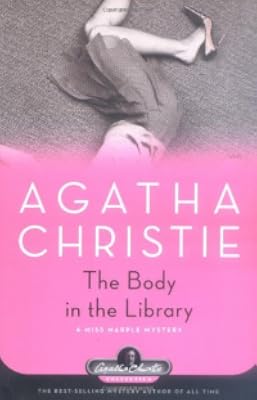
The iconic Miss Marple must investigate the case of a girl found dead in Agatha Christie's classic mystery, The Body in the Library.It's seven in the morning. The Bantrys wake to find the body of a young woman in their library. She is wearing an evening dress and heavy makeup, which is now smeared across her cheeks. But who is she? How did she get there? And what is the connection with another dead girl, whose charred remains are later discovered in an abandoned quarry?
The respectable show more Bantrys invite Miss Marple into their home to investigate. Amid rumors of scandal, she baits a clever trap to catch a ruthless killer.
. show less
Tags
Recommendations












Member Reviews
Written seventy-eight years ago, this book still feels modern and fresh.
It's brimming with energy, humour, and sharp observations and has a twisty plot that kept me guessing right to the end.
'The Body In The Library' was published in 1942 but it feels fresh, light and modern. It has a clever plot that I didn't even begin to guess the truth of but which didn't feel at all like a cheat.
I was pleased to see that the police were shown to be quite competent and did most of the leg work. This made the story more convincing and provided me with plenty of evidence to mull over without any chance of me figuring out what was going on. The competence of the police also served to highlight how Jane Marple's insights were and how ruthlessly she show more used them to extract information unavailable to the police by pressing the buttons of the people she interrogated.
I love that Jane Marple is driven by insight into people's wickedness, frailties, vanities and self-deceptions, with empathy coming almost as an afterthought and only then for people that she sees as innocents. I realised that I wouldn't want to meet her unless she was on my side and even then, she'd know things about me that I don't even admit to myself.
Until I read 'The Murder At The Vicarage' last September, my impressions of Jane Marple came entirely from adaptations of the novels for television. Now that I'm encountering the original text, I wonder how the TV people came to have left out most of the humour. They seem to have paid more attention to the period clothes and cars than to the tone of the novel.
There is a strong undercurrent of humour in 'The Body In The Library', some of it aimed at the genre in an in-joke kind of way, but most of it aimed at the pompous, the unkind and the hypocritical.
Jane Marple has a rare understanding that while class is important, it is money that drives our most desperate actions. She is able to see well-to-do gentlefolk with disconcerting accuracy, seeing beyond the manners and the social position to the person beneath, but is also able to do the same thing with people who make their living serving the gentlefolk. This makes Jane Marple something of an outsider, a status she seems entirely comfortable with.
I think the thing I enjoyed most about the book was the humour. From the start, 'The Body In The Library' reads like a rather drole assault on the more ridiculous elements of detective fiction combined with wickedly accurate evocations of what she calls 'the ruling class of censorious spinsters'.
The whole set up of the book, the finding of the body of an unknown young woman in the library of a respectable Colonel, is positioned as so unlikely (except in detective books) that it is hard for the Colonel and his wife to accept the possibility of it being real. This takes a swipe at detective fiction (where such discoveries go unremarked) and makes the discovery a source of humour rather than horror, that sets the tone for the novel.
Christie double-down on this by having the Colonel's wife, Dolly, call Jane Marple (even though it is not yet eight o'clock in the morning) and invite her to come to the house. Dolly explains that she wants Jane to come because she knows about murders and:
'What I feel is that if one has got to have a murder actually happening in one’s house, one might as well enjoy it, if you know what I mean. That’s why I want you to come and help me find out who did it and unravel the mystery and all that. It really is rather thrilling, isn’t it?’
I thought this was fun but also a reality check we readers of mysteries who emphasise the puzzle of finding the murderer over the brutal death of the person murdered.
When Christie moves on to show how the village gossip network functions, she doesn't miss an opportunity to deride the unconscious entitéement of the gossipers. I particularly liked this description:
‘What news?’ demanded Miss Hartnell. She had a deep bass voice and visited the poor indefatigably, however hard they tried to avoid her ministrations.
I used Poirot as my jumping-off point for reading Christie. Now I wish I'd started with Jane Marple. I think Christie likes Jane whereas she only tolerates Poirot. There are exceptions of course. 'The Murder Of Roger Ackroyd' is pretty hard to beat. show less
It's brimming with energy, humour, and sharp observations and has a twisty plot that kept me guessing right to the end.
'The Body In The Library' was published in 1942 but it feels fresh, light and modern. It has a clever plot that I didn't even begin to guess the truth of but which didn't feel at all like a cheat.
I was pleased to see that the police were shown to be quite competent and did most of the leg work. This made the story more convincing and provided me with plenty of evidence to mull over without any chance of me figuring out what was going on. The competence of the police also served to highlight how Jane Marple's insights were and how ruthlessly she show more used them to extract information unavailable to the police by pressing the buttons of the people she interrogated.
I love that Jane Marple is driven by insight into people's wickedness, frailties, vanities and self-deceptions, with empathy coming almost as an afterthought and only then for people that she sees as innocents. I realised that I wouldn't want to meet her unless she was on my side and even then, she'd know things about me that I don't even admit to myself.
Until I read 'The Murder At The Vicarage' last September, my impressions of Jane Marple came entirely from adaptations of the novels for television. Now that I'm encountering the original text, I wonder how the TV people came to have left out most of the humour. They seem to have paid more attention to the period clothes and cars than to the tone of the novel.
There is a strong undercurrent of humour in 'The Body In The Library', some of it aimed at the genre in an in-joke kind of way, but most of it aimed at the pompous, the unkind and the hypocritical.
Jane Marple has a rare understanding that while class is important, it is money that drives our most desperate actions. She is able to see well-to-do gentlefolk with disconcerting accuracy, seeing beyond the manners and the social position to the person beneath, but is also able to do the same thing with people who make their living serving the gentlefolk. This makes Jane Marple something of an outsider, a status she seems entirely comfortable with.
I think the thing I enjoyed most about the book was the humour. From the start, 'The Body In The Library' reads like a rather drole assault on the more ridiculous elements of detective fiction combined with wickedly accurate evocations of what she calls 'the ruling class of censorious spinsters'.
The whole set up of the book, the finding of the body of an unknown young woman in the library of a respectable Colonel, is positioned as so unlikely (except in detective books) that it is hard for the Colonel and his wife to accept the possibility of it being real. This takes a swipe at detective fiction (where such discoveries go unremarked) and makes the discovery a source of humour rather than horror, that sets the tone for the novel.
Christie double-down on this by having the Colonel's wife, Dolly, call Jane Marple (even though it is not yet eight o'clock in the morning) and invite her to come to the house. Dolly explains that she wants Jane to come because she knows about murders and:
'What I feel is that if one has got to have a murder actually happening in one’s house, one might as well enjoy it, if you know what I mean. That’s why I want you to come and help me find out who did it and unravel the mystery and all that. It really is rather thrilling, isn’t it?’
I thought this was fun but also a reality check we readers of mysteries who emphasise the puzzle of finding the murderer over the brutal death of the person murdered.
When Christie moves on to show how the village gossip network functions, she doesn't miss an opportunity to deride the unconscious entitéement of the gossipers. I particularly liked this description:
‘What news?’ demanded Miss Hartnell. She had a deep bass voice and visited the poor indefatigably, however hard they tried to avoid her ministrations.
I used Poirot as my jumping-off point for reading Christie. Now I wish I'd started with Jane Marple. I think Christie likes Jane whereas she only tolerates Poirot. There are exceptions of course. 'The Murder Of Roger Ackroyd' is pretty hard to beat. show less
This was my first time reading Agatha Christie. I found her characters surprisingly funny and interesting and the plotting, of course, drove the book. Incredible, how well those two dynamics inspire voracious reading: plot and character. Christie has no obvious thematic interests. There is no analysis of the human condition here, nor any theoretical concerns relating to language, meaning, or metaphysical identity (at least not in this book). Yet her ability to craft a compelling, mathematical proof of plotting is masterful. I can see why so many readers have read so much of her work. I'll soon count myself among them.
When reading a book that starts with a retired English Colonel and his wife, and is set in a quaint English village, the last words you expect the Colonel’s wife to say to one of her friends are, “But you’re so good at bodies!” and “If one has got to have a murder in one’s house, one might as well enjoy it.” But of course, if that book is The Body In The Library by Agatha Christie and features Miss Jane Marple, those are words to expect and relish.
In her usual stylish way, Agatha Christie lays a course of false leads amongst the truth behind the murder of two young women. And in her usual way, Miss Marple quietly observes and with her unique understanding of human nature, manages to put the puzzle together. By the end of show more the book, the murderer is revealed and all is well again.
A lovely murder mystery to curl up with, also as usual, I recommend Agatha Christie’s The Body In The Library. show less
In her usual stylish way, Agatha Christie lays a course of false leads amongst the truth behind the murder of two young women. And in her usual way, Miss Marple quietly observes and with her unique understanding of human nature, manages to put the puzzle together. By the end of show more the book, the murderer is revealed and all is well again.
A lovely murder mystery to curl up with, also as usual, I recommend Agatha Christie’s The Body In The Library. show less
Not as good (or as funny, and I think that is mostly what is missing) as [b:Murder at the Vicarage|16331|Murder at the Vicarage (Miss Marple, #1)|Agatha Christie|https://i.gr-assets.com/images/S/compressed.photo.goodreads.com/books/1388386575l/16331._SX50_.jpg|2589654]; enjoyable all the same.
I love that this elderly woman is dismissed routinely (at one point one of the suspects actually says to her, "Be quiet, you old hag"). I love that Christie allows her title character to be referred to as an "old hag" with no ensuing bitterness or self-doubt. I especially love that Miss Marple solves the crimes based almost exclusively on the life experience she has gained, by virtue of living long enough to become an old hag.
Truly if this is what show more old hagness looks like then I can hardly wait to become one myself. show less
I love that this elderly woman is dismissed routinely (at one point one of the suspects actually says to her, "Be quiet, you old hag"). I love that Christie allows her title character to be referred to as an "old hag" with no ensuing bitterness or self-doubt. I especially love that Miss Marple solves the crimes based almost exclusively on the life experience she has gained, by virtue of living long enough to become an old hag.
Truly if this is what show more old hagness looks like then I can hardly wait to become one myself. show less
We purchased some Penguin book cover postcards, and I'm trying to read the related books before I send out the cards, and this was one of them. Having never before read Agatha Christie, I found it quite an enjoyable journey with this cast of characters. I applaud her for taking on "the body in the library" scenario head-on, (though I found the way the body ended up there was disappointingly unrealistic to me). And I appreciated the confidence that allowed her to make Miss Marple something of a supporting actor in the drama. Don't know that I'll be searching out more Christie, but then again...what exactly did happen on that Orient Express?
This was my first time reading Agatha Christie. I found her characters surprisingly funny and interesting and the plotting, of course, drove the book. Incredible, how well those two dynamics inspire voracious reading: plot and character. Christie has no obvious thematic interests. There is no analysis of the human condition here, nor any theoretical concerns relating to language, meaning, or metaphysical identity (at least not in this book). Yet her ability to craft a compelling, mathematical proof of plotting is masterful. I can see why so many readers have read so much of her work. I'll soon count myself among them.
When the body of an unknown young blonde woman is found in the library of Gossington Hall both Colonel and Mrs. Bantry are completely baffled about how she came to be there. While the police do their investiagtions, Mrs. Bantry solicits the help of Miss Marple to determine just who did commit the murder. The case will bring them to a seaside resort and to the old friend of the Bantrys, Mr. Jefferson, whose complicated relationships may just be at the heart of the matter.
Agatha Christie always hits the spot for me and this one was no exception. Miss Marple's detecting skills are top notch as ever, the mystery is well crafted, and I'm always a sucker for any book that involves a library of any kind. I appreciated that this book used the show more limited omniscient viewpoint which allowed for the plot to follow multiple characters at once and, of course, leave Miss Marple's conclusions hidden from the reader until the very end. Again, I always enjoy the humour Christie uses in her novels. I particularly got great glee from one of the characters, an afficionado of detective novels, mentioning he had autographs from several mystery writers including Dorothy Sayers and Agatha Christie. An excellent Marple mystery and just great fun all around. show less
Agatha Christie always hits the spot for me and this one was no exception. Miss Marple's detecting skills are top notch as ever, the mystery is well crafted, and I'm always a sucker for any book that involves a library of any kind. I appreciated that this book used the show more limited omniscient viewpoint which allowed for the plot to follow multiple characters at once and, of course, leave Miss Marple's conclusions hidden from the reader until the very end. Again, I always enjoy the humour Christie uses in her novels. I particularly got great glee from one of the characters, an afficionado of detective novels, mentioning he had autographs from several mystery writers including Dorothy Sayers and Agatha Christie. An excellent Marple mystery and just great fun all around. show less
Members
- Recently Added By
Lists

Read the book and saw the movie
1,170 works; 195 members

Crime and Mysteries to Read
746 works; 31 members

British Mystery
469 works; 14 members

Agatha Christie Miss Marple
12 works; 1 member

Books About Murder
313 works; 7 members

Book-Themed Mysteries
21 works; 5 members

Female Protagonist
1,056 works; 57 members

Detective Stories
343 works; 5 members

Teresa's favorite mystery series and authors
55 works; 2 members

Favorite Books from the 1940s
38 works; 3 members
Female Author
1,234 works; 66 members

TBR
77 works; 1 member

Cozy Mysteries Book Club
12 works; 1 member

Books Read in 2023
5,638 works; 147 members

Books Read in 2010
631 works; 11 members

Books Read in 2022
5,226 works; 115 members

Books Read in 2018
4,360 works; 110 members

Books on my Kindle
162 works; 3 members

Books Read in 2017
4,249 works; 129 members

Books Read in 2015
3,299 works; 129 members

Agatha Christie Chronology
93 works; 1 member
Author Information

2,183+ Works 441,770 Members
One of the most successful and beloved writer of mystery stories, Agatha Mary Clarissa Christie was born in 1890 in Torquay, County Devon, England. She wrote her first novel, The Mysterious Affair at Styles, in 1920, launching a literary career that spanned decades. In her lifetime, she authored 79 crime novels and a short story collection, 19 show more plays, and six novels written under the name of Mary Westmacott. Her books have sold over a billion copies in the English language with another billion in 44 foreign languages. Some of her most famous titles include Murder on the Orient Express, Mystery of the Blue Train, And Then There Were None, 13 at Dinner and The Sittaford Mystery. Noted for clever and surprising twists of plot, many of Christie's mysteries feature two unconventional fictional detectives named Hercule Poirot and Miss Jane Marple. Poirot, in particular, plays the hero of many of her works, including the classic, The Murder of Roger Ackroyd (1926), and Curtain (1975), one of her last works in which the famed detective dies. Over the years, her travels took her to the Middle East where she met noted English archaeologist Sir Max Mallowan. They married in 1930. Christie accompanied Mallowan on annual expeditions to Iraq and Syria, which served as material for Murder in Mesopotamia (1930), Death on the Nile (1937), and Appointment with Death (1938). Christie's credits also include the plays, The Mousetrap and Witness for the Prosecution (1953; film 1957). Christie received the New York Drama Critics' Circle Award for 1954-1955 for Witness. She was also named Dame Commander of the Order of the British Empire in 1971. Christie died in 1976. (Bowker Author Biography) show less
Some Editions
Series

Belongs to Publisher Series
Work Relationships
Is contained in
Five Complete Miss Marple Novels: The Body in the Library, A Caribbean Mystery, The Mirror Crack'd, Nemesis, What Mrs. McGillicuddy Saw! by Agatha Christie
A Miss Marple Quartet: The Body in the Library, A Pocket Full of Rye, A Murder Is Announced, The Moving Finger by Agatha Christie
Starring Miss Marple = The Invincible Miss Marple: A Murder is Announced, The Body in the Library, Murder with Mirrors by Agatha Christie
Agatha Christie Crime Collection: The Body in the Library, Hercule Poirot's Christmas, Peril at End House by Agatha Christie
Miss Marple Novels: The Murder at the Vicarage / The Body in the Library / A Pocket Full of Rye / Sleeping Murder by Agatha Christie
The Best of Miss Marple Boxed Set (The Body in the Library/Nemesis/Murder with Mirrors/The Mirror Crack'd) by Agatha Christie
The Body in the Library | Three Act Tragedy | Murder in the Mews and Other Stories by Agatha Christie
Poirot Investigates & The Body in the Library: Two Best-Selling Agatha Christie Novels in One Great Audiobook by Agatha Christie
The Body in the Library / The Secret of Chimneys / Evil Under the Sun / Sparkling Cyanide by Agatha Christie
Has the adaptation
Common Knowledge
- Canonical title
- The Body in the Library
- Original title
- The Body in the Library
- Original publication date
- 1942-02-01
- People/Characters
- Jane Marple; Arthur Bantry (Colonel); Dolly Bantry; Josephine Turner; Conway Jefferson; Adelaide Jefferson (show all 20); Mark Gaskell; Ruby Keene; Sir Henry Clithering; Superintendent Harper; Inspector Slack; Raymond Starr; Basil Blake; Dinah Lee; Hugh Maclean; Peter Carmody; Colonel Melchett; Constable Palk; Pamela Reeves; Griselda Clement
- Important places
- St. Mary Mead, England, UK; Gossington Hall, St. Mary Mead, England, UK; Danemouth, England, UK
- Related movies
- The Body in the Library (1984 | IMDb); Marple: The Body in the Library (2004 | IMDb)
- Dedication
- To My Friend Nan
- First words
- Mrs Bantry was dreaming.
- Last words
- (Click to show. Warning: May contain spoilers.)And Raymond returned to the ballroom.
- Original language*
- englanti
- Disambiguation notice
- This is the main work for The Body in the Library by Agatha Christie. It should not be combined with any adaptation (e.g., film version), abridgement, or larger work.
WorldCat has ISBN 9504916759 for BOTH Un cadáver en la biblioteca (Translation of The Body in the Library) AND El atroz encanto de ser argentinos by Marcos Aguinis.
*Some information comes from Common Knowledge in other languages. Click "Edit" for more information.
Classifications
Statistics
- Members
- 6,750
- Popularity
- 1,786
- Reviews
- 173
- Rating
- (3.70)
- Languages
- 27 — Bulgarian, Catalan, Chinese, Czech, Danish, Dutch, English, Finnish, French, German, Greek, Hebrew, Hungarian, Indonesian, Italian, Korean, Norwegian (Bokmål), Norwegian, Polish, Romanian, Serbian, Croatian, Slovenian, Spanish, Swedish, Turkish, Portuguese (Portugal)
- Media
- Paper, Audiobook, Ebook
- ISBNs
- 233
- UPCs
- 1
- ASINs
- 105