On This Page
Description
"In this sequel to 'The Virgin in the Garden, ' in the 1950s, Stephanie Potter, now married to a clergyman, is conflicted about her domestic life and her strivings for intellectual fulfillment; her brilliant sister Frederica eagerly embarks on her academic (and sexual) education at Cambridge University; and their troubled brother Marcus painfully tries to find friendship and love."Tags
Recommendations

















Member Recommendations


Member Reviews
The second Frederica novel picks up where the first one left off and takes us through to 1957, following Frederica through an incongruous spell as an au pair in the south of France and her undergraduate years in Cambridge, and Stephanie and Daniel through the challenges of starting a family and looking after the damaged-but-recovering Marcus as well as Daniel's elderly mother.
Frederica's story is largely rueful comedy, as she experiments intellectually, emotionally and sexually with a string of more or less unsuitable men. Meanwhile, we have a strong hint already in the Prologue that things aren't going to go well for Stephanie and Daniel, however sensible, pragmatic and resilient they are.
On the sidelines, the new University of North show more Yorkshire is launched, and Alexander is working on a new play, still in the fifties dead-end medium of verse drama, on the subject of Van Gogh's last years in Arles. This gives us the setting for the book's philosophical backbone, a long and wide-ranging discussion about how things relate to the words we use to name them and the painted images and metaphors we use to represent them, and how the human process of finding and understanding those names and images works.
Once again there's a lot about constraints on the role of women in fifties intellectual life, with social-realist detail obviously taken from Byatt's own experience both as student and as parent, and quite a bit of sharp comment on the culture of the time. Byatt is particularly hard on the boozy, macho pomposity-bashing of Kingsley Amis and the Angry Young Men — not only because of their indisputably narrow treatment of female characters, but also because they put the author in a position to declare anything he wants pompous and ridiculous, even when it's something valuable and worth preserving. That's worth bearing in mind when we look at today's funny memes!
A tighter, more claustrophobic story than The virgin in the garden, and quite tough in parts — intellectually challenging when it spins off into philosophical side-tracks, and emotionally-challenging in the Stephanie story. But never dull.
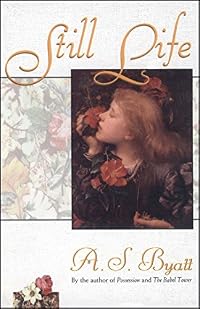
Fun to see that in 1985 Penguin were still prepared to let their cover artists have time to read the book: the Angela Barrett illustration puts characters from the story into the stage-set of Alexander's Van Gogh play (as described in the book) and plays around with some of the colour effects Byatt discusses. show less
Frederica's story is largely rueful comedy, as she experiments intellectually, emotionally and sexually with a string of more or less unsuitable men. Meanwhile, we have a strong hint already in the Prologue that things aren't going to go well for Stephanie and Daniel, however sensible, pragmatic and resilient they are.
On the sidelines, the new University of North show more Yorkshire is launched, and Alexander is working on a new play, still in the fifties dead-end medium of verse drama, on the subject of Van Gogh's last years in Arles. This gives us the setting for the book's philosophical backbone, a long and wide-ranging discussion about how things relate to the words we use to name them and the painted images and metaphors we use to represent them, and how the human process of finding and understanding those names and images works.
Once again there's a lot about constraints on the role of women in fifties intellectual life, with social-realist detail obviously taken from Byatt's own experience both as student and as parent, and quite a bit of sharp comment on the culture of the time. Byatt is particularly hard on the boozy, macho pomposity-bashing of Kingsley Amis and the Angry Young Men — not only because of their indisputably narrow treatment of female characters, but also because they put the author in a position to declare anything he wants pompous and ridiculous, even when it's something valuable and worth preserving. That's worth bearing in mind when we look at today's funny memes!
A tighter, more claustrophobic story than The virgin in the garden, and quite tough in parts — intellectually challenging when it spins off into philosophical side-tracks, and emotionally-challenging in the Stephanie story. But never dull.
Fun to see that in 1985 Penguin were still prepared to let their cover artists have time to read the book: the Angela Barrett illustration puts characters from the story into the stage-set of Alexander's Van Gogh play (as described in the book) and plays around with some of the colour effects Byatt discusses. show less
Still Life is the second novel in the quartet about Frederica Potter, now studying literature and young men at Cambridge. Reading the novel is like eating dense dark chocolate -- it needs to be savored a bit at a time. Still Life leisurely rambles through a three-year period from 1953-56 contemplating the various lives of Frederica, her siblings Stephanie and Marcus, and the playwright Alexander Wedderburn, all of whom also figured largely in the first novel, The Virgin in the Garden.
There is little plot, but life moments are examined in minute detail against the backdrop of Van Gogh's letters (Alexander is writing a play about him), heady intellectual conversations, and voluminous literary allusions. Byatt obviously designed the book show more to have the quality of a still life painting, meant to be contemplated and studied. And hidden among the subjects is the memento mori -- embodied by a cataclysmic accident at the end of the book.
It took me a chapter or two to get into the book -- its pace is so different from The Virgin in the Garden which hurls headlong through one hectic summer -- but I found it genuinely rewarding. show less
There is little plot, but life moments are examined in minute detail against the backdrop of Van Gogh's letters (Alexander is writing a play about him), heady intellectual conversations, and voluminous literary allusions. Byatt obviously designed the book show more to have the quality of a still life painting, meant to be contemplated and studied. And hidden among the subjects is the memento mori -- embodied by a cataclysmic accident at the end of the book.
It took me a chapter or two to get into the book -- its pace is so different from The Virgin in the Garden which hurls headlong through one hectic summer -- but I found it genuinely rewarding. show less
Ever since reading 'The Children's Book' by A. S. Byatt I've loved her writing. A month or so go I found one of hers in a thrift shop, and I could not wait to read it.
'Still Life' is part of the story of Frederica Potter (the second book of four). It describes a couple of years in the life of Frederica, Stephanie and Marcus, siblings in the fifties in England. Stephanie is married to Daniel, and expecting her first child. Frederica is starting her university years in Cambridge after six months in France as an au pair. Marcus is troubled, and for now, living with Stephanie and Daniel because he can't stand living at home anymore.
The book just meanders on, describing what happens (in beautiful language, like expected from Byatt) without show more really a main purpose to the story. In between the lives of the Potters and those around them we also get Vincent van Gogh and his struggles in life, as well as those of other artists, living (and part of the story) or dead. It is hard for me to say what I think about the story. I loved the language, the flow, the descriptions and the philosophy. I have no idea what the purpose was, but that doesn't bother me as much as I would have thought. It was just a lovely glimpse into the lives of many people in England, in the fifties, in all stages of life. Four out of five stars. show less
'Still Life' is part of the story of Frederica Potter (the second book of four). It describes a couple of years in the life of Frederica, Stephanie and Marcus, siblings in the fifties in England. Stephanie is married to Daniel, and expecting her first child. Frederica is starting her university years in Cambridge after six months in France as an au pair. Marcus is troubled, and for now, living with Stephanie and Daniel because he can't stand living at home anymore.
The book just meanders on, describing what happens (in beautiful language, like expected from Byatt) without show more really a main purpose to the story. In between the lives of the Potters and those around them we also get Vincent van Gogh and his struggles in life, as well as those of other artists, living (and part of the story) or dead. It is hard for me to say what I think about the story. I loved the language, the flow, the descriptions and the philosophy. I have no idea what the purpose was, but that doesn't bother me as much as I would have thought. It was just a lovely glimpse into the lives of many people in England, in the fifties, in all stages of life. Four out of five stars. show less
Brilliant.
I have to say, I'm still befuddled by people who don't like to read or think about books about people who like to read books and think.
Watch for Byatt's own intrusions to remark on her craft, Alexander Wedderburn's meditations on the phrase 'Still Life,' Frederica and Marcus and Byatt wondering at various points, and often together, about the nature of metaphor.
A perfect gift for expectant mothers.
I have to say, I'm still befuddled by people who don't like to read or think about books about people who like to read books and think.
Watch for Byatt's own intrusions to remark on her craft, Alexander Wedderburn's meditations on the phrase 'Still Life,' Frederica and Marcus and Byatt wondering at various points, and often together, about the nature of metaphor.
A perfect gift for expectant mothers.
This was a strange book. Nowhere near as brilliant as Possession, but interesting in its own right. I enjoyed the descriptions of human experience. Every now and then I came across something I hadn't ever heard described so well. Also, every now and then the author spoke up and talked about what she was trying to do with her book and what was and wasn't working, which was extremely weird. I don't like books written with some kind of gimmick or experimental approach, and I felt like this one completely fell flat at the end. All the same, I thin A. S. Byatt is a fine reader and I really enjoyed the book for its intellectual and artistic depth.
While certainly taking my time with the series, I am impressed w/ Byatt's study of a scholar as a young woman, her family, and the shadowed idea of England in the 1950s. There is a measure of Iris Murdoch at play. Byatt knows that, knows that we know.
One of my favorite books of all time. A rich exploration of family and many many other things, intricately interwoven into the story e.g. like Van Gogh in Arles and his letters to Theo, or evolutionary biology and science. If you're confused by Prologue (only about 6 pages) set in the 80s, DO NOT WORRY ABOUT IT! Just skip it completely and read the rest of the book. It will make sense later.
Members
- Recently Added By
Published Reviews
Still life extends its scene to France, Cambridge University, and London, with the devising of a play about Van Gogh as one major theme, involving consideration of his—and all—art. The weight, length, seriousness and complexity of these novels made them fit works for indexing.
added by KayCliff
Lists

Art of Reading
188 works; 5 members
Author Information

83+ Works 38,215 Members
A.S. Byatt was born on August 24, 1936 in Sheffield, England. She received a B.A. from Newnham College, Cambridge in 1957, did graduate study at Bryn Mawr College from 1957-58, and attended Somerville College, Oxford from 1958-59. She was a staff member in the extra-mural department at the University of London from 1962-71. From 1968-69, she was show more also a part-time lecturer in the liberal studies department of the Central School of Art and Design, London. She was a lecturer at University College from 1972-80 and then senior lecturer from 1981-83. She became a full-time writer in 1983. Her works include The Biographer's Tale, The Virgin in the Garden, Babel Tower, A Whistling Woman, and The Children's Book. She also wrote numerous collections of short stories including Sugar and Other Stories, The Matisse Stories, The Djinn in the Nightingale's Eye, Elementals, and Little Black Book of Stories. Byatt received the English Speaking Union fellowship in 1957-58, the Fellow of the Royal Society of Literature in 1983, the Silver Pen Award for Still Life, and the Booker Prize for Possession: A Romance in 1990. (Bowker Author Biography) show less
Some Editions
Awards and Honors
Awards
Series

Work Relationships
Is contained in
Common Knowledge
- Canonical title
- Still Life
- Original title
- Still Life
- Original publication date
- 1985
- People/Characters
- Frederica Potter
- Important places
- England, UK
- Epigraph
- "Such," he said, "O King, seems to me the present life of men on earth, in comparison with that time which to us is uncertain, as if when on a winter's night you sit feasting with your ealdormen and thegns--a single sparrow s... (show all)hould fly swiftly into the hall, and coming in at one door, fly out through another. Soon, from winter going back into winter, it is lost to your eyes."
- Dedication
- For Jenny Flowerdew
May 4, 1936 - October 11, 1978 - First words
- It was written over the entrance, gold letters on purple gloss on red brick.
- Quotations
- There is something both gratifying and humiliating in watching a man who has taken you for a routinely silly woman begin to take you seriously.
"I suffer from having to use a limited vocabulary. All the time. How big do you suppose the average used vocabulary is? 1,000 words? 2,000? William [her two-year-old son] can't know that many and Mary even fewer. And the peop... (show all)le I see in the shops and most of the people in this parish wouldn't understand the words I really care about if I were suddenly to say them, right out, out of the blue. So the words become ghosts. They haunt me. ... We learn to think and can't use our thinking words ... like discourse. Discourse of reason. Sophistical. Ideal -- in a Platonic sense. Catalyst. Anacoluthon. Mendacious. Realism. The worst things are the words that do have meaning in the tiny vocabulary I do use, like real and ideal, words that lose half their associations."
The decorum of the novel, on the whole, requires that time not be given to grief. ... One of the many unpleasant aspects of grief is the need to feel responsible or guilty.
The germ of this novel was a fact which was also a metaphor: a young woman, with a child, looking at a tray of earth in which unthinned seedlings on etiolated pale stalks died in the struggle for survival ... Nasturtium, Gian... (show all)t Climbing, mixed'.
Clever Gillian commented that the word desolate was the centre of the poem, almost allowing one to be taken out of it, like the word forlorn in the *Nightingale*. - Last words
- (Click to show. Warning: May contain spoilers.)Daniel was twisting something in his fingers. It was the dog-collar.
"Thanks." - Blurbers
- Morrison, Toni; Burgess, Anthony; Murdoch, Iris
Classifications
Statistics
- Members
- 1,512
- Popularity
- 15,170
- Reviews
- 13
- Rating
- (3.89)
- Languages
- 7 — Danish, English, French, German, Italian, Norwegian (Bokmål), Spanish
- Media
- Paper, Audiobook, Ebook
- ISBNs
- 24
- ASINs
- 11