On This Page
Description
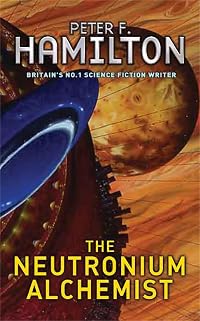
The ancient menace has finally escaped from Lalonde, shattering the Confederation's peaceful existence. Those who succumbed to it have acquired godlike powers but now follow a far-from-divine gospel as they advance inexorably from world to world. On planets and asteroids, individuals battle for survival against the strange and brutal forces unleashed upon the universe. Governments teeter on the brink of anarchy, the Confederation Navy is dangerously over-stretched, and a dark messiah show more prepares to invoke his own version of the final Night. In such desperate times the last thing the galaxy needs is a new and terrifyingly powerful weapon. Yet Dr. Alkad Mzu is determined to retrieve the Alchemist so that she can complete her thirty-year-old vendetta to slay a star. This means that Joshua Calvert has to find Dr. Mzu and bring her back before the Alchemist can be reactivated. But he's not alone in the chase, and there are people on both sides who have their own ideas about how to use the ultimate doomsday device. show lessTags
Recommendations




Member Reviews
I could just repeat my review of the first book of the series. I really like the story and the grand ideas, but it could easily been written in two thirds of the volume. I know that's not generally the point of space opera but it seems like a waste to "get through" one third of the book just to get to "the good part". Nevertheless, I will be reading the third installment of the series because this world and this story are just too interesting to quit. I'll give my brain some rest first though...
Hamilton, Peter F. The Neutronium Alchemist. 1997. Night’s Dawn No. 2. Warner, 2000.
About eight years after Dan Simmons wrote a monumental space opera series in which he resurrected John Keats, Peter F. Hamilton wrote an equally impressive, albeit much less literary, series in which he resurrects the like of Fletcher Christian, Al Capone, and Elvis. On a distant planet some aliens manage to lock open the gate to a pocket universe, allowing the sensation-deprived dead to take over the bodies of the living. That was all in Reality Dysfunction, the first novel. In this one, the dead are getting organized with leadership by Al Capone. Will Al conquer the galaxy? In another ring of Hamilton’s interstellar circus, a mad scientist with a show more grudge and a superweapon (the Neutronium Alchemist of the title) is looking to get even with some war criminals. Al Capone and others would also like the weapon. The action moves right along but following it all presents a considerable challenge. There are a dozen different locations with a gaggle of different characters in each one. Since many of the locations are spaceships, you cannot count on them staying in one place. There is also a lot of far-future technology, much spooky physics, and several religions and governing philosophies to get the head around. Is it worth the effort—yes, indeed! But I do have two nits to pick. Why Al Capone and not some far future gangster? Finally, can’t we find a less old-fashioned term than “datavise” for a future alternative to email? Take a deep breath. On to The Naked God to wrap up the plot. show less
About eight years after Dan Simmons wrote a monumental space opera series in which he resurrected John Keats, Peter F. Hamilton wrote an equally impressive, albeit much less literary, series in which he resurrects the like of Fletcher Christian, Al Capone, and Elvis. On a distant planet some aliens manage to lock open the gate to a pocket universe, allowing the sensation-deprived dead to take over the bodies of the living. That was all in Reality Dysfunction, the first novel. In this one, the dead are getting organized with leadership by Al Capone. Will Al conquer the galaxy? In another ring of Hamilton’s interstellar circus, a mad scientist with a show more grudge and a superweapon (the Neutronium Alchemist of the title) is looking to get even with some war criminals. Al Capone and others would also like the weapon. The action moves right along but following it all presents a considerable challenge. There are a dozen different locations with a gaggle of different characters in each one. Since many of the locations are spaceships, you cannot count on them staying in one place. There is also a lot of far-future technology, much spooky physics, and several religions and governing philosophies to get the head around. Is it worth the effort—yes, indeed! But I do have two nits to pick. Why Al Capone and not some far future gangster? Finally, can’t we find a less old-fashioned term than “datavise” for a future alternative to email? Take a deep breath. On to The Naked God to wrap up the plot. show less
Massive space opera, and only part two of a trilogy. Ranges over star systems with dizzying speed, moves the story forward, and introduces new mysteries for the final installment. My only criticism is my own fault, I left it too long before starting it, and had forgotten a lot of "The Reality Dysfunction", so I was a bit confused at times. Hamilton does not spoon feed his readers, you have to struggle to keep up with the pace. I enjoyed this challenge enormously though.
How is it even possible to review a book jammed with a future galactic civilization getting invaded by the dead of all history?
Succinctly, I suppose. ;)
... unlike the first and second books in the series, at 1000 pages for the first and just under 1,300 pages for the second and an even bigger page count for the third. Ah, well, at least the book is epic as hell. The invasion goes from one world to a vast swath of the galaxy. Just how often do we get epic space operas with living spaceships, high-tech alien races, a vast number of inhabited worlds, only to have it turn into a war of the Living versus the Dead?
With a tiny alteration, of course. These aren't the dead rising up from graves. The dead are rising up out of history and out of show more purgatory, taking over the bodies of the living in a vast way. Vast numbers. And now it's almost magic versus high-tech in a very unusual war.
With Al Capone. :) And anti-matter. :) Hippies and star-busters.
Very fun. I have to admit it took me a while to get into Hamilton's writing style, but once I finally got to this proper comfort level, things really took off. :) show less
Succinctly, I suppose. ;)
... unlike the first and second books in the series, at 1000 pages for the first and just under 1,300 pages for the second and an even bigger page count for the third. Ah, well, at least the book is epic as hell. The invasion goes from one world to a vast swath of the galaxy. Just how often do we get epic space operas with living spaceships, high-tech alien races, a vast number of inhabited worlds, only to have it turn into a war of the Living versus the Dead?
With a tiny alteration, of course. These aren't the dead rising up from graves. The dead are rising up out of history and out of show more purgatory, taking over the bodies of the living in a vast way. Vast numbers. And now it's almost magic versus high-tech in a very unusual war.
With Al Capone. :) And anti-matter. :) Hippies and star-busters.
Very fun. I have to admit it took me a while to get into Hamilton's writing style, but once I finally got to this proper comfort level, things really took off. :) show less
I read the [b:The Reality Dysfunction|45245|The Reality Dysfunction (Night's Dawn, #1)|Peter F. Hamilton|https://d202m5krfqbpi5.cloudfront.net/books/1331274659s/45245.jpg|747250], the first book of the Night's Dawn Trilogy in August 2012, I just finished this second volume The Neutronium Alchemist on December 13, 2013. So more than one year has elapsed since reading the first one. With a leaky memory like mine a lot of details have fallen by the wayside during the intervening period. Going back to reread the 1000 pages of [b:The Reality Dysfunction|45245|The Reality Dysfunction (Night's Dawn, #1)|Peter F. Hamilton|https://d202m5krfqbpi5.cloudfront.net/books/1331274659s/45245.jpg|747250] is out of the question. I considered reading up show more summaries in Wikipedia or some other web sites but then I decided to throw caution to the wind and just dive into this second book and see what happen. It is a testament to [a:Peter F. Hamilton|25375|Peter F. Hamilton|https://d202m5krfqbpi5.cloudfront.net/authors/1235123752p2/25375.jpg]'s writing skill that he manages to bring me back to speed without a prologue chapter that summarize what went on in the previous book. The little details and characters’ names gradually fell into place as I read on. Funny how the brain archives these details in some dusty storage places and they come out when the memory is jogged.
As with all the Peter F. Hamilton’s books that I have read so far The Neutronium Alchemist is a long book but a quick read. His prose is always clear, his pacing is good and never grind to a halt. Most of the main characters are fairly engaging and his “Confederation Universe” is always full of wonder. The only difficulty I tend to have is the large cast of characters, there are so many minor characters that I find it impossible to remember who they all are and whose side they are on. There is, however, a “Cast of Characters” appendix at the end of the book if you don’t mind jumping back and forth to that as you read. I personally could not be bothered so I just figure them out from the context of the chapters.
The Neutronium Alchemist of course continues where [b:The Reality Dysfunction|45245|The Reality Dysfunction (Night's Dawn, #1)|Peter F. Hamilton|https://d202m5krfqbpi5.cloudfront.net/books/1331274659s/45245.jpg|747250] left off. In the first book we are introduced to the Confederation Universe and what happen when the souls of the dead start coming back to possess the living. Obviously that doesn’t sound very sci-fi, more like some ridiculous “exorcist in space” silliness you may get in an episode of Family Guy, but leave it to Hamilton to come up with some pseudo-science to make the concept somewhat believable within a sci-fi setting*. The major difference between this second volume and the previous one is that the return of the dead through possession is now and an established fact and the readers are spared the dull process of each character being skeptical to begin with until their jaws drop when the dead come calling. The struggle between the living and the dead was too uneven in the first book, in this one at least the living have found some way of coping but not defeating the enemy.
Characterization is also much more interesting in this book as many chapters are told from the possessed characters’ point of view, some of whom are even decent people. The usage of historical characters like Al Capone and Fletcher Christian as major characters also piles on the fun. Hamilton’s plotting skills is second to none, I cannot imagine how he manages to juggle all the numerous plot strands and gradually weave them into a cohesive story. He also has a great eye for minutiae, like this little scene from a possessed character’s view point: “Once he’d actually thrown up after transforming sachets of bread into chocolate gateau – he hadn't removed the foil wrapping first.”
The Neutronium Alchemist, like [b:The Reality Dysfunction|45245|The Reality Dysfunction (Night's Dawn, #1)|Peter F. Hamilton|https://d202m5krfqbpi5.cloudfront.net/books/1331274659s/45245.jpg|747250] before it, is not a book to read for edification. It is just a fun romp. A book this length is bound to have themes you can glean from but why not just give yourself a well-earned break and just kick back and enjoy.
The final volume [b:The Naked God|45260|The Naked God (Night's Dawn, #3)|Peter F. Hamilton|https://d202m5krfqbpi5.cloudfront.net/books/1316548289s/45260.jpg|1396625] is just as long as The Neutronium Alchemist. Damn you Peter F!
__________________________________
*There is a good discussion of whether The Night Dawn Trilogy is science fiction or science fantasy here
Note: I intended to mention the phrase “massive epic space opera” somewhere in the review, but I can’t find a place to shoehorn it in so I’ll just stick it here. show less
As with all the Peter F. Hamilton’s books that I have read so far The Neutronium Alchemist is a long book but a quick read. His prose is always clear, his pacing is good and never grind to a halt. Most of the main characters are fairly engaging and his “Confederation Universe” is always full of wonder. The only difficulty I tend to have is the large cast of characters, there are so many minor characters that I find it impossible to remember who they all are and whose side they are on. There is, however, a “Cast of Characters” appendix at the end of the book if you don’t mind jumping back and forth to that as you read. I personally could not be bothered so I just figure them out from the context of the chapters.
The Neutronium Alchemist of course continues where [b:The Reality Dysfunction|45245|The Reality Dysfunction (Night's Dawn, #1)|Peter F. Hamilton|https://d202m5krfqbpi5.cloudfront.net/books/1331274659s/45245.jpg|747250] left off. In the first book we are introduced to the Confederation Universe and what happen when the souls of the dead start coming back to possess the living. Obviously that doesn’t sound very sci-fi, more like some ridiculous “exorcist in space” silliness you may get in an episode of Family Guy, but leave it to Hamilton to come up with some pseudo-science to make the concept somewhat believable within a sci-fi setting*. The major difference between this second volume and the previous one is that the return of the dead through possession is now and an established fact and the readers are spared the dull process of each character being skeptical to begin with until their jaws drop when the dead come calling. The struggle between the living and the dead was too uneven in the first book, in this one at least the living have found some way of coping but not defeating the enemy.
Characterization is also much more interesting in this book as many chapters are told from the possessed characters’ point of view, some of whom are even decent people. The usage of historical characters like Al Capone and Fletcher Christian as major characters also piles on the fun. Hamilton’s plotting skills is second to none, I cannot imagine how he manages to juggle all the numerous plot strands and gradually weave them into a cohesive story. He also has a great eye for minutiae, like this little scene from a possessed character’s view point: “Once he’d actually thrown up after transforming sachets of bread into chocolate gateau – he hadn't removed the foil wrapping first.”
The Neutronium Alchemist, like [b:The Reality Dysfunction|45245|The Reality Dysfunction (Night's Dawn, #1)|Peter F. Hamilton|https://d202m5krfqbpi5.cloudfront.net/books/1331274659s/45245.jpg|747250] before it, is not a book to read for edification. It is just a fun romp. A book this length is bound to have themes you can glean from but why not just give yourself a well-earned break and just kick back and enjoy.
The final volume [b:The Naked God|45260|The Naked God (Night's Dawn, #3)|Peter F. Hamilton|https://d202m5krfqbpi5.cloudfront.net/books/1316548289s/45260.jpg|1396625] is just as long as The Neutronium Alchemist. Damn you Peter F!
__________________________________
*There is a good discussion of whether The Night Dawn Trilogy is science fiction or science fantasy here
Note: I intended to mention the phrase “massive epic space opera” somewhere in the review, but I can’t find a place to shoehorn it in so I’ll just stick it here. show less
I think I'm going to have to do a more thorough review later. At this point, I'm just going to focus on mechanics.
I like this book. And this series. Honestly, I do. However, I'm at the point where I really think that the whole Night's Dawn series was actually written as one big tome of an epic, and the publishers decided to break it into three (or six, as you decided to buy them) novels just for the sake of the spine. And geez, what a doorstopper a 3500 page book would be anyway. There are just limits.
But, when we hit the last chapter of The Neutronium Alchemist, I really didn't feel like we were building toward a climax. Nothing heart-wrenching, no amazing clincher that wraps the book up, not even a real cliffhanger to make people want show more to read the next one. There were a couple of mysteries, but not really a "OH HOLY CRAP WHAT THE HECK'S HAPPENING" sort of thing. And starting the next book, the first chapter felt like it was just the next chapter of the previous book.
I think that's the thing that's getting me the most, besides the outrageous number of POVs and locations. It's really taking a wiki for me to get through this without losing track of who's where and doing what. And the plot feels like it's ramping up at a steady pace, and in such a way that it feels more real to me than a typical epic. I feel like I could be reading a tome about WWII at this point, although I think an author would have selected fewer POVs for an actual history book to avoid confusing his reader.
I'm finding the meat of the series interesting in and of themselves; we don't often deal with religions in science fiction that are not utterly imaginary, unless it's a Christian Sci-Fi novel, which I steer clear of. Hamilton definitely handles it with the care of a historian -- no proselytizing, just reflecting the different beliefs of the systems and cultures he's working with. It's interesting, and something I'd like to write a review or an essay specifically addressing, but one that will take some significant research and thought on its own. I'm still curious about the implications of Father Horst's abilities, but it was mentioned in the first book and then never again.
As it stands, I'm continuing on in the slog. Not because it's particularly sloggy, as it t'were, but because the world building really is intricate and extensive. Not an easy series to read by any means, but if you're really looking for something TRULY EPIC in its story, this is definitely what to go for. show less
I like this book. And this series. Honestly, I do. However, I'm at the point where I really think that the whole Night's Dawn series was actually written as one big tome of an epic, and the publishers decided to break it into three (or six, as you decided to buy them) novels just for the sake of the spine. And geez, what a doorstopper a 3500 page book would be anyway. There are just limits.
But, when we hit the last chapter of The Neutronium Alchemist, I really didn't feel like we were building toward a climax. Nothing heart-wrenching, no amazing clincher that wraps the book up, not even a real cliffhanger to make people want show more to read the next one. There were a couple of mysteries, but not really a "OH HOLY CRAP WHAT THE HECK'S HAPPENING" sort of thing. And starting the next book, the first chapter felt like it was just the next chapter of the previous book.
I think that's the thing that's getting me the most, besides the outrageous number of POVs and locations. It's really taking a wiki for me to get through this without losing track of who's where and doing what. And the plot feels like it's ramping up at a steady pace, and in such a way that it feels more real to me than a typical epic. I feel like I could be reading a tome about WWII at this point, although I think an author would have selected fewer POVs for an actual history book to avoid confusing his reader.
I'm finding the meat of the series interesting in and of themselves; we don't often deal with religions in science fiction that are not utterly imaginary, unless it's a Christian Sci-Fi novel, which I steer clear of. Hamilton definitely handles it with the care of a historian -- no proselytizing, just reflecting the different beliefs of the systems and cultures he's working with. It's interesting, and something I'd like to write a review or an essay specifically addressing, but one that will take some significant research and thought on its own. I'm still curious about the implications of Father Horst's abilities, but it was mentioned in the first book and then never again.
As it stands, I'm continuing on in the slog. Not because it's particularly sloggy, as it t'were, but because the world building really is intricate and extensive. Not an easy series to read by any means, but if you're really looking for something TRULY EPIC in its story, this is definitely what to go for. show less
Enjoyed this novel - a grand sweeping space opera - a great deal. As volume 2 in a series, the story was off to a great start and kept going. In book 1 of the series, I was a bit overwhelmed by the sheer number of characters constantly being introduced. In this book, there are still new characters but it slowed down a bit and we got to explore more the characters a bit more deeply.
Enjoying Hamilton's descriptions of space ships, space stations, Edenist habitats around gas giants and more. I'm also enjoying the hard SF elements like having acceleration couches on spaceships (so you don't get injured by acceleration), the impact of maintenance on advanced technology (i.e. systems breaking down over time when neglected vs being well show more maintained) and more.
I'm looking forward to starting the third and final volume of the series soon! show less
Enjoying Hamilton's descriptions of space ships, space stations, Edenist habitats around gas giants and more. I'm also enjoying the hard SF elements like having acceleration couches on spaceships (so you don't get injured by acceleration), the impact of maintenance on advanced technology (i.e. systems breaking down over time when neglected vs being well show more maintained) and more.
I'm looking forward to starting the third and final volume of the series soon! show less
Members
- Recently Added By
Lists

TED 2013 Summer Reading List
190 works; 13 members
Author Information

123+ Works 42,631 Members
Peter F. Hamilton was born in Rutland, England on March 2, 1960. He started writing in 1987 and sold his first short story to Fear magazine in 1988. His first novel, Mindstar Rising, was published in 1993. His other works include the Night's Dawn series; Fallen Dragon; and the Void series. (Bowker Author Biography)
Some Editions
Series

Belongs to Publisher Series
Science Fiction Book Club (14217)
Work Relationships
Is contained in
Contains
Has as a reference guide/companion
Common Knowledge
- Canonical title
- The Neutronium Alchemist
- Original publication date
- 1997-10-20
- People/Characters
- Louise Kavanagh
- First words
- It seemed to Louise Kavanagh as though the fearsome midsummer heat had persisted for endless, dreary weeks rather than just the four Duke-days since the last meagre shower of rain.
- Last words
- (Click to show. Warning: May contain spoilers.)"I don't know. There's no trace of it, none at all."
- Original language
- English
- Disambiguation notice
- In some areas The Neutronium Alchemist is published as two separate books, The Neutronium Alchemist: Consolidation and The Neutronium Alchemist: Conflict. Please do not combine this book with either of t... (show all)hose.
Classifications
Statistics
- Members
- 2,200
- Popularity
- 9,172
- Reviews
- 19
- Rating
- (4.05)
- Languages
- English, German, Portuguese
- Media
- Paper, Audiobook, Ebook
- ISBNs
- 22
- ASINs
- 16