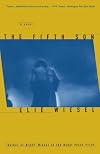
The Fifth Son
by Elie Wiesel
On This Page
Description
Fiction. Literature. Historical Fiction. HTML:Reuven Tamiroff, a Holocaust survivor, has never been able to speak about his past to his son, a young man who yearns to understand his father’s silence. As campuses burn amidst the unrest of the Sixties and his own generation rebels, the son is drawn to his father’s circle of wartime friends in search of clues to the past. Finally discovering that his brooding father has been haunted for years by his role in the murder of a brutal SS officer show more just after the war, young Tamiroff learns that the Nazi is still alive. Haunting, poetic, and very contemporary, The Fifth Son builds to an unforgettable climax as the son sets out to complete his father’s act of revenge. show lessTags
Recommendations






















Member Reviews
The title refers to the Four Sons of the Passover Haggadah: "There is, of course, a fifth son, but he does not appear in the tale because he is gone. Thus, the duty of a Jewish father is to the living. When will you finally understand, Reuven, that the dead are not part of the Haggadah?" [p. 35]
Right before this quote is a very long sentence that I liked. It seems to refer to a Midrash that when Moses, Miriam and the children of Israel celebrate after crossing the sea of reeds, in which the Egyptian soldiers died, the angels also begin to sing until God chastises them, saying that His children are drowning:
Passover eve we are recounting, chanting, the ancient tale of our ancestors' departure, a wild, exhilarating race, I am looking for show more Moses and Moses is looking for us and the Egyptian soldiers are hounding us,driving us into the sea and they are following us into the sea and it is victory and like the angels I love to sing and like the angels I am reprimanded by God one does not sing in the presence of death one does not sing of death and I say to God thank you thank you Lord for having killed our enemies thank you for having killed them yourself thank you for having spared us that task and God answers one does not say thank you in the presence of death one does not say thank you to death.
But then, Father, when does one say thank you? And to whom? [p. 34] show less
Right before this quote is a very long sentence that I liked. It seems to refer to a Midrash that when Moses, Miriam and the children of Israel celebrate after crossing the sea of reeds, in which the Egyptian soldiers died, the angels also begin to sing until God chastises them, saying that His children are drowning:
Passover eve we are recounting, chanting, the ancient tale of our ancestors' departure, a wild, exhilarating race, I am looking for show more Moses and Moses is looking for us and the Egyptian soldiers are hounding us,driving us into the sea and they are following us into the sea and it is victory and like the angels I love to sing and like the angels I am reprimanded by God one does not sing in the presence of death one does not sing of death and I say to God thank you thank you Lord for having killed our enemies thank you for having killed them yourself thank you for having spared us that task and God answers one does not say thank you in the presence of death one does not say thank you to death.
But then, Father, when does one say thank you? And to whom? [p. 34] show less
È difficile vivere per il figlio di Reuven Tamiroff, segnato dal tragico destino dei suoi: una comunità condannata a morte da un ufficiale delle SS; un padre che si è fatto silenzioso sotto il peso delle immagini che lo perseguitano; una madre che si è rifugiata nella follia; e Ariel, il fratellino scomparso nell'inferno nazista, col quale il narratore a poco a poco si identifica. Alla fine della guerra Reuven Tamiroff aveva deciso di farsi giustizia da solo. Trent'anni dopo suo figlio riparte alla caccia del carnefice miracolosamente sfuggito all'attentato. Ma la vendetta non è più sufficiente. Come potrebbe un individuo vendicare la morte di una intera comunità? E se non possiamo liberarci delle nostre ossessioni qual è il show more nostro dovere se non quello di non smettere mai di ricordare e di sperare malgrado tutto? (fonte: Giuntina) show less
May 24, 2020Italian
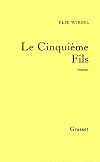
> LE CINQUIÈME FILS par Elie Wiesel Grasset
Se reporter au compte rendu de Jacqueline LÉVI-VALENSI
In: Revue Esprit No. 86 (2) (Février 1984), pp. 202-203… ; (en ligne),
URL : https://esprit.presse.fr/article/levi-valensi-jacqueline/le-cinquieme-fils-par-e...
Se reporter au compte rendu de Jacqueline LÉVI-VALENSI
In: Revue Esprit No. 86 (2) (Février 1984), pp. 202-203… ; (en ligne),
URL : https://esprit.presse.fr/article/levi-valensi-jacqueline/le-cinquieme-fils-par-e...
Oct 10, 2020 (Edited)French
Ratings
Members
- Recently Added By
Author Information

129+ Works 49,934 Members
Eliezer "Elie" Wiesel was born in Sighet, Romania on September 30, 1928. In 1944, he and his family were deported along with other Jews to the Nazi death camp Auschwitz. His mother and his younger sister died there. He loaded stones onto railway cars in a labor camp called Buna before being sent to Buchenwald, where his father died. He was show more liberated by the United States Third Army on April 11, 1945. After the war ended, he learned that his two older sisters had also survived. He was placed on a train of 400 orphans that was headed to France, where he was assigned to a home in Normandy under the care of a Jewish organization. He was educated at the Sorbonne and supported himself as a tutor, a Hebrew teacher and a translator. He started writing for the French newspaper L'Arche. In 1948, L'Arche sent him to Israel to report on that newly founded state. He also became the Paris correspondent for the daily Yediot Ahronot. In this capacity, he interviewed the novelist Francois Mauriac, who urged him to write about his war experiences. The result was La Nuit (Night). After the publication of Night, Wiesel became a writer, literary critic, and journalist. His other books include Dawn, The Accident, The Gates of the Forest, The Jews of Silence: A Personal Report on Soviet Jewry, and Twilight. He received a numerous awards and honors for his literary work including the William and Janice Epstein Fiction Award in 1965, the Jewish Heritage Award in 1966, the Prix Medicis in 1969, and the Prix Livre-International in 1980. He received the Nobel Peace Prize in 1986 for his work in combating human cruelty and in advocating justice. He had a leading role in the creation of the United States Holocaust Memorial Museum in Washington, D. C. He died on July 2, 2016 at the age of 87. (Bowker Author Biography) show less
Some Editions
Awards and Honors
Common Knowledge
- Canonical title
- The Fifth Son
- Original title
- Le cinquième fils
- Original publication date
- 1983; 1985 translation
- People/Characters
- Ariel Tamiroff; Reuven Tamiroff; Simha-the-Dark; Rachel Tamiroff; Bontchek; Lisa
- Important places
- Brooklyn, New York, New York, USA; Davarowsk
- Epigraph
- Blessed is God who gave the Torah to His people
Israel, blessed is He. The Torah speaks about four
sons: one who is wise and one who is contrary;
one who is simple and one who does not even know
ho... (show all)w to ask a question.
The Passover Haggadah - Dedication
- For Elisha
and all the other children of survivors - First words
- Was it dawn or dusk?
- Last words
- (Click to show. Warning: May contain spoilers.)A sad summing up: I have moved heaven and earth, I have risked damnation and madness by interrogating the memory of the living and the dreams of the dead in order to live the life of those who, near and far, continue to haunt me: but when, yes when, shall I finally begin to live my life, my own?
- Original language
- French
Classifications
- Genres
- General Fiction, Fiction and Literature, Historical Fiction
- DDC/MDS
- 843.914 — Literature & rhetoric French Literature French fiction 1900- 20th Century 1945-1999
- LCC
- PQ2683 .I32 .C613 — Language and Literature French, Italian, Spanish and Portuguese literatures French literature Modern literature 1961-2000
- BISAC
Statistics
- Members
- 463
- Popularity
- 65,250
- Reviews
- 3
- Rating
- (3.79)
- Languages
- 8 — Czech, Dutch, English, French, German, Italian, Norwegian (Bokmål), Swedish
- Media
- Paper, Ebook
- ISBNs
- 20
- ASINs
- 11