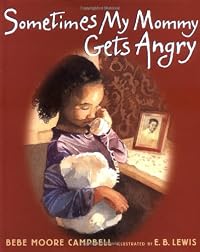
Sometimes My Mommy Gets Angry
by Bebe Moore Campbell
On This Page
Description
A little girl copes with her mother's mental illness, with the help of her grandmother and friends.Tags
Recommendations









Member Reviews
When I first read the description of this book, I was eager to read it and see how the author portrayed such a sensitive topic to young readers. Although the book shows the support system surrounding Annie, it briefly touches on her mother's mental illness which more mature readers can assume is bipolar disorder. However, it stereotypes the mental illness and includes little to no relevant information about the disease-it almost paints Annie's mother in a negative light that I did not understand. I think that the author could have done a much better job portraying mental illness in a more positive way.
This book describes the story of Annie, a young girl living with her mother who suffers from a mental illness. Although it is not directly stated, I believe Annie's mother suffers from bi-polar disorder because of her severe highs and lows. In the mornings, Annie's mother is happy and cheerful. Her and her mother eat breakfast together and her mother combs her hair as they laugh and joke. In the evenings, however, when Annie arrives home from school her mother is sad, angry and depressed. One reason I enjoyed this book was because of the realistic story line. Many children may live with a parent who suffers from a mental illness and this story lets them know they are not alone. It also provides children with coping strategies; when show more Annie's mother is not happy, she thinks happy thoughts, makes herself a snack and calls her grandma. Children who are also in these types of situations may take these coping strategies and use them to comfort themselves, just as Annie did. I also enjoyed this book because of the realistic, water-color illustrations which depict the true feelings of the characters. When Annie comes home from school, the angry, depressed look on her mothers face that is presented in the illustration may be very similar to what a child may see when dealing with a parent or loved one suffering from the same mental illness as Annie's mother. Overall, the main idea of this story is to offer children resilience by presenting different coping strategies and reassuring them that they are not at fault for their parent's illness. show less
This book is a sad reminder of what some children have to deal with on a daily basis. Annie, the little girl in this book had a grandmother and neighbors who were able to help support her and encourage her through her mother's mental illness. Unfortunately, many other children do not have that kind of support system. This book was written with empathy toward the child and the mother with the mental illness. Hopefully, it can help other children in the same predicament.
Sometimes My Mommy Gets Angry tells the story of a little girl, Annie, and her mom. Throughout the story, we see all of the changes that Annie's mom goes through. Some mornings Annie's mom is so happy that she can't stop smiling, and other mornings Annie's mom is so upset that she won't crack a smile. Annie's grandmother explain's to Annie that her momma is sick, but that it is okay because momma still loves her. This book is a perfect example of realistic fiction because of the so real topic that it discusses, and it would serve as a great introduction to mental illnesses for children who can't quite understand them yet. I throughly enjoyed reading this book, and I would recommend it for children and even adults who want to learn more show more about mental health. show less
The book, Sometimes My Mommy Gets Angry, is a very powerful story that I really enjoyed. I enjoyed this because of its meaningful subject and its suggestions for kids who are in similar situations. The book is about a child with a mother who has some sort of emotional disorder and gets angry no reason. When the child is at school the story is very lighthearted and cheery, but when she comes home the story becomes very serious. This made the book very powerful since it put you in the same emotional setting that the child is in. The story also gives some suggestions on what to do if you are in a similar situation. When the child is frightened she calls her grandmother. It is during this conversation that some suggestions are pointed out. show more They say things like, “I can go to Mr. and Mrs. Simms’ house until you come and get me,” and “I can think happy thoughts.” The main idea of this story is best summed up with a quote from the book itself, “I can’t stop the rain from falling, but I can find sunshine in my mind.” show less
This books tells of an African American girl living with a mother who is mentally ill. The The first person narrative and relaistic watercolor paintings show the child at home with her undpredicitable parent, who is manic and cheerful in the morning, then angry, depressed aand paranoid in the afternoon when the child comes home from school. When her mother yells at her, annie calls her grandmother who always assures her that it is not her fault and helps her through the evening and the difficult times. It is depicted with realistic sensitivity. The author's goal is to offer children resilience by introducing coping strategies and helping them to understand that they are not to blame for their parents' difficulties.
This is a great book for you to use to discuss mental health issues with young children. This book is in the perspective of a young girl who has a mother that has some good and bad days. The grandma is there to support Annie, but even still Annie has to do things for herself when her mother is not in her better moods.
Age- 3+
Source- Pierce College Library
Age- 3+
Source- Pierce College Library
Members
- Recently Added By
Author Information

16+ Works 2,992 Members
Bebe Moore Campbell 1950-2006 Bebe Moore Campbell (b. 1950) is an award-winning author and a journalist. In her 1989 memoir, Sweet Summer: Growing up With and Without My Dad, she recalls living in Philadelphia with her mother during the school year and spending summers with her father in North Carolina. The book has been hailed for its bittersweet show more remembrances of a dual childhood and life in the South at the merge of the social revolution of the 1960s. Her other nonfiction includes Successful Women, Angry Men: Backlash in the Two-Career Marriage (1986). She has written the novels Your Blues Ain't Like Mine (1992) and Brothers and Sisters (1994). Campbell's interest in mental health prompted here to write her first children's book, Sometimes My Mommy Gets Angry, published in September 2003. This book won the National Alliance for the Mentally Ill (NAMI) Outstanding Literature Award for 2003. It tells the story of how a little girl copes with being reared by her mentally ill mother. Ms. Campbell was a member of the National Alliance for the Mentally Ill and a founding member of NAMI-Inglewood. Her book 72 Hour Hold also deals with mental illness. Her first play, "Even with the Madness", debuted in New York in June 2003. Campbell has contributed nonfiction articles to Ms, Working Mother, Ebony, the New York Times Magazine, the Washington Post, the Los Angeles Times, Seventeen, Parents, and Glamour, and is a regular commentator for National Public Radio's Morning Edition. She earned a B.S. in Elementary Education from the University of Pittsburgh. She died from complications related to brain cancer on November 27, 2006. (Bowker Author Biography) show less
All Editions
Awards and Honors
Classifications
- Genre
- Children's Books
- DDC/MDS
- 616.89 — Applied Science & Technology Medicine & health Diseases, Allergies, Skin Conditions Nervous Disorders: Autism, Anorexia, OCD Mental disorders: bi-polar/schizophrenia
- LCC
- PZ7 .C15079 .S — Language and Literature Fiction and juvenile belles lettres Fiction and juvenile belles lettres Juvenile belles lettres
- BISAC
Statistics
- Members
- 147
- Popularity
- 222,007
- Reviews
- 51
- Rating
- (4.03)
- Languages
- English
- Media
- Paper
- ISBNs
- 6