On This Page
Description
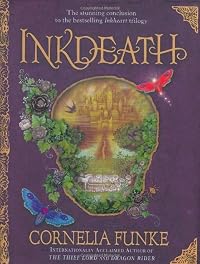
As Bluejay--Mo's fictitious double--tries to keep the Book of Immortality from unraveling, Adderhead kidnaps all the children in the kingdom, asking for Bluejay's surrender or the children will be doomed to slavery in the silver mines.Tags
Recommendations





Member Reviews
Inkdeath is a darker book than Inkheart and Inkspell. This third book and trilogy finale shifts its focus away from magic and adventure and into something more sinister. There are more villains than ever before in the Inkworld and allies are less stalwart. While the magic of Inkheart leads me to love the trilogy, it is Inkdeath that engrossed me the most.
There is not so much action in Inkdeath as there are high stakes. Of particular interest to me is Mortimer’s transformation. I saw the Inkheart film long before I read any of the books, and Mo will forever be Brendan Fraser in my mind. Watching the way that character evolves to fill the role needed of him in the Inkworld is fascinating and a bit heartbreaking (which makes it that much show more easier to relate to Meggie and Reesa). Between besting cruel rulers and saving children and having a meeting with Death, there is so much going on in Inkdeath to appeal to any reader, but it’s Mo’s descent that shines most in this novel. I have no idea if this was Funke’s intent or just my personal interpretation, but I really like it.
To be sure, this book has its flaws. It’s far too long and feels like it ambles along sometimes. Where there are so many ticking clocks and things at stake, Inkdeath‘s leisurely pace frustrated me as a reader. While Funke is not a particularly urgent writer, the pacing of the book was further agitated by the multiple POVs. Inkdeath has five main POVs – Mo, Reesa, Meggie, Fengolia, and Orpheus. Meggie and Mo still hold the spotlight, but that is an awful lot of voices. There are also characters that have one or two POV chapters, such as Elinor, Dustfinger, and Farid. From a writer’s perspective, I really enjoy telling the story from the voice of the character who is in the right place at the right time. From a reader’s perspective, it’s a bit much. I personally didn’t get the voices tangled, but by this time I’m well familiar with each of the characters and found their individual internal monologues easy to navigate. Others may not be so fortunate.
The Inkworld remains as vivid and interesting as ever. One cannot help but to side with Fengolio a bit in this one, despite his cantankerous nature – he created an incredible world and Orpheus’ machinations cheapen the magic a bit. There’s also a new setting conjured by Fengolio that I just… didn’t buy. The blue faeries and the Fire-Dancers and the Black Prince and his Bear – all the elements from the original story before humans entered the world and began mucking about – remains as wonderful as ever.
As much as it pains me to admit this, there are characters I really enjoyed in Inkheart and Inkspell that just don’t seem to have a purpose. Farid and Meggie are left mostly to following in their heroes’ shadows and being angsty. Elinor is absolutely one of my favorite characters, and I am begrudgingly forced to admit she doesn’t add much. In fact, Elinor has never been much more than a means-to-an-end to move the story along in places, which is a shame before I adore her. Orpheus, our villain, is so cartoonishly bad that he reminds me of the Bowler Hat Guy from Disney’s Meet the Robinsons. His physical description is nothing like the character, but it’s the only way I can picture him. The characters are all fun and interesting, but they just don’t bring as much to the story as I wanted.
One of the magical things about Inkdeath was that I spent so much time worrying after Mo or for the poor glass men who were constantly abused by Fengolio and Orpheus that I didn’t think of all these things that bothered me until hours after I finished the book. The main premise of the Inkworld trilogy revolves around a man who reads worlds from books and makes them come to life. That same breathless magic is in Inkdeath as vibrantly it is the rest of the trilogy. You dive in, and you are immediately caught up in the world around you. It’s so easy to forget about life for a while.
For all the qualms I have about the trilogy – whether it be translation or fact, but wouldn’t it be amazing to read them in their original German?- I still think that this collection is one of the most creative stories I’ve ever read and I adore the story they tell. I very much recommend it to readers of all ages. show less
There is not so much action in Inkdeath as there are high stakes. Of particular interest to me is Mortimer’s transformation. I saw the Inkheart film long before I read any of the books, and Mo will forever be Brendan Fraser in my mind. Watching the way that character evolves to fill the role needed of him in the Inkworld is fascinating and a bit heartbreaking (which makes it that much show more easier to relate to Meggie and Reesa). Between besting cruel rulers and saving children and having a meeting with Death, there is so much going on in Inkdeath to appeal to any reader, but it’s Mo’s descent that shines most in this novel. I have no idea if this was Funke’s intent or just my personal interpretation, but I really like it.
To be sure, this book has its flaws. It’s far too long and feels like it ambles along sometimes. Where there are so many ticking clocks and things at stake, Inkdeath‘s leisurely pace frustrated me as a reader. While Funke is not a particularly urgent writer, the pacing of the book was further agitated by the multiple POVs. Inkdeath has five main POVs – Mo, Reesa, Meggie, Fengolia, and Orpheus. Meggie and Mo still hold the spotlight, but that is an awful lot of voices. There are also characters that have one or two POV chapters, such as Elinor, Dustfinger, and Farid. From a writer’s perspective, I really enjoy telling the story from the voice of the character who is in the right place at the right time. From a reader’s perspective, it’s a bit much. I personally didn’t get the voices tangled, but by this time I’m well familiar with each of the characters and found their individual internal monologues easy to navigate. Others may not be so fortunate.
The Inkworld remains as vivid and interesting as ever. One cannot help but to side with Fengolio a bit in this one, despite his cantankerous nature – he created an incredible world and Orpheus’ machinations cheapen the magic a bit. There’s also a new setting conjured by Fengolio that I just… didn’t buy. The blue faeries and the Fire-Dancers and the Black Prince and his Bear – all the elements from the original story before humans entered the world and began mucking about – remains as wonderful as ever.
As much as it pains me to admit this, there are characters I really enjoyed in Inkheart and Inkspell that just don’t seem to have a purpose. Farid and Meggie are left mostly to following in their heroes’ shadows and being angsty. Elinor is absolutely one of my favorite characters, and I am begrudgingly forced to admit she doesn’t add much. In fact, Elinor has never been much more than a means-to-an-end to move the story along in places, which is a shame before I adore her. Orpheus, our villain, is so cartoonishly bad that he reminds me of the Bowler Hat Guy from Disney’s Meet the Robinsons. His physical description is nothing like the character, but it’s the only way I can picture him. The characters are all fun and interesting, but they just don’t bring as much to the story as I wanted.
One of the magical things about Inkdeath was that I spent so much time worrying after Mo or for the poor glass men who were constantly abused by Fengolio and Orpheus that I didn’t think of all these things that bothered me until hours after I finished the book. The main premise of the Inkworld trilogy revolves around a man who reads worlds from books and makes them come to life. That same breathless magic is in Inkdeath as vibrantly it is the rest of the trilogy. You dive in, and you are immediately caught up in the world around you. It’s so easy to forget about life for a while.
For all the qualms I have about the trilogy – whether it be translation or fact, but wouldn’t it be amazing to read them in their original German?- I still think that this collection is one of the most creative stories I’ve ever read and I adore the story they tell. I very much recommend it to readers of all ages. show less
For me Inkdeath was my favorite of the three. The battle between the writers (Orpheus and Fenoglio) and the readers (Orpheus, Meggie and Mo) is fuel to a great story. Orpheus in all his arrogance thinks himself the master puppeteer in the every growing and changing story. Funke writes great characters you love (Dustfinger, Meggie, Mo, Resa, The Black Prince) and truly hate (Adder, The Piper and Orpheus). The adventure is continues from start to finish. Every time it seems good will prevail, something happens to set them back. Fenoglio finally realizes, although he created the story in Inkheart, the story is taking control of itself and the characters within are creating a new path for themselves each day. I enjoyed the development of show more Meggie's relationship with Doria as Farid continued to drift further away. The development of Mo as the Bluejay and his new bond with the Fire-eater is exciting. Together they seek out a means to reverse Mo and Meggie's mistake of creating an immortal character in The Adderhead. It was a nice read to also see the great strength in many of the females in the book. I like that Violente played a key role as she works to challenge her father and the other men who are attempting to control the lives of so many in the book, A great ending to an exciting series. I recommend this unique story for a variety of ages. show less
This is the third book in the Inkheart trilogy, featuring people who can read themselves and others into or out of books, including the fictional fantasy world of Inkheart.
It's an enjoyable series, overall, with the kind of writing that's primarily aimed at young people but is sophisticated enough to be satisfying for adults. It's all rather charmingly meta, not to mention carefully calculated to appeal to those of us with bookish souls. And it's a pretty good fantasy story, too. But... Well, it has one major flaw, and that's that it's too darned long, much longer that it really ought to be. This final volume is the worst offender on that score, at nearly 700 pages, leaving me far too often feeling torn between enjoying the story and show more running out of patience with it.
Rating: This is difficult, because there is definitely a four-star story here, but I feel like I'm just going to have to dock it half a star for dragging along too slowly. So, 3.5/5. show less
It's an enjoyable series, overall, with the kind of writing that's primarily aimed at young people but is sophisticated enough to be satisfying for adults. It's all rather charmingly meta, not to mention carefully calculated to appeal to those of us with bookish souls. And it's a pretty good fantasy story, too. But... Well, it has one major flaw, and that's that it's too darned long, much longer that it really ought to be. This final volume is the worst offender on that score, at nearly 700 pages, leaving me far too often feeling torn between enjoying the story and show more running out of patience with it.
Rating: This is difficult, because there is definitely a four-star story here, but I feel like I'm just going to have to dock it half a star for dragging along too slowly. So, 3.5/5. show less
Definitely the best of the trilogy, this book provides an exciting and satisfying conclusion. The most interesting conflict for me was not between the Bluejay and the Adderhead, but between Fenoglio and Orpheus - two authors dabbling with the power to manipulate the story through writing their own endings. The extent of that power still remains vague by the end, as does the question of how 'real' the Inkworld is, but in a way that leaves a sense of enduring mystery rather than frustration. I recommend this book with caution however, since this is certainly the most adult of the three. Scenes include a man "fondling" a housemaid on his lap, another submerging himself in a bathtub of fairy blood, and a once-pacific hero who now kills show more almost casually, among other things. I was chalking it up to the author's German origin possibly suggesting different mores for children's literature - although upon reflection, this isn't much worse than what's encountered in similar books for this age group (e.g. Brian Jacques' Redwall). show less
Summary: If Inkheart was mostly Meggie's book, and Inkspell was mostly Dustfinger's, Inkdeath clearly belongs to Mo. After the end of Inkspell, when Mo bound immortality for the Adderhead into the White Book, it seems as though Mo, Meggie, and Resa should be able to go back to their own world. However, despite his reluctance to come in the first place, Mo is falling in love with the Inkworld, and some days it seems as though the Bluejay is taking him over. Meanwhile, Farid is still trying to find a way to get the White Women to release their hold on Dustfinger, Fenoglio is still unable to write any more words to influence his own story, and Orpheus has set himself up to manipulate the story to his own ends. When the Adderhead discovers show more that Mo sabotaged the White Book, leaving it - and consequently him - to rot alive, he threatens the children of Ombra in an attempt to draw out Mo and make him fix the book. But Mo has been called by so many names - Bookbinder, Silvertongue, Bluejay - which of those is he really? And who - Orpheus, Fenoglio, or someone else - will write the ending of the story?
Review: We love books because they can open up new worlds for us; they give us a chance to escape our own lives, and live for a while in another life, another world. However, I suspect part of that love for books is that we can close them again and return to our own lives, and leave the other worlds contained between the covers. Fiction is a wonderful place to visit, but would you really want to live there?
That's one of the issues that's played with in this book, the third in a series that's dedicated to the love of books and stories. The story-within-a-story (within a story) format is played well, and even though it's clear that the Inkworld is not always a nice place, and things aren't sugar-coated and stories don't always end happily, part of me still wants to live there. The amazing thing is that the Inkworld feels real enough that I could live there, like it's not a creation of Funke's, but a world that sprung into being and is telling its own story.
Objectively, yes, Inkdeath is a long book, as were both of its predecessors, and a few of the plot twists could probably have been cut. But subjectively, I didn't care one whit: I knew it was long, but I was so absorbed in the story that it never felt like it was dragging, and once it was over, I immediately wanted to turn around and dive back into Inkheart, just so that I didn't have to leave Funke's world and say goodbye to her characters. Those characters are just as well-built as her world is, and even relatively minor, peripheral characters are unique, interesting, and multi-dimensional - real people living in a real world.
The dilemma came as I approached the ending of this book... I almost didn't want to listen to it, in part because I didn't want it to be over, but also because I was afraid for the characters I'd come to love, and didn't see how Funke was going to pull off the ending. We read fantasy, particularly young-adult fantasy, expecting the good guys to win, but Funke had made it clear throughout the book that stories don't always end happily. I won't spoil anything, but I will say that while the end was not quite what I would have chosen, it was surprising, satisfying, and fully in line with the tone of the series as a whole.
One minor quibble: this book really made me wish that they'd kept the direct translation from German for the title of the second book... it didn't make much difference at the time, but in retrospect it really should have been Inkblood instead of Inkspell. 4.5 out of 5 stars.
Recommendation: Just wonderful. I thought Inkheart was a little slow in the middle, but it was worth it for the rest of this entirely enchanting series - to which Inkdeath makes an incredibly satisfying end. show less
Review: We love books because they can open up new worlds for us; they give us a chance to escape our own lives, and live for a while in another life, another world. However, I suspect part of that love for books is that we can close them again and return to our own lives, and leave the other worlds contained between the covers. Fiction is a wonderful place to visit, but would you really want to live there?
That's one of the issues that's played with in this book, the third in a series that's dedicated to the love of books and stories. The story-within-a-story (within a story) format is played well, and even though it's clear that the Inkworld is not always a nice place, and things aren't sugar-coated and stories don't always end happily, part of me still wants to live there. The amazing thing is that the Inkworld feels real enough that I could live there, like it's not a creation of Funke's, but a world that sprung into being and is telling its own story.
Objectively, yes, Inkdeath is a long book, as were both of its predecessors, and a few of the plot twists could probably have been cut. But subjectively, I didn't care one whit: I knew it was long, but I was so absorbed in the story that it never felt like it was dragging, and once it was over, I immediately wanted to turn around and dive back into Inkheart, just so that I didn't have to leave Funke's world and say goodbye to her characters. Those characters are just as well-built as her world is, and even relatively minor, peripheral characters are unique, interesting, and multi-dimensional - real people living in a real world.
The dilemma came as I approached the ending of this book... I almost didn't want to listen to it, in part because I didn't want it to be over, but also because I was afraid for the characters I'd come to love, and didn't see how Funke was going to pull off the ending. We read fantasy, particularly young-adult fantasy, expecting the good guys to win, but Funke had made it clear throughout the book that stories don't always end happily. I won't spoil anything, but I will say that while the end was not quite what I would have chosen, it was surprising, satisfying, and fully in line with the tone of the series as a whole.
One minor quibble: this book really made me wish that they'd kept the direct translation from German for the title of the second book... it didn't make much difference at the time, but in retrospect it really should have been Inkblood instead of Inkspell. 4.5 out of 5 stars.
Recommendation: Just wonderful. I thought Inkheart was a little slow in the middle, but it was worth it for the rest of this entirely enchanting series - to which Inkdeath makes an incredibly satisfying end. show less
What an absolute pleasure it was reading this book! After the very disappointing book 2, Corneila Funke pulled it all out in Ink Death! All our heroes get plenty of screen time and plenty of room to grow. Adapt, change, and grow plus a very healthy dose of optimism meant that even when things were looking bleak, there was always hope.
As for villains... well! Capricorn and Basta may have been really nasty and easy to hate ones... but with the Adderhead and Orpheus the level of nastiness expanded! How many times did you just want to wring Orpheus' neck? How often did your own nose wrinkle up at the prospect of the Adderhead?
A wonderful, wonderful book!
As for villains... well! Capricorn and Basta may have been really nasty and easy to hate ones... but with the Adderhead and Orpheus the level of nastiness expanded! How many times did you just want to wring Orpheus' neck? How often did your own nose wrinkle up at the prospect of the Adderhead?
A wonderful, wonderful book!
"Hark, the footsteps of the night
Fade in silence long.
Quiet chirps my reading light
Like a cricket's song.
Books inviting us to read
On the bookshelves stand.
Piers for bridges that will lead
Into fairyland."
Rainer Maria Rilke, "Vigils III," from Sacrifice to the Lares
I was very wary of this book. As I said in my review of its predecessor, Inkspell, I felt that that chapter had relied too much on there being a third book to come. I was also wary of Funke's choice of focus and the possibility of the dead coming back to life. I was disappointed. But that's part of the reason that I didn't wait so long to read this one. (Yes, I waited over three months, but it took me twice as long to pick up the preceding book after I read Inkheart.)
After my show more dissatisfaction with the lead-in from Inkspell, I was very very happily impressed with this book. Inkdeath is ripe with the heady and heavy themes you'd expect of its name, but the treatment of those themes really dazzled me. The invisible but omnipresent and omnipotent characters of life and death are expanded exponentially within these pages, and it's as if the reader can finally feel the weight of the choices made by each person.
What I loved most was the division within Mortimer -- we understand that he is Mortimer and the bookbinder and the Bluejay, and we feel his inner conflict. Inkheart is really about Meggie, for me. Inkspell is about Dustfinger. In Inkdeath, Mo really reaches the height of his character. And maybe it helps that he lives like two men in one, but I finally felt in-touch with him and I was (for lack of a better word) dazzled by the transformation within him.
As for the other characters, I was finally satisfied in the expansion of Violante's character (and Jacopo's) as well as Resa's. But I stand by the fact that Elinor and Darius still felt excessive once we were in the Inkworld. Their inclusion is tidy...almost a little too tidy. They weren't really necessary and didn't contribute much to the story on the whole, but they *just* fit in. Orpheus, however...I had said of Inkspell that he was like a glob of gunk on the beautiful pages, that I didn't think we needed to meet him as early as we did. But in this book I understood the necessity--it builds him up as an antagonist, eventually increases the love Brianna has for her father, and serves to open up the space for Doria to step in.
Doria brings up more questions though -- if Orpheus had never come to Inkworld, would Fenoglio's story for Doria still have come true? It calls into question the boundaries between what is written and what is yet to occur. Are all of our destinies written out, waiting to fall into place with our every misstep, or are our missteps also destined? Are we all living out someone's literary whim?
That was my favorite part about the very end...even if it IS very tidy, Funke has stayed true to her emphasis- the question of reality. The child, living in the Inkworld, dreams of the land his parents came from, and how "it must be exciting in that other world, much more exciting than in his own." Are all worlds, even the one we live in, scripted in ink and parchment? Do we only need the right words written by the right person, and the right reader with the right voice to read us out of our stories and onto the pages of another?
As a final bit of business, I need to applaud translator Anthea Bell's work on this series. A good translator can sometimes be hard to find, but Cornelia Funke's words are in the hands of a goddess with Bell. With a very few minor errors* you wouldn't realize that it hadn't been written in English to begin with. Bravissima.
* The only error I could recall after reading is on Page 515 of the hardcover edition (Scholastic). Orpheus says, of Night-Mares: " 'The strolling players say they are the dead sent back by the White Women because even they couldn't wash the dark stains from their souls. So they condemn them to wander without human bodies, driven by their own darkness, in a world that is no longer theirs...until they are finally extinguished, eaten away by the air they can't breathe, burned by the sun from which nobody protects them. But until that happens they are like hungry dogs--very hungry.' " The concept is that they have no flesh to protect them, not that they have no other persons to protect them. So this should be "no body" instead of "nobody."
Lauren Cartelli
www.theliterarygothamite.com show less
Fade in silence long.
Quiet chirps my reading light
Like a cricket's song.
Books inviting us to read
On the bookshelves stand.
Piers for bridges that will lead
Into fairyland."
Rainer Maria Rilke, "Vigils III," from Sacrifice to the Lares
I was very wary of this book. As I said in my review of its predecessor, Inkspell, I felt that that chapter had relied too much on there being a third book to come. I was also wary of Funke's choice of focus and the possibility of the dead coming back to life. I was disappointed. But that's part of the reason that I didn't wait so long to read this one. (Yes, I waited over three months, but it took me twice as long to pick up the preceding book after I read Inkheart.)
After my show more dissatisfaction with the lead-in from Inkspell, I was very very happily impressed with this book. Inkdeath is ripe with the heady and heavy themes you'd expect of its name, but the treatment of those themes really dazzled me. The invisible but omnipresent and omnipotent characters of life and death are expanded exponentially within these pages, and it's as if the reader can finally feel the weight of the choices made by each person.
What I loved most was the division within Mortimer -- we understand that he is Mortimer and the bookbinder and the Bluejay, and we feel his inner conflict. Inkheart is really about Meggie, for me. Inkspell is about Dustfinger. In Inkdeath, Mo really reaches the height of his character. And maybe it helps that he lives like two men in one, but I finally felt in-touch with him and I was (for lack of a better word) dazzled by the transformation within him.
As for the other characters, I was finally satisfied in the expansion of Violante's character (and Jacopo's) as well as Resa's. But I stand by the fact that Elinor and Darius still felt excessive once we were in the Inkworld. Their inclusion is tidy...almost a little too tidy. They weren't really necessary and didn't contribute much to the story on the whole, but they *just* fit in. Orpheus, however...I had said of Inkspell that he was like a glob of gunk on the beautiful pages, that I didn't think we needed to meet him as early as we did. But in this book I understood the necessity--it builds him up as an antagonist, eventually increases the love Brianna has for her father, and serves to open up the space for Doria to step in.
Doria brings up more questions though -- if Orpheus had never come to Inkworld, would Fenoglio's story for Doria still have come true? It calls into question the boundaries between what is written and what is yet to occur. Are all of our destinies written out, waiting to fall into place with our every misstep, or are our missteps also destined? Are we all living out someone's literary whim?
That was my favorite part about the very end...even if it IS very tidy, Funke has stayed true to her emphasis- the question of reality. The child, living in the Inkworld, dreams of the land his parents came from, and how "it must be exciting in that other world, much more exciting than in his own." Are all worlds, even the one we live in, scripted in ink and parchment? Do we only need the right words written by the right person, and the right reader with the right voice to read us out of our stories and onto the pages of another?
As a final bit of business, I need to applaud translator Anthea Bell's work on this series. A good translator can sometimes be hard to find, but Cornelia Funke's words are in the hands of a goddess with Bell. With a very few minor errors* you wouldn't realize that it hadn't been written in English to begin with. Bravissima.
* The only error I could recall after reading is on Page 515 of the hardcover edition (Scholastic). Orpheus says, of Night-Mares: " 'The strolling players say they are the dead sent back by the White Women because even they couldn't wash the dark stains from their souls. So they condemn them to wander without human bodies, driven by their own darkness, in a world that is no longer theirs...until they are finally extinguished, eaten away by the air they can't breathe, burned by the sun from which nobody protects them. But until that happens they are like hungry dogs--very hungry.' " The concept is that they have no flesh to protect them, not that they have no other persons to protect them. So this should be "no body" instead of "nobody."
Lauren Cartelli
www.theliterarygothamite.com show less
Members
- Recently Added By
Lists

1001 Children's Books You Must Read Before You Grow Up
774 works; 101 members

Book Hoppers
15 works; 5 members

Books Read in 2015
3,299 works; 126 members

Books Read in 2021
5,361 works; 114 members

Books Read in 2022
5,226 works; 112 members
Author Information

Author Cornelia Maria Funke was born in Dorsten, Germany on December 10, 1958. After graduating from the University of Hamburg, she worked as a social worker for three years. After completing a course in book illustration at the Hamburg State College of Design, she worked as a children's book illustrator and designed board games. Her desire to show more draw magical worlds and her disappointment over the way some stories were written inspired her to write her own children's books. Her book, The Thief Lord, won the Mildred L. Batchelder Award for the best translated children's book of the year and the Book Sense Book of the Year Award. She has also received the Book Sense Children's Literature Award for Inkheart and Inkspell. Funke has written numerous books including Dragon Rider, When Santa Fell to Earth, Igraine The Brave, Reckless, Saving Mississippi, Inkheart, Inkspell, Inkdeath, Igraine the Brave, and The Princess Knight. Inkheart was adapted into a film. Cornelia Funke was voted into the Time magazine's list of the 100 most influential people of 2005. (Bowker Author Biography) show less
Some Editions
Awards and Honors
Series


Belongs to Publisher Series
Work Relationships
Is contained in
Common Knowledge
- Canonical title
- Inkdeath
- Original title
- Tintentod
- Original publication date
- 2007-09-27 (German original) (German original); 2008 (English translation) (English translation)
- People/Characters
- Mortimer Folchart; Meggie Folchart; Resa Folchart; Elinor Loredan; Fenoglio; Dustfinger (show all 17); Farid; Orpheus; Violante; The Adderhead; Doria; Darius; The Black Prince; Death; The Piper; Jacopo; The Milksop
- Important places
- Inkworld; Ombra; The Castle in the Lake
- Epigraph
- I am the song that sings the bird.
I am the leaf that grows the land.
I am the tide that moves the moon.
I am the stream that halts the sand.
I am the cloud that drives the storm.
I am the earth that lights... (show all) the sun.
I am the fire that strikes the stone.
I am the clay that shapes the hand.
I am the word that speaks the man.
--Charles Causely, "I am the Song." - Dedication
- To Rolf, always -- it was the best of things to be married to Dustfinger.
To Ileen, who knows all about loss and was always there to understand and ease the pain.
To Andrew, Angie, Antonia, Cam and James, Caro... (show all)line, Elinor, and last but for sure not least, Lionel and Oliver, who all brought so much light, warmth, and true friendship to dark days.
And to the City of Angels, which fed me with beauty and wilderness and with the feeling that I had found my Inkworld. - First words
- Moonlight fell on Elinor's bathrobe, her nightdress, her bare feet, and the dog lying in front of them.
- Last words
- (Click to show. Warning: May contain spoilers.)Because it must be exciting in that other world, much more exciting than in his own....
- Original language
- German
- Canonical LCC
- PT2666.U49 I55313
Classifications
- Genres
- Fiction and Literature, Fantasy, Kids, Tween
- DDC/MDS
- 833.914 — Literature & rhetoric German & related literatures German fiction 1900- 1900-1990 1945-1990
- LCC
- PT2666 .U49 .I55313 — Language and Literature German, Dutch and Scandinavian literatures German literature Individual authors or works 1961-2000
- BISAC
Statistics
- Members
- 8,152
- Popularity
- 1,365
- Reviews
- 132
- Rating
- (3.92)
- Languages
- 16 — Catalan, Chinese, Czech, Dutch, English, Finnish, French, German, Italian, Norwegian (Bokmål), Polish, Portuguese, Russian, Spanish, Swedish, Turkish
- Media
- Paper, Audiobook, Ebook
- ISBNs
- 71
- ASINs
- 27