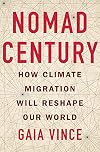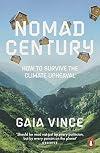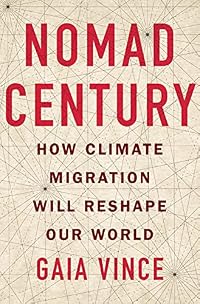
Nomad Century: How Climate Migration Will Reshape Our World
by Gaia Vince
On This Page
Description
Drawing on a career of environmental reporting and over two years of travel to the front lines of climate migration across the globe, an award-winning science journalist, in this urgent call to action, discusses the underreported, seismic consequences of climate change and how it will reshape humanity.Tags
Recommendations































Member Reviews
My brain has gone numb and my eyes are fatigued after this dense slog of a smallish book and its long, long paragraphs. (Only 210 pages.) But I finished.
As for the content, there were some amazing ideas. I hope they work. The first part about the billions migrating north and settling into new cities built just for them with open arms... well, the cynic in me shook my head. Especially after reading The Hate Next Door where neo-Nazi-type militias are hunting migrants at the Mexican border with their arsenals of AK-47s. So, good luck with that welcome!
There are plenty of Americans who would welcome them, like me. But with all the fear-mongering on social media, the politicians and the government would never coordinate such a show more plan.
Recommended to anyone seeking solutions to the climate crisis and looking for hope while there is still a little time to mitigate the worst of the impacts. show less
As for the content, there were some amazing ideas. I hope they work. The first part about the billions migrating north and settling into new cities built just for them with open arms... well, the cynic in me shook my head. Especially after reading The Hate Next Door where neo-Nazi-type militias are hunting migrants at the Mexican border with their arsenals of AK-47s. So, good luck with that welcome!
There are plenty of Americans who would welcome them, like me. But with all the fear-mongering on social media, the politicians and the government would never coordinate such a show more plan.
Recommended to anyone seeking solutions to the climate crisis and looking for hope while there is still a little time to mitigate the worst of the impacts. show less
***.5
The book starts off with a stark description of the impact that climate change will have on the habitable environment of the planet during this century, and the ensuing mass migration that will inevitably result.
The author then goes on to argue that rather than shunning or fearing the climate refugees, most of whom will originate from some of the world's poorest regions in the Global South, the richer Northern nations should instead welcome them. Just as cities prosper by an influx of diversity, so will our entire species benefit from the interchange of cultures and genes. So far, so good, but she makes the bizarre claim that the desire to keep outsiders out is a recent development arising from the modern nation-state in the 18th show more century. As if the Jewish people weren't expelled, exiled, and banished from Spain, England, France, Russia, and elsewhere multiple times from the 13th-18th century, to name just one prominent counter example.
She then goes on to examine the way that various categories of migrants and refugees are dealt with today, which makes it clear that new approaches and better policies will be required to accommodate the millions displaced by climate change. Again she tries to make the case that national borders are artificial modern constructs, and that everyone benefits by allowing the free flow of populations to wherever they want to go, regardless of their reason for migrating. She provides some positive economic figures, but almost completely glosses over the cultural clashes that have arisen over the past decade, which has occurred with a fraction of the amount of population transfer that she's proposing.
The book concludes with some suggestions of what can be done to mitigate the damage of climate change, but as with her rosy depiction of immigrants, the optimism quickly outruns reality. I appreciate the resistance to succumbing to doomerism, but some of the proposals are far-fetched at best. show less
The book starts off with a stark description of the impact that climate change will have on the habitable environment of the planet during this century, and the ensuing mass migration that will inevitably result.
The author then goes on to argue that rather than shunning or fearing the climate refugees, most of whom will originate from some of the world's poorest regions in the Global South, the richer Northern nations should instead welcome them. Just as cities prosper by an influx of diversity, so will our entire species benefit from the interchange of cultures and genes. So far, so good, but she makes the bizarre claim that the desire to keep outsiders out is a recent development arising from the modern nation-state in the 18th show more century. As if the Jewish people weren't expelled, exiled, and banished from Spain, England, France, Russia, and elsewhere multiple times from the 13th-18th century, to name just one prominent counter example.
She then goes on to examine the way that various categories of migrants and refugees are dealt with today, which makes it clear that new approaches and better policies will be required to accommodate the millions displaced by climate change. Again she tries to make the case that national borders are artificial modern constructs, and that everyone benefits by allowing the free flow of populations to wherever they want to go, regardless of their reason for migrating. She provides some positive economic figures, but almost completely glosses over the cultural clashes that have arisen over the past decade, which has occurred with a fraction of the amount of population transfer that she's proposing.
The book concludes with some suggestions of what can be done to mitigate the damage of climate change, but as with her rosy depiction of immigrants, the optimism quickly outruns reality. I appreciate the resistance to succumbing to doomerism, but some of the proposals are far-fetched at best. show less
An analysis of human migration to date and a lucid extrapolation of the vast increase that will be forced upon us by the climate crisis. She outlines some of the wide-ranging solutions that will be required - somewhat sketchy but this is not a "how-to" manual - including redesigning cities, different forms of agriculture, and engineering for life on more marginal land. The facts and figures are very impressive, but the main thrust of her argument is that it must be a managed process with trans-national agreement, even the dissolution of current national borders themselves. This is the part I find hard to swallow. Having seen daily exhibitions of various governments' xenophobia, racism, and sickening disregard for the lives of desperate show more migrants how can we hope that these same people won't just build a higher wall and turn their backs? In short, it's a very worthwhile book but doesn't really give me any cause for optimism show less
Important book but lots of the information is repeated multiple times.
Donation by Ann Lewis
Ratings
Members
- Recently Added By
Author Information

13+ Works 542 Members
Gaia Vince is the author of Adventures in the Anthropocene: A Journey to the Heart of the Planet we Made, which won the 2015 Royal Society Winton Prize for Science Books. (Bowker Author Biography)
Awards and Honors
Classifications
- Genres
- Science & Nature, Nonfiction, General Nonfiction
- DDC/MDS
- 362.87 — Social sciences Social problems and social services Social problems of and services to groups of people Problems of and services to other groups
- LCC
- GE149 — Geography, Anthropology and Recreation Environmental Sciences Environmental sciences
- BISAC
Statistics
- Members
- 150
- Popularity
- 217,299
- Reviews
- 5
- Rating
- (3.50)
- Languages
- English, Italian
- Media
- Paper, Audiobook, Ebook
- ISBNs
- 10
- ASINs
- 4