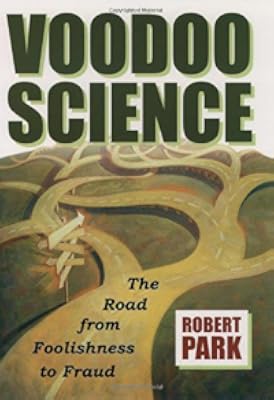
Voodoo Science: The Road from Foolishness to Fraud
by Robert L. Park
On This Page
Description
In a time of dazzling scientific progress, how can we separate genuine breakthroughs from the noisy gaggle of false claims? From Deepak Chopra's "quantum alternative to growing old" to unwarranted hype surrounding the International Space Station, Robert Park leads us down the back alleys of fringe science, through the gleaming corridors of Washington power and even into our evolutionary past to search out the origins of voodoo science. Along the way, he offers simple and engaging science show more lessons, proving that you don't have to be a scientist to spot the fraudulent science that swirls around us. show lessTags
Recommendations






Member Reviews
This highly readable book is an excellent discussion of how the lack of scientific literacy in America affects all of us.
Physicist Robert Park begins this wide survey of bad science with a discussion of how the media is helping to confuse Americans by regularly covering stories of exciting, but highly improbable, scientific claims. In a detailed discussion of the cold fusion disaster of 1989, he then goes on to look at basic human nature and how wishful thinking on the part of a scientist can lead from self-delusion to fraud with remarkable speed.
Though Park discusses some of the usual suspects such as homeopathy, astrology, and Deepak Chopra’s quantum stretches, he also spends a lot of time looking at more conventional scientific show more issues such as the manned space program. Park eloquently explains how politics, national pride and emotion have contributed to the wasting billions of dollars on a program that is—from a scientific standpoint—totally not worth it.
The chapter that I enjoyed the most is the one in which Park did a detailed breakdown of the EMF scare that began when a seriously flawed study showed a correlation between rates of childhood leukemia and the proximity of power lines. Park explains how that one flawed study, combined with an overzealous reporter trying to sell books, kept that fear alive for decades, causing great suffering to both parents and those with houses near suspect power lines, not to mention the diversion of enormous amounts of money to numerous follow up studies that ultimately showed that there was absolutely no connection.
Despite the findings of solid science on the EMF-cancer connection, the fear may well have been kept alive by hungry lawyers looking for the next big tort payday had it not been for some positive developments in how the courts relate to matters of science. Strong precedent has now been set requiring any science testimony admitted to an argument to be based on sound, accepted principles and not simply on some fringe scientists’ willingness to say that anything might cause cancer in exchange for a paycheck.
Despite this very positive step, Park’s book makes it clear that the public’s lack of basic scientific literacy allows people to be exploited and manipulated in unacceptable ways. Though parts of the book go into more scientific detail than I generally find interesting, Park’s argument is so compelling I made a point of re-reading these sections, making sure I understood them, so that I hopefully will no longer be part of the problem. show less
Physicist Robert Park begins this wide survey of bad science with a discussion of how the media is helping to confuse Americans by regularly covering stories of exciting, but highly improbable, scientific claims. In a detailed discussion of the cold fusion disaster of 1989, he then goes on to look at basic human nature and how wishful thinking on the part of a scientist can lead from self-delusion to fraud with remarkable speed.
Though Park discusses some of the usual suspects such as homeopathy, astrology, and Deepak Chopra’s quantum stretches, he also spends a lot of time looking at more conventional scientific show more issues such as the manned space program. Park eloquently explains how politics, national pride and emotion have contributed to the wasting billions of dollars on a program that is—from a scientific standpoint—totally not worth it.
The chapter that I enjoyed the most is the one in which Park did a detailed breakdown of the EMF scare that began when a seriously flawed study showed a correlation between rates of childhood leukemia and the proximity of power lines. Park explains how that one flawed study, combined with an overzealous reporter trying to sell books, kept that fear alive for decades, causing great suffering to both parents and those with houses near suspect power lines, not to mention the diversion of enormous amounts of money to numerous follow up studies that ultimately showed that there was absolutely no connection.
Despite the findings of solid science on the EMF-cancer connection, the fear may well have been kept alive by hungry lawyers looking for the next big tort payday had it not been for some positive developments in how the courts relate to matters of science. Strong precedent has now been set requiring any science testimony admitted to an argument to be based on sound, accepted principles and not simply on some fringe scientists’ willingness to say that anything might cause cancer in exchange for a paycheck.
Despite this very positive step, Park’s book makes it clear that the public’s lack of basic scientific literacy allows people to be exploited and manipulated in unacceptable ways. Though parts of the book go into more scientific detail than I generally find interesting, Park’s argument is so compelling I made a point of re-reading these sections, making sure I understood them, so that I hopefully will no longer be part of the problem. show less
I feel that I know Robert Park, who was director of the Washington Office of the American Physical Society when this book was published, because of his weekly "What's New" column [see http://www.bobpark.org/bob.html], even though we have never met. "Voodoo Science" distills his thoughts on some of the most important recent examples of pathological science in the news and public life. In these ten chapters, he discusses Congress' perpetual credulity for claims of perpetual motion and "free energy" (not the kind I teach!), the low-frequency EMF scare, the politics of manned space exploration, Roswell and aliens, homeopathy, and Deepak Chopra, among others. While Park sympathizes with some whose lack of technical knowledge and show more understanding of the methods of science make them susceptible to charlatans, he also has a good theory as to how well-meaning amateurs like Joe Newman get caught up in the process that leads from an experiment in the garage to fraudulent claims of infinite energy. A constant throughout these episodes is the irresponsible behavior of the news media when reporting controversial issues with a scientific or technical component. CBS News was doing it again last night (6/29/00), when they devoted a full "48 Hours" program to psychic detectives, ESP, communication with the dead, and similar nonsense. Hardly a skeptical viewpoint was mentioned (as usual). show less
Profrssor Park has written a clear and scathing book about fraud in the name of science. Whether the fraud is perpetrated by those who are pure of heart yet devoid of knowledge or those who are driven by greed and uncaring of knowledge. This is, quite simply a most necessary book in the present society, as we are bombarded by outrageous and dubious claims from celebrity hucksters. This extends from the government to those perveyor of quality widgets at the home shopping channels.
Professor Park's examples, from SDI proponents to UFO worshippers to technophobes to my favorite, perpetual motion machine enthousiasts truly covers a wide swath of people. Being an electrical engineer, I have had the distinct displeasure of dealing with two show more issues in particular, one is the perpetual motion machine and the other is the power line controversy. We all knew that the claims are bunk, but it was hard to convince the layman. Hence the opportunity for people to mislead themselves or to be mislead by others.
This book clears up a lot of the arguments presented by the voodoo scientists. The moment, as described by Professor Park, that these hucksters are revealed are the best moments of the reading. It redeems our faith in science and technology as well as strikes a blow for competent scientists everywhere.
His description of Edward Teller and SDI as well as the Space station fiasco very much reaffirms all that we have suspected and further reveals the lack of technical depth that is plaguing the leadership of our governemnt. His description of the expert panels mandated by law to review technical claims actually gave me a sense of relief, that yes there are redeemable qulaities for the legal profession.
Overall, this was a great book to read and it was all very enjoyable, especially if you have followed some of these cases closely. show less
Professor Park's examples, from SDI proponents to UFO worshippers to technophobes to my favorite, perpetual motion machine enthousiasts truly covers a wide swath of people. Being an electrical engineer, I have had the distinct displeasure of dealing with two show more issues in particular, one is the perpetual motion machine and the other is the power line controversy. We all knew that the claims are bunk, but it was hard to convince the layman. Hence the opportunity for people to mislead themselves or to be mislead by others.
This book clears up a lot of the arguments presented by the voodoo scientists. The moment, as described by Professor Park, that these hucksters are revealed are the best moments of the reading. It redeems our faith in science and technology as well as strikes a blow for competent scientists everywhere.
His description of Edward Teller and SDI as well as the Space station fiasco very much reaffirms all that we have suspected and further reveals the lack of technical depth that is plaguing the leadership of our governemnt. His description of the expert panels mandated by law to review technical claims actually gave me a sense of relief, that yes there are redeemable qulaities for the legal profession.
Overall, this was a great book to read and it was all very enjoyable, especially if you have followed some of these cases closely. show less
Science!
Is there anything it can't do?
Voodoo Science offered an in depth look into the pseudoscience the plagues the National conscious. The book examined some of the more popular aspects of pseudoscience (i.e. perpetual motion machines, homeopathy, Roswell, etc.) and the reasons why such claims are inherently false. Throughout the book a nod is given to the scientific method, as well as a sobering account of why such a method is importance.
Scientists are not cast as infallible, but rather as humble and logical - and not beyond corruption. If they are wrong, they step down, pseudoscience occurs when they do not. The logic of the book was what attracted me, and the patience with which it viewed those who step outside of the scientific show more bounds. Overall, I would recommend this book to anyone who is searching for an explanation of why scientists should be respected, and why their work is as important as it is. show less
Is there anything it can't do?
Voodoo Science offered an in depth look into the pseudoscience the plagues the National conscious. The book examined some of the more popular aspects of pseudoscience (i.e. perpetual motion machines, homeopathy, Roswell, etc.) and the reasons why such claims are inherently false. Throughout the book a nod is given to the scientific method, as well as a sobering account of why such a method is importance.
Scientists are not cast as infallible, but rather as humble and logical - and not beyond corruption. If they are wrong, they step down, pseudoscience occurs when they do not. The logic of the book was what attracted me, and the patience with which it viewed those who step outside of the scientific show more bounds. Overall, I would recommend this book to anyone who is searching for an explanation of why scientists should be respected, and why their work is as important as it is. show less
Reviewed Nov 2001
Robert Park is a professor of physics and if you don't know this about the book jacket it would become apparent when he describes global warming, coin tossing and magnets. As well as perpetual motion machines and cold fusion. Park also laments the TM movement in Washington DC, (he was also popped for this article in a recent S.I. letter to editor) The author has a confusing way of wandering off he will be explaining something like cold fusion and in the middle he will start explaining a person or event more in detail often referring back to another chapter. he does a good job of supporting science, the necessity of it all and how when done in a scholarly manner it works against pseudoscience. Park quites a Harvard show more physicist, Richard Wilson about the use of the word "possible". It's possible that a dog could be running down main St. It is even possible a lion could be running down Main st., but if someone said a stegosaurus was running down Main st. you would assume he's mistaken, in some sense it might be possible its more likely he saw a dog and thought it was a stegosaurus. (p. 160-161) One chapter, the virtual astronaut discourages humans advancement towards outer space and encourages machines to do our explorations for us, I found this interesting.
17-2001 show less
Robert Park is a professor of physics and if you don't know this about the book jacket it would become apparent when he describes global warming, coin tossing and magnets. As well as perpetual motion machines and cold fusion. Park also laments the TM movement in Washington DC, (he was also popped for this article in a recent S.I. letter to editor) The author has a confusing way of wandering off he will be explaining something like cold fusion and in the middle he will start explaining a person or event more in detail often referring back to another chapter. he does a good job of supporting science, the necessity of it all and how when done in a scholarly manner it works against pseudoscience. Park quites a Harvard show more physicist, Richard Wilson about the use of the word "possible". It's possible that a dog could be running down main St. It is even possible a lion could be running down Main st., but if someone said a stegosaurus was running down Main st. you would assume he's mistaken, in some sense it might be possible its more likely he saw a dog and thought it was a stegosaurus. (p. 160-161) One chapter, the virtual astronaut discourages humans advancement towards outer space and encourages machines to do our explorations for us, I found this interesting.
17-2001 show less
Robert Park tackles a number of scientific hoaxes and examples of just plain bad science in this illuminating book. He examines several different types of "voodoo science," with examples. There are sciencists that apparently starts out well-intentioned, but want so badly to believe in their own results that they ignore flaws in their research, and eventually start falsifying or obscuring evidence; the chapter on cold fusion covers this rather nicely. There are out-and-out hucksters, like the guys who will try to convince you that they've discovered perpetual motion, and will sell you an engine for a few hundred bucks. And there is "science" that has always been bad science, like homeopathy and astrology, that has nonetheless become an show more intractable part of our culture. My favorite chapter was on the widespread panic about electromagnetic fields and high-tension power lines. Park very neatly dissects how this started out as a flawed scientific study regarding high-tension power lines and childhood leukemia, was quickly seized upon by several sensationalist journalists, and ultimately took decades and millions of dollars in research to debunk -- and some people STILL believe you can get cancer from living under power lines! show less
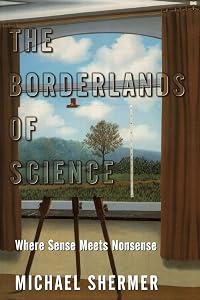
Dr. Park is a physics professor at Maryland, and the American Physical Society's representative in Washington. He pulled together columns he writes for one of the physical journals for this book. It concerns science that is not right but not fraud, and ranges over various perpetual motion and endless energy schemes, cancer from electromagnetic fields and the lack of evidence for that scare, a very negative view of the space shuttle and space station, and other topics. It was very enjoyable, and much better than the other pseudoscience debunking book that came out this year, The Borderlands of Science, since this writer actually knows the science he writes about.
Members
- Recently Added By
Lists

Best Science Books for Non-Scientists
113 works; 57 members
Author Information

6+ Works 659 Members
Robert L. Park is professor of physics at the University of Maryland. He is the author of Voodoo Science: The Road from Foolishness to Fraud.
Common Knowledge
- Original publication date
- 2000
- First words
- (Preface): In 1982, William (Willy) Fowler, a Cal Tech physicist whose seminal work on elemental abundances would be recognized with a Nobel Prize a year later, called me to ask if I would use my sabbatical year to establish... (show all) an office of public affairs in Washington for the American Physical Society.
I called Joe Newman at his home in Lucedale, Mississippi. - Last words
- (Click to show. Warning: May contain spoilers.)Strange and very wonderful.
- Blurbers
- Allen, Steve; Goodenough, Ursula; Fitch, Val L.; Gross, Paul; Cole, K. C.; Dawkins, Richard
Classifications
Statistics
- Members
- 542
- Popularity
- 54,914
- Reviews
- 11
- Rating
- (3.90)
- Languages
- English, Romanian, Spanish
- Media
- Paper, Ebook
- ISBNs
- 10
- ASINs
- 2