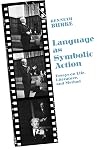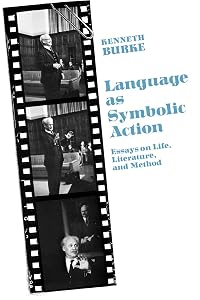
Language As Symbolic Action: Essays on Life, Literature, and Method
by Kenneth Burke
On This Page
Description
From the Preface:The title for this collection was the title of a course in literary criticism that I gave for many years at Bennington College. And much of the material presented here was used in that course. The title should serve well to convey the gist of these various pieces. For all of them are explicitly concerned with the attempt to define and track down the implications of the term "symbolic action," and to show how the marvels of literature and language look when considered form show more that point of view. show lessTags
Recommendations









Member Reviews
Poetics, the singular subject, the screened mind-body-unconsciousness, and the human examining itself, is "apparently" Burke's bailiwick.
One of the major themes of Burke's criticism is "victimage". He finds in food, in character, in Commandments, and in the aching words.
Chapter Six is entitled "I, Eye, Ay--Concerning Emerson's Early Essay on 'Nature,' and the Machinery of Transcendence". Burke finds the Essay more than a Happiness Pill. He understands the charm and buoyancy of it, and concurs with the accuracy of naming it "transcendence". [187]
In "The Seven Offices" Burke sought to decide how few functions people really performed for each other. The first six are: Govern (rule); Serve (material provision); Defend; Teach; Entertain; show more Cure. He later added Console.
After comparing Emerson's medicine to Socratic, as shredded by Nietzsche's Twilight, Burke loves Emerson for his "idealistic upsurge". "Even in those days, I feel sure, both he and Whitman suspected they might be whistling in the dark. But they loved the gesture (if whistling is a gesture)...Emerson's scheme for transcendence ... propounded before his fellow townsmen had lost their sense of a happy, predestined future."
There was not yet the crying need to turn to, and begin hoarding, relics of an "ancestral past", like "an unregenerate Southerner's attic, with its trunkload of Confederate money". [192]
As if studying Scripture, which of course it is, Burke approaches the form of the essay, "Nature". He examines its terministic conditions, the material sensations he calls "apocalyptic" in the sense that word means "revealing", and that is how Emerson uses the word. He traces Emerson's resonant examination of "facts seen in light of ideas". Setting up Supernature, or stylistic bridges (intermediaries) for a dialectic theology. You make the distinction between "God" and "Man", bridged as "God-Man".
Burke invokes the three canticles of the Divine Comedy which end on references to the stars, and proposes calling Emerson "starry-eyed". [193] Emerson become transparent eyeball, as he spoke of the universe through which the light of a higher law shines. [194]
He recognizes Emerson's transcendentalism as disciplinary view of Social Structure as Nature. The discordant "Property and its filial systems of debt and credit"--which grind the widow, the orphan, and the sons of genius--is a preceptor whose lessons cannot be foregone, and "is needed most by those who suffer from it most". [196] A preceptor! show less
One of the major themes of Burke's criticism is "victimage". He finds in food, in character, in Commandments, and in the aching words.
Chapter Six is entitled "I, Eye, Ay--Concerning Emerson's Early Essay on 'Nature,' and the Machinery of Transcendence". Burke finds the Essay more than a Happiness Pill. He understands the charm and buoyancy of it, and concurs with the accuracy of naming it "transcendence". [187]
In "The Seven Offices" Burke sought to decide how few functions people really performed for each other. The first six are: Govern (rule); Serve (material provision); Defend; Teach; Entertain; show more Cure. He later added Console.
After comparing Emerson's medicine to Socratic, as shredded by Nietzsche's Twilight, Burke loves Emerson for his "idealistic upsurge". "Even in those days, I feel sure, both he and Whitman suspected they might be whistling in the dark. But they loved the gesture (if whistling is a gesture)...Emerson's scheme for transcendence ... propounded before his fellow townsmen had lost their sense of a happy, predestined future."
There was not yet the crying need to turn to, and begin hoarding, relics of an "ancestral past", like "an unregenerate Southerner's attic, with its trunkload of Confederate money". [192]
As if studying Scripture, which of course it is, Burke approaches the form of the essay, "Nature". He examines its terministic conditions, the material sensations he calls "apocalyptic" in the sense that word means "revealing", and that is how Emerson uses the word. He traces Emerson's resonant examination of "facts seen in light of ideas". Setting up Supernature, or stylistic bridges (intermediaries) for a dialectic theology. You make the distinction between "God" and "Man", bridged as "God-Man".
Burke invokes the three canticles of the Divine Comedy which end on references to the stars, and proposes calling Emerson "starry-eyed". [193] Emerson become transparent eyeball, as he spoke of the universe through which the light of a higher law shines. [194]
He recognizes Emerson's transcendentalism as disciplinary view of Social Structure as Nature. The discordant "Property and its filial systems of debt and credit"--which grind the widow, the orphan, and the sons of genius--is a preceptor whose lessons cannot be foregone, and "is needed most by those who suffer from it most". [196] A preceptor! show less
Ratings
Members
- Recently Added By
Author Information

35+ Works 1,882 Members
Born in Pittsburgh, Burke was educated at Ohio State and Columbia universities. During his early career, he became involved with a number of little magazines, including Broom and Secession. He also wrote for The Dial and The Nation as a music critic. His greatest fame, however, has been as a literary critic. Omnivorously eclectic, Burke has found show more in the analysis of human symbolic activities a key to the largest cultural issues. For Burke, literature is the most prominent and sophisticated form of "symbolic action," one that provides "equipment for living" by allowing us to try out hypothetical strategies for dealing with the endless variety of human situations and experiences. Human society demands some principle of order, but the language and reason that create order can fall into rigid abstractions that can be destructive and violently imposed. Literature shows us an image of sacrifice, forgiveness, and flexibility that plays an important role in keeping society functioning flexibly. Burke's writing is extensive, complex and wide ranging, but also unique and uniquely important among current critical approaches. (Bowker Author Biography) show less
Classifications
- Genres
- Nonfiction, Literature Studies and Criticism, Fiction and Literature, Philosophy
- DDC/MDS
- 801.95 — Literature & rhetoric Literature, rhetoric & criticism Philosophy and theory Nature and character Literary theory and criticism
- LCC
- PN511 .B793 — Language and Literature Literature (General) Literature (General) Literary history Collections
- BISAC
Statistics
- Members
- 185
- Popularity
- 177,394
- Reviews
- 1
- Rating
- (4.08)
- Languages
- English
- Media
- Paper, Ebook
- ISBNs
- 4
- ASINs
- 5