On This Page
Description
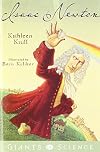
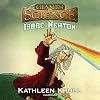
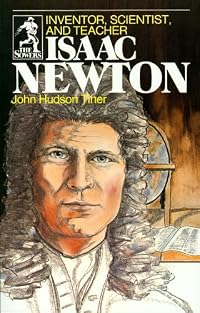
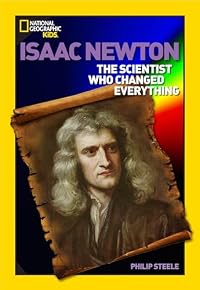
Isaac Newton was not only briiliant, but secretive, vindictive and obsessive. Here is a portrait of the man, contradictions and all, than places him against the backdrop of seventeenth-century England, a time of plague, the Great Fire of London, and two revolutions.Tags
Recommendations




Member Reviews
Krull gives a detailed and humane look at the life of one of the most intelligent people ever known, in a humorous and interesting way that makes it a perfect book for kids. From sticking needles in his eye and drinking turpentine, to improving the telescope and discovering calculus, Newton's weirdest quirks and greatest moments of genius are presented together in a way that shows the real person, rather than just a man wearing a wig under an apple tree. The story and the science involved are told in an easy to understand manner, with lots of white space surrounding a large text, and a relatively simple vocabulary. The large-headed illustrations tie in with the oddness and humor, and poke fun at Newton's larger-than-life brain. The show more personal and lighthearted attitude of the book could draw in readers who are resistant to nonfiction texts. show less
Krull snaps your attention like a juicy novel, “Secretive, withdrawn, obsessive. Ruthless, bitter, perhaps in need of therapy . . . All these things apply to Isaac Newton. Oh, and he was one of the greatest scientific minds of all time. (Albert Einstein, who should know, said Newton was the greatest.)” How can any young mind resist that temptation to find out more—hooked! Newton invented a new form of mathematics called calculus (I was very proud of my B as an undergrad ), he created the reflecting telescope, the principle of gravity, he described the basic laws of motion that underlie all of physics. Kulikov’s illustrations in black and white are inviting—comic book style. Newton’s childhood was disturbing and probably show more damaged him emotionally, but perhaps fed his brilliant mind toward such profound discoveries. Krull likens Newton and his thrill at finally reaching Trinity College (Cambridge) to the thrill Harry Potter felt at entering Hogwarts.
If You Liked This, Try: Leonardo Da Vinci: Giants of Science #1 by Kathleen Krull, Something Out of Nothing: Marie Curie and Radium by Carla Killough McClafferty, Sigmund Freud: Giants of Science #3 by Kathleen Krull, Escape!: The Story of the Great Houdini by Sid Fleischman, Up Before Daybreak: Cotton And People In America by Deborah Hopkinson. show less
If You Liked This, Try: Leonardo Da Vinci: Giants of Science #1 by Kathleen Krull, Something Out of Nothing: Marie Curie and Radium by Carla Killough McClafferty, Sigmund Freud: Giants of Science #3 by Kathleen Krull, Escape!: The Story of the Great Houdini by Sid Fleischman, Up Before Daybreak: Cotton And People In America by Deborah Hopkinson. show less
Impulse from library. Definitely better for the target audience, especially for children so fascinated by STEM subjects that they don't develop social skills and don't need friends who aren't similarly interested.
"Plato is my friend, Aristotle is my friend, but my best friend is truth."
I agree.
Newton referred to poetry as "ingenious fiddle-faddle."
To a certain extent, I agree.
The book would be even better if it had included a timeline of world history, especially the history of the 'giants' upon whose 'shoulders he stood' but also which kings, what was happening in the New World, and in Arts & Literature. I will always argue that Context is Key to understanding.
"Plato is my friend, Aristotle is my friend, but my best friend is truth."
I agree.
Newton referred to poetry as "ingenious fiddle-faddle."
To a certain extent, I agree.
The book would be even better if it had included a timeline of world history, especially the history of the 'giants' upon whose 'shoulders he stood' but also which kings, what was happening in the New World, and in Arts & Literature. I will always argue that Context is Key to understanding.
I really enjoyed reading Giants of Science. I picked it out randomly from the bookstore, and found it to be an extremely engaging, informative, student friendly account of Isaac Newton. What I knew about Isaac Newton before the book: He wrote the laws of motion and universal gravitation before he was 25, took years to publicize it because he was scared, and said he was "standing on the shoulders of giants."
What I learned from this book was the how and why behind these events, but also a great deal more about how he has shaped science as we now understand it on a fundamental level.
The reason I was particularly taken with Krull's book is that it is accessible. Students will enjoy reading it, despite that it is a book about an old dead show more scientist. Her tone is sarcastic, comic, and light, which makes the book engaging to read the entire was through. She begins chronologically through the time he was 25, then she switches to different threads of his life and work, spending a chapter on each. This was the only thing that caused me some confusion because we would jump forward then backwards in time, but it was a sensible organization style since it went thematically. show less
What I learned from this book was the how and why behind these events, but also a great deal more about how he has shaped science as we now understand it on a fundamental level.
The reason I was particularly taken with Krull's book is that it is accessible. Students will enjoy reading it, despite that it is a book about an old dead show more scientist. Her tone is sarcastic, comic, and light, which makes the book engaging to read the entire was through. She begins chronologically through the time he was 25, then she switches to different threads of his life and work, spending a chapter on each. This was the only thing that caused me some confusion because we would jump forward then backwards in time, but it was a sensible organization style since it went thematically. show less
Isaac Newton's biography from Krull's, "Giants of Science" series offers a raw account of Newton's life and accomplishments. From being labeled as "inattentive," "idle," and "sober, silent, thinking child," who was left behind by his mother to marry a Church of England clergyman, and growing up to be one of the most accomplished and respected scientists in the Royal Society. But while he became famous for his scientific discoveries, Newton was extremely distrustful and arrogant among his colleagues, and the author poses the question to the reader what could Newton have really accomplished if he wasn't so narrow-minded and on frequent campaigns to destroy the credibility of other scientists.
Newton's childhood offers interest and meaning show more to today's child - he was made fun of, resented by other boys his age, and never really fit in with his peers, and his story is relevant to the increasing attention to bullying in today's schools.
The author's dialogue is casual and would be very easy to read for children ages 10-12, and is engaging because in featuring each accomplishment and major event in Newton's life, the author offers quotes and sources revealing his experience and frustrations with his work, making Newton a believable and multidimensional character. show less
Newton's childhood offers interest and meaning show more to today's child - he was made fun of, resented by other boys his age, and never really fit in with his peers, and his story is relevant to the increasing attention to bullying in today's schools.
The author's dialogue is casual and would be very easy to read for children ages 10-12, and is engaging because in featuring each accomplishment and major event in Newton's life, the author offers quotes and sources revealing his experience and frustrations with his work, making Newton a believable and multidimensional character. show less
This book details the various accomplishments of Issac Newton. It highlights the political and historical setting in which Newton made his discoveries. It does not paint a noble image of Newton, but shows his humanity by spending time discussing how Newton experimented with his ideas for years before writing about them and his extreme reluctance to socialize with others. It also shows the darker side of Newton who mistrusted his peers and formed a series of villainous relationships with Robert Hooke, Gottfried Leibniz, and John Flamsteed.
This book could be partitioned out and chapters given to the course they most correlate to. Classes that could use this are calculus, physics, physical science, and chemistry. Many of the experiments show more that Newton completed in his time of seclusion could be repeated as labs. show less
This book could be partitioned out and chapters given to the course they most correlate to. Classes that could use this are calculus, physics, physical science, and chemistry. Many of the experiments show more that Newton completed in his time of seclusion could be repeated as labs. show less
Independent reader level: Grade 5+
Members
- Recently Added By
Author Information

97+ Works 16,760 Members
All Editions
Awards and Honors
Awards
Distinctions
Notable Lists
Series

Common Knowledge
- Canonical title
- Isaac Newton
- People/Characters
- Isaac Newton
- Quotations
- His patience and concentration were unparalleled--perhaps no one else in history has ever had the same power to focus, like a sharp beam of light.
Classifications
Statistics
- Members
- 484
- Popularity
- 62,362
- Reviews
- 12
- Rating
- (4.06)
- Languages
- English
- Media
- Paper, Audiobook, Ebook
- ISBNs
- 16
- ASINs
- 3