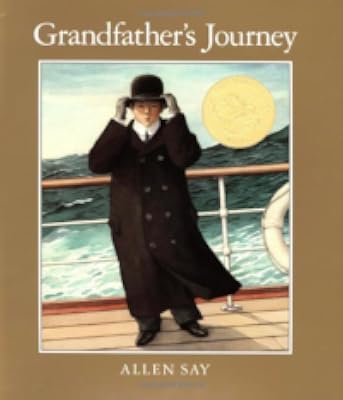
Grandfather's Journey
by Allen Say
On This Page
Description
A Japanese American man recounts his grandfather's journey to America which he later also undertakes, and the feelings of being torn by a love for two different countries.Tags
Recommendations






Member Reviews
Using beautiful pictures and a spare writing style, Allen Say has captured what it means to live in two cultures at once. In Grandfather's Journey, a young boy remembers his grandfather's memories of Japan and America and his love for both countries. As a young boy in Japan, the grandfather is able to instill a yearning for travel and a desire to explore America. When the grandson is able to go to America, he comprehends even better the feelings of his grandfather.
I was immediately drawn to this book because of the beauty of its illustrations and the quality of craft demonstrated in its construction and the care given to its writing. I feel that this book deals with subjects that may be uncomfortable for light reading with children but show more that it still touches on genuine feelings that shouldn't be ignored or glossed over. I was entranced by the narrative and artistic combination and felt emotionally satisfied after reading it. My son liked the pictures of the boat on the sea and the train.
I think that this book could be used very effectively in our area because of the high number of children from elsewhere. A conversation could be started about where “home” is and what it means for each child, and that it's ok to feel homesick or to always have a place that you long for. A good way of helping young people relate to this story would also be to interview their grandparents or other older relatives and have them reminisce about their memories of “home.” show less
I was immediately drawn to this book because of the beauty of its illustrations and the quality of craft demonstrated in its construction and the care given to its writing. I feel that this book deals with subjects that may be uncomfortable for light reading with children but show more that it still touches on genuine feelings that shouldn't be ignored or glossed over. I was entranced by the narrative and artistic combination and felt emotionally satisfied after reading it. My son liked the pictures of the boat on the sea and the train.
I think that this book could be used very effectively in our area because of the high number of children from elsewhere. A conversation could be started about where “home” is and what it means for each child, and that it's ok to feel homesick or to always have a place that you long for. A good way of helping young people relate to this story would also be to interview their grandparents or other older relatives and have them reminisce about their memories of “home.” show less
This is now one of my favorite picture books. Although simple the words are powerful and the illustrations are striking. Each page tells the story of one man’s journey to America and his love for seeing the world. Each picture is framed as if it is a picture of the adventure and the bittersweet feelings of eventually realizing that he missed home. It is astonishing to me how such an emotional story can be told in so few words. The ending is quite heartwarming as the author realizes that after his own journey in life he now feels as if he understands his grandfather
The immensely talented Allen Say won the Caldecott Medal for this beautiful picture-book tribute to his grandfather, and to the immigrant experience, and it is not difficult to see why! Using simple text and luminous artwork, he explores his grandfather's story: how he wanted to see the world, as a young man, and set out on a sea-voyage from his native Japan; how he ended up in the USA, and journeyed all over the country, eventually settling in California; how he found a bride in Japan, but raised his daughter in the states; how the family eventually returned to Japan, where the daughter married Allen Say's father; and how the grandfather longed, until his dying day, to see America one last time. Say concludes with a two page spread show more about his own experience living between two countries, an experience that has given him insight into his grandfather's life journey...
Grandfather's Journey, which I first read in 1993, the year it was released, and have just reread for The Picture-Book Club to which I belong, where our theme this month is "traveling," is a truly wonderful book, as emotionally powerful as it is aesthetically appealing. Say's artwork is always gorgeous - I love his use of light and shadow, and the different effects, whether gentle or harsh, that he achieves - and his story here is moving. There is all the simplicity of rightness here - everything works, in and of itself, and everything works together - making this a truly outstanding example of the picture-book genre. I finished it with a lump in my throat, as I always do. Highly recommended, to anyone who appreciates beautiful watercolor paintings, and to anyone looking for children's stories about family, and the experience of belonging to more than one culture and country. show less
Grandfather's Journey, which I first read in 1993, the year it was released, and have just reread for The Picture-Book Club to which I belong, where our theme this month is "traveling," is a truly wonderful book, as emotionally powerful as it is aesthetically appealing. Say's artwork is always gorgeous - I love his use of light and shadow, and the different effects, whether gentle or harsh, that he achieves - and his story here is moving. There is all the simplicity of rightness here - everything works, in and of itself, and everything works together - making this a truly outstanding example of the picture-book genre. I finished it with a lump in my throat, as I always do. Highly recommended, to anyone who appreciates beautiful watercolor paintings, and to anyone looking for children's stories about family, and the experience of belonging to more than one culture and country. show less
Through pensive portraits and delicately faded art, Allen Say pays tribute to his grandfather's persistent longing for home that continues within Allen.
This restlessness and constant desire to be in two places speaks to a universal experience as well as the deeply personal ties of family to place, and what it means to be at home in more than one country.
This restlessness and constant desire to be in two places speaks to a universal experience as well as the deeply personal ties of family to place, and what it means to be at home in more than one country.
A simply told but emotionally true account of a man's grandfather's process of changing homes repeatedly between Japan and America during times of big change, and how it feels to be between places.
The illustrations in this Caldecott winner are very well done and beautifully complement this melancholy tale of love and loss. Through the illustrations, the reader is able to join in the journey as Say's grandfather travels the world, as his mother marries and starts a family, and as Say himself follows in his grandfather's footsteps and moves across the Pacific to California. Perhaps the most beautiful thing about this book is that if one were to ignore the words and simply look at the pictures, one might mistake the illustration depicting what we, as readers, know to be Allen Say in California as simply being another image of the young man we were introduced to in the beginning of the book. The man standing before the palm trees, show more however, is that first young man's grandson, and although Say's grandfather never got the opportunity to return to California himself, this image subtly suggests that he was able to return in spirit with his grandson. show less
The message in this Caldecott winner captured the beautiful relationship that a grandfather and a grandson share regardless of time and space.The author told 2 lifetimes of stories that intertwined as one.
As a Mexican- American and future wife of a Moroccan man, I can relate to this story whole-heartedly. My fiancee gets these emotions when he is here in Oklahoma and then goes home to Morocco to visit family and vice versa. He wants to be here, but still misses the smells and noises of the streets in Casablanca and Sale, Morocco.
In the classroom, I would incorporate the familiarity with home, where it be, and other places in the world. Understanding emotions, sights, cultures, and what we would we miss. Multi-cultural diferences.
As a Mexican- American and future wife of a Moroccan man, I can relate to this story whole-heartedly. My fiancee gets these emotions when he is here in Oklahoma and then goes home to Morocco to visit family and vice versa. He wants to be here, but still misses the smells and noises of the streets in Casablanca and Sale, Morocco.
In the classroom, I would incorporate the familiarity with home, where it be, and other places in the world. Understanding emotions, sights, cultures, and what we would we miss. Multi-cultural diferences.
Members
- Recently Added By
Published Reviews
Gr 3 Up-A personal history of three generations of the author's family that points out the emotions that are common to the immigrant experience. Splendid, photoreal watercolors have the look of formal family portraits or candid snapshots, all set against idyllic landscapes in Japan and in the U.S. (Sept., 1993)
added by sriches
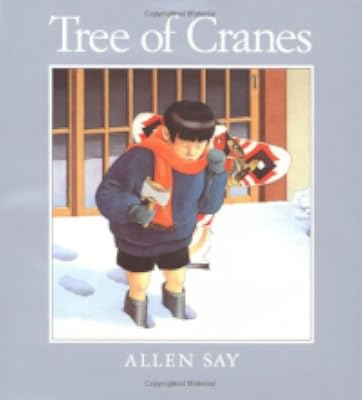
Say transcends the achievements of his Tree of Cranes and A River Dream with this breathtaking picture book, at once a very personal tribute to his grandfather and a distillation of universally shared emotions. Elegantly honed text accompanies large, formally composed paintings to convey Say's family history; the sepia tones and delicately faded colors of the art suggest a much-cherished and show more carefully preserved family album. A portrait of Say's grandfather opens the book, showing him in traditional Japanese dress, ``a young man when he left his home in Japan and went to see the world.'' Crossing the Pacific on a steamship, he arrives in North America and explores the land by train, by riverboat and on foot. One especially arresting, light-washed painting presents Grandfather in shirtsleeves, vest and tie, holding his suit jacket under his arm as he gazes over a prairie: ``The endless farm fields reminded him of the ocean he had crossed.'' Grandfather discovers that ``the more he traveled, the more he longed to see new places,'' but he nevertheless returns home to marry his childhood sweetheart. He brings her to California, where their daughter is born, but her youth reminds him inexorably of his own, and when she is nearly grown, he takes the family back to Japan. The restlessness endures: the daughter cannot be at home in a Japanese village; he himself cannot forget California. Although war shatters Grandfather's hopes to revisit his second land, years later Say repeats the journey: ``I came to love the land my grandfather had loved, and I stayed on and on until I had a daughter of my own.'' The internal struggle of his grandfather also continues within Say, who writes that he, too, misses the places of his childhood and periodically returns to them. The tranquility of the art and the powerfully controlled prose underscore the profundity of Say's themes, investing the final line with an abiding, aching pathos: ``The funny thing is, the moment I am in one country, I am homesick for the other.'' Ages 4-8. (Oct.)
"The immigrant experience has rarely been so poignantly evoked as it is in this direct, lyrical narrative that is able to stir emotions through the sheer simplicity of its telling." show less
"The immigrant experience has rarely been so poignantly evoked as it is in this direct, lyrical narrative that is able to stir emotions through the sheer simplicity of its telling." show less
added by sriches
Lists

Caldecott Medal Books
91 works; 15 members

Best children's picture books
377 works; 85 members

Five in a Row
144 works; 8 members

my children books reading list-from 100 great books
101 works; 7 members

Honey For a Child's Heart
1,152 works; 25 members

Reading Rainbow
193 works; 10 members

Books Read in 2023
5,547 works; 145 members

Beautiful Feet Books
304 works; 7 members

Five in a Row
174 works; 2 members

Precious People
119 works; 1 member
Author Information

35+ Works 11,522 Members
Allen Say was born in 1937 in Yokohama, Japan and grew up during the war, attending seven different primary schools amidst the ravages of falling bombs. His parents divorced in the wake of the end of the war and he moved in with his maternal grandmother, with whom he did not get along with. She eventually let him move into a one room apartment, show more and Say began to make his dream of being a cartoonist a reality. He was twelve years old. Say sought out his favorite cartoonist, Noro Shinpei, and begged him to take him on as an apprentice. He spent four years with Shinpei, but at the age of 16 moved to the United States with his father. Say was sent to a military school in Southern California but then expelled a year later. He struck out to see California with a suitcase and twenty dollars. He moved from job to job, city to city, school to school, painting along the way, and finally settled on advertising photography and prospered. Say's first children's book was done in his photo studio, between shooting assignments. It was called "The Ink-Keeper's Apprentice" and was the story of his life with Noro Shinpei. After this, he began to illustrate his own picture books, with writing and illustrating becoming a sort of hobby. While illustrating "The Boy of the Three-year Nap" though, Say suddenly remembered the intense joy I knew as a boy in my master's studio and decided to pursue writing and illustrating full time. Say began publishing books for children in 1968. His early work, consisting mainly of pen-and-ink illustrations for Japanese folktales, was generally well received; however, true success came in 1982 with the publication of The Bicycle Man, based on an incident in Say's life. "The Boy of the Three-Year Nap" published in 1988, and written by Dianne Snyder, was selected as a 1989 Caldecott Honor Book and winner of The Boston Globe-Horn Book Award for best picture book. (Bowker Author Biography) show less
Awards and Honors
Awards
Distinctions
Notable Lists
Work Relationships
Is contained in
Common Knowledge
- Original publication date
- 1993
- Important places
- Japan; California, USA
- Dedication
- To Richard, Francine, and Davis
- First words
- My grandfather was a young man when he left his home in Japan and went to see the world.
- Last words
- (Click to show. Warning: May contain spoilers.)I think I know my grandfather now. I miss him very much.
- Publisher's editor
- Lorraine, Walter
Classifications
Statistics
- Members
- 3,577
- Popularity
- 4,560
- Reviews
- 255
- Rating
- (4.11)
- Languages
- Chinese, English, French, German
- Media
- Paper, Audiobook, Ebook
- ISBNs
- 27
- UPCs
- 2
- ASINs
- 11