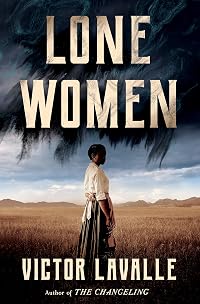
Lone Women
by Victor LaValle
On This Page
Description
"Adelaide Henry carries an enormous steamer trunk with her wherever she goes. It's locked at all times. Because when the trunk is opened, people around her start to disappear... The year is 1914, and Adelaide is in trouble. Her secret sin killed her parents, and forced her to flee her hometown of Redondo, California, in a hellfire rush, ready to make her way to Montana as a homesteader. Dragging the trunk with her at every stop, she will be one of the "lone women" taking advantage of the show more government's offer of free land for those who can cultivate it-except that Adelaide isn't alone. And the secret she's tried so desperately to lock away might be the only thing keeping her alive"-- show lessTags
Recommendations


















Member Reviews
The opening of 'Lone Women' captured my imagination. It was visually and emotionally powerful, taking me inside Adelaide Henry's head and making it my home while still being aware that I didn't know her at all, except that I knew she was going to be strong and full of surprises and the that some of them would not be nice surprises. From the beginning, the was a constant sense of foreboding, like a stink rising from the heavy, locked steamer trunk that Adelaide is the only thing Adelaide was hauling with her from the ashes of her old life to her new one.
For the first half of the book, I slipped into a satisfying piece of historical fiction with some supernatural elements to it.
The people were vividly drawn and very believable. The show more important characters were mostly strong women carving a place for themselves. What made them strong and the type of place they were trying to carve varied enormously, leaving room for conflict and collaboration between the women and getting me invested in their struggles.
I liked the way Montana itself became a character in the story. The way the wind beat relentlessly on the women trying to cross its vast, flat, empty spaces. At first, Adelaide thinks that the landscape is trying to kill all the settlers. Then she comes to recognise that the landscape is not inimical to them but completely indifferent to them. Not hostile, simply not a place where people should not choose to live. It took me a while to realise that this said a lot about the range of choices the Lone Women settling there saw themselves as having.
The historical context was established by showing the challenges the women in the story faced on a day-to-day basis rather than through an infodump or a covert history lecture. I can't remember having read any other novel set in Montana at the start of the last century. It was all new to me and yet I felt that I was standing somewhere solid and real.
Violence, the threat of violence and the consequences of violence are the threads used to sow together the people, the place and the plot into a coherent pattern. Some of the violence and threat comes from Adelaides' mysterious trunk. Some of it comes from predators she encounters along the way or who come hunting her and the people around her. Some of it is simply a taken-for-granted attribute of the time and place that Adelaide is living in. All of it is well done.
In this story, violence does more than keep the story moving and maintaining tension. Showing violence as ubiquitous, inevitable, and inescapable changes the characters' and the reader's reaction to it. When violence is not an aberration but an attribute, not a bug but a feature, everyone has to think through what use they will put violence to, who they are willing to protect and how they will do it.
The reality of violence makes everything more personal. There are no arms-length, delivered-by-faceless-institutions options for providing help or punishment. Whatever gets done, gets done by someone you know to someone you know.
It seemed to me that the ever-present potential for personally delivered violence partially explained why the women in the story seemed to have developed an ability to see situations and consequences more clearly than the men around them. The women have more hazards to protect themselves from and less power to do it with.
One way for the women to protect themselves is to stop being Lone Women and become part of a collective. At first, it seemed that Victor LaValle was using the Busy Bees, led by the wealthiest woman in town and promoting a version of sisterhood, female empowerment and mutual support, as an example of this. Then I understood that sisterhood was just a busker's pitch to get the marks inside the Carney tent. What the Busy Bees really exemplify is the weaponisation of exclusion as a mechanism for sustaining and extending power and privilege through patronage. The concept of community is co-opted and refocussed not on mutual support but on defining who is 'us' and who shouldn't be here at all.
For the most part, I enjoyed 'Lone Women' as a tense piece of historical fiction with some weirdness added to give it spice.
In the end though, it was the weirdness that I found hardest to deal with in this book. I really, really wanted to know what was in the steamer trunk. When I found out, I was surprised and intrigued. The answer was novel and scary but no more difficult to accept than many ideas that I swallow whole when I'm reading Urban Fantasy.
The thing is, this isn't Urban Fantasy. I don't think it's horror either. I think this is fiction with an intent. The time and the place seem to have been chosen to make it easier to realise that intent. It seems to me that, the bones that the plot and character are stretched across before violence stitches them tightly in place, are not genre tropes but a set of messages or lessons.
Towards the end of the book, this bone structure seemed to break through the skin of the story, distracting me from what was going on and making me question whether I was supposed to see something real or just a symbol of something else or something real that was also a symbol of something else.
The people, events and setting of the book became so heavily burdened with symbolism or with an additional significance that I sometimes feel that a Chyron running across the bottom of the scenes I was visualising, distracting me from the tension of the plot by running captions like:
Do you see how defining people as different is the first step towards exclusion and the consolidation of power with the few?
Have you understood that society wants these women to be Lone Women, even while it excludes and punishes them for being so?
Freedom lies in the Lone Women coming together in an acceptance that there is strength in difference and diversity?
I stayed immersed in the book to the end. It was a stimulating read, full of powerful images. When it was over, I felt like I watched a really good movie but wished that they'd toned down the score a little. show less
For the first half of the book, I slipped into a satisfying piece of historical fiction with some supernatural elements to it.
The people were vividly drawn and very believable. The show more important characters were mostly strong women carving a place for themselves. What made them strong and the type of place they were trying to carve varied enormously, leaving room for conflict and collaboration between the women and getting me invested in their struggles.
I liked the way Montana itself became a character in the story. The way the wind beat relentlessly on the women trying to cross its vast, flat, empty spaces. At first, Adelaide thinks that the landscape is trying to kill all the settlers. Then she comes to recognise that the landscape is not inimical to them but completely indifferent to them. Not hostile, simply not a place where people should not choose to live. It took me a while to realise that this said a lot about the range of choices the Lone Women settling there saw themselves as having.
The historical context was established by showing the challenges the women in the story faced on a day-to-day basis rather than through an infodump or a covert history lecture. I can't remember having read any other novel set in Montana at the start of the last century. It was all new to me and yet I felt that I was standing somewhere solid and real.
Violence, the threat of violence and the consequences of violence are the threads used to sow together the people, the place and the plot into a coherent pattern. Some of the violence and threat comes from Adelaides' mysterious trunk. Some of it comes from predators she encounters along the way or who come hunting her and the people around her. Some of it is simply a taken-for-granted attribute of the time and place that Adelaide is living in. All of it is well done.
In this story, violence does more than keep the story moving and maintaining tension. Showing violence as ubiquitous, inevitable, and inescapable changes the characters' and the reader's reaction to it. When violence is not an aberration but an attribute, not a bug but a feature, everyone has to think through what use they will put violence to, who they are willing to protect and how they will do it.
The reality of violence makes everything more personal. There are no arms-length, delivered-by-faceless-institutions options for providing help or punishment. Whatever gets done, gets done by someone you know to someone you know.
It seemed to me that the ever-present potential for personally delivered violence partially explained why the women in the story seemed to have developed an ability to see situations and consequences more clearly than the men around them. The women have more hazards to protect themselves from and less power to do it with.
One way for the women to protect themselves is to stop being Lone Women and become part of a collective. At first, it seemed that Victor LaValle was using the Busy Bees, led by the wealthiest woman in town and promoting a version of sisterhood, female empowerment and mutual support, as an example of this. Then I understood that sisterhood was just a busker's pitch to get the marks inside the Carney tent. What the Busy Bees really exemplify is the weaponisation of exclusion as a mechanism for sustaining and extending power and privilege through patronage. The concept of community is co-opted and refocussed not on mutual support but on defining who is 'us' and who shouldn't be here at all.
For the most part, I enjoyed 'Lone Women' as a tense piece of historical fiction with some weirdness added to give it spice.
In the end though, it was the weirdness that I found hardest to deal with in this book. I really, really wanted to know what was in the steamer trunk. When I found out, I was surprised and intrigued. The answer was novel and scary but no more difficult to accept than many ideas that I swallow whole when I'm reading Urban Fantasy.
The thing is, this isn't Urban Fantasy. I don't think it's horror either. I think this is fiction with an intent. The time and the place seem to have been chosen to make it easier to realise that intent. It seems to me that, the bones that the plot and character are stretched across before violence stitches them tightly in place, are not genre tropes but a set of messages or lessons.
Towards the end of the book, this bone structure seemed to break through the skin of the story, distracting me from what was going on and making me question whether I was supposed to see something real or just a symbol of something else or something real that was also a symbol of something else.
The people, events and setting of the book became so heavily burdened with symbolism or with an additional significance that I sometimes feel that a Chyron running across the bottom of the scenes I was visualising, distracting me from the tension of the plot by running captions like:
Do you see how defining people as different is the first step towards exclusion and the consolidation of power with the few?
Have you understood that society wants these women to be Lone Women, even while it excludes and punishes them for being so?
Freedom lies in the Lone Women coming together in an acceptance that there is strength in difference and diversity?
I stayed immersed in the book to the end. It was a stimulating read, full of powerful images. When it was over, I felt like I watched a really good movie but wished that they'd toned down the score a little. show less
Victor LaValle's Lone Women is nothing less than brilliant, a historical/horror novel that delivers readers a succession of surprises. Real surprises.
As Lone Women opens, the novel's central character, Adelaide Henry, is leaving behind the small black farming community in which she was raised, taking with her only a a carefully padlocked, exceptionally heavy trunk. That trunk contains her family's burden: a demon. (The blurbs for the novel include this information, so it doesn't count as a spoiler.) She's been convinced by what she'll soon find is an all-too-good-to-be-true brochure describing homesteading in Montana. The brochure claims winters in Montana are milder than those in the U.S. south, but as one of the new neighbors tells show more Adelaide, "This land tries to kill us every day."
Adelaide is one of only three Black women in her new, scattered community. People help each other out, not so much from generosity, but from the knowledge they might be facing desperate need at any time. Offer a service to your neighbor; then you can demand help in your turn. There's a certain level of of cross-gender, cross-race acceptance, but it doesn't run deep.
Lone Women simultaneously offers an account of survival in a harsh world and a roller coaster of destruction at the times the trunk comes unlocked. Even if neither horror nor historical fiction are among you favorite reading material, you should give this book a try. Seriously. You'll experience some real surprises.
I received a free electronic review copy of this title from the publisher via NetGalley; the opinions are my own. show less
As Lone Women opens, the novel's central character, Adelaide Henry, is leaving behind the small black farming community in which she was raised, taking with her only a a carefully padlocked, exceptionally heavy trunk. That trunk contains her family's burden: a demon. (The blurbs for the novel include this information, so it doesn't count as a spoiler.) She's been convinced by what she'll soon find is an all-too-good-to-be-true brochure describing homesteading in Montana. The brochure claims winters in Montana are milder than those in the U.S. south, but as one of the new neighbors tells show more Adelaide, "This land tries to kill us every day."
Adelaide is one of only three Black women in her new, scattered community. People help each other out, not so much from generosity, but from the knowledge they might be facing desperate need at any time. Offer a service to your neighbor; then you can demand help in your turn. There's a certain level of of cross-gender, cross-race acceptance, but it doesn't run deep.
Lone Women simultaneously offers an account of survival in a harsh world and a roller coaster of destruction at the times the trunk comes unlocked. Even if neither horror nor historical fiction are among you favorite reading material, you should give this book a try. Seriously. You'll experience some real surprises.
I received a free electronic review copy of this title from the publisher via NetGalley; the opinions are my own. show less
Please note that I received this book via NetGalley. This did not affect my rating or review.
How does Victor LaValle do this! I am mad at myself for gulping this book down, but I could not slow myself. At one point I had to say go slower, go slower, you are getting to the end, and I was not able to slow down. I needed a great horror book and LaValle per usual delivers. The characters are so damn good. The writing is lyrical. The flow is top-notch. The setting is perfect (Montana in the 1900s). The ending is too. I got nothing to quibble about. I would warn people though that this is horror novel, so there is some blood and other things that may make you squeamish as a reader.
"Lone Women" follows 31 year old Adelaide Henry. Adelaide show more seems to be on the run from something. Leaving behind her family farm and the secrets it holds, she leaves with nothing but a traveling bag and a steamer trunk. She decides to leave California for the state of Montana because she has read clippings before about how a lone woman can end up settling and gaining land in that state. And she hopes it is far away enough to hide her secrets. Of course, things don't go as planned, and Adelaide ends up having to decide to tell the truth of her family to her new friends or keep running.
Adelaide was great. I felt for her. A woman in her thirties who was tied to her parents (unwilling) because of a dark secret. A Black (or Negro woman as she is referred to in the story) has very few options in 1914 in America, but she is determined to still go on, though part of her wonders why she is bothering. Her traveling by ship to Seattle and then by train to Montana shows how tough she is.
The other characters we meet, Bertie Brown and Fiona and Grace and her child Sam are wonderful. I loved Bertie and Fiona and wanted a short story about them and how they met. Grace and Sam and the secrets they shared were a surprise, but of course you realize this is why they were drawn to Adelaide and she to them. I am still surprised that LaValle is able to bring all of these people to life in just a little over 200 pages. Not a word is wasted. We also get some other characters who you learn to worry about since some learn Adelaide's secret, like the Mudges, and then the Reeds's.
The writing was fantastic. At times it may seem a bit repetitive, but it's because Adelaide is left haunted by the words her mother did and did not say to her. And at times, her mother's ghost walks besides her.
The setting of Montana in this time period was bleak. It seems like anything could and would kill you. And you can see how many flocked to the Reed's and the couple's supposed charity. But of course all charity comes with strings. I also thought it was great that LaValle is able to show how Adelaide how to carry herself differently in Montana since she was Black. Even though all of the people she meets at one point are white. I was surprised a bit by her "romance" in the book because I wondered how something like that would have been taken back then. In the end though it ended up not mattering much.
The ending was great. I loved the idea behind it and smiled. Fantastic read! 5 stars!! show less
How does Victor LaValle do this! I am mad at myself for gulping this book down, but I could not slow myself. At one point I had to say go slower, go slower, you are getting to the end, and I was not able to slow down. I needed a great horror book and LaValle per usual delivers. The characters are so damn good. The writing is lyrical. The flow is top-notch. The setting is perfect (Montana in the 1900s). The ending is too. I got nothing to quibble about. I would warn people though that this is horror novel, so there is some blood and other things that may make you squeamish as a reader.
"Lone Women" follows 31 year old Adelaide Henry. Adelaide show more seems to be on the run from something. Leaving behind her family farm and the secrets it holds, she leaves with nothing but a traveling bag and a steamer trunk. She decides to leave California for the state of Montana because she has read clippings before about how a lone woman can end up settling and gaining land in that state. And she hopes it is far away enough to hide her secrets. Of course, things don't go as planned, and Adelaide ends up having to decide to tell the truth of her family to her new friends or keep running.
Adelaide was great. I felt for her. A woman in her thirties who was tied to her parents (unwilling) because of a dark secret. A Black (or Negro woman as she is referred to in the story) has very few options in 1914 in America, but she is determined to still go on, though part of her wonders why she is bothering. Her traveling by ship to Seattle and then by train to Montana shows how tough she is.
The other characters we meet, Bertie Brown and Fiona and Grace and her child Sam are wonderful. I loved Bertie and Fiona and wanted a short story about them and how they met. Grace and Sam and the secrets they shared were a surprise, but of course you realize this is why they were drawn to Adelaide and she to them. I am still surprised that LaValle is able to bring all of these people to life in just a little over 200 pages. Not a word is wasted. We also get some other characters who you learn to worry about since some learn Adelaide's secret, like the Mudges, and then the Reeds's.
The writing was fantastic. At times it may seem a bit repetitive, but it's because Adelaide is left haunted by the words her mother did and did not say to her. And at times, her mother's ghost walks besides her.
The setting of Montana in this time period was bleak. It seems like anything could and would kill you. And you can see how many flocked to the Reed's and the couple's supposed charity. But of course all charity comes with strings. I also thought it was great that LaValle is able to show how Adelaide how to carry herself differently in Montana since she was Black. Even though all of the people she meets at one point are white. I was surprised a bit by her "romance" in the book because I wondered how something like that would have been taken back then. In the end though it ended up not mattering much.
The ending was great. I loved the idea behind it and smiled. Fantastic read! 5 stars!! show less
I've developed a taste for Westerns lately and have always enjoyed stories of people overcoming adversity, so this seemed like a sure thing. I put it off because I'm not naturally a fan of horror. Lately, however, I've been on a mission to overcome my aversion by reading well-written novels that also happen to fall in the horror genre (e.g. The Terror, Where the Dead Wait, 1922, Red Rabbit). This experiment has shown that I've been missing out on a lot of really great books, including this one.
Lone Women is not your typical horror novel. Were it not for the graphic (but not gratuitous) violence of just a few scenes, I doubt it would be relegated to the genre at all, perhaps finding a home amongst the fantasy or magical realism books. show more Even those elements, though, play a small part in the overall success of the novel. In the end, this is a book about survival, community, and how we channel the rage created by injustice (and what might happen if it has no focus). It questions how we define monsters and who gets make those definitions. And unlike so many horrific western tales (I'm looking at you, Blood Meridian), it comes down on the side of hope. Not pie-in-the-sky hope, but rather work-your-ass-off-think-for-yourself-and-take-care-of-each-other hope. LaValle never hides from the fact that we live in a world where horrors abound (slavery, Indigenous displacement, and the multitude of petty meannesses that permeate daily life, to name but a few), but that's not the end of the story for him. I'd like to think there's a bit of truth in this fiction. show less
Lone Women is not your typical horror novel. Were it not for the graphic (but not gratuitous) violence of just a few scenes, I doubt it would be relegated to the genre at all, perhaps finding a home amongst the fantasy or magical realism books. show more Even those elements, though, play a small part in the overall success of the novel. In the end, this is a book about survival, community, and how we channel the rage created by injustice (and what might happen if it has no focus). It questions how we define monsters and who gets make those definitions. And unlike so many horrific western tales (I'm looking at you, Blood Meridian), it comes down on the side of hope. Not pie-in-the-sky hope, but rather work-your-ass-off-think-for-yourself-and-take-care-of-each-other hope. LaValle never hides from the fact that we live in a world where horrors abound (slavery, Indigenous displacement, and the multitude of petty meannesses that permeate daily life, to name but a few), but that's not the end of the story for him. I'd like to think there's a bit of truth in this fiction. show less
This was my first LaValle read, but it certainly won't be my last. Despite the fact that I wasn't sure I was in the mood for historical horror, and was just picking it up because of my book club, LaValle hooked me in immediately, and every time I picked up the book, I didn't want to stop reading. The reveals were fantastic, and despite the darkness of the story, LaValle's characters are created with such love and nuance, and there's such care given to the world-building, it never felt as dark as it might have, and the threads of hope made it a truly special book.
I can't read to read more from him, and I'd recommend this book to any horror reader.
I can't read to read more from him, and I'd recommend this book to any horror reader.
“Here’s an interesting moment in any friendship. That time when one person has revealed something essential about themselves and the other must decide if they can accept it.”
If you’re a fan of historical fiction with a supernatural twist, this one might just pique your interest. Set in the early 1900s, the story follows Adelaide Henry, a Black woman fleeing her troubled past in California for the remote, harsh landscapes of Montana. All she takes with her is a mysterious steamer trunk that she never lets out of her sight—and for good reason. What’s inside is more than a mere possession; it’s a dark secret that Adelaide must confront as she tries to build a new life on the frontier.
Victor LaValle blends historical fiction show more and magical realism in a way that brings the Wild West to life while adding an eerie, otherworldly layer. The story explores themes of survival, community, and the burdens we carry, both literal and metaphorical. It’s an intriguing premise, but I have to admit—I’m not the biggest fan of mixing historical fiction with magical realism. While I appreciated the historical backdrop, the supernatural elements gave the story an odd, almost disjointed feel. I suspect that’s what kept me at a bit of a distance, though I can see how other readers might find it compelling.
One thing I truly appreciated, though, was the book’s symbolism. The “demon” in the story was such a powerful metaphor for the baggage we all carry—whether it’s guilt, grief, or fear—and how confronting it can lead to freedom or destruction, depending on how we approach it. I also loved that the cast of primary characters was almost entirely women, which felt refreshing for a frontier tale. The book touches on issues like gender roles, race, and independence in ways that feel subtle yet impactful.
A fun tidbit about the author: Victor LaValle is known for his ability to mix horror, fantasy, and social commentary seamlessly, and his novel The Changeling earned him widespread acclaim. LaValle’s knack for crafting stories that feel both timeless and unique shines through in Lone Women, even if the magical realism wasn’t entirely my cup of tea.
If you enjoy stories that challenge genre conventions and tackle weighty themes with a touch of the supernatural, Lone Women might be worth a read. For me, while it didn’t quite hit all the right notes, I still came away appreciating its creativity and the thought-provoking way it explored what it means to be burdened—and ultimately, unburdened. show less
If you’re a fan of historical fiction with a supernatural twist, this one might just pique your interest. Set in the early 1900s, the story follows Adelaide Henry, a Black woman fleeing her troubled past in California for the remote, harsh landscapes of Montana. All she takes with her is a mysterious steamer trunk that she never lets out of her sight—and for good reason. What’s inside is more than a mere possession; it’s a dark secret that Adelaide must confront as she tries to build a new life on the frontier.
Victor LaValle blends historical fiction show more and magical realism in a way that brings the Wild West to life while adding an eerie, otherworldly layer. The story explores themes of survival, community, and the burdens we carry, both literal and metaphorical. It’s an intriguing premise, but I have to admit—I’m not the biggest fan of mixing historical fiction with magical realism. While I appreciated the historical backdrop, the supernatural elements gave the story an odd, almost disjointed feel. I suspect that’s what kept me at a bit of a distance, though I can see how other readers might find it compelling.
One thing I truly appreciated, though, was the book’s symbolism. The “demon” in the story was such a powerful metaphor for the baggage we all carry—whether it’s guilt, grief, or fear—and how confronting it can lead to freedom or destruction, depending on how we approach it. I also loved that the cast of primary characters was almost entirely women, which felt refreshing for a frontier tale. The book touches on issues like gender roles, race, and independence in ways that feel subtle yet impactful.
A fun tidbit about the author: Victor LaValle is known for his ability to mix horror, fantasy, and social commentary seamlessly, and his novel The Changeling earned him widespread acclaim. LaValle’s knack for crafting stories that feel both timeless and unique shines through in Lone Women, even if the magical realism wasn’t entirely my cup of tea.
If you enjoy stories that challenge genre conventions and tackle weighty themes with a touch of the supernatural, Lone Women might be worth a read. For me, while it didn’t quite hit all the right notes, I still came away appreciating its creativity and the thought-provoking way it explored what it means to be burdened—and ultimately, unburdened. show less
Review originally posted at The Fantasy Review
Stories about the American West are difficult to write well. The idea of the West has been over-romanticized to the point where it is only too easy to gloss over the horrors, violence, and struggles inherently tangled up in Westward expansion across North America. As pop culture icons like Yellowstone become the most popular symbol of the modern Western U.S., and shows like Deadwood or the popular Westerns of the middle twentieth century for the historic West, we continue to white-wash the history of the West, making it solely the domain of the White man.
Luckily, this is starting to change as we have new stories about both the modern and historic West that are setting the record straight and show more telling the stories of history’s ignored and erased peoples. Victor Lavalle’s latest novel, Lone Women, explores the tensions of both race and gender in colonization of Montana through the lens of a Black woman, Adelaide, as she tries to keep a mysterious secret while also starting a new life for herself.
What results is a powerful historical-horror-thriller that explores the challenges of attempting to escape one’s past, while also adding richness and texture to the homesteading movement in Montana in the early 1900s. If you are a fan of historical fiction with light speculative elements, you cannot hesitate to pick this book up.
We have all experienced moments in our lives when we wish to escape – to flee the lives that we are living and start over. To unshackle ourselves from the chains of our trauma; to unburden ourselves from the baggage we accumulate as we trudge through the struggles of our lives. No one better exemplifies this feeling better than Adelaide herself, who burns her house down with her deceased parents inside when we first meet her in Lone Women. Her goal is to escape the life she has been living, a life that we readers are not privy to in these opening pages and go to Montana where land is freely available for those who are willing to farm it.
But Adelaide’s past is not just a metaphorical weight holding her down as she travels from California to Montana, she is lugging with her an actual box. Inside this box is a terrifying demon that Adelaide will do anything to prevent from escaping. This box, and the demon awaiting within it, becomes the core tension of Lone Women – the literal horror of a murderous and blood-thirsty creature, and Adelaide’s troubled family history that the box represents. Through this symbol, Lavalle expertly weaves a gorgeous and horrifying tale, one that might be scarier in the realm of reality than in the thriller and horror elements that Lavalle injects into the novel.
Within all of this, Lavalle doesn’t seem much interested in writing a horror or thriller novel, per se. It’s not easy to distill this book down into a genre, because in many ways there are horror and thriller elements. Characters get brutally murdered, there is a demon in a box, and there are perhaps even greater human threats as racism, sexism, and ablism rear their ugly heads. As the novel progresses, as readers we jump into the heads of a greater number of characters, both hero and foe, as the various plotlines all come careening towards each other. The main tension in the book doesn’t come from jump scares nor a devilish atmosphere, but rather the slow burn sense of foreboding as we can see these characters moving closer and closer into each other’s orbits, and we know that things won’t be pretty when they eventually collide.
So while there are thriller and horror attributes to Lone Women, it also a quiet and contemplative novel. Characters spend much time contemplating their own positions in society, their own needs, wants, and desires. There is much discussion and reflection on their own pasts, what got them to this point, and the traumas they carry with them. For all of these characters (both the protagonists and antagonists) carry trauma with them because happy people didn’t move West. The West was a place of rebirth, even though the trials and tribulations of life only tended to worsen when you got there. Lavalle ensures that this book is character forward; the plot is relatively simple and thin but it is Lavalle’s fully-realized and fleshed-out characters who add an immense depth to the novel and who make it compulsively readable.
And what a wonderful and diverse cast of characters populate this book. There is, of course, Adelaide, our main hero who we spend a majority of time of the novel with. Lavalle also surrounds Adelaide with so many other characters who contribute to the small Montana community Lavalle built, making the world feel lived in and complete despite being a rather short novel (I say, mostly coming from the chunky fantasy book space). Grace, one of the other titular lone women (Montana was one of the few places where women were granted land for working it without having a male relative with them) and her son Sam add joy, humor, and rising stakes as the novel progresses. Fiona and Bertie act as wonderful allies in Adelaide’s fight, as well as giving Adelaide a much-needed Black community in a white-dominated world. Even the villainous characters, the Reeds and mysterious Mudges, give the reader a lot to chew on and don’t feel villainous just for the sake of villainy.
Through this cast of characters Lavalle is able to explore feelings of racial isolation, implicit and structural sexism, as well as the fluidity of gender identity and gender roles as we move through the different contexts of our lives. The bigger ideas, what some might call the “literary” merit of the novel, are what make this book a compelling and fascinating character study, with the horror/mystery/thriller elements just adding onto the historical masterpiece that LaValle has created here.
Concluding Thoughts: Not necessarily for readers looking for screams and thrills, Lone Women is a masterfully told piece of literary speculative historical fiction about the traumas we are trying to escape and the baggage we carry. LaValle crafts a wholly original novel that not only deals with our metaphorical and literal demons, but also reorients our understanding of the American West away from the “White man” narratives we are often told toward those that are often erased – in this case, Black women. This was a powerful, tense novel of hardship, endurance, and rebirth, and now I cannot wait to dive into Lavalle’s back catalog of works. show less
Stories about the American West are difficult to write well. The idea of the West has been over-romanticized to the point where it is only too easy to gloss over the horrors, violence, and struggles inherently tangled up in Westward expansion across North America. As pop culture icons like Yellowstone become the most popular symbol of the modern Western U.S., and shows like Deadwood or the popular Westerns of the middle twentieth century for the historic West, we continue to white-wash the history of the West, making it solely the domain of the White man.
Luckily, this is starting to change as we have new stories about both the modern and historic West that are setting the record straight and show more telling the stories of history’s ignored and erased peoples. Victor Lavalle’s latest novel, Lone Women, explores the tensions of both race and gender in colonization of Montana through the lens of a Black woman, Adelaide, as she tries to keep a mysterious secret while also starting a new life for herself.
What results is a powerful historical-horror-thriller that explores the challenges of attempting to escape one’s past, while also adding richness and texture to the homesteading movement in Montana in the early 1900s. If you are a fan of historical fiction with light speculative elements, you cannot hesitate to pick this book up.
We have all experienced moments in our lives when we wish to escape – to flee the lives that we are living and start over. To unshackle ourselves from the chains of our trauma; to unburden ourselves from the baggage we accumulate as we trudge through the struggles of our lives. No one better exemplifies this feeling better than Adelaide herself, who burns her house down with her deceased parents inside when we first meet her in Lone Women. Her goal is to escape the life she has been living, a life that we readers are not privy to in these opening pages and go to Montana where land is freely available for those who are willing to farm it.
But Adelaide’s past is not just a metaphorical weight holding her down as she travels from California to Montana, she is lugging with her an actual box. Inside this box is a terrifying demon that Adelaide will do anything to prevent from escaping. This box, and the demon awaiting within it, becomes the core tension of Lone Women – the literal horror of a murderous and blood-thirsty creature, and Adelaide’s troubled family history that the box represents. Through this symbol, Lavalle expertly weaves a gorgeous and horrifying tale, one that might be scarier in the realm of reality than in the thriller and horror elements that Lavalle injects into the novel.
Within all of this, Lavalle doesn’t seem much interested in writing a horror or thriller novel, per se. It’s not easy to distill this book down into a genre, because in many ways there are horror and thriller elements. Characters get brutally murdered, there is a demon in a box, and there are perhaps even greater human threats as racism, sexism, and ablism rear their ugly heads. As the novel progresses, as readers we jump into the heads of a greater number of characters, both hero and foe, as the various plotlines all come careening towards each other. The main tension in the book doesn’t come from jump scares nor a devilish atmosphere, but rather the slow burn sense of foreboding as we can see these characters moving closer and closer into each other’s orbits, and we know that things won’t be pretty when they eventually collide.
So while there are thriller and horror attributes to Lone Women, it also a quiet and contemplative novel. Characters spend much time contemplating their own positions in society, their own needs, wants, and desires. There is much discussion and reflection on their own pasts, what got them to this point, and the traumas they carry with them. For all of these characters (both the protagonists and antagonists) carry trauma with them because happy people didn’t move West. The West was a place of rebirth, even though the trials and tribulations of life only tended to worsen when you got there. Lavalle ensures that this book is character forward; the plot is relatively simple and thin but it is Lavalle’s fully-realized and fleshed-out characters who add an immense depth to the novel and who make it compulsively readable.
And what a wonderful and diverse cast of characters populate this book. There is, of course, Adelaide, our main hero who we spend a majority of time of the novel with. Lavalle also surrounds Adelaide with so many other characters who contribute to the small Montana community Lavalle built, making the world feel lived in and complete despite being a rather short novel (I say, mostly coming from the chunky fantasy book space). Grace, one of the other titular lone women (Montana was one of the few places where women were granted land for working it without having a male relative with them) and her son Sam add joy, humor, and rising stakes as the novel progresses. Fiona and Bertie act as wonderful allies in Adelaide’s fight, as well as giving Adelaide a much-needed Black community in a white-dominated world. Even the villainous characters, the Reeds and mysterious Mudges, give the reader a lot to chew on and don’t feel villainous just for the sake of villainy.
Through this cast of characters Lavalle is able to explore feelings of racial isolation, implicit and structural sexism, as well as the fluidity of gender identity and gender roles as we move through the different contexts of our lives. The bigger ideas, what some might call the “literary” merit of the novel, are what make this book a compelling and fascinating character study, with the horror/mystery/thriller elements just adding onto the historical masterpiece that LaValle has created here.
Concluding Thoughts: Not necessarily for readers looking for screams and thrills, Lone Women is a masterfully told piece of literary speculative historical fiction about the traumas we are trying to escape and the baggage we carry. LaValle crafts a wholly original novel that not only deals with our metaphorical and literal demons, but also reorients our understanding of the American West away from the “White man” narratives we are often told toward those that are often erased – in this case, Black women. This was a powerful, tense novel of hardship, endurance, and rebirth, and now I cannot wait to dive into Lavalle’s back catalog of works. show less
Members
- Recently Added By
Lists

Reading Group 2024
4 works; 1 member

Books Read in 2023
5,547 works; 145 members

LGBTQ+ Speculative Fiction
821 works; 51 members

Literature About Women and Girls
394 works; 39 members

Diverse Horror
262 works; 6 members

Fiction: Historical
288 works; 3 members

Books Set in Montana
9 works; 4 members

2024 Hugo Awards -- Eligible Works -- Novels
44 works; 6 members

Fiction Published in 2023
17 works; 2 members

Nightmares Not Included
175 works; 3 members

Top Five Books of 2023
767 works; 317 members
Dublin Literary Award 2024 Longlist
66 works; 4 members

Horror Spotlight Readalong
37 works; 2 members
Author Information

55+ Works 8,134 Members
Victor D. LaValle is an assistant professor in the graduate writing program at Columbia University. He lives in Brooklyn, New York.
Some Editions
Awards and Honors
Awards
Distinctions
Common Knowledge
- Canonical title
- Lone Women
- Original publication date
- 2023-03-28
- People/Characters
- Adelaide Henry; Grace Price; Bertie Brown; Sam Price; Joab Mudge; Fiona Wong (show all 9); Mrs. Mudge; Jerrine Reed; Matthew Kirby
- Important places
- Montana, USA; Big Sandy, Montana, USA; Lucerne Valley, California, USA
- Epigraph
- "Wanna fly, you got to give up the shit that weighs you down."
—Toni Morrison, Song of Solomon - Dedication
- To Paul, my brother
- First words
- There are two kinds of people in this world: those who live with shame, and those who die from it.
- Last words
- (Click to show. Warning: May contain spoilers.)The past is complicated.
- Original language
- English
- Canonical DDC/MDS
- 813.54
- Canonical LCC
- PS3562.A8458 L66
Classifications
- Genres
- Horror, Historical Fiction, Fiction and Literature, Fantasy, General Fiction
- DDC/MDS
- 813.54 — Literature & rhetoric American literature in English American fiction in English 1900-1999 1945-1999
- LCC
- PS3562 .A8458 .L66 — Language and Literature American literature American literature Individual authors 1961-
- BISAC
Statistics
- Members
- 1,319
- Popularity
- 18,291
- Reviews
- 49
- Rating
- (3.83)
- Languages
- English, Polish
- Media
- Paper, Audiobook, Ebook
- ISBNs
- 8
- ASINs
- 3