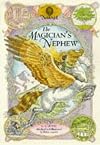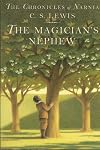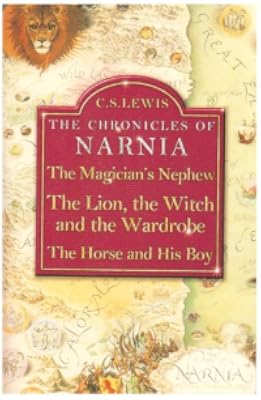
The Magician's Nephew / The Lion, the Witch, and the Wardrobe / The Horse and His Boy
by C. S. Lewis
The Chronicles of Narnia: Publication order (Collections and Selections — 1, 5-6)
On This Page
Description
The battle of good against evil is fought in the magical world of Narnia, in the most enchanting fantasy novels ever written. This volume brings together the first three books of the timeless fantasy series.New cover and new type treatment!The Magician's Nephew opens the doorway to the magical land of Narnia for the first time... In The Lion, the Witch and the Wardrobe, Peter, Edmund, Susan and Lucy stumble upon the world of Narnia. Here, Winter and the White Witch are the greatest threats show more and the children must join forces with the great lion, Aslan, to battle against the evil enchantment. In The Horse and His Boy, Shasta, the slave boy, meets Bree, a talking horse, and together they flee on a wild and dangerous journey through strange cities, eerie tombs and harsh deserts - in search of Narnia, where there is freedom and safety. show lessTags
Recommendations

















Member Reviews
[10th April 2013: Review of 'The Horse and His Boy' only. 3 stars]
When this was published, it was probably seen as quite a decent little fantasy adventure, and maybe it's still possible to read it at that level now (though even then it feels dated and too "precious"). However, it really is impossible to ignore the horribly embedded racism (and to a lesser degree, sexism), and it was not a comfortable read. Read with a great sense of caution!
[2nd April 2013: Review of 'The Lion, the Witch and the Wardrobe' only. 3 and 1/2 stars]
It's an interesting experience, reading something as an adult for the first time, when you've seen it adapted as both a live action and an animated movie. It probably robs some of the iconic images and key scenes show more of their power in print, unfortunately. That's not actually a criticism of the book itself; I suspect I would have loved this as a kid - particularly its grab-bag approach to incorporating aspects of Western mythology, not to mention the talking animals :-). And I don't see how the scene where Aslan sacrifices his life could fail to be powerful, no matter how much foreknowledge the reader has (and leaving aside the issue of the fairly heavy-handed Christian parallels). Overall it's less of a pleasant ramble than 'The Magician's Nephew', and less time is spent on characterisation (with the exception of Edmund and perhaps Lucy). However, this is compensated for by more of an epic feel.
[7th March 2013: Review of 'The Magician's Nephew' only. 3 stars]
Amazingly enough, this is my first time reading the Chronicles of Narnia. It's interesting reading a much-loved classic of the genre when you're not the intended audience, not to mention that fact that sixty years have passed since it was written. While this first book is definitely a product of its time (and the dialogue in particular hasn't aged well), it still has a degree of charm. The potentially-annoying Christian elements are relatively low-key here, and blended comfortably with other mythologies. The Witch is actually quite impressive - I would have liked to see more of her rampaging through London - and I loved some of the little touches, such as the lamp-post tree. I'm quite looking forward to reading the rest of the series. show less
When this was published, it was probably seen as quite a decent little fantasy adventure, and maybe it's still possible to read it at that level now (though even then it feels dated and too "precious"). However, it really is impossible to ignore the horribly embedded racism (and to a lesser degree, sexism), and it was not a comfortable read. Read with a great sense of caution!
[2nd April 2013: Review of 'The Lion, the Witch and the Wardrobe' only. 3 and 1/2 stars]
It's an interesting experience, reading something as an adult for the first time, when you've seen it adapted as both a live action and an animated movie. It probably robs some of the iconic images and key scenes show more of their power in print, unfortunately. That's not actually a criticism of the book itself; I suspect I would have loved this as a kid - particularly its grab-bag approach to incorporating aspects of Western mythology, not to mention the talking animals :-). And I don't see how the scene where Aslan sacrifices his life could fail to be powerful, no matter how much foreknowledge the reader has (and leaving aside the issue of the fairly heavy-handed Christian parallels). Overall it's less of a pleasant ramble than 'The Magician's Nephew', and less time is spent on characterisation (with the exception of Edmund and perhaps Lucy). However, this is compensated for by more of an epic feel.
[7th March 2013: Review of 'The Magician's Nephew' only. 3 stars]
Amazingly enough, this is my first time reading the Chronicles of Narnia. It's interesting reading a much-loved classic of the genre when you're not the intended audience, not to mention that fact that sixty years have passed since it was written. While this first book is definitely a product of its time (and the dialogue in particular hasn't aged well), it still has a degree of charm. The potentially-annoying Christian elements are relatively low-key here, and blended comfortably with other mythologies. The Witch is actually quite impressive - I would have liked to see more of her rampaging through London - and I loved some of the little touches, such as the lamp-post tree. I'm quite looking forward to reading the rest of the series. show less
Одна из самых главных книг моего детства.
Nov 29, 2008Russian
Ratings
Members
- Recently Added By
Author Information

529+ Works 523,335 Members
C. S. (Clive Staples) Lewis, "Jack" to his intimates, was born on November 29, 1898 in Belfast, Ireland. His mother died when he was 10 years old and his lawyer father allowed Lewis and his brother Warren extensive freedom. The pair were extremely close and they took full advantage of this freedom, learning on their own and frequently enjoying show more games of make-believe. These early activities led to Lewis's lifelong attraction to fantasy and mythology, often reflected in his writing. He enjoyed writing about, and reading, literature of the past, publishing such works as the award-winning The Allegory of Love (1936), about the period of history known as the Middle Ages. Although at one time Lewis considered himself an atheist, he soon became fascinated with religion. He is probably best known for his books for young adults, such as his Chronicles of Narnia series. This fantasy series, as well as such works as The Screwtape Letters (a collection of letters written by the devil), is typical of the author's interest in mixing religion and mythology, evident in both his fictional works and nonfiction articles. Lewis served with the Somerset Light Infantry in World War I; for nearly 30 years he served as Fellow and tutor of Magdalen College at Oxford University. Later, he became Professor of Medieval and Renaissance English at Cambridge University. C.S. Lewis married late in life, in 1957, and his wife, writer Joy Davidman, died of cancer in 1960. He remained at Cambridge until his death on November 22, 1963. (Bowker Author Biography) show less
Series

Work Relationships
Common Knowledge
- Canonical title
- The Magician's Nephew / The Lion, the Witch, and the Wardrobe / The Horse and His Boy
- Disambiguation notice
- This is an omnibus of books 1-3 (chronological order). The edition with the ISBN 1856058387, while titled simply The Chronicles of Narnia belongs here and should not be combined with the complete 7-volume set.
Classifications
Statistics
- Members
- 363
- Popularity
- 86,622
- Reviews
- 2
- Rating
- (4.02)
- Languages
- English, French, Italian, Russian
- Media
- Paper
- ISBNs
- 11
- ASINs
- 4