On This Page
Description
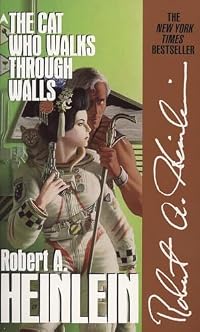
Robert A. Heinlein has written some of the best-selling science-fiction novels of all time, including the beloved classic Stranger in a strange land. Now, in The cat who walked through walls, he creates his most compelling character ever: Dr. Richard Ames, ex-military man, sometime writer, and unfortunate victim of mistaken identity. When a stranger attempting to deliver a cryptic message is shot dead at his dinner table, Ames is thrown headfirst into danger, intrigue, and other dimensions show more where Lazarus Long still thrives, where Jubal Harshaw lives surrounded by beautiful women, and where a daring plot to rescue the sentient computer called Mike can change the direction of all human history. show lessTags
Recommendations













Member Reviews
Heinlein, Robert A. The Cat Who Walks Through Walls: A Comedy of Manners. 1985. World as Myth No. 3. Ace, 1988.
Popular writers, like popular musicians and actors, I suppose, sometimes reach a point where they are no longer hungry for new fans, where their new work becomes a commentary on their early work and speaks to the readers who have been with them from the beginning. That is certainly true of the whole World as Myth series of late Heinlein novels. So, don’t bother to pick up The Cat that Walks Through Walls if you don’t recognize Hazel Stone, Lazarus Long, Jubal Harshaw, and some of the other members of the Heinlein future history roadshow. Even the subtitle is an echo of Job: A Comedy of Justice (1984), which suggests that show more The Cat Who Walks Through Walls is in some ways a sequel to that book as well as to The Number of the Beast (1980). In short, Heinlein is just rearranging the blocks in his toybox, and his tongue is stuck well and truly in his cheek. Every major character goes by multiple names. All of them are, in one way or another, stand-ins for the author and winking self-parody. Richard Ames, a combat veteran, is almost literally a clone of Lazarus Long—and they dislike one another. He is also almost a clone of Roger Stone, Hazel’s son in The Rolling Stones (1952). Roger is one of the early Heinlein spokesmen, who writes serial stories with his mother and son, even as Heinlein was writing about him with his wife Virginia. Like Pixel the kitten, everything in the novel walks through all of Heinlein’s story walls. Four stars with a wink. show less
Popular writers, like popular musicians and actors, I suppose, sometimes reach a point where they are no longer hungry for new fans, where their new work becomes a commentary on their early work and speaks to the readers who have been with them from the beginning. That is certainly true of the whole World as Myth series of late Heinlein novels. So, don’t bother to pick up The Cat that Walks Through Walls if you don’t recognize Hazel Stone, Lazarus Long, Jubal Harshaw, and some of the other members of the Heinlein future history roadshow. Even the subtitle is an echo of Job: A Comedy of Justice (1984), which suggests that show more The Cat Who Walks Through Walls is in some ways a sequel to that book as well as to The Number of the Beast (1980). In short, Heinlein is just rearranging the blocks in his toybox, and his tongue is stuck well and truly in his cheek. Every major character goes by multiple names. All of them are, in one way or another, stand-ins for the author and winking self-parody. Richard Ames, a combat veteran, is almost literally a clone of Lazarus Long—and they dislike one another. He is also almost a clone of Roger Stone, Hazel’s son in The Rolling Stones (1952). Roger is one of the early Heinlein spokesmen, who writes serial stories with his mother and son, even as Heinlein was writing about him with his wife Virginia. Like Pixel the kitten, everything in the novel walks through all of Heinlein’s story walls. Four stars with a wink. show less
I was giving this a re-read, as I found a copy in a box of books from my aunt.
Obviously, being Heinlein, there are going to be some things to offend, whether or not they were actual representations of his personal philosophy or not. The usual drastic misunderstandings of socialism, libertarianism, flirtations with militaristic fascism, a really weird flavour of misogyny, lots of free-love without basically any boundaries...but again, one knows this going into Heinlein and acting as if its an offensive surprise isn't really productive (like reading Lovecraft and not expecting some degree of racism). Especially in what was one of his last novel length works. So this isn't going to rehash any of those points.
The first two thirds (first show more two sections) of the book are a sort of romping, fast-paced, pulpy space adventure mashed up with a Bond story and a detective thriller. Even if you haven't read enough Heinlein to recognize the significant amount of character and place references peppering this story, I think the archetypes that main characters fill is going to be recognizable. Men and women of action who can do just about anything. Its light, fast, and fun. But then it suffers from an even more extreme version of the same fault I find in Stranger In A Strange Land. The story shifts gears abruptly and hard into an altogether different sort of story for part 3. One which seemingly is trying to give some overall unifying shape not only to Heinlein's World As Myth cycle, but maybe his entire body of work. Its jarring. I think both stories would likely have been better served by being separate works, with appropriate fleshing out of both stories. To the degree that I'd give 4 stars to the Richard and Hazel story of the first two thirds if it was a stand alone space adventure, but final third focusing on the Time Corps, the extended Lazarus family, and multiple timelines really drags the overall score down. show less
Obviously, being Heinlein, there are going to be some things to offend, whether or not they were actual representations of his personal philosophy or not. The usual drastic misunderstandings of socialism, libertarianism, flirtations with militaristic fascism, a really weird flavour of misogyny, lots of free-love without basically any boundaries...but again, one knows this going into Heinlein and acting as if its an offensive surprise isn't really productive (like reading Lovecraft and not expecting some degree of racism). Especially in what was one of his last novel length works. So this isn't going to rehash any of those points.
The first two thirds (first show more two sections) of the book are a sort of romping, fast-paced, pulpy space adventure mashed up with a Bond story and a detective thriller. Even if you haven't read enough Heinlein to recognize the significant amount of character and place references peppering this story, I think the archetypes that main characters fill is going to be recognizable. Men and women of action who can do just about anything. Its light, fast, and fun. But then it suffers from an even more extreme version of the same fault I find in Stranger In A Strange Land. The story shifts gears abruptly and hard into an altogether different sort of story for part 3. One which seemingly is trying to give some overall unifying shape not only to Heinlein's World As Myth cycle, but maybe his entire body of work. Its jarring. I think both stories would likely have been better served by being separate works, with appropriate fleshing out of both stories. To the degree that I'd give 4 stars to the Richard and Hazel story of the first two thirds if it was a stand alone space adventure, but final third focusing on the Time Corps, the extended Lazarus family, and multiple timelines really drags the overall score down. show less
When Colin Campbell (aka Richard Ames, aka Senator Richard Johnson) is unjustly (and inexplicably) accused of murder on the space habitat Golden Rule, it sets off a roller-coaster flight through Lunar space and -- ultimately -- through time and a multitude of universes. Riddled with snappy dialogue and utterly self-referent, it's best read by someone who is either familiar with Heinlein's Lazarus Long series, or by someone who doesn't care that much of it makes no sense at all.
Enjoyable for all the reasons Heinlein is ever enjoyable--fast-pace, snappy dialogue, likable characters, dashes of philosophy, and gripping writing. The precise workings of the final third escape me (I suspect a more thorough and recent familiarity with several other key Heinlein novels would help with this problem), but mostly I was having too much fun to care much. I can never tell when I thoroughly enjoy a Heinlein if that fact is the result of my being in just the right mood for him or of that particular book being better than some of the others. Whatever the reason, The Cat Who Walks Through Walls was a delight.
Why, why, why? Why am I so stupid? After I finished my last Heinlein book some months ago (can't remember which one, sorry), in my review I said I'd never read another one of his books, I was so disgusted with him as a perverted writer. I mean, he's a De Sade pervert. Dirty old man. And I'm no prude. But I don't want to pick up a decent seeming sci fi book only to find it full of nothing more than gratuitous sex and little else, likely designed to shock and titillate. It's stupid and, frankly, boring. I think Heinlein has written a couple of decent books I've liked over the years, but generally he's very overrated and he's really a disgusting person. So I can't explain what made me stop in the bookstore this weekend while browsing show more through the shelves and pick this book up and look at the back cover. But the synopsis made it sound interesting and since it was a decent used price, I thought why not. So I did. And regretted it.
The book is about Dr. Richard Ames, who is a resident of Golden Rule habitat, which is a space colony near the moon. One night, he is out to dinner with his soon-to-be wife Gwen Novak when a strange man is killed directly in front of him at his table. Before he knows it, he's running for his life from an unknown enemy or group of enemies. The thing that made me want to stop reading this book, which I did, was that so many unlikely things happened to Ames and Gwen in a 20 hour period, that it was completely unbelievable. The murder, the three minute cleanup and disappearance of the corpse, the assassination attempt, the evictions, the other murder, the murder frame up, the chase, the rip offs, the sabotaged space ship which crash lands, etc. It's just too damn much. If half of this stuff would happen to anyone in a 20 hour period, they'd have a nervous breakdown. It's not believable. To make matters worse, the dialogue is so damned "proper" and so, frankly, stilted, it's not to be believed either. Gwen takes the assassin under care to turn him into a proper person by educating him in his speech patterns, because one needs to learn how to speak properly if one wants to get ahead in life. Seriously? He just tried to kill your husband. WTF? That's beyond stupid. And their dialogues and "witticisms" (if you can actually call them that) during their stressful flight from authority stretches imagination. No one talks like that. At all. Ever. No one. It's beyond stupid. And so I stopped reading. Bear in mind my comment that Heinlein is a perv. So I read some reviews of this book after I stopped reading and to my total lack of surprise, this book turns into a giant Penthouse jerkoff complete with orgies and incest and tons of naked women throwing themselves at Ames throughout the book and why am I not surprised? I know a lot of sci fi writer geeks are a little sex obsessed, probably because they never got any growing up, but damn, what the HELL is wrong with Heinlein? He's a sick bastard. OK, I learned my lesson. I should have stuck to my guns. No matter how good the back cover sounded, it was Heinlein and bound to be bad, so this was definitely my last Heinlein book ever and he can kiss my ass. What an overrated writer. What a bad excuse for a sci fi author. What a freak. Definitely not recommended, both for the plot and the porn. show less
The book is about Dr. Richard Ames, who is a resident of Golden Rule habitat, which is a space colony near the moon. One night, he is out to dinner with his soon-to-be wife Gwen Novak when a strange man is killed directly in front of him at his table. Before he knows it, he's running for his life from an unknown enemy or group of enemies. The thing that made me want to stop reading this book, which I did, was that so many unlikely things happened to Ames and Gwen in a 20 hour period, that it was completely unbelievable. The murder, the three minute cleanup and disappearance of the corpse, the assassination attempt, the evictions, the other murder, the murder frame up, the chase, the rip offs, the sabotaged space ship which crash lands, etc. It's just too damn much. If half of this stuff would happen to anyone in a 20 hour period, they'd have a nervous breakdown. It's not believable. To make matters worse, the dialogue is so damned "proper" and so, frankly, stilted, it's not to be believed either. Gwen takes the assassin under care to turn him into a proper person by educating him in his speech patterns, because one needs to learn how to speak properly if one wants to get ahead in life. Seriously? He just tried to kill your husband. WTF? That's beyond stupid. And their dialogues and "witticisms" (if you can actually call them that) during their stressful flight from authority stretches imagination. No one talks like that. At all. Ever. No one. It's beyond stupid. And so I stopped reading. Bear in mind my comment that Heinlein is a perv. So I read some reviews of this book after I stopped reading and to my total lack of surprise, this book turns into a giant Penthouse jerkoff complete with orgies and incest and tons of naked women throwing themselves at Ames throughout the book and why am I not surprised? I know a lot of sci fi writer geeks are a little sex obsessed, probably because they never got any growing up, but damn, what the HELL is wrong with Heinlein? He's a sick bastard. OK, I learned my lesson. I should have stuck to my guns. No matter how good the back cover sounded, it was Heinlein and bound to be bad, so this was definitely my last Heinlein book ever and he can kiss my ass. What an overrated writer. What a bad excuse for a sci fi author. What a freak. Definitely not recommended, both for the plot and the porn. show less
The Cat Who Walks Through Walls, by R. A. Heinlein
Lord, I thought this novel would never get over....! I suspect I made a mistake in actually listening to this book in isolation. I had Blackstone Audio's version of audiobook, with Mr. Tom Weiner narrating it. (Unfortunately, he has narrated another page and a half audiobook's as well.). I chose it because it was available for download from my local library, not realizing it is part of a greater series. It does not stand well on it's own. I'm not sure it would stand well in conjunction with it's series either though, I found some major issues with it.
The first is the main voice. There were way, way too many characters in this novel, to be taken care of by just one voice actor. His women show more all sounded rather the same, except for Hazel/Gwen/Lipschits. And everyone else just kind of melted in together, sometimes. It was confusing.
This book starts out engagingly enough, with a mystery on a moon-orbiting space habitat. As can be expected from Heinlein, there is passing commentary on the governement of the habitat, all privately owned and controlled. When the action passes to the Moon we discover that this story is more commentary about how the government on the moon has changed in the 100 or so years since the revolution. James Bond style space adventure with witty banter and a clever female sidekick. Despite the sagacity of the girl (actually much older than we initially think), Heinlein has sprinkled weird sexist remarks about both men and women throughout the entire novel, which, now that I'm older, I see he does in ALL his novels, but it's still kind of grating. My problem may be at least partially due to the voice-actor reading the book, but I think it is also inherent in the character himself. I found Ames/Campbell so pretentious that he is unlikeable and never felt like he had a realistic human interaction, not even with himself.
Then there is the disjointed plot, which is unsatisfyingly patched together at the end with the Deus Ex Machina device of peripheral characters popping off through time and coming back with answers to all of the questions including some that were never asked. Reading this was like reading two different books - the first half consisting of fairly straight, middle-of-the-road space opera, and the second half going into one of Heinlein's mystical worlds. Once Lazarus Long enters the picture, the book rapidly degenerates into the usual confused 'World-Is-Myth' mishmash, with the obligatory long expository party scenes in which far too much is explained. I don't really enjoy that style as much anyway, but this was highly confusing, what with the various counts of incest, interbreeding, extended family lines and of course time-jumping.
And then that's where it turns just weird. Time travel, parallel dimensions, blah blah blah. And I'm a sci-fi fan. I don't mind that stuff. But it seemed random, unmotivated, and unjustified in the plot.
I felt a lot of the author's personality coming through, and that personality was more "grumpy old man" than anything else. A sexist, misogynistic, possibly racist, DIRTY, grumpy old man. Heinlein is known to have non-conventional ideas about marriage and relationships, but this was really pushing it. Spanking just doesn't need to be a major theme in a sci-fi novel. I'm NOT a prude, but seriously..... Now, mid-novel, we're in a world that was surely made up by a prepubescent teenage boy fantasizing about a place where people are allowed to walk around naked and have sex with anyone they want and marry multiple people. They greet each other by making out, with tongues. (Yes I know there are no more colds, flush or s.t.d.'s. So what.). Also, Stuff goes down that is unexplained and makes no sense even though these events appear to be major plot points. Characters also have unexplained emotional reactions to seemingly normal events. I seriously began to wonder if the book would ever make sense again.
Another really odd thing: toward the end, a large, black, rage-filled character named Samuel Beaux is suddenly introduced as yet another two-dimensional foil. The pun (if that's what it is) is obvious: "Sam Beaux", "Sambo" - but Heinlein spells it out just to make it clear for the idiots in the crowd. He apparently felt that he nullified the implied racism by suddenly having Ames/Campbell turn out to be black himself, although there were absolutely no clues to indicate that anywhere prior to that point. In fact, Ames calls Beaux "Boy" in the process, which strikes a very false note indeed.
I spent most of the story wondering who was who and who said what. It felt like I'd been dropped into the middle of a reunion for a family I'd never meant, tasked with picking out the few strands of relevant data from a sea of meaningless prattle. The whole book purportedly leads up to a profound event, but we're not let in on what happens with that event. Were they successful? Did their grand and utterly convoluted schemes pay off? Just what the hell was going on...?
The Cat who walks through walls didn't even have the gall to show up until "book 3", chapter 26....! What the hell? The cat was the most interesting character...!
Then, literally in the last 5 pages, Heinlein suddenly decides to wrap things up so he has one character (badly) attempt to explain the entire rest of the book and then it ends. I have never been happier to see a book end without caring how. I just needed it to be over.
2 stars, because I was SO very bored. Untold times I wanted to quit, but I pushed through it. Boo..! show less
Lord, I thought this novel would never get over....! I suspect I made a mistake in actually listening to this book in isolation. I had Blackstone Audio's version of audiobook, with Mr. Tom Weiner narrating it. (Unfortunately, he has narrated another page and a half audiobook's as well.). I chose it because it was available for download from my local library, not realizing it is part of a greater series. It does not stand well on it's own. I'm not sure it would stand well in conjunction with it's series either though, I found some major issues with it.
The first is the main voice. There were way, way too many characters in this novel, to be taken care of by just one voice actor. His women show more all sounded rather the same, except for Hazel/Gwen/Lipschits. And everyone else just kind of melted in together, sometimes. It was confusing.
This book starts out engagingly enough, with a mystery on a moon-orbiting space habitat. As can be expected from Heinlein, there is passing commentary on the governement of the habitat, all privately owned and controlled. When the action passes to the Moon we discover that this story is more commentary about how the government on the moon has changed in the 100 or so years since the revolution. James Bond style space adventure with witty banter and a clever female sidekick. Despite the sagacity of the girl (actually much older than we initially think), Heinlein has sprinkled weird sexist remarks about both men and women throughout the entire novel, which, now that I'm older, I see he does in ALL his novels, but it's still kind of grating. My problem may be at least partially due to the voice-actor reading the book, but I think it is also inherent in the character himself. I found Ames/Campbell so pretentious that he is unlikeable and never felt like he had a realistic human interaction, not even with himself.
Then there is the disjointed plot, which is unsatisfyingly patched together at the end with the Deus Ex Machina device of peripheral characters popping off through time and coming back with answers to all of the questions including some that were never asked. Reading this was like reading two different books - the first half consisting of fairly straight, middle-of-the-road space opera, and the second half going into one of Heinlein's mystical worlds. Once Lazarus Long enters the picture, the book rapidly degenerates into the usual confused 'World-Is-Myth' mishmash, with the obligatory long expository party scenes in which far too much is explained. I don't really enjoy that style as much anyway, but this was highly confusing, what with the various counts of incest, interbreeding, extended family lines and of course time-jumping.
And then that's where it turns just weird. Time travel, parallel dimensions, blah blah blah. And I'm a sci-fi fan. I don't mind that stuff. But it seemed random, unmotivated, and unjustified in the plot.
I felt a lot of the author's personality coming through, and that personality was more "grumpy old man" than anything else. A sexist, misogynistic, possibly racist, DIRTY, grumpy old man. Heinlein is known to have non-conventional ideas about marriage and relationships, but this was really pushing it. Spanking just doesn't need to be a major theme in a sci-fi novel. I'm NOT a prude, but seriously..... Now, mid-novel, we're in a world that was surely made up by a prepubescent teenage boy fantasizing about a place where people are allowed to walk around naked and have sex with anyone they want and marry multiple people. They greet each other by making out, with tongues. (Yes I know there are no more colds, flush or s.t.d.'s. So what.). Also, Stuff goes down that is unexplained and makes no sense even though these events appear to be major plot points. Characters also have unexplained emotional reactions to seemingly normal events. I seriously began to wonder if the book would ever make sense again.
Another really odd thing: toward the end, a large, black, rage-filled character named Samuel Beaux is suddenly introduced as yet another two-dimensional foil. The pun (if that's what it is) is obvious: "Sam Beaux", "Sambo" - but Heinlein spells it out just to make it clear for the idiots in the crowd. He apparently felt that he nullified the implied racism by suddenly having Ames/Campbell turn out to be black himself, although there were absolutely no clues to indicate that anywhere prior to that point. In fact, Ames calls Beaux "Boy" in the process, which strikes a very false note indeed.
I spent most of the story wondering who was who and who said what. It felt like I'd been dropped into the middle of a reunion for a family I'd never meant, tasked with picking out the few strands of relevant data from a sea of meaningless prattle. The whole book purportedly leads up to a profound event, but we're not let in on what happens with that event. Were they successful? Did their grand and utterly convoluted schemes pay off? Just what the hell was going on...?
The Cat who walks through walls didn't even have the gall to show up until "book 3", chapter 26....! What the hell? The cat was the most interesting character...!
Then, literally in the last 5 pages, Heinlein suddenly decides to wrap things up so he has one character (badly) attempt to explain the entire rest of the book and then it ends. I have never been happier to see a book end without caring how. I just needed it to be over.
2 stars, because I was SO very bored. Untold times I wanted to quit, but I pushed through it. Boo..! show less
At what point am I supposed to believe that this has an actual comprehensible story line? This novel is such a hodge-podge that one must wonder whether it is a conglomeration of two (or three) different books Heinlein was trying to write at the time.
First off, for all those who claim that you cannot appreciate this book unless you have read all the other Heinlein books - back off. I've read almost all of them. That argument is so weak. The references to the other novels, most notably, The Moon Is A Harsh Mistress, are hardly consequential. More like oblique.
What is inconsequential is the first 320 pages (out of 388). One need only read the last five (out of 30) chapters of this book. The rest doesn't matter as they are all red herring show more plot lines that go nowhere. If you wish to read about a hyper-extended escape scene that serves no real purpose, then enjoy the first 200 pages. If you want to read about ridiculous family relationships, then enjoy the next 130. Whatever you do, do not try to remember what you think are important facts, because there are none. Mysterious Schultz in chapter 1? Forgotten. Walker Evans group? Never heard of again. Important characters in space station Golden Rule - Morris, Mr. Middlegaff, Bill, Tree-San? Dr. Schultz (different from other one) all vanished. Numerous Luna characters? Who remembers? Attackers on the bus? No idea.
Story needs a rescue, sudden shift to time travel. Introduce a whole new slate of characters all inter-related (save the sentients) with similar looks and names. New mission defined. Rescue a sentient computer from Luna. This by a people so advanced they have instantaneous FTL and time travel and surrounded by other sentient things, but they need this relic. Sheesh!
Meet lots of past RAH and other sci-fi/fantasy characters. Big whoop. Means nothing.
Short last chapter wrap up is desperate attempt to resurrect all lost sub-plots. Abysmal.
As a big fan of his early works, I'm always willing to give RAH a chance. This was one chance to far. show less
First off, for all those who claim that you cannot appreciate this book unless you have read all the other Heinlein books - back off. I've read almost all of them. That argument is so weak. The references to the other novels, most notably, The Moon Is A Harsh Mistress, are hardly consequential. More like oblique.
What is inconsequential is the first 320 pages (out of 388). One need only read the last five (out of 30) chapters of this book. The rest doesn't matter as they are all red herring show more plot lines that go nowhere. If you wish to read about a hyper-extended escape scene that serves no real purpose, then enjoy the first 200 pages. If you want to read about ridiculous family relationships, then enjoy the next 130. Whatever you do, do not try to remember what you think are important facts, because there are none. Mysterious Schultz in chapter 1? Forgotten. Walker Evans group? Never heard of again. Important characters in space station Golden Rule - Morris, Mr. Middlegaff, Bill, Tree-San? Dr. Schultz (different from other one) all vanished. Numerous Luna characters? Who remembers? Attackers on the bus? No idea.
Story needs a rescue, sudden shift to time travel. Introduce a whole new slate of characters all inter-related (save the sentients) with similar looks and names. New mission defined. Rescue a sentient computer from Luna. This by a people so advanced they have instantaneous FTL and time travel and surrounded by other sentient things, but they need this relic. Sheesh!
Meet lots of past RAH and other sci-fi/fantasy characters. Big whoop. Means nothing.
Short last chapter wrap up is desperate attempt to resurrect all lost sub-plots. Abysmal.
As a big fan of his early works, I'm always willing to give RAH a chance. This was one chance to far. show less
Members
- Recently Added By
Published Reviews
In een vrij in de ruimte zwevende stad, niet ver van de Maan, raakt Richard Ames (een ex-militair die eigenlijk Campbell heet) in de ban van de mooie en slimme Gwen Novak. Daardoor wordt hij het middelpunt van allerlei intriges, waar hij in het begin helmaal niets van begrijpt, maar die hem van het ene gevaar in het andere storten. Uiteindelijk blijkt Gwen te behoren tot de omvangrijke show more 'familie' van Lazarus Long, die de tijd en de dimensies ten goede probeert te manipuleren, en Richard daarbij nodig heeft. Het nieuwste boek van de oude meester (geb. 1907) is tot ver over de helft vlot, grappig en avontuurlijk. Het laatste deel, het 'universum' van Lazarus Long, heeft Heinlein sedert 'Time enough for love' al zo vaak beschreven, dat het gaat vervelen. Luchtig, af en toe wat babbelzuchtig boek waarin alle stokpaardjes van de auteur weer eens komen opdraven. Het leest als een trein - en dat is de voornaamste verdienste van dit pretentieloos amusement. De engelse editie werd aangeboden op 86-10-051.
(NBD|Biblion recensie, Drs. P.M.H. Cuijpers) show less
(NBD|Biblion recensie, Drs. P.M.H. Cuijpers) show less
added by karnoefel
Lists

Speculative Fiction to Read
706 works; 31 members

Favorite Childhood Books
1,602 works; 516 members

Writers as Characters in Fiction
120 works; 19 members

Books Read in 2017
4,248 works; 130 members

Animals in the Title
498 works; 11 members

Books I Read Before The Invention Of The Internet.
144 works; 1 member
Author Information

459+ Works 173,822 Members
Robert Anson Heinlein was born on July 7, 1907 in Butler, Mo. The son of Rex Ivar and Bam Lyle Heinlein, Robert Heinlein had two older brothers, one younger brother, and three younger sisters. Moving to Kansas City, Mo., at a young age, Heinlein graduated from Central High School in 1924 and attended one year of college at Kansas City Community show more College. Following in his older brother's footsteps, Heinlein entered the Navel Academy in 1925. After contracting pulmonary tuberculosis, of which he was later cured, Heinlein retired from the Navy and married Leslyn MacDonald. Heinlein was said to have held jobs in real estate and photography, before he began working as a staff writer for Upton Sinclair's EPIC News in 1938. Still needing money desperately, Heinlein entered a writing contest sponsored by the science fiction magazine Thrilling Wonder Stories. Heinlein wrote and submitted the story "Life-Line," which went on to win the contest. This guaranteed Heinlein a future in writing. Using his real name and the pen names Caleb Saunders, Anson MacDonald, Lyle Monroe, John Riverside, and Simon York, Heinlein wrote numerous novels including For Us the Living, Methuselah's Children, and Starship Troopers, which was adapted into a big-budget film for Tri-Star Pictures in 1997. The Science Fiction Writers of America named Heinlein its first Grand Master in 1974, presented 1975. Officers and past presidents of the Association select a living writer for lifetime achievement. Also, the Science Fiction and Fantasy Hall of Fame inducted Heinlein in 1998. Heinlein died in 1988 from emphysema and other related health problems. Heinlein's remains were scattered from the stern of a Navy warship off the coast of California. (Bowker Author Biography) show less
Some Editions
Awards and Honors
Awards
Distinctions
Series


Belongs to Publisher Series
Work Relationships
Has the (non-series) prequel
Common Knowledge
- Original publication date
- 1985-11
- People/Characters
- Jubal Harshaw; Adam Selene; Gay Deceiver; Colonel Richard Colin Ames Campbell; Lazarus Long; Manuel Garcia O'Kelly (Manny) (show all 7); Hazel Stone
- Important places
- Golden Rule (space station); Luna City, Luna; Tellus Tertius (Third Earth); Hong Kong Luna, Luna; Grinnell, Iowa, USA
- Epigraph
- Ah Love!
could you and I with Him conspire
To grasp this sorry Scheme of Things entire, Would we not shatter it to bits - and then
Re-mould it nearer to the Heart's Desire!
RUBAIYAT OF OMAR KHAYYAM
Qua... (show all)train XCIX, Fifth Edition
(as rendered by Edward FitzGerlad)
'Whatever you do, you'll regret it.' Allan McLeod Gray 1905-1975 - Dedication
- To
Jerry and Larry and Harry Dean and Dan and Jim Poul and Buz and Sarge
(Men to have at your back)
R.A.H. - First words
- 'We need you to kill a man.'
- Last words
- (Click to show. Warning: May contain spoilers.)If they come back—or a fresh gang, I don't care—I'm going to get us a baker's dozen.
- Original language
- English
Classifications
Statistics
- Members
- 5,226
- Popularity
- 2,589
- Reviews
- 56
- Rating
- (3.48)
- Languages
- 12 — Czech, Dutch, English, Finnish, French, German, Hebrew, Italian, Portuguese, Russian, Spanish, Swedish
- Media
- Paper, Audiobook, Ebook
- ISBNs
- 38
- ASINs
- 20