On This Page
Description
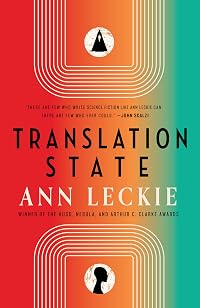
Qven was created to be a Presgr translator. The pride of their Clade, they always had a clear path before them: learn human ways, and eventually, make a match and serve as an intermediary between the dangerous alien Presgr and the human worlds. The realization that they might want something different isn't "optimal behavior". It's the type of behavior that will have you eliminated. But Qven rebels anyway, determined to find a way to belong on their own terms. As a Conclave of the various show more species approaches-and the long-standing treaty between the humans and the Presgr is on the line-the paths of all three will collide in a chain of events that will have ripple effects across galaxies. show lessTags
Recommendations












Member Recommendations
rocks009 Explores issues of gender and belonging in a strange universe.
30
Member Reviews
I am so glad that Leckie continues to write in the Radch universe, because the world-building here is so rich, and there is so much to enjoy!
Like all of the Radch books, you spend the first chapter or two thinking "oh no, this is too complicated, I'm never going to be able to keep track of this storyline," but then the characters all feel so real that it actually turns out to be very easy to follow the story, even at times when you don't really have enough information to totally understand what is going on (but don't worry, you'll get all the information later and it will all make sense... more or less).
The book at first seems to follow some very disparate characters, but all of their storylines converge into a very satisfying show more narrative. It's hard to summarize the plot.... one character is sent on a wild goose chase to track down a person who went missing 200 years ago, but decides to deft expectations and actually do a good job. When they do track down a descendant of the missing person, the discovery threatens to break a centuries-old treaty. All of the main characters grapple with big questions about who they are, what family means, and what kind of control they have over their own fates in a society that is trying to keep them in rigid roles. The story is engaging, the relationships feel very real, and it never becomes overly sentimental.
I listened to the audiobook, and Adjoa Andoh delivers an absolutely virtuoso performance, rapidly switching between a variety of voices and accents. You know from the first word which character is speaking, despite a proliferation of characters. Absolutely astonishing voice acting. show less
Like all of the Radch books, you spend the first chapter or two thinking "oh no, this is too complicated, I'm never going to be able to keep track of this storyline," but then the characters all feel so real that it actually turns out to be very easy to follow the story, even at times when you don't really have enough information to totally understand what is going on (but don't worry, you'll get all the information later and it will all make sense... more or less).
The book at first seems to follow some very disparate characters, but all of their storylines converge into a very satisfying show more narrative. It's hard to summarize the plot.... one character is sent on a wild goose chase to track down a person who went missing 200 years ago, but decides to deft expectations and actually do a good job. When they do track down a descendant of the missing person, the discovery threatens to break a centuries-old treaty. All of the main characters grapple with big questions about who they are, what family means, and what kind of control they have over their own fates in a society that is trying to keep them in rigid roles. The story is engaging, the relationships feel very real, and it never becomes overly sentimental.
I listened to the audiobook, and Adjoa Andoh delivers an absolutely virtuoso performance, rapidly switching between a variety of voices and accents. You know from the first word which character is speaking, despite a proliferation of characters. Absolutely astonishing voice acting. show less
This is one of those gripping books that I couldn't put down. The three main characters are all doing their best with the hands they are dealt, in a variety of situations that are both excitingly weird and sci-fi and alien and yet deeply human. It is deliciously warm and fuzzy and woke, with themes of found family and choosing who you are, and recovering after assault. It is also great to be back in the complex Radchaai universe.
When Enae's Grandmaman dies, the family discovers there is a new heir and no money; Enae herself is remembered in the will, but she's sent on a mission for what everyone believes is a cold trail, finding a person of interest from a couple of decades ago. Meanwhile, Qven is growing up as a Presger Translator (truly a wild and violent alien existence) and Reet is adopted and never felt a true part of a family or, really, anything until someone tells him he's a long-lost heir.
These three viewpoints trade off to tell us a story set in Imperial Radch. It can be read as a standalone, but those who have read more books in this universe will perhaps more deeply understand the significance of the treaty between the Raadch and the Presger, as show more well as the political machinations that are only hinted at here. I was intrigued by the depth we begin to see of the Presger point of view, what it means to be a Translator, and that there's even more to know about them, their culture, and possibly some factions. I was delighted to see what appears to be a nod to Murderbot (one of the characters enjoys watching "Pirate Exiles of the Death Moons" and introduces another to it). And I find myself wanting to revisit the rest of the Imperial Radch books while waiting for whatever Ann Leckie does next. show less
These three viewpoints trade off to tell us a story set in Imperial Radch. It can be read as a standalone, but those who have read more books in this universe will perhaps more deeply understand the significance of the treaty between the Raadch and the Presger, as show more well as the political machinations that are only hinted at here. I was intrigued by the depth we begin to see of the Presger point of view, what it means to be a Translator, and that there's even more to know about them, their culture, and possibly some factions. I was delighted to see what appears to be a nod to Murderbot (one of the characters enjoys watching "Pirate Exiles of the Death Moons" and introduces another to it). And I find myself wanting to revisit the rest of the Imperial Radch books while waiting for whatever Ann Leckie does next. show less
A book club pick :)
I enjoy Ann Leckie’s books so much – because of her imagination; because of the fantastical, the weird, the unexpected; because it’s usually one hell of a story; because of cool stuff she does with gender that makes you rethink your assumptions; because of the characters that you come to care for so much.
Enae’s story is about coming of age (who says it only happens when you are very young?), discovering new things about yourself, shouldering responsibility and going through with things no matter what. It was wonderful to see how sie used hir past experiences to do unexpected, new and dangerous things.
“Enae had choices. Sie wasn’t used to having choices. What did you do, with so many choices in front of show more you?”
What does it take to become friends? What is family, and how do you find the people you belong together with, places where you belong? The book tackles this so effortlessly.
The world of Presger Translators is mind-boggling mindfuck, and this is an understatement. (How do authors come up with this stuff, anyway? :) ) And I loved Reet’s and Qven’s journey. It’s so uncanny, scary, truly alien… and also so touching, emotional, at times funny.
“Certainly I never imagined what it would be like to have anyone in the world say they would die to keep me alive.” Oh.
There are so many things in the story I really want to gush about, but then this review would be full of spoilers, so I need to restrain myself.
If I wanted to complain about anything at all, it would be the fact that Pirate Exiles of the Death Moon is not available in my universe and I cannot watch it together with Reet and Qven. There is royalty in disguise! A hidden pirate base! A heroic first mate! Come on… ;)
The ending was very satisfying and made me happy :) show less
I enjoy Ann Leckie’s books so much – because of her imagination; because of the fantastical, the weird, the unexpected; because it’s usually one hell of a story; because of cool stuff she does with gender that makes you rethink your assumptions; because of the characters that you come to care for so much.
Enae’s story is about coming of age (who says it only happens when you are very young?), discovering new things about yourself, shouldering responsibility and going through with things no matter what. It was wonderful to see how sie used hir past experiences to do unexpected, new and dangerous things.
“Enae had choices. Sie wasn’t used to having choices. What did you do, with so many choices in front of show more you?”
What does it take to become friends? What is family, and how do you find the people you belong together with, places where you belong? The book tackles this so effortlessly.
The world of Presger Translators is mind-boggling mindfuck, and this is an understatement. (How do authors come up with this stuff, anyway? :) ) And I loved Reet’s and Qven’s journey. It’s so uncanny, scary, truly alien… and also so touching, emotional, at times funny.
“Certainly I never imagined what it would be like to have anyone in the world say they would die to keep me alive.” Oh.
There are so many things in the story I really want to gush about, but then this review would be full of spoilers, so I need to restrain myself.
If I wanted to complain about anything at all, it would be the fact that Pirate Exiles of the Death Moon is not available in my universe and I cannot watch it together with Reet and Qven. There is royalty in disguise! A hidden pirate base! A heroic first mate! Come on… ;)
The ending was very satisfying and made me happy :) show less
Another excursion into Anne Leckie's Imperial Radch universe. In this novel, three different characters pursue converging paths of discovery and end up each changed by the encounter. It's perhaps not too much of a spoiler to say that there are happy endings all round; the tension in the book comes from seeing how the characters will get there from where they started out - some of those starts are fairly extreme. But certainly I was ahead of the author when I spotted one of the congruencies between two of the characters about half-way in. This did not spoil the book for me.
I saw some parallels with Martha Wells' Murderbot Diaries, in that one of the characters prefers to retire to their quarters and curl up with their favourite tv soap show more adventure series, and later uses that to bond with another character. But something else struck me about this book, which it has in common with the Martha Wells and also with the books of Becky Chambers (which are still on my TBR pile, but I've read enough reviews to have some idea that they fall into this category).
I recently read a paper in the scholarly journal of science fiction, Foundation, on Leslie F. Stone, a pre-Golden Age writer in the pulps, and the varied reaction to a woman writer in the late 1920s and early 1930s. The debate seemed strangely contemporary, with women readers saying "Yes, we want SF stories with exciting super-science, but we want feelings and relationships too", whilst some male readers had a more hostile reaction, saying "We want exciting super-science but we also want intellects cold and hard and super-rational, and the more unfeeling, the better". In the end, that attitude prevailed, especially when John W. Campbell came on the editorial scene; Campbell rejected a Leslie Stone story, saying "We don't need this sort of thing in science fiction". And the identification of SF as "boys' stuff" set in and hasn't gone away, even amongst those who should know better and despite a lot of trying. I doubt that Anne Leckie could have sold stories to John W. Campbell. Fortunately, things have changed.
I'm beginning to feel that the Imperial Radch books are rather like Iain M, Banks' Culture novels. The books are not a series, in that there are few, if any, recurring characters, and the plot of each book is pretty much self-contained. Instead, in both series, each book adds another brick into a wall of comprehension, adding to our knowledge of their respective universes. In the case of Translation State, we find out much more about Presger Translators, the near-humans bred by the alien Presger to act as go-betweens for their interactions with human races in Radchaai space. Previous novels have set up Presger Translators as near-mythical characters of great power and danger, though the few we have come across in earlier books are either enigmatic or comic, as their disconnection from human societies lead them to all manner of faux pas in their dealings with humans. All this changes in Translation State. We see just why Presger Translators are considered dangerous, as dangerous as the Presger themselves. We also see that it might just be that the term "Translator" may not just refer to languages.
We also see that the concept of the ancillaries - human soldiers put under direct control of their ship's governing AI, with many ancillaries carrying out massive parallel task processing in the real world under the direction of one AI - may have its conceptual origin in certain races who can have the same consciousness occupy multiple bodies; the Presger Translators seem to be able to have two bodies sharing a consciousness and yet each acting independently, and other races who interact with humans via remote biomech avatars seem to be able to manage the same trick as well.
The writing is fairly plain and straightforward, though Leckie's characters often have a particular turn of phrase accurately reflecting their personalities. The fluidity of gender is an ongoing theme; different races have different numbers of genders, whilst other races get this wrong, either because they have different numbers of genders, or have no concept of it all (this often applies to AIs, as in the original trilogy), or (in the case of a Radch Ambassador) because they are simply too arrogant to worry about such niceties. But everyone seems to just roll with it, and no-one gets too exercised about people getting other people's pronouns wrong, because, as a character in a Joe Haldeman story once said, "Such things happen when different peoples meet".
(I did get a little puzzled by the first main character we are introduced to, who is identified as neuter but is referred to by the personal pronoun 'sie'. Trouble is, in German that's a feminine pronoun, and that threw me for a while. But I fairly quickly got into the habit of visualising the neuter characters as if they were some of the non-binary actors now appearing in tv shows like Star Trek: Discovery, and that little bit of visualisation gymnastics helped a lot.)
We also get a good picture of a group of nationalists who start out as a slightly comic pressure group, then become a political irritant, and finally become a threat, especially when they try to put into practice their firmly-held - but wrong - belief that the Presger do not actually exist and stories of their awfulness are a conspiracy by virtually everyone else. This, plus the pronoun soup, gave the story quite a contemporary twist; perhaps too contemporary for some readers, who might not be able to see past the gender fluidity. But hey, this is science fiction; if you can't cope with depictions of many very different lives, different worlds and different societies, perhaps you should go away and read something a bit less challenging? show less
I saw some parallels with Martha Wells' Murderbot Diaries, in that one of the characters prefers to retire to their quarters and curl up with their favourite tv soap show more adventure series, and later uses that to bond with another character. But something else struck me about this book, which it has in common with the Martha Wells and also with the books of Becky Chambers (which are still on my TBR pile, but I've read enough reviews to have some idea that they fall into this category).
I recently read a paper in the scholarly journal of science fiction, Foundation, on Leslie F. Stone, a pre-Golden Age writer in the pulps, and the varied reaction to a woman writer in the late 1920s and early 1930s. The debate seemed strangely contemporary, with women readers saying "Yes, we want SF stories with exciting super-science, but we want feelings and relationships too", whilst some male readers had a more hostile reaction, saying "We want exciting super-science but we also want intellects cold and hard and super-rational, and the more unfeeling, the better". In the end, that attitude prevailed, especially when John W. Campbell came on the editorial scene; Campbell rejected a Leslie Stone story, saying "We don't need this sort of thing in science fiction". And the identification of SF as "boys' stuff" set in and hasn't gone away, even amongst those who should know better and despite a lot of trying. I doubt that Anne Leckie could have sold stories to John W. Campbell. Fortunately, things have changed.
I'm beginning to feel that the Imperial Radch books are rather like Iain M, Banks' Culture novels. The books are not a series, in that there are few, if any, recurring characters, and the plot of each book is pretty much self-contained. Instead, in both series, each book adds another brick into a wall of comprehension, adding to our knowledge of their respective universes. In the case of Translation State, we find out much more about Presger Translators, the near-humans bred by the alien Presger to act as go-betweens for their interactions with human races in Radchaai space. Previous novels have set up Presger Translators as near-mythical characters of great power and danger, though the few we have come across in earlier books are either enigmatic or comic, as their disconnection from human societies lead them to all manner of faux pas in their dealings with humans. All this changes in Translation State. We see just why Presger Translators are considered dangerous, as dangerous as the Presger themselves. We also see that it might just be that the term "Translator" may not just refer to languages.
We also see that the concept of the ancillaries - human soldiers put under direct control of their ship's governing AI, with many ancillaries carrying out massive parallel task processing in the real world under the direction of one AI - may have its conceptual origin in certain races who can have the same consciousness occupy multiple bodies; the Presger Translators seem to be able to have two bodies sharing a consciousness and yet each acting independently, and other races who interact with humans via remote biomech avatars seem to be able to manage the same trick as well.
The writing is fairly plain and straightforward, though Leckie's characters often have a particular turn of phrase accurately reflecting their personalities. The fluidity of gender is an ongoing theme; different races have different numbers of genders, whilst other races get this wrong, either because they have different numbers of genders, or have no concept of it all (this often applies to AIs, as in the original trilogy), or (in the case of a Radch Ambassador) because they are simply too arrogant to worry about such niceties. But everyone seems to just roll with it, and no-one gets too exercised about people getting other people's pronouns wrong, because, as a character in a Joe Haldeman story once said, "Such things happen when different peoples meet".
(I did get a little puzzled by the first main character we are introduced to, who is identified as neuter but is referred to by the personal pronoun 'sie'. Trouble is, in German that's a feminine pronoun, and that threw me for a while. But I fairly quickly got into the habit of visualising the neuter characters as if they were some of the non-binary actors now appearing in tv shows like Star Trek: Discovery, and that little bit of visualisation gymnastics helped a lot.)
We also get a good picture of a group of nationalists who start out as a slightly comic pressure group, then become a political irritant, and finally become a threat, especially when they try to put into practice their firmly-held - but wrong - belief that the Presger do not actually exist and stories of their awfulness are a conspiracy by virtually everyone else. This, plus the pronoun soup, gave the story quite a contemporary twist; perhaps too contemporary for some readers, who might not be able to see past the gender fluidity. But hey, this is science fiction; if you can't cope with depictions of many very different lives, different worlds and different societies, perhaps you should go away and read something a bit less challenging? show less
While I love Leckie’s Ancillary trilogy (I know, not its official name), I was a bit hesitant about this one. From what I’d seen of the Presger Translators, I wasn’t sure they were the sorts of characters I’d be comfortable getting up close with.
This novel follows three different characters, and I quickly became invested, wondering and anticipating how these three storylines would collide with each other. Enae, fifty-six, after decades of keeping house for hir late Grandmaman, is offered an unexpected job with travel opportunities, tracking down a fugitive who disappeared 200 years ago. Reet, thirty-one, who was adopted in infancy and works in maintenance on a space station, is approached by a group who claim to have solved the show more mystery of his genetic heritage. And Qven is a young person who describes their upbringing and their increasing desire to avoid the future expected of them.
This novel is successful on multiple levels: as a compelling and satisfying mystery; as an addition to the Imperial Radch universe (well, the universe beyond the Radch); and as a story I was comfortable reading.
Yes, parts of Qven’s story made me squeamish, and while I’m not sure it helped that manner Qven talks about those things is offhand and often also ambiguous -- on one hand I very much appreciate the absence of gory descriptions, on the other hand there’s something disturbing about Qven’s matter-of-fact acceptance of such things -- it did help that Qven finds other aspects of their circumstances disturbing. So rather than focusing on details which bothered me, I empathised with Qven’s goal of wanting to escape and focused on that. (I think it is interesting to consider the ways in which Qven is and isn’t like a teen protagonist in a dystopia, questioning their beliefs about their society and the world.) And I like that Leckie is very concerned with her characters’ emotional wellbeing.
Kirkus Reviews apparently calls this as Another of Leckie’s beautiful mergings of the political, philosophical, and personal, which strikes me as an apt summary (and also, satisfyingly alliterative). show less
This novel follows three different characters, and I quickly became invested, wondering and anticipating how these three storylines would collide with each other. Enae, fifty-six, after decades of keeping house for hir late Grandmaman, is offered an unexpected job with travel opportunities, tracking down a fugitive who disappeared 200 years ago. Reet, thirty-one, who was adopted in infancy and works in maintenance on a space station, is approached by a group who claim to have solved the show more mystery of his genetic heritage. And Qven is a young person who describes their upbringing and their increasing desire to avoid the future expected of them.
This is what the Teachers tell you: when you exit into the World, you’ll take the place you’ve been prepared for since birth, each of us chosen for our suitability, without reference to favouritism or any sort of partiality. Each role is necessary and noble, part of our great work, and we will all be happy and fulfilled.
It’s all a lie.
This novel is successful on multiple levels: as a compelling and satisfying mystery; as an addition to the Imperial Radch universe (well, the universe beyond the Radch); and as a story I was comfortable reading.
Yes, parts of Qven’s story made me squeamish, and while I’m not sure it helped that manner Qven talks about those things is offhand and often also ambiguous -- on one hand I very much appreciate the absence of gory descriptions, on the other hand there’s something disturbing about Qven’s matter-of-fact acceptance of such things -- it did help that Qven finds other aspects of their circumstances disturbing. So rather than focusing on details which bothered me, I empathised with Qven’s goal of wanting to escape and focused on that. (I think it is interesting to consider the ways in which Qven is and isn’t like a teen protagonist in a dystopia, questioning their beliefs about their society and the world.) And I like that Leckie is very concerned with her characters’ emotional wellbeing.
Kirkus Reviews apparently calls this as Another of Leckie’s beautiful mergings of the political, philosophical, and personal, which strikes me as an apt summary (and also, satisfyingly alliterative). show less
Ann Leckie continues to be the embodiment of all the good things about CJ Cherryh and Lois McMaster Bujold that we didn't know we needed but would have if we'd thought about it for a second. Her crisp prose style and complicated universe and elegant plots and loveable protagonists are entirely her own, however. With much of the focus on the terrifying and enigmatic alien Presgrs and the treaty which keeps them from casually dismantling ships, stations and people, this one is especially intriguing, and if the Presgr remain as inscrutable as ever, we have a better understanding of what we don't understad by the end, and that's good sci fi.
Members
- Recently Added By
Lists

Novels featuring language professionals
98 works; 12 members

LGBTQ+ Speculative Fiction
820 works; 51 members

Books Read in 2023
5,547 works; 145 members

hypatian_kat to-read
429 works; 3 members

Top Five Books of 2023
767 works; 317 members

2024 Hugo Awards -- Eligible Works -- Novels
44 works; 6 members

infjsarah's wishlist
408 works; 2 members

Wishlist
4 works; 1 member

Paranormal investigators and space detectives
274 works; 9 members

Books That Made Us Cry
278 works; 145 members

Top Five Books of 2024
795 works; 264 members

Books Read in 2025
4,091 works; 97 members
naturallogg's 2025 in Books
50 works; 1 member

Favorite Science Fiction
456 works; 218 members

Books Read in 2026
1,894 works; 66 members
Author Information

29+ Works 19,765 Members
Ann Leckie was born in Toledo, Ohio on March 2, 1966. She attended Clarion West Writers Workshop and studied under Octavia Butler. Her debut novel Ancillary Justice won several awards, 2014 Hugo Award for Best Novel, Nebula Award, the Arthur C. Clarke Award, and the 2013 BSFA Award. Her next book was Ancillary Sword. It won the 2014 BSFA Award for show more Best Novel and the 2015 Locus Award for Best Science Fiction Novel. Ancillary Mercy is the third book the Imperial Radch trilogy. Her short stories include Hesperia and Glory, Marsh Gods, The God of Au, The Endangered Camp, The Unknown God, Beloved of the Sun, and Maiden, Mother, Crone. (Bowker Author Biography) show less

Ann Leckie is a LibraryThing Author, an author who lists their personal library on LibraryThing.
Some Editions
Awards and Honors
Awards
Distinctions
Notable Lists
Series

Common Knowledge
- Original publication date
- 2023-06-06
- People/Characters
- Enae Athtur; Qven; Reet Hluid; Istver Hluid; Echemin Hluid; Translator Dlar (show all 7); Sphene
- First words
- The last stragglers in the funeral procession were barely out the ghost door before the mason bots unfolded their long legs and reached for the pile of stones they'd removed from the wall so painstakingly the day before.
- Last words
- (Click to show. Warning: May contain spoilers.)"I may have," agreed Enae, leaning back in hir seat as the shuttle accelerated. "Just a little."
- Blurbers
- Scalzi, John
- Original language
- English
Classifications
Statistics
- Members
- 1,069
- Popularity
- 23,984
- Reviews
- 47
- Rating
- (4.08)
- Languages
- English
- Media
- Paper, Audiobook, Ebook
- ISBNs
- 10
- ASINs
- 5