
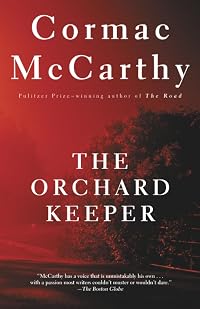
The Orchard Keeper
by Cormac McCarthy
On This Page
Description
In a small, remote community in rural Tennessee in the years between the two world wars, John Wesley Rattner, a young boy, and Marion Sylder, an outlaw and bootlegger who, unbeknownst to either of them, has killed the boy's father enact a drama that seems born of the land itself.Tags
Recommendations






Member Reviews
Rereading McCarthy’s first novel, The Orchard Keeper, reminds me of the origins of his novels as he describes the mountain culture of East Tennessee. The story revolves around three characters: Uncle Arthur Ownby, an isolated woodsman, who lives beside a rotting apple orchard; John Wesley Rattner, a young mountain boy; and Marion Sylder, an outlaw and bootlegger. It begins as the young bootlegger Marion Sylder disposes of a man's body in an abandoned peach orchard, a place that serves as a metaphor for the culture's impending decline, after killing him out of self-defense. The body is discovered by the kindly guardian of the orchard, Arthur Ownby, who chooses not to report it. For seven years, he let it to rest in peace. The elderly show more man also values his personal solitude and tranquility, and when they are invaded by a government holding tank placed on a neighboring hill, he shoots his X at the tank.
Both men adhere to ancient mountain customs, which are by definition ungoverned by the laws of the encroaching contemporary world. In contrast to them, the law enforcement officials who eventually apprehend Sylder, beat him, and committed him to a mental facility appear degenerate. John Wesley Rattner, a youngster who hunts and traps, who is befriended by the two men, and who matures in the novel, represents another important aspect of the book. Ironically, he is the dead man's son. Even though the ancient customs are out of date, he chooses to remain faithful to them.
This first novel shows signs of the novelist that McCarthy will become as he travels further west in his some of his subsequent novels. It is a great place to introduce yourself as a reader of one of our country's greatest novelists. show less
Both men adhere to ancient mountain customs, which are by definition ungoverned by the laws of the encroaching contemporary world. In contrast to them, the law enforcement officials who eventually apprehend Sylder, beat him, and committed him to a mental facility appear degenerate. John Wesley Rattner, a youngster who hunts and traps, who is befriended by the two men, and who matures in the novel, represents another important aspect of the book. Ironically, he is the dead man's son. Even though the ancient customs are out of date, he chooses to remain faithful to them.
This first novel shows signs of the novelist that McCarthy will become as he travels further west in his some of his subsequent novels. It is a great place to introduce yourself as a reader of one of our country's greatest novelists. show less
I am a fan of Cormac McCarthy. His writing style is unlike that of most American authors: minimalist, articulate, clear and - at times - brutal. He has an incredible knack for putting the reader in the story, in the very places he describes.
The Orchard Keeper is maybe one of the lesser stories I have read by him. It focuses on the lives of three people representing three generations, their lives connected, although not necessarily of the same family. The story takes place in Tennessee, around 1950.
The characters are John Wesley Rattner, a young teenager living with his mother; Marion Sylder, a bootlegger who (it turns out) has killed Rattner's father - in self defense - although Rattner does not know this; and elderly Ather Ownby, show more Rattner's uncle, who lives alone with his old dog in a run-down cabin in what used to be an orchard. The interaction between the characters seems incidental to the story, and what becomes of each character is not in any obvious way connected to the other characters.
The story is disjointed, and probably intentionally so. McCarthy's sparse construction style leaves it up to the reader to determine what is going on, with the author providing only significant events as road signs on the twisting narrative. My take is that he has attempted to capture a pivotal period: the post-World-War-II era.
Ownby represents the past - defined by self-sufficiency and independence; an acceptance of the world as it is, and a willingness to function therein. Rattner represents the future - increasingly untethered to the past, seeking a way to pass from what was left of the pre-War world to the demands of the future. This makes Sylder something of a linchpin to the story, a man trying to bridge the past with the future; in the end, his attempts to adapt to the exigencies of the future are ensnared by the remnants of the past.
At least, that's my take on it. This book is redolent of the typical McCarthy writing style - scenes articulated in sparse but driving language that dares the reader to flow with the prose, and rewards the reader willing to do so with an unequaled experience. show less
The Orchard Keeper is maybe one of the lesser stories I have read by him. It focuses on the lives of three people representing three generations, their lives connected, although not necessarily of the same family. The story takes place in Tennessee, around 1950.
The characters are John Wesley Rattner, a young teenager living with his mother; Marion Sylder, a bootlegger who (it turns out) has killed Rattner's father - in self defense - although Rattner does not know this; and elderly Ather Ownby, show more Rattner's uncle, who lives alone with his old dog in a run-down cabin in what used to be an orchard. The interaction between the characters seems incidental to the story, and what becomes of each character is not in any obvious way connected to the other characters.
The story is disjointed, and probably intentionally so. McCarthy's sparse construction style leaves it up to the reader to determine what is going on, with the author providing only significant events as road signs on the twisting narrative. My take is that he has attempted to capture a pivotal period: the post-World-War-II era.
Ownby represents the past - defined by self-sufficiency and independence; an acceptance of the world as it is, and a willingness to function therein. Rattner represents the future - increasingly untethered to the past, seeking a way to pass from what was left of the pre-War world to the demands of the future. This makes Sylder something of a linchpin to the story, a man trying to bridge the past with the future; in the end, his attempts to adapt to the exigencies of the future are ensnared by the remnants of the past.
At least, that's my take on it. This book is redolent of the typical McCarthy writing style - scenes articulated in sparse but driving language that dares the reader to flow with the prose, and rewards the reader willing to do so with an unequaled experience. show less
An intense and atmospheric but ultimately flawed first novel by Cormac McCarthy. It was published in 1965 when McCarthy was in his very early thirties and shows signs both of his later genius and the abiding fault of ambitious first novels in trying to be self-consciously over-literary.
In this case, it is hard to pin down what precisely is going wrong as one works one's way through. The genius is undoubtedly there, the command of language is superb and his descriptions of nature are mostly flawless. Those of humanity are flawless.
He just so damn good at what he does well that it ironically points up where he fails in two directions - overwriting (to the point of ennui at points) and an allusive obscurity that rather arrogantly expects show more us to work as hard at reading the novel as he clearly did at writing it.
The story in itself is more a description of a situation than a clear narrative. Very poor and fairly uneducated Appalachians (the story is set in Tennessee) come up against nature, chance and necessity and, to some extent, an authority which has rules that are to be respected and evaded.
The 'blurb' tries to market the book as a relationship between a bootlegger Marion Snyder and a young boy, John Wesley, whose father, unbeknownst to the lad, was killed, not without justification, by Snyder but I am not sure how much this actually matters.
What we have instead are several inter-connecting threads based around a particular locality which is both partly civilised and partly wild. McCarthy is excellent on such easily forgotten matters as the nature of mud, how water flows in creeks and how people actually hit each other.
The particular set pieces where things happen to people or people make journeys or men relate to other men (or their dogs and other animals) are, in themselves masterful. Women are very much secondary, even irrelevant, to the tale but, frankly, that does not matter here.
So where does it fail? It fails because McCarthy had an extremely bad case of 'similitis' - over and over again in describing nature (which takes up a good prop0rtion of the book) he uses simile and metaphor to excess and, at a certain point, it comes to look over-elaborate and condescending.
The use of 'as if' or 'like' develops into a tic which seems to mimic the epic tradition as if McCarthy was trying to be a little too clever by half in implying that his rough-hewn laconic Appalachians are somehow closer to the Ancient Greeks or Romans than at first sight appears plausible.
In fact, such an idea might have merit. There is an air of implied tragedy (though very muted by a flawed but still partially caring State) as well as perhaps a bucolic relationship to nature, for all its harshness, of Appalachian people compared to those who lived in cities like Knoxville.
It is a noble experiment but it does not quite work because the brilliant natural descriptions get bogged down periodically in this extended 'literariness' that seems surplus to requirements. It is the same error made by the much younger (when he wrote his first novel) Graham Greene.
I used the word 'condescending' and I think that is right especially when you discover that he was a Rhode Island boy who moved to Knoxville when he was six and that his father was a lawyer with the Tennessee Valley Authority.
Perhaps the disciplined and ambitious literary near-graduate (he did not actually graduate) was both fascinated and a little frightened by the horny-handed law avoiders of the hills. Perhaps he is trying to put them in a literary box where they can be understood better by 'his type'.
Let me be clear that he is not at all condescending towards his characters who have a fictional reality self-evidently drawn from close knowledge of the local culture and environment. It is perhaps only condescending in its attempt to make this world literary and box it in.
It is as if he takes a world that he can observe and record masterfully (both the countryside and its human and animal inhabitants) and then treats them as little more than raw material for a somewhat narcissistic literary ambition.
It is the work that matters which is fine but he could have done a better job at masking this and not accidentally showing himself as precursor by half a century of the educated distancing from people who would probably be voting for Trump in 2016.
We cannot make contemporary political points based on a man writing in the early 1960s about the late 1930s (and able to use the word 'nigger' as it would have been used by the men of his time) but the literariness creates two worlds for us - the educated writer's and the uneducated subject.
This is a matter only of style (an obsession with right style is the flaw) rather than of content. McCarthy does not deny agency to his subjects. If there is some stereotyping it is the stereotyping that reflects reality. If a cop is a brute, then it is because cops could be brutes.
The book is a little harder to read than it should be. It is arrogant in style (when dealing with nature) while being the precise opposite in content (especially when dealing with humanity). Things do not always need to be 'like' other things to be fully understood.
Whatever the irritations, you know when you come to the end of the book that you are dealing with more than a fine writer. You are dealing with a potential literary genius. The irritation comes from this genius not seeing the humane wood because of his intense concern with the literary trees. show less
In this case, it is hard to pin down what precisely is going wrong as one works one's way through. The genius is undoubtedly there, the command of language is superb and his descriptions of nature are mostly flawless. Those of humanity are flawless.
He just so damn good at what he does well that it ironically points up where he fails in two directions - overwriting (to the point of ennui at points) and an allusive obscurity that rather arrogantly expects show more us to work as hard at reading the novel as he clearly did at writing it.
The story in itself is more a description of a situation than a clear narrative. Very poor and fairly uneducated Appalachians (the story is set in Tennessee) come up against nature, chance and necessity and, to some extent, an authority which has rules that are to be respected and evaded.
The 'blurb' tries to market the book as a relationship between a bootlegger Marion Snyder and a young boy, John Wesley, whose father, unbeknownst to the lad, was killed, not without justification, by Snyder but I am not sure how much this actually matters.
What we have instead are several inter-connecting threads based around a particular locality which is both partly civilised and partly wild. McCarthy is excellent on such easily forgotten matters as the nature of mud, how water flows in creeks and how people actually hit each other.
The particular set pieces where things happen to people or people make journeys or men relate to other men (or their dogs and other animals) are, in themselves masterful. Women are very much secondary, even irrelevant, to the tale but, frankly, that does not matter here.
So where does it fail? It fails because McCarthy had an extremely bad case of 'similitis' - over and over again in describing nature (which takes up a good prop0rtion of the book) he uses simile and metaphor to excess and, at a certain point, it comes to look over-elaborate and condescending.
The use of 'as if' or 'like' develops into a tic which seems to mimic the epic tradition as if McCarthy was trying to be a little too clever by half in implying that his rough-hewn laconic Appalachians are somehow closer to the Ancient Greeks or Romans than at first sight appears plausible.
In fact, such an idea might have merit. There is an air of implied tragedy (though very muted by a flawed but still partially caring State) as well as perhaps a bucolic relationship to nature, for all its harshness, of Appalachian people compared to those who lived in cities like Knoxville.
It is a noble experiment but it does not quite work because the brilliant natural descriptions get bogged down periodically in this extended 'literariness' that seems surplus to requirements. It is the same error made by the much younger (when he wrote his first novel) Graham Greene.
I used the word 'condescending' and I think that is right especially when you discover that he was a Rhode Island boy who moved to Knoxville when he was six and that his father was a lawyer with the Tennessee Valley Authority.
Perhaps the disciplined and ambitious literary near-graduate (he did not actually graduate) was both fascinated and a little frightened by the horny-handed law avoiders of the hills. Perhaps he is trying to put them in a literary box where they can be understood better by 'his type'.
Let me be clear that he is not at all condescending towards his characters who have a fictional reality self-evidently drawn from close knowledge of the local culture and environment. It is perhaps only condescending in its attempt to make this world literary and box it in.
It is as if he takes a world that he can observe and record masterfully (both the countryside and its human and animal inhabitants) and then treats them as little more than raw material for a somewhat narcissistic literary ambition.
It is the work that matters which is fine but he could have done a better job at masking this and not accidentally showing himself as precursor by half a century of the educated distancing from people who would probably be voting for Trump in 2016.
We cannot make contemporary political points based on a man writing in the early 1960s about the late 1930s (and able to use the word 'nigger' as it would have been used by the men of his time) but the literariness creates two worlds for us - the educated writer's and the uneducated subject.
This is a matter only of style (an obsession with right style is the flaw) rather than of content. McCarthy does not deny agency to his subjects. If there is some stereotyping it is the stereotyping that reflects reality. If a cop is a brute, then it is because cops could be brutes.
The book is a little harder to read than it should be. It is arrogant in style (when dealing with nature) while being the precise opposite in content (especially when dealing with humanity). Things do not always need to be 'like' other things to be fully understood.
Whatever the irritations, you know when you come to the end of the book that you are dealing with more than a fine writer. You are dealing with a potential literary genius. The irritation comes from this genius not seeing the humane wood because of his intense concern with the literary trees. show less
I usually like Cormac McCarthy, but this one saw my feet caught in the mud. I often found it difficult to understand what was happening and to whom (characters in new chapters are often introduced only as 'he', despite having names); the moment when the dog was abandoned was the only moment that really struck me, from a dramatic point of view. The words sometimes look good on the page, but The Orchard Keeper is overgrown and hard to dig into. The narrative is buried under the prose, and the prose is hard ground.
The book is verbose and overeggs its portentousness ("a fevered look in his eye like some wild spodomantic sage divining in driven haste the fate of whole galaxies against their imminent ruin" (pg. 240)) – a common and show more justified criticism of this author. McCarthy can deliver atmosphere and landscape, but I can only listen to twigs crack underfoot so many times. I craved plot. It's well to paint a sunrise, but you've got to do something with the day. show less
The book is verbose and overeggs its portentousness ("a fevered look in his eye like some wild spodomantic sage divining in driven haste the fate of whole galaxies against their imminent ruin" (pg. 240)) – a common and show more justified criticism of this author. McCarthy can deliver atmosphere and landscape, but I can only listen to twigs crack underfoot so many times. I craved plot. It's well to paint a sunrise, but you've got to do something with the day. show less
1. The Orchard Keeper by Cormac McCarthy (1965, 250 page Kindle ebook, read Dec 26 - Jan 1)
Yes, my first review of a book I read this year. I actually waited to review it until I head read something about McCarthy, in Cormac McCarthy : American Canticles by Kenneth Lincoln. But the help Lincoln offered was limited. And, really, it's not a book that lends to any scholarly analysis.
This is McCarthy's first novel, published in 1965. It won the William Faulkner Foundation Award for Notable First Novel in 1966, but didn't sell. And, Lincoln tells me, McCarthy, who twice quite college programs, was meanwhile getting by with essentially no income and no interest in any kind of day job. What he seems to have been doing is immersing himself in show more an atmosphere of words.
There is, in a way, a very simple set of qualities to The Orchard Keeper. The story is straight forward with heavy undertones of Greek mythology. The woman are few and spare and isolated (and, no, none of them have a conversation with other women), and also almost impenetrable. This is about men who fall outside the regular rules. The book opens at the close of the prohibition, and spends most of its time in the 1930's in impoverished eastern Tennessee in the vicinity of the Great Smoky Mountains and in a tradition of lawlessness and rum running. One character was alive during the US Civil War.
Lincoln will tell me McCarthy "clearly has original materials, a lexicon from heaven to hell, an inventive sense of craft and a high regard for the masters of story telling". He also points out the many "loose threads" that aren't all tied off, although the book does close in a satisfying way. I'm left with an impression of sketches worked out and joined together. There is a clear sequence of events, even if McCarthy muddies over the readers sense of it. But many parts feel as if they could stand independently on their own. And, as other reviews have noted, it lacks the narrative drive that is apparently present in his later books.
This, The Orchard Keeper, is about language and atmosphere. Nature is very present and the foundation for everything here. And as wonderful as is the use of language to capture it, it's not beautiful so much as organic, cold, slimy, filthy and everywhere in the way and part of everything. The humans seem to grow out of the natural background language, and sometimes only barely out of it. When Marion Sylder finds himself in a fight for his life, he "stood, still in the somnambulant slow motion as if time itself were running down, and watched, and watched the man turn, seeming to labor not under water but in some more viscous fluid, tortuous, slow, and the jack itself falling down on an angle over the dying forces of gravity...". One wonders if he is still in the womb. Even human speech, with it's heavy Tennessee dialect, seems to just edge out of rest of the language, and just barely make the case that, yes indeed, these men are human and a bit different then the muck and animals and death and decay that surround them...except when these humans come across as sterile, and that will define them, badly, as law enforcement.
McCarthy's metaphysics comes across in odd ways. In how one character was no hero and another tells us there are no heroes anymore. Heaven can come from a pick-up truck ("The truck doors spread simultaneously like rusty wings and fell to in a rattle of glass uncushioned by any upholstery"). And mental peace and perturbation can come in a number of variations, generally a half-step from nature.
Toward early morning he woke, sat up quickly and looked about him. It was still dark and the fire had long since died, still dark and quiet with the silence that seems to be of itself listening, an astral quiet where planets collide soundlessly, beyond the auricular dimension altogether.
I wrote down about 20 words from the book that caught my attention not only because I was not familiar with them, but also because of the wonderful way he used them. The sounds of obscure words that match so perfectly with his atmosphere. Words like slatterns, threnody, gramarye, or auricular. Or more common words used in wonderful forms. Like esotery, as in "an esotery of small items down to pornographic picture books." or encysted, as in to become enclosed in a cyst, in this case of molten glass beer bottles, or purl, like "the riffle and purl of the water".
I don't think one needs to read this book unless they are particularly interested in McCarthy, but I think if you are looking to get lost in language and some curiosity you will find this one rewarding, you might even acquire some kind of sense of Appalachian Tennessee.
2015
https://www.librarything.com/topic/185746#5026918 show less
Yes, my first review of a book I read this year. I actually waited to review it until I head read something about McCarthy, in Cormac McCarthy : American Canticles by Kenneth Lincoln. But the help Lincoln offered was limited. And, really, it's not a book that lends to any scholarly analysis.
This is McCarthy's first novel, published in 1965. It won the William Faulkner Foundation Award for Notable First Novel in 1966, but didn't sell. And, Lincoln tells me, McCarthy, who twice quite college programs, was meanwhile getting by with essentially no income and no interest in any kind of day job. What he seems to have been doing is immersing himself in show more an atmosphere of words.
There is, in a way, a very simple set of qualities to The Orchard Keeper. The story is straight forward with heavy undertones of Greek mythology. The woman are few and spare and isolated (and, no, none of them have a conversation with other women), and also almost impenetrable. This is about men who fall outside the regular rules. The book opens at the close of the prohibition, and spends most of its time in the 1930's in impoverished eastern Tennessee in the vicinity of the Great Smoky Mountains and in a tradition of lawlessness and rum running. One character was alive during the US Civil War.
Lincoln will tell me McCarthy "clearly has original materials, a lexicon from heaven to hell, an inventive sense of craft and a high regard for the masters of story telling". He also points out the many "loose threads" that aren't all tied off, although the book does close in a satisfying way. I'm left with an impression of sketches worked out and joined together. There is a clear sequence of events, even if McCarthy muddies over the readers sense of it. But many parts feel as if they could stand independently on their own. And, as other reviews have noted, it lacks the narrative drive that is apparently present in his later books.
This, The Orchard Keeper, is about language and atmosphere. Nature is very present and the foundation for everything here. And as wonderful as is the use of language to capture it, it's not beautiful so much as organic, cold, slimy, filthy and everywhere in the way and part of everything. The humans seem to grow out of the natural background language, and sometimes only barely out of it. When Marion Sylder finds himself in a fight for his life, he "stood, still in the somnambulant slow motion as if time itself were running down, and watched, and watched the man turn, seeming to labor not under water but in some more viscous fluid, tortuous, slow, and the jack itself falling down on an angle over the dying forces of gravity...". One wonders if he is still in the womb. Even human speech, with it's heavy Tennessee dialect, seems to just edge out of rest of the language, and just barely make the case that, yes indeed, these men are human and a bit different then the muck and animals and death and decay that surround them...except when these humans come across as sterile, and that will define them, badly, as law enforcement.
McCarthy's metaphysics comes across in odd ways. In how one character was no hero and another tells us there are no heroes anymore. Heaven can come from a pick-up truck ("The truck doors spread simultaneously like rusty wings and fell to in a rattle of glass uncushioned by any upholstery"). And mental peace and perturbation can come in a number of variations, generally a half-step from nature.
Toward early morning he woke, sat up quickly and looked about him. It was still dark and the fire had long since died, still dark and quiet with the silence that seems to be of itself listening, an astral quiet where planets collide soundlessly, beyond the auricular dimension altogether.
I wrote down about 20 words from the book that caught my attention not only because I was not familiar with them, but also because of the wonderful way he used them. The sounds of obscure words that match so perfectly with his atmosphere. Words like slatterns, threnody, gramarye, or auricular. Or more common words used in wonderful forms. Like esotery, as in "an esotery of small items down to pornographic picture books." or encysted, as in to become enclosed in a cyst, in this case of molten glass beer bottles, or purl, like "the riffle and purl of the water".
I don't think one needs to read this book unless they are particularly interested in McCarthy, but I think if you are looking to get lost in language and some curiosity you will find this one rewarding, you might even acquire some kind of sense of Appalachian Tennessee.
2015
https://www.librarything.com/topic/185746#5026918 show less
This is a surprising book. Somehow I managed to save McCarthy's first-published novel for the last I had yet to read, so I'm well familiar with his style by now. This book feels thin in some ways, then, because I recognize here the stylistic experiments that he later perfects in other novels. But this is not a bad thing. It's akin to watching Blood Simple after seeing all of the Coen brothers' other movies--it can be a bit transparent sometimes but there's a thrill at beholding the early attempts. Then ending to The Orchard Keeper is a bit more blatantly mythic than I'd have prefered (he actually uses the words "myth" and "legend"), so it feels slighter than I'd want it to because I prefer the subtlty of his subsequent work, but thin show more McCarthy is still a hell of a lot meatier than most fiction out there even today, and I loved the book. show less
I decided to read McCarthy in order, including the novels I hadn't got around to reading the first time, because I just kept re-reading Blood Meridian. Well, as others have noted, this one is more or less McCarthy juvenilia. It gives you much of what is best about his later work--the sheer density of nouns, mostly--but also a bunch of what is worst about 20th century American literature: the tiresome scene-setting ("Fartswogton was a small town about twenty miles outside Nashville..."), the haziness masquerading as profundity (see also: Robinson, Marilynne, Housekeeping, which is more or less this book but with women instead of men), and the simultaneous need for a plot (because there are no ideas, or formal innovations, or really form show more at all) and inability to provide one.
On the other hand, this man could always write sentences. show less
On the other hand, this man could always write sentences. show less
Members
- Recently Added By
Published Reviews
ThingScore 50
Mr. McCarthy is expert in generating an emotional climate, in suggesting instead of in stating, in creating a long succession of brief, dramatic scenes described with flashing visual impact. He may neglect the motivation of some of his characters. He may leave some doubt as to what is going on now. But he does write with torrential power.
added by eereed
Lists

20th Century Literature
1,161 works; 54 members

Cormac McCarthy books
13 works; 1 member
Author Information

36+ Works 104,620 Members
Awards and Honors
Work Relationships
Common Knowledge
- Canonical title*
- Il guardiano del frutteto
- Original title
- The orchard keeper
- Original publication date
- 1965
- People/Characters
- John Wesley Rattner; Marion Sylder
- Important places
- Tennessee, USA
- First words
- For some time now the road had been deserted, white and scorching yet, though the sun was already reddening the western sky.
- Last words
- (Click to show. Warning: May contain spoilers.)On the lips of the strange race that now dwells there their names are myth, legend, dust.
- Publisher's editor
- Erskine, Albert Russel, Jr.
*Some information comes from Common Knowledge in other languages. Click "Edit" for more information.
Classifications
Statistics
- Members
- 1,720
- Popularity
- 12,834
- Reviews
- 40
- Rating
- (3.55)
- Languages
- 9 — Czech, English, French, German, Italian, Norwegian (Bokmål), Polish, Portuguese, Spanish
- Media
- Paper, Audiobook, Ebook
- ISBNs
- 33
- ASINs
- 14