On This Page
Description
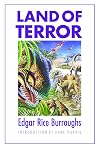
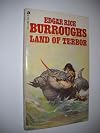
"If you have ever wondered what a civilized man of the twentieth century would do if catapulted into an Old Stone Age where huge cave bears, saber-toothed tigers, monstrous carnivorous dinosaurs, mammoths, and mastodons roamed the savage terrain, you need look no further than Land of Terror, the sixth installment of Edgar Rice Burroughs's Pellucidar series." "Years ago David Innes and Abner Perry bored straight down through five hundred miles of the earth's crust and landed in Pellucidar, show more the savage, primeval world that lies at the center of the earth. This is the story of their continuing adventures in the timeless land of perpetual noon and their encounters with the hideous creatures and savage men who pursue them. Although they encounter enemies at every turn, David and Abner find a few loyal friends as they embark on exhilarating adventures."--BOOK JACKET. show lessTags
Recommendations









Member Reviews
LAND OF TERROR picks up after the end of BACK TO THE STONE AGE and tells of David Innes' and Dian the Beautiful's return home southward from the north, albeit, for the most part, seperately. While, again, ERB expands the map of Pellucidar, introducing new peoples and cultures, the tone of this entry in the chronicle of Pellucidar is an aberration from all the others. It is Pellucidar as if written by Jonathan Swift (of GULLIVER'S TRAVELS) and Lewis Carroll (of ALICE IN WONDERLAND). David Innes first encounters a gender-role-reversed society of fierce Amazon-like women, then a more-than-Stone-Age "civilized" settlement of madmen and madwomen reminiscent of Carroll's Red Queen's Court, then man-eating giants, then giant ants, and then the show more racial role reversal of a black-skinned people contemptuous of white-skinned.
Coincidences ("fortunate chances") that are prevalent in all the earlier Pellucidar books reach an absurd scale in LAND OF TERROR, permitting David Innes and his companion to sneak away after being captured from one odd group to the next, and, yet, still stay in close proximity to his beloved Dian the Beautiful. This strains the necessary readers' suspension of belief and too often fails to engage the reader's investment in the story.
ERB extends this change in perspective to what has been previously understood regarding Pellucidar in the earlier novels where it has been related that a Pellucidarian's natural homing instinct only works on land not when on the sea. But the people of the Floating Islands possess "a new phase of that amazing homing instinct" that works while at sea (p. 124), but, as they are not mainlanders, it only works for locating their island and not the mainland (p. 157).
With this rereading, I found I agreed with the majority of readers and reviewers that LAND OF TERROR is the poorest novel in the Pellucidar series.
And yet . . .
ERBzine contributor "Nkima" in their critique of the book, CHATTERING FROM THE SHOULDER #9 [April 6, 2000 -- which I highly recommend reading (link below)], makes note that it is precisely Burroughs breaking away from the tone and tenor of the earlier books, and that this makes LAND OF TERROR deserving of a fresh, open-minded look in regard to what Burrough's wished to achieve, share, and have readers consider and reflect upon in this novel:
"The fact of the matter is: Burroughs was tired of writing about the hero who wins every battle with ease, and so he diminished the stature of his main characters to more human proportions. ...
I think he lets his characters slip their classical heroic masks to show real human faces underneath. He almost writes about real human beings.
Burroughs seemed to be afraid to write of humans with weaknesses. Anyone weak had to be a complete madman or a degenerate of some sort. Normal people in his world were all heroic and strong. He had to knock Tarzan silly will a blow to his head to move him around in believable scenes at all.
I like it when his formulas were allowed to shatter and we get glimpses of the writer's own humanity. A Great Stomping David, Emperor of Pellucidar, is not a pretty picture, and even he parodies Perry's bringing "civilization" to Pellucidar in this story. "When I left Sari on this expedition I am about to tell you of, Perry was trying to perfect poison gas. He claimed that it would do even more to bring civilization to the Old Stone Age." John Carter of Mars could stand such bringing down a peg."
-- ERBzine Vol. 0324, CHATTERING FROM THE SHOULDER #9 [April 6, 2000];
https://www.erbzine.com/mag3/0324.html
Thus, on reflection and reconsidering the novel, in part, as a Swift-like personal social commentary (however heavy-handed), my initial dislike for the story has softened by a degree of respect for ERB's social insights and perspectives and what he sought to achieve with his adventure characters in a different literary medium. show less
Coincidences ("fortunate chances") that are prevalent in all the earlier Pellucidar books reach an absurd scale in LAND OF TERROR, permitting David Innes and his companion to sneak away after being captured from one odd group to the next, and, yet, still stay in close proximity to his beloved Dian the Beautiful. This strains the necessary readers' suspension of belief and too often fails to engage the reader's investment in the story.
ERB extends this change in perspective to what has been previously understood regarding Pellucidar in the earlier novels where it has been related that a Pellucidarian's natural homing instinct only works on land not when on the sea. But the people of the Floating Islands possess "a new phase of that amazing homing instinct" that works while at sea (p. 124), but, as they are not mainlanders, it only works for locating their island and not the mainland (p. 157).
With this rereading, I found I agreed with the majority of readers and reviewers that LAND OF TERROR is the poorest novel in the Pellucidar series.
And yet . . .
ERBzine contributor "Nkima" in their critique of the book, CHATTERING FROM THE SHOULDER #9 [April 6, 2000 -- which I highly recommend reading (link below)], makes note that it is precisely Burroughs breaking away from the tone and tenor of the earlier books, and that this makes LAND OF TERROR deserving of a fresh, open-minded look in regard to what Burrough's wished to achieve, share, and have readers consider and reflect upon in this novel:
"The fact of the matter is: Burroughs was tired of writing about the hero who wins every battle with ease, and so he diminished the stature of his main characters to more human proportions. ...
I think he lets his characters slip their classical heroic masks to show real human faces underneath. He almost writes about real human beings.
Burroughs seemed to be afraid to write of humans with weaknesses. Anyone weak had to be a complete madman or a degenerate of some sort. Normal people in his world were all heroic and strong. He had to knock Tarzan silly will a blow to his head to move him around in believable scenes at all.
I like it when his formulas were allowed to shatter and we get glimpses of the writer's own humanity. A Great Stomping David, Emperor of Pellucidar, is not a pretty picture, and even he parodies Perry's bringing "civilization" to Pellucidar in this story. "When I left Sari on this expedition I am about to tell you of, Perry was trying to perfect poison gas. He claimed that it would do even more to bring civilization to the Old Stone Age." John Carter of Mars could stand such bringing down a peg."
-- ERBzine Vol. 0324, CHATTERING FROM THE SHOULDER #9 [April 6, 2000];
https://www.erbzine.com/mag3/0324.html
Thus, on reflection and reconsidering the novel, in part, as a Swift-like personal social commentary (however heavy-handed), my initial dislike for the story has softened by a degree of respect for ERB's social insights and perspectives and what he sought to achieve with his adventure characters in a different literary medium. show less
LAND OF TERROR picks up after the end of BACK TO THE STONE AGE and tells of David Innes' and Dian the Beautiful's return home southward from the north, albeit, for the most part, seperately. While, again, ERB expands the map of Pellucidar, introducing new peoples and cultures, the tone of this entry in the chronicle of Pellucidar is an aberration from all the others. It is Pellucidar as if written by Jonathan Swift (of GULLIVER'S TRAVELS) and Lewis Carroll (of ALICE IN WONDERLAND). David Innes first encounters a gender-role-reversed society of fierce Amazon-like women, then a more-than-Stone-Age "civilized" settlement of madmen and madwomen reminiscent of Carroll's Red Queen's Court, then man-eating giants, then giant ants, and then the show more racial role reversal of a black-skinned people contemptuous of white-skinned.
Coincidences ("fortunate chances") that are prevalent in all the earlier Pellucidar books reach an absurd scale in LAND OF TERROR, permitting David Innes and his companion to sneak away after being captured from one odd group to the next, and, yet, still stay in close proximity to his beloved Dian the Beautiful. This strains the necessary readers' suspension of belief and too often fails to engage the reader's investment in the story.
ERB extends this change in perspective to what has been previously understood regarding Pellucidar in the earlier novels where it has been related that a Pellucidarian's natural homing instinct only works on land not when on the sea. But the people of the Floating Islands possess "a new phase of that amazing homing instinct" that works while at sea (p. 224), but, as they are not mainlanders, it only works for locating their island and not the mainland (p. 283).
With this rereading, I found I agreed with the majority of readers and reviewers that LAND OF TERROR is the poorest novel in the Pellucidar series.
And yet . . .
ERBzine contributor "Nkima" in their critique of the book, CHATTERING FROM THE SHOULDER #9 [April 6, 2000 -- which I highly recommend reading (link below)], makes note that it is precisely Burroughs breaking away from the tone and tenor of the earlier books, and that this makes LAND OF TERROR deserving of a fresh, open-minded look in regard to what Burrough's wished to achieve, share, and have readers consider and reflect upon in this novel:
"The fact of the matter is: Burroughs was tired of writing about the hero who wins every battle with ease, and so he diminished the stature of his main characters to more human proportions. ...
I think he lets his characters slip their classical heroic masks to show real human faces underneath. He almost writes about real human beings.
Burroughs seemed to be afraid to write of humans with weaknesses. Anyone weak had to be a complete madman or a degenerate of some sort. Normal people in his world were all heroic and strong. He had to knock Tarzan silly will a blow to his head to move him around in believable scenes at all.
I like it when his formulas were allowed to shatter and we get glimpses of the writer's own humanity. A Great Stomping David, Emperor of Pellucidar, is not a pretty picture, and even he parodies Perry's bringing "civilization" to Pellucidar in this story. "When I left Sari on this expedition I am about to tell you of, Perry was trying to perfect poison gas. He claimed that it would do even more to bring civilization to the Old Stone Age." John Carter of Mars could stand such bringing down a peg."
-- ERBzine Vol. 0324, CHATTERING FROM THE SHOULDER #9 [April 6, 2000];
https://www.erbzine.com/mag3/0324.html
Thus, on reflection and reconsidering the novel, in part, as a Swift-like personal social commentary (however heavy-handed), my initial dislike for the story has softened by a degree of respect for ERB's social insights and perspectives and what he sought to achieve with his adventure characters in a different literary medium. show less
Coincidences ("fortunate chances") that are prevalent in all the earlier Pellucidar books reach an absurd scale in LAND OF TERROR, permitting David Innes and his companion to sneak away after being captured from one odd group to the next, and, yet, still stay in close proximity to his beloved Dian the Beautiful. This strains the necessary readers' suspension of belief and too often fails to engage the reader's investment in the story.
ERB extends this change in perspective to what has been previously understood regarding Pellucidar in the earlier novels where it has been related that a Pellucidarian's natural homing instinct only works on land not when on the sea. But the people of the Floating Islands possess "a new phase of that amazing homing instinct" that works while at sea (p. 224), but, as they are not mainlanders, it only works for locating their island and not the mainland (p. 283).
With this rereading, I found I agreed with the majority of readers and reviewers that LAND OF TERROR is the poorest novel in the Pellucidar series.
And yet . . .
ERBzine contributor "Nkima" in their critique of the book, CHATTERING FROM THE SHOULDER #9 [April 6, 2000 -- which I highly recommend reading (link below)], makes note that it is precisely Burroughs breaking away from the tone and tenor of the earlier books, and that this makes LAND OF TERROR deserving of a fresh, open-minded look in regard to what Burrough's wished to achieve, share, and have readers consider and reflect upon in this novel:
"The fact of the matter is: Burroughs was tired of writing about the hero who wins every battle with ease, and so he diminished the stature of his main characters to more human proportions. ...
I think he lets his characters slip their classical heroic masks to show real human faces underneath. He almost writes about real human beings.
Burroughs seemed to be afraid to write of humans with weaknesses. Anyone weak had to be a complete madman or a degenerate of some sort. Normal people in his world were all heroic and strong. He had to knock Tarzan silly will a blow to his head to move him around in believable scenes at all.
I like it when his formulas were allowed to shatter and we get glimpses of the writer's own humanity. A Great Stomping David, Emperor of Pellucidar, is not a pretty picture, and even he parodies Perry's bringing "civilization" to Pellucidar in this story. "When I left Sari on this expedition I am about to tell you of, Perry was trying to perfect poison gas. He claimed that it would do even more to bring civilization to the Old Stone Age." John Carter of Mars could stand such bringing down a peg."
-- ERBzine Vol. 0324, CHATTERING FROM THE SHOULDER #9 [April 6, 2000];
https://www.erbzine.com/mag3/0324.html
Thus, on reflection and reconsidering the novel, in part, as a Swift-like personal social commentary (however heavy-handed), my initial dislike for the story has softened by a degree of respect for ERB's social insights and perspectives and what he sought to achieve with his adventure characters in a different literary medium. show less
https://nwhyte.livejournal.com/3424586.html
One of Burroughs’ Pellucidar novels, published in 1944. Our hero goes on an Odyssey-style voyage in the world hidden beneath our own where he has already resided for many years. He escapes from strange cultures where women and non-white men are in charge, because he is smarter. He is gallant towards his own womenfolk, even though they are indistinguishable as characters. In the end, he returns to the safe haven of white male supremacy and order is restored. It's a racist mess.
One of Burroughs’ Pellucidar novels, published in 1944. Our hero goes on an Odyssey-style voyage in the world hidden beneath our own where he has already resided for many years. He escapes from strange cultures where women and non-white men are in charge, because he is smarter. He is gallant towards his own womenfolk, even though they are indistinguishable as characters. In the end, he returns to the safe haven of white male supremacy and order is restored. It's a racist mess.
As much as I love Edgar Rice Burroughs' books and the Pellucidar series in general, it's clear he was coasting by this point. Whilst Innes stumbling from one bizarre situation to another was fun at times, even taking into account the hand-wavy logic set up in the previous books, things didn't really add up. We have a random tribe of gender swaps and a random tribe of the insane; none of which are handled with anything more than his usual sledgehammer sensitivity (which was to be expected to be honest, especially given his jarring sexism was as apparent as ever), before moving on and forgetting about them. The dialogue is worse than ever and the world just seems less interesting than it once did. Too often it felt like a bad roleplaying show more adventure or those dodgy episodes from the third season of Lexx.
Having said that, there were enjoyable moments of high adventure. Battling prehistoric and weird monsters can never get boring and there was a touching set of scenes with some Mammoths he befriends. I also enjoyed the giant ant tribe, which is a lost world trope I'm becoming rather fond of. All this was interspersed with his attempts at social commentary on our civilisation ranging from barely insightful to tongue in cheek.
Overall it was the usual formula, but looking more tired and vacuous than the previous stories. I'm frankly impressed it took until book six before the shine wore off for me. show less
Having said that, there were enjoyable moments of high adventure. Battling prehistoric and weird monsters can never get boring and there was a touching set of scenes with some Mammoths he befriends. I also enjoyed the giant ant tribe, which is a lost world trope I'm becoming rather fond of. All this was interspersed with his attempts at social commentary on our civilisation ranging from barely insightful to tongue in cheek.
Overall it was the usual formula, but looking more tired and vacuous than the previous stories. I'm frankly impressed it took until book six before the shine wore off for me. show less
One can almost feel the mad laughter of Burroughs as he lets go of all reality in this sixth book of Pellucidar. He creates ant people and a city where everyone is insane; a mother strang les her child to death because ":it feels good";so-called "priests do perennial cartwheels about an ugly totem to appease the gods. Wait a minute! This sounds like any Amiericn city of 2008 today.
Pellucidar Series # 6
Al final de Regreso a la Edad de Piedra, David Innes encontraba al fin a Von Horst, plenamente integrado en Pelúcidar, como nuevo líder de Lo-Har. Pero, a menudo, regresar a casa en un mundo como Pellucidar puede convertirse en una odisea, y eso es lo que le sucede a David Innes, cuyo regreso a Sari se tuerce casi desde el principio, lo cual sirve de excusa a Edgar Rice Burroughs para mostrarnos nuevas áreas inexploradas del mundo interior, así como nuevas criaturas y razas.
Nov 30, 2022Spanish
Members
- Recently Added By
Lists

1945 (2020) Retro-Hugo Eligible Novels
14 works; 1 member

Books Read in 2020
4,379 works; 124 members
Author Information

768+ Works 65,327 Members
Edgar Rice Burroughs was born on September 1, 1875, in Chicago. His father, George Tyler was a distiller and a battery manufacturer. Early in life Burroughs attempted to support his family in a variety of occupations, including railroad policeman, business partner, and miner. None of these proved successful. However, Burroughs had always enjoyed show more reading adventure fiction and decided to try his hand at writing. His first attempt, written under the pseudonym Normal Bean, sold very quickly and Burroughs' career took off. Although critics and educators have not always been supportive of Burroughs' writing, the characters in his stories have entertained readers for many years. Tarzan was the most popular, earning Burroughs enough money to start his own publishing house and a motion picture company. Another character, John Carter, is the hero of Burroughs' Mars adventure series. The continuing popularity of these characters has led some critics to reconsider the value of Burroughs' writing and to acknowledge significant themes in his stories. Burroughs died on March 19, 1950. (Bowker Author Biography) show less
Some Editions
Awards and Honors
Awards
Series

Belongs to Publisher Series
Work Relationships
Common Knowledge
- Original publication date
- 1944
- People/Characters
- Abner Perry
- First words
- When Jason Gridley got in touch with me recently by radio and told me it was The Year of Our Lord Nineteen Hundred and Thirty-nine on the outer crust, I could scarcely believe him, for it seems scarcely any time at all since ... (show all)Abner Perry and I bored our way through the Earth's crust to the inner world in the great iron mole that Perry had invented for the purpose of prospecting for minerals just beneath the surface of the Earth.
- Last words
- (Click to show. Warning: May contain spoilers.)Lu-Bra was returned to Suvi; and the warriors who escorted her brought back word that made me still happier, and also gave me some slight idea as to the length of time that I was a prisoner on Ruva, for the word that they brought me was that Zor and Kleeto had reached Suvi safely, and that they had mated and already had a little son.
Classifications
Statistics
- Members
- 437
- Popularity
- 70,029
- Reviews
- 7
- Rating
- (3.33)
- Languages
- Dutch, English, Spanish
- Media
- Paper, Ebook
- ISBNs
- 14
- ASINs
- 22