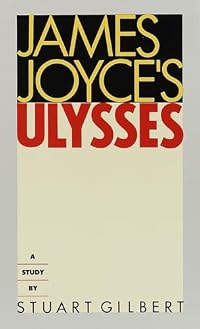
James Joyce's Ulysses: A Study
by Stuart Gilbert
On This Page
Description
This classic exegesis was written under Joyce's supervision.Tags
Recommendations

















Member Reviews
One of the earliest exegetical treatments of Joyce’s masterpiece. Gilbert had been commissioned by Sylvia Beach to work on the French translation of Ulysses, and subsequently spent many hours going over the text with Joyce himself. Gilbert emphasizes (perhaps overmuch) the symbolism and mythology deployed by Joyce, having been directed to works that Joyce claimed as sources, from the Odyssey to Victor Bérard’s Les Phéniciens et l’Odyssée to Esoteric Buddhism and Growth of the Soul by A.P. Sinnett (biographer of Mme Blavatsky). Nabokov thought that Gilbert’s book was dull and pedantic, but we have to remember that Gilbert meant to defend Joyce against those who said that Ulysses was formless, chaotic and nonsensical — hence show more the emphasis on formal and classical elements.
Later commentators point out that there are many different ways of reading Ulysses (of course there are), but the chapter summaries by Gilbert are useful for indicating the influence of Homer and drawing attention to phrases and symbols that recur across episodes. At the time Gilbert’s book was published, Ulysses was banned in English-speaking countries, so the long passages from Joyce’s work included in Gilbert’s chapter analyses were a kind of Anglo-Irish samizdat.
Gilbert is not dull, but he is serious; he had little to say about Joyce’s humor. Still, I like reading a good erudite discussion about the ancient Mediterranean and esotericism. Also, it is from Gilbert that we first learned of the schema that Joyce had in mind while composing Ulysses — the scene/hour/organ/art/color/symbol/technic framework Joyce typed out for the avant-garde composer George Antheil in 1924 (which you can see in the “One Hundred Years of James Joyce’s Ulysses” exhibition on the Morgan Library’s website).
Not the definitive treatment of Ulysses (there probably isn’t one), but indispensable nonetheless. show less
Later commentators point out that there are many different ways of reading Ulysses (of course there are), but the chapter summaries by Gilbert are useful for indicating the influence of Homer and drawing attention to phrases and symbols that recur across episodes. At the time Gilbert’s book was published, Ulysses was banned in English-speaking countries, so the long passages from Joyce’s work included in Gilbert’s chapter analyses were a kind of Anglo-Irish samizdat.
Gilbert is not dull, but he is serious; he had little to say about Joyce’s humor. Still, I like reading a good erudite discussion about the ancient Mediterranean and esotericism. Also, it is from Gilbert that we first learned of the schema that Joyce had in mind while composing Ulysses — the scene/hour/organ/art/color/symbol/technic framework Joyce typed out for the avant-garde composer George Antheil in 1924 (which you can see in the “One Hundred Years of James Joyce’s Ulysses” exhibition on the Morgan Library’s website).
Not the definitive treatment of Ulysses (there probably isn’t one), but indispensable nonetheless. show less
A helpful guide after reading Joyce, but like most how-to-read books it tells much I'm not interested in and leaves out many of the things I wondered about.
The penultimate title on my to-read list in preparation for reading James Joyce's Ulysses this year. I was convinced from reading in Nora: A Biography of Nora Joyce of the close collaboration Joyce made with Gilbert that this is a good prep work.
- Nora: A Biography of Nora Joyce
Jewish (Semitic) Leopold Bloom moves through the a real Dublin landscape as Ulysses made his Odyssey through the Semitic-named real geography of the Mediterranean.
Further..
Around him Joyce was gathering a new circle. Stanislaus distrusted them as sycophants, and perhaps they were. They were also hard-working sycophants, deeply committed to helping him with the preparation and publication of his difficult new book. Chief among them were Maria Jolas and her husband Eugene, an energetic American couple who were publishing extracts from Work in Progress in their cosmopolitan literary journal, transition. Another important recruit was Stuart Gilbert. Gilbert (whoseshow more
name Joyce pronounced with three syllables: Gi-la-bert) was an Oxford-trained lawyer who had served as a judge in Burma and who was devoting himself to explicating and translating Ulysses. Gilbert's French wife, Moune, a small lively woman, was active in publishing. She soon became one of Nora's best friends.
...
In the afternoon Stuart Gilbert came over from his boarding house, and the two men worked on Gilbert's study of Ulysses, which was to become for many readers an indispensable, if humorless, guide to the difficult book.
- Nora: A Biography of Nora Joyce
Jewish (Semitic) Leopold Bloom moves through the a real Dublin landscape as Ulysses made his Odyssey through the Semitic-named real geography of the Mediterranean.
In the course of his long study of Homeric origins M. Bérard demonstrates that the poet of the Odyssey must have had access to, and carefully studied, some Phoenician record of voyages in the eastern and western Mediterranean, a pre-Achaean "Mirror of the Sea". A very large number of the Odyssean place-names are of Semitic origin; these were the names under which the places came to be known to the earliest Greek navigators. The latter translated the names into their own tongue, and so each place had a pair of names-the Phoenician and the Greek. For instance (Odyssey X, 135) Circe's island is named Aiaie. The "island of Circe" is an exact translation of the Semitic compound Ai-aie...
Further..
Obviously the value of such a work as this depends on its authenticity, and "authenticity" in the present case implies that the ideas, interpretations and explanations put forward in these pages are not capricious or speculative, but were endorsed by Joyce himself. Thus it may be of some interest if I describe briefly the circumstances leading up to the writing of this book and those under which it was writ-ten. It was when I was assisting MM. Auguste Morel and Valéry Larbaud in the translation of Ulysses into French that the project suggested itself to me. In making a translation the first essential is thoroughly to understand what one is translating; any vagueness or uncertainty in this respect must lead to failure. This applies especially when the texture of the work to be translated is intricate, or the meaning elusive. One begins with a close analysis, and only when the implications of the original are fully unravelled does one start looking for approximations in the other language. Thus I made a point of consulting Joyce on every doubtful point, of ascertaining from him the exact associations he had in mind when using proper names...show less
When you need a 450-page book to understand an 800-page book, you are in deep water.
The less one leans on Stuart Gilbert books the better.Read the book out loud, JAAJ was a writer for the ear. all the exa-Jesuitical stuff is dandy, but soak your ears with Ulysses. Relish the spoken word.
absolutely invaluable for understanding ULYSSES -- compares THE ODYSSEY book by book with ULYSSES. Read Joyce with Gilbert at your elbow.
Ratings
Members
- Recently Added By
Lists

20th Century Literature
1,161 works; 55 members
Author Information

4+ Works 1,275 Members
Some Editions
Series
Belongs to Publisher Series
Peregrine Books (Y13)
Work Relationships
Is a study of
Common Knowledge
- Canonical title
- James Joyce's Ulysses: A Study
- Original title
- James Joyce's Ulysses: a study
- Original publication date
- 1930
- People/Characters
- Aeolus
- Blurbers
- Saturday Review
Classifications
Statistics
- Members
- 1,144
- Popularity
- 21,927
- Reviews
- 6
- Rating
- (3.81)
- Languages
- English, German
- Media
- Paper
- ISBNs
- 7
- ASINs
- 29