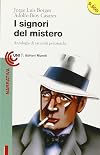
Los mejores cuentos policiales 1-2
by Adolfo Bioy Casares (Editor), Jorge Luis Borges (Editor)
On This Page
Description
"Para elegir los textos de este volumen hemos seguido el único criterio posible, el criterio hedónico. La lectura de cada una de las piezas que lo componen fue para nosotros muy grata." La relación que cultivaron por más de medio siglo Jorge Luis Borges y Adolfo Bioy Casares escribió uno de los capítulos más singulares de la literatura del siglo XX: la obra en colaboración que publicaron con los seudónimos comunes H. Bustos Domecq y B. Suarez Lynch. Del mismo modo, la notoria show more pasión que compartieron a lo largo de sus vidas por el género policial encontró expresión en dos antologías beneficiadas por el privilegio de su selección exquisita: Los mejores cuentos policiales I y II, editadas originalmente en 1943 y 1951, que aquí se reúnen en un único volumen por primera vez. Si cada uno de los treinta y un cuentos que forma parte de este libro tiene reservado algo de la felicidad que Borges y Bioy encontraron en su lectura, el conjunto puede considerarse al mismo tiempo celebración del género y de su amistad. show lessTags
Recommendations






















Member Reviews
PRATELEIRA EUNICE1 LIVRO 20
Aunque, lógicamente, hay algunos relatos mejores que otros, lo cierto es que la selección es muy interesante, muy amena. Desde el humorismo meramente lúdico de "Cazador cazado", de W. Collins, al auténtico suspense de "Si muriera antes de despertar", de W. Irish, pasando por la historia de ambiente esotérico de "Las doce figuras del mundo", de los propios compiladores, el cuento de fantasmas llamado "Personas o cosas desconocidas", de J.D. Carr o la clásica historia de magos que cierra el volumen. Me gustaron, además del relato de Irish, los dos que le siguen: "Aventura en la Mansión de las Tinieblas", de E. Queen (clásica historia de asesinato en un espacio cerrado), y "Tres hombres muertos", de E. Phillpots (historia con un show more cierto regusto exótico, que nunca acaba de resolverse hasta el final). show less
Jul 7, 2011Spanish
Como fervientes aficionados al género policial y de intriga, que cultivaron tanto conjuntamente como por separado, y como grandes escritores, pocas personas podrían resultar más idóneas que Jorge Luis Borges y Adolfo Bioy Casares para compilar una antología de Los mejores cuentos policiales.
Aug 29, 2021Spanish
Ratings
Members
- Recently Added By
Author Information

Adolfo Bioy Casares has collaborated with Jorge Luis Borges on a number of works. They compiled Anthology of Fantastic Literature (1940), a documentation of the development of Spanish American suprarealism, and Six Problems for Don Isidro Parodi (1981), a playful and inventive variation on the theme of the detective who cannot visit the scene of show more the crime. Bioy Casares's numerous works are characterized by intelligence and a sense of playful fantasy. The Invention of Morel (1953), concerns a scientist's illusions about immortality. Asleep in the Sun is a bizarre tale written in an epistolary form. Ultimately the recipient of the letter is left to wonder whether, in fact, the puzzle has any solution or whether, like much of Bioy Casares's and Borges's work, it is an inside joke between author and reader. (Bowker Author Biography) show less

Born in Buenos Aires, Argentina, in 1899, Jorge Borges was educated by an English governess and later studied in Europe. He returned to Buenos Aires in 1921, where he helped to found several avant-garde literary periodicals. In 1955, after the fall of Juan Peron, whom he vigorously opposed, he was appointed director of the Argentine National show more Library. With Samuel Beckett he was awarded the $10,000 International Publishers Prize in 1961, which helped to establish him as one of the most prominent writers in the world. Borges regularly taught and lectured throughout the United States and Europe. His ideas have been a profound influence on writers throughout the Western world and on the most recent developments in literary and critical theory. A prolific writer of essays, short stories, and plays, Borges's concerns are perhaps clearest in his stories. He regarded people's endeavors to understand an incomprehensible world as fiction; hence, his fiction is metaphysical and based on what he called an esthetics of the intellect. Some critics have called him a mystic of the intellect. Dreamtigers (1960) is considered a masterpiece. A central image in Borges's work is the labyrinth, a mental and poetic construct, that he considered a universe in miniature, which human beings build and therefore believe they control but which nevertheless traps them. In spite of Borges's belief that people cannot understand the chaotic world, he continually attempted to do so in his writing. Much of his work deals with people's efforts to find the center of the labyrinth, symbolic of achieving understanding of their place in a mysterious universe. In such later works as The Gold of the Tigers, Borges wrote of his lifelong descent into blindness and how it affected his perceptions of the world and himself as a writer. Borges died in Geneva in 1986. (Bowker Author Biography) show less
Work Relationships
Common Knowledge
- Canonical title
- Los mejores cuentos policiales 1-2
- Original title
- Los mejores cuentos policiales
Classifications
Statistics
- Members
- 121
- Popularity
- 270,502
- Reviews
- 3
- Rating
- (3.82)
- Languages
- English, Italian, Spanish
- Media
- Paper
- ISBNs
- 13
- ASINs
- 3