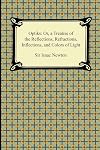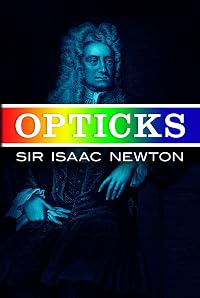
Opticks: Or a Treatise of the Reflections, Refractions, Inflections & Colours of Light
by Sir Isaac Newton
On This Page
Description
From 1670 to 1672, Newton lectured on optics while developing his theory of color. This led to his invention of the refracting telescope in 1672, which would correct chromatic aberration in the traditional refracting telescope, and so impressed the Royal Society that they encouraged him to publish his work. "Opticks" was Newton's second major contribution in this field, and offered new insights into the nature of color, light, and the phenomena of diffraction. The book also includes Newton's show more Queries, which address a wide range of physical phenomena, include the nature and transmission of heat, the possible cause of gravity, electrical phenomena, chemical action, and ethics of both science and human conduct. show lessTags
Recommendations







Member Reviews
This groundbreaking treatise on the nature of light was originally written in 1704 by Sir Isaac Newton. This particular book is based on the fourth edition, which was printed in 1730. Using practical and repeatable experiments, Newton demonstrates the nature of light and the origins of color. I'm not sure if this is abridged or not but either way it is quite interesting.
I have read The Principia which is also by Newton, but Opticks is far more understandable and accessible. Principia was mostly based on theory and was translated from Latin, so it is a breath of fresh air to have a book that was originally written in English and has images that are close to the text that refers to them. Also, Opticks is quite practical since the show more experiments can be reproduced. All you need is a set of prisms, natural light and a way to shut out that light.
The treatise is split into three books, but I don't think it is complete. I believe the preface mentioned that some of the book was removed in the later editions, but I don't think it took away from the book itself. This book also contains a portion containing the history of the treatise and a forward by Albert Einstein.
All in all, this book was quite amazing and well written. I would certainly read this again. show less
I have read The Principia which is also by Newton, but Opticks is far more understandable and accessible. Principia was mostly based on theory and was translated from Latin, so it is a breath of fresh air to have a book that was originally written in English and has images that are close to the text that refers to them. Also, Opticks is quite practical since the show more experiments can be reproduced. All you need is a set of prisms, natural light and a way to shut out that light.
The treatise is split into three books, but I don't think it is complete. I believe the preface mentioned that some of the book was removed in the later editions, but I don't think it took away from the book itself. This book also contains a portion containing the history of the treatise and a forward by Albert Einstein.
All in all, this book was quite amazing and well written. I would certainly read this again. show less
Ratings
Members
- Recently Added By
Author Information

170+ Works 3,411 Members
Born at Woolsthorpe, England, Sir Isaac Newton was educated at Trinity College, Cambridge University, where he graduated in 1665. During the plague of 1666, he remained at Woolsthorpe, during which time he formulated his theory of fluxions (the infinitesimal calculus) and the main outlines of his theories of mechanics, astronomy, and optics, show more including the theory of universal gravitation. The results of his researches were not circulated until 1669, but when he returned to Trinity in 1667, he was immediately appointed to succeed his teacher as professor of mathematics. His greatest work, the Mathematical Principles of Natural Philosophy, was published in 1687 to immediate and universal acclaim. Newton was elected to Parliament in 1689. In 1699, he was appointed head of the royal mint, and four years later he was elected president of the Royal Society; both positions he held until his death. In later life, Newton devoted his main intellectual energies to theological speculation and alchemical experiments. In April 1705, Queen Anne knighted Newton during a royal visit to Trinity College, Cambridge. He was only the second scientist to have been awarded knighthood. Newton died in his sleep in London on March 31, 1727, and was buried in Westminster Abbey. Because of his scientific nature, Newton's religious beliefs were never wholly known. His study of the laws of motion and universal gravitation became his best-known discoveries, but after much examination he admitted that, "Gravity explains the motions of the planets, but it cannot explain who set the planets in motion. God governs all things and knows all that is or can be done." (Bowker Author Biography) show less
Series
Belongs to Publisher Series
Work Relationships
Is contained in
Common Knowledge
- Canonical title
- Opticks: Or a Treatise of the Reflections, Refractions, Inflections & Colours of Light
- Original publication date
- 1704
Classifications
- Genres
- Science & Nature, Nonfiction, General Nonfiction, History, Philosophy
- DDC/MDS
- 535 — Natural sciences & mathematics Physics Light
- LCC
- QC353 .N57 — Science Physics Physics Optics. Light
- BISAC
Statistics
- Members
- 341
- Popularity
- 92,908
- Reviews
- 2
- Rating
- (3.85)
- Languages
- 5 — English, French, German, Latin, Spanish
- Media
- Paper, Ebook
- ISBNs
- 27
- UPCs
- 1
- ASINs
- 7