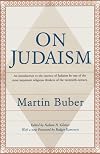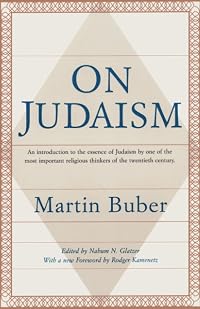
On Judaism
by Martin Buber
On This Page
Description
Edited by Nahum N. Glatzer With a new Foreword by Rodger Kamenetz "The question I put before you, as well as before myself, is the question of the meaning of Judaism for the Jews. Why do we call ourselves Jews? I want to speak to you not of an abstraction but of your own life . . . its authenticity and essence." With these words, Martin Buber takes us on a journey into the heart of Judaism--its spirit, vision, and relevance to modern life.Tags
Recommendations



































Member Reviews
I tried to read Buber two other times in the past 15 years, but had trouble understanding/really getting into it. Although I didn't fall in love with this book, i did finish it. It made me think about what it means to be Jewish and gave me insight into the thinking before the invasion of Palestine and the genocide of the Palestinian people. I'd read more of his work
The author is intimately familiar with the positions of relevant thinkers.
Ratings
Members
- Recently Added By
Author Information

247+ Works 13,039 Members
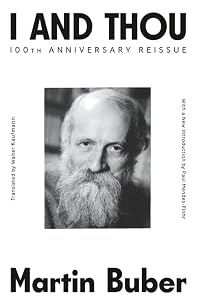
Martin Buber was born in Vienna, the son of Solomon Buber, a scholar of Midrashic and medieval literature. Martin Buber studied at the universities of Vienna, Leipzig, Zurich, and Berlin, under Wilhelm Dilthey and Georg Simmel. As a young student, he joined the Zionist movement, advocating the renewal of Jewish culture as opposed to Theodor show more Herzl's political Zionism. At age 26 he became interested in Hasidic thought and translated the tales of Nahman of Bratslav. Hasidism had a profound impact on Buber's thought. He credited it as being the inspiration for his theories of spirituality, community, and dialogue. Buber is responsible for bringing Hasidism to the attention of young German intellectuals who previously had scorned it as the product of ignorant eastern European Jewish peasants. Buber also wrote about utopian socialism, education, Zionism, and respect for the Palestinian Arabs, and, with Franz Rosenzweig, he translated the Bible. He was appointed to a professorship at the University of Frankfurt in 1925, but, when the Nazis came to power, he received an appointment at the Hebrew University of Jerusalem. Buber died in 1965. (Bowker Author Biography) show less
Common Knowledge
- Original language
- German
Classifications
Statistics
- Members
- 323
- Popularity
- 99,137
- Reviews
- 2
- Rating
- (3.86)
- Languages
- Dutch, English, French
- Media
- Paper, Ebook
- ISBNs
- 6
- ASINs
- 4