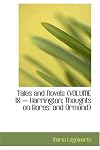
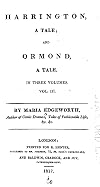
Harrington; Thoughts on Bores; and Ormond
by Maria Edgeworth
On This Page
Description
Excerpt: ... your honour afore he'd settle-I tell him 'tis the change of beds, which always hinders a body to sleep the first night." The sense of having totally forgotten the poor fellow-the contrast between this forgetfulness and the anxiety and contrition of the two preceding nights, actually surprised Ormond: he could hardly believe that he was one and the same person. Then came excuses to himself: "Gratitude- common civility-the peremptoriness of King Corny-his passionate temper, when show more opposed on this tender point-the locked door-and two to one: in short, there was an impossibility in the circumstances of doing otherwise than what he had done. But then the same impossibility-the same circumstances-might recur the next night, and the next, and so on: the peremptory temper of King Corny was not likely to alter, and the moral obligation of gratitude would continue the same; so that at nineteen was he to become, from complaisance, what his soul and body abhorred-an habitual drunkard? And what would become of Lady Annaly's interest in his fate or his improvement?" The two questions were not of equal importance, but our hero was at this time far from having any just proportion in his reasoning: it was well he reasoned at all. The argument as to the obligation of gratitude-the view he had taken of the never-ending nature of the evil, which must be the consequence of beginning with weak complaisance-above all, the feeling that he had so lost his reason as not only to forget Moriarty, but to have been again incapable of commanding his passions, if any thing had occurred to cross his temper, determined Ormond to make a firm resistance on the next occasion that should occur: it did occur the very next night. After a dinner given to his chief tenants and the genteel people of the islands- a dinner in honour and in introduction of his adopted son, King Corny gave a toast "to the Prince presumptive," as he now styled him-a bumper toast. Soon... show lessTags
Members
- Recently Added By
Lists

Books Featured in Jane Austen's Bookshelf
37 works; 7 members
Author Information

149+ Works 3,765 Members
Maria Edgeworth was born in Blackbourton, Oxfordshire, England on January 1, 1767. She was educated at a school in Derby, England and then attended a school in London. In 1782, she went to live with her father at Edgeworthstown and acted as his chief assistant and secretary in the management of his estates. She helped educate her brothers and show more sisters, and the stories she invented for them were later published under the title The Parents Assistant. Her novels and stories fall into three categories: sketches of Irish life, commentary on contemporary English society, and instruction in children's moral training. Her first work, Letters for Literary Ladies, a plea for the reform of woman's education, was published in 1795. She would later collaborate with her father Richard Lovell Edgeworth on Practical Education and Essays on Professional Education. Her first novel, Castle Rackrent, was published in 1800. Her other works include Belinda, Moral Tales, The Absentee, and Helen. During the Irish famine (1845-1847), she did what she could to alleviate the suffering of the Irish peasants including having a large quantity of flour and rice sent over from Boston to give out among the starving. She died in 1849 at the age of 82. (Bowker Author Biography) show less
Series
Belongs to Publisher Series
Common Knowledge
- Canonical title
- Harrington; Thoughts on Bores; and Ormond
Classifications
Statistics
- Members
- 12
- Popularity
- 1,873,865
- Languages
- English
- Media
- Paper, Ebook
- ISBNs
- 5
- ASINs
- 2