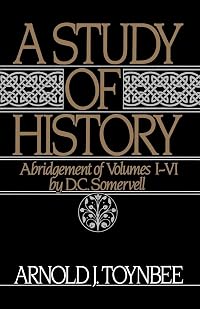
A Study of History, Vol. 1: Abridgement of Volumes I-VI
by Arnold J. Toynbee
A Study of History - Somervell Abridgement (Volumes 1-6 abridged), A Study of History (Collections and Selections — 1-6, Somervell abridged, Vol. 1)
On This Page
Description
Arnold Toynbee's A Study of History has been acknowledged as one of the greatest achievements of modern scholarship. A ten-volume analysis of the rise and fall of human civilizations, it is a work of breath-taking breadth and vision. D.C. Somervell's abridgement, in two volumes, of thismagnificent enterprise, preserves the method, atmosphere, texture, and, in many instances, the very words of the original. Originally published in 1947 and 1957, these two volumes are themselves a great show more historical achievement.Volume 1, which abridges the first six volumes of Toynbee's study, includes the Introduction, The Geneses of Civilizations, and The Disintegrations of Civilizations. Volume 2, an abridgement of Volumes VII-X, includes sections on Universal States, Universal churches, Heroic Ages, ContactsBetween Civilizations in Space, Contacts Between Civilizations in Time, Law and Freedom in History, The Prospects of the Western Civilization, and the Conclusion.Of Somervell's work, Toynbee wrote, "The reader now has at his command a uniform abridgement of the whole book, made by a clear mind that has not only mastered the contents but has entered into the writer's outlook and purpose." show lessTags
Recommendations























Member Reviews
A study of history had been on my reading list for a while, I initially thought I'd go for the entire series but ended up reading this abridgement instead. I'm glad I chose the abridgement because reading the original would have been an even bigger waste of time.
This book supposedly covers all civilizations, but this is really true only insofar as all of them are MENTIONED at some point. The great majority of material is taken from western history, particularly from the classic Athens-Rome-Europe axis, with Christendom as the example of a "universal religion". The existing literature on non-European history was of course much more limited when this work was written than it is today, and undoubtedly mr Toynbee was very well acquainted show more with all the material available to him, but why should you as a reader of history today be limited by what was there in the 1940s?
The second problem with this work is its philosophy. Toynbee searches for genesis, growth, breakdown and disintegration patterns in the "life-cycle" of civilizations. This looks extremely interesting when you browse the table of contents, but the actual work is quite disappointing. Basically a model which applies reasonably well to western European history (Athens-Rome-Europe, again) is forced on all other civilizations, and the results are not pretty. A couple of suitably interpreted cases from a couple of civilizations are enough to "prove" any given proposition. Possible objections are not discussed at all even though anyone with a good knowledge of world history will see that the argumentation is often ridiculously weak.
Finally, I should mention that I think volumes VII-X provide more interesting reading because they do not drag the dead weight of the Argument with them. But on the other hand these latter volumes are burdened by the author's religious convictions which make some texts resemble sermons more than historical writing. show less
This book supposedly covers all civilizations, but this is really true only insofar as all of them are MENTIONED at some point. The great majority of material is taken from western history, particularly from the classic Athens-Rome-Europe axis, with Christendom as the example of a "universal religion". The existing literature on non-European history was of course much more limited when this work was written than it is today, and undoubtedly mr Toynbee was very well acquainted show more with all the material available to him, but why should you as a reader of history today be limited by what was there in the 1940s?
The second problem with this work is its philosophy. Toynbee searches for genesis, growth, breakdown and disintegration patterns in the "life-cycle" of civilizations. This looks extremely interesting when you browse the table of contents, but the actual work is quite disappointing. Basically a model which applies reasonably well to western European history (Athens-Rome-Europe, again) is forced on all other civilizations, and the results are not pretty. A couple of suitably interpreted cases from a couple of civilizations are enough to "prove" any given proposition. Possible objections are not discussed at all even though anyone with a good knowledge of world history will see that the argumentation is often ridiculously weak.
Finally, I should mention that I think volumes VII-X provide more interesting reading because they do not drag the dead weight of the Argument with them. But on the other hand these latter volumes are burdened by the author's religious convictions which make some texts resemble sermons more than historical writing. show less
411. A Study of History, by Arnold J. Toynbee; Abridgement of Volumes I-VI, by D. C. Somervell (read 17 Feb 1952) On Feb 3, 1952 I said: I have a rule that I don't read abridged works, but in this case that rule simply kept me from Toynbee. For he is not too available complete, and I doubt I would ever get to reading the unabridged volumes. Then, too, I can yet. My decision to read this marks another step to force my mind to more thought-provoking reading. Far too long have I been content with novels, etc. I am quite well read in fiction--it is in serious work that I am awfully deficient. So far the book is good, but shows its abridgement at times. Toynbee recognizes 21 civilizations, six existing today--Western, Orthodox, Islamic, show more Hindu, Far Eastern (Chinese,& Korean) and Japanese. On Feb 12 I quoted this from the book on Gibbon: The theme is declared in Gibbon: "I have described the triumph of Barbarism and Religion." It never occurred to Gibbon that the Age of the Antonines was ...but the Indian summer of Hellenic history. The degree of his hallucination is betrayed by the very title...the decline and fall of the Roman Empire!.. If Gibbon had set himself to tell his longer story from its beginning he would have found that the triumph of Barbarism and Religion was ...but ...an epilogue--not the cause of the breakdown but only an unstable accompaniment of a dissolution in which the long process of disintegration was bound tp end...if Gibbon had carried his inquest back to the time beginning ...he would have had to report that the Hellenic Society was a suicide...he would declare that the mortal blow was delivered 600 years earlier than Gibbon supposed, and that the hand that dealt it was the victim's own." On Feb 16 I have another long excerpt which I won't inscribe herein now show less
I can remember when Toynbee was spoken of with great respect in historical discussions,but that was probably 40 years ago.
Goodwill
theory of rise and fall of civilizations, external pressure vs. internal, role of external and internal proletariats in fall,
Recommended by John Muir along with Will Durant's The story of Philosophy.
Members
- Recently Added By
Lists

Shaykh Hamza's Book Recommendations
439 works; 3 members

Wishlist
99 works; 1 member
Author Information

250+ Works 5,784 Members
Arnold J. Toynbee was born in London, England on April 14, 1889. He was educated at Balliol College, Oxford and studied briefly at the British School at Athens. He served in the British foreign office during both world wars and was a delegate to the 1919 Paris Peace Congress. From 1925 to 1955, he held the position of director of studies at the show more Royal Institute of International Affairs and was professor of history at the University of London during approximately the same time. His publications include The Western Question in Greece and Turkey, Civilization on Trial, East to West: A Journey round the World, the 12-volume A Study of History, and Hellenism: The History of a Civilization. He died on October 22, 1975. (Bowker Author Biography) show less
All Editions
Awards and Honors
Distinctions
Series


Work Relationships
Common Knowledge
- Original publication date
- 1946 (Somervell abridgement) (Somervell abridgement)
- People/Characters
- John Dalberg-Acton, 1st Baron Acton; Alexander the Great; Alfred the Great; Aristotle; Augustine of Hippo (saint 354-430); Augustus Caesar (show all 9); Charlemagne; Constantine the Great; Euripides
- Important places
- Abyssinia; Acadia; Achaemenid Empire; Afghanistan; Andes Mountains; Angkor Wat, Cambodia (show all 59); Assyria; Athens, Greece; Austria; The Tower of Babel, Babylon (Genesis 11:1-9); Babylonia; Baghdad, Iraq; British Empire; Bulgaria; Cairo, Egypt; Carolingian Empire; Sri Lanka (as Ceylon); China; Easter Island, Valparaíso, Chile; Egypt; England, UK; France; Germany; United Kingdom; Greece; Hatti; Holy Roman Empire; Iceland; Inca Empire; India; Iran; Ireland; Italy; Japan; Louisiana, USA; Macedon (Kingdom of); Maurya Empire; Mexico; Mughal Empire; The Netherlands; New England, USA; North Carolina, USA; Ottoman Empire; Polynesia; Prussia; Roman Empire; Russia; Scotland, UK; South Africa; South Carolina, USA; Spain; Sparta, Greece; Syria; Switzerland; Turkey; Tyre, Lebanon; USSR; Virginia, USA; Rapa Nui, Valparaíso, Chile
- Important events
- Battle of Actium; Battle of Adowa; Battle of Adrianople; American Revolution; Battle of Cannae; Battle of Leuctra
- First words
- Historians generally illustrate rather than correct the ideas of the communities within which they live and work, and the development in the last few centuries, and more particularly in the last few generations, of the would-... (show all)be self-sufficient national sovereign state has led historians to choose nations as the normal fields of historical study.
- Last words
- (Click to show. Warning: May contain spoilers.)Our Study is not yet at an end; but we have arrived at the verge of the last of our fields of inquiry.
- Original language*
- Engels
- Disambiguation notice
- This Work is Volume 1 only (Volumes I-VI) of Somervell's abridgement of Toynbee's A Study of History. It should not be combined with either Volume 2 or Somervell's complete 2-volume abridgement, Caplan's 1-volum... (show all)e abridgment, nor should it be combined with any other abridgement or any individual volumes of Toynbee's unabridged Work. Thank you.
*Some information comes from Common Knowledge in other languages. Click "Edit" for more information.
Classifications
Statistics
- Members
- 781
- Popularity
- 35,654
- Reviews
- 8
- Rating
- (3.66)
- Languages
- English, Finnish, German
- Media
- Paper, Ebook
- ISBNs
- 6
- ASINs
- 30