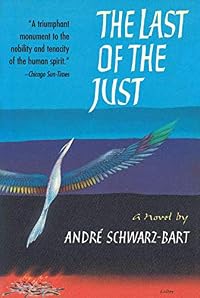
The Last of the Just
by André Schwarz-Bart
On This Page
Description
On March 11, 1185, in the old Anglican city of York, the Jews of the city were brutally massacred by their townsmen. As legend has it, God blessed the only survivor of this medieval pogrom, Rabbi Yom Tov Levy, as one of the Lamed-Vov, the thirty-six Just Men of Jewish tradition, a blessing which extended to one Levy of each succeeding generation. This terrifying and remarkable legacy is traced over eight centuries, from the Spanish Inquisition, to expulsions from England, France, Portugal, show more Germany, and Russia, and to the small Polish village of Zemyock, where the Levys settle for two centuries in relative peace. It is in the twentieth century that Ernie Levy emerges, The Last of the Just, in 1920s Germany, as Hitler's sinister star is on the rise and the agonies of Auschwitz loom on the horizon. This classic work, long unavailable in a trade edition, is one of those few novels that, once read, is never forgotten. show lessTags
Recommendations




















Member Recommendations

Member Reviews
...the ancient Jewish tradition of the Lamed-Vov, a tradition that certain Talmudists trace back to the source of the centuries, to the mysterious time of the prophet Isaiah. Rivers of blood have flowed, columns of smoke have obscured the sky, but surviving all these dooms, the tradition has remained inviolate down to our own time. According to it, the world reposes upon thirty-six Just Men, the Lamed-Vov, indistinguishable from simple mortals; often they are unaware of their station. But if just one of them were lacking, the sufferings of mankind would poison even the souls of the newborn, and humanity would suffocate with a single cry. For the Lamed-Vov are the hearts of the world multiplied, and into them, as into one receptacle, show more pour all our griefs.
I have read many novels, memoirs, and histories about the Holocaust, but this may be the most literary that I've encountered. It is beautifully written and weaves history, legend, and religion into a fascinating story about the transference of the Just Man from one generation to the next within the Levy family, culminating in the life and death of Ernie Levy. The story begins with the horrific tales of Rabbi Yom Tov Levy and his progeny who suffered death and martyrdom over and over throughout the centuries in most of the countries of Europe. It is a seemingly endless cycle of persecution bringing us into the present with the story of Ernie's grandfather, Mordecai.
As an adolescent, Mordecai was forced to leave the shtetl of Zemyock, Poland and hire himself out as a farm hand in order to keep his parents and siblings from starvation. They would rather starve, because to the Hasidic Levy family, nothing is worth turning from the study of God. Furthermore, on every job, Mordecai is forced to fight in order to establish his place in the hierarchy. Eventually, he becomes an itinerant peddler and meets and falls in love with a fiery young woman named Judith. Although his family doesn't approve of her, eventually Mordecai and Judith settle in Zemyock and raise a family. Finally, Mordecai is able to devote himself to religious study.
Their oldest son, Benjamin, doesn't seem to fit the bill as the next Just Man. He is skinny and small with a large head, unlike his three more robust younger brothers, and Mordecai fairly ignores him. A vicious pogrom forces Benjamin to leave Zemyock and move to Germany, where things seem much safer than in Eastern Europe. Ah, do you see the shadow of destiny falling? Benjamin becomes a tailor and eventually earns enough to bring his parents to live with him and soon his wife. Completely cowed by the headstrong Judith, Fraulein Leah Blumenthal is the mother to a large brood of children, yet remains naive and impotent of power.
And so we come to Ernie, neither the oldest or youngest, small and unassuming, but possessed of an undeniably sensitive soul. Nurtured and protected by his family, especially the patriarch Mordecai, Ernie nonetheless suffers from the growing Nazi presence in Stillenstadt. The story of his childhood is sweet and horrible and a window into the suffering of Jewish children in 1930's Germany. Ernie's innocence is gnawed away until he is only a shell filled with despair and hopelessness. As a young man he wanders, believing himself to be nothing more than the dog the Nazi's have labeled him. The story of his redemption in Paris and his ultimate fate, I will leave you to discover, but needless to say, as a Just Man, Ernie's destiny is not an easy one.
I loved the language of this book, although it is not an easy read emotionally. The author writes beautifully of the tortures of a sensitive soul, affinity with nature, the trials of childhood relationships, and the bleakness of losing your way in life. And arching over all of this, humanity, lies the Holocaust. It's as awful as you might imagine, but even worse is the idea you are left with. What if we have murdered the Last Just Man? To what brink have we brought ourselves spiritually, and is it possible to recover?
Highly recommended. show less
I have read many novels, memoirs, and histories about the Holocaust, but this may be the most literary that I've encountered. It is beautifully written and weaves history, legend, and religion into a fascinating story about the transference of the Just Man from one generation to the next within the Levy family, culminating in the life and death of Ernie Levy. The story begins with the horrific tales of Rabbi Yom Tov Levy and his progeny who suffered death and martyrdom over and over throughout the centuries in most of the countries of Europe. It is a seemingly endless cycle of persecution bringing us into the present with the story of Ernie's grandfather, Mordecai.
As an adolescent, Mordecai was forced to leave the shtetl of Zemyock, Poland and hire himself out as a farm hand in order to keep his parents and siblings from starvation. They would rather starve, because to the Hasidic Levy family, nothing is worth turning from the study of God. Furthermore, on every job, Mordecai is forced to fight in order to establish his place in the hierarchy. Eventually, he becomes an itinerant peddler and meets and falls in love with a fiery young woman named Judith. Although his family doesn't approve of her, eventually Mordecai and Judith settle in Zemyock and raise a family. Finally, Mordecai is able to devote himself to religious study.
Their oldest son, Benjamin, doesn't seem to fit the bill as the next Just Man. He is skinny and small with a large head, unlike his three more robust younger brothers, and Mordecai fairly ignores him. A vicious pogrom forces Benjamin to leave Zemyock and move to Germany, where things seem much safer than in Eastern Europe. Ah, do you see the shadow of destiny falling? Benjamin becomes a tailor and eventually earns enough to bring his parents to live with him and soon his wife. Completely cowed by the headstrong Judith, Fraulein Leah Blumenthal is the mother to a large brood of children, yet remains naive and impotent of power.
And so we come to Ernie, neither the oldest or youngest, small and unassuming, but possessed of an undeniably sensitive soul. Nurtured and protected by his family, especially the patriarch Mordecai, Ernie nonetheless suffers from the growing Nazi presence in Stillenstadt. The story of his childhood is sweet and horrible and a window into the suffering of Jewish children in 1930's Germany. Ernie's innocence is gnawed away until he is only a shell filled with despair and hopelessness. As a young man he wanders, believing himself to be nothing more than the dog the Nazi's have labeled him. The story of his redemption in Paris and his ultimate fate, I will leave you to discover, but needless to say, as a Just Man, Ernie's destiny is not an easy one.
I loved the language of this book, although it is not an easy read emotionally. The author writes beautifully of the tortures of a sensitive soul, affinity with nature, the trials of childhood relationships, and the bleakness of losing your way in life. And arching over all of this, humanity, lies the Holocaust. It's as awful as you might imagine, but even worse is the idea you are left with. What if we have murdered the Last Just Man? To what brink have we brought ourselves spiritually, and is it possible to recover?
Highly recommended. show less
How common is a phase of Shoah exploration? I found it rather odd and off-outting when I fell into a period in my early 20s, I was nearly obsessed and read constantly from scholarly analyses, memoirs and novels. I found the subject nearly untenable for most people in Southern Indiana: why would you want to read about that? Since then I have encountered a half dozen kindred souls who likewise went inexplicably overboard on this darkest of subjects.
I read this novel in 1994 and was ripped as if by the throat and throttled violently.
I read this novel in 1994 and was ripped as if by the throat and throttled violently.
A compelling, tragic and poignant story of the Just, a legendary succession from one Jewish generation to the next of the Just Man, chosen by God to be the embodiment of the suffering of the Jews, beginning in the 12th century and ending with the Nazi death camps. Often overlong and meandering, especially in the first half of the book, events pick up speed and draw to a horrifying and tragic conclusion by the 1940's. The book, while powerful and moving, could have easily been half the length. But the last days of Ernie Levy, the Last of the Just, will not be forgotten as he attempts to ease the fear and suffering of his fellow condemned Jews in the gas chamber.
Read it as a teenager, was floored by it then, and remains memorable to this day some fifty years later. Firmly grounded in Jewish folklore of the thirty-six righteous men in every generation (in Hebrew called lamed vavniks) because of whom the world is preserved from destruction, a theme which runs through Schwartzbart's novel and gives it its binding cohesiveness to the very end which terminates with the Holocaust. Because of the multi-century progression of the narrative, to me it has never been simply another Holocaust novel per se. It is history, tradition, folklore, changing backgrounds and successions of assorted events along the way, even if the logical evolution of the novel heads towards its horrible denouement.
How sad it is show more that Andre Schwartbart who wrote this novel (I believe) in his mid-20s, never followed up his precocious ability with anything remotely commensurate with the so-exciting promise he then showed.
Serge. show less
How sad it is show more that Andre Schwartbart who wrote this novel (I believe) in his mid-20s, never followed up his precocious ability with anything remotely commensurate with the so-exciting promise he then showed.
Serge. show less
nobody i told about this book had ever heard of it and i can't figure out why. it is a fantastic and powerful novel. when people ask me what its about though, i had trouble telling them. it is about humanity - wonderful, vulnerable, broken humanity. it is an agonizing read - made me feel like throwing up at times. made me smile a lot and laugh out loud a few times as well. it should be read.
This is a very sad, but true partial history of the Jews until the Holocaust. Schwarz-Bart kept my interest, but i would have preferred no magic realism. he follows one family for centuries, and ends with ernie, a lamed vovnek, murdered in the holocaust.
The first third of the book is dedicated to the Levy family’s ancestry, an ancestry filled with legendary Lamed-Vovniks throughout the generations. The reader is shown how they have martyred themselves in the name of suffering for mankind. The last two-thirds of the book concerns itself with one person, and his name is Ernie. We watch Ernie grow from a child into a man, and through overwhelming imagery, see him suffer for mankind during the Holocaust.
Antisemitism runs rampant throughout the pages, from one son to the next, each holy man is faced with their own set of trials and tribulations. The reader is shown how the Eastern and Western European Jewish community has paid a price for over 800 years, the years since the eleventh show more century through the Holocaust. Jewish persecution has had its roots dug deep into the earth throughout the ages. As a cultural and historical resource The Last of the Just is invaluable. It gives the reader an awareness of how antisemitism has steadfastly taken hold throughout the centuries, without a let up. show less
Antisemitism runs rampant throughout the pages, from one son to the next, each holy man is faced with their own set of trials and tribulations. The reader is shown how the Eastern and Western European Jewish community has paid a price for over 800 years, the years since the eleventh show more century through the Holocaust. Jewish persecution has had its roots dug deep into the earth throughout the ages. As a cultural and historical resource The Last of the Just is invaluable. It gives the reader an awareness of how antisemitism has steadfastly taken hold throughout the centuries, without a let up. show less
Members
- Recently Added By
Published Reviews
"Den siste rettferdige" tok franske lesere med storm da den kom ut i 1959, og forfatteren mottok den høythengende Goncourt-prisen (sensasjonelt for en debutroman).
En gammel jødisk legende forteller at det i hvert slektledd må finnes 36 rettferdige, som skal påta seg slektens byrder og sikre dens fortsettelse. Handlingen begynner i York i året 1185, med en pogrom i en aldri avsluttet serie show more av pogromer. Nærmere vår egen tid er det Ernie Levy – bokens hovedperson – som fullfører historien. Han blir "den siste rettferdige" idet han elendig, men verdig møter døden i gasskammeret, som den siste i slekten Levy. Året er 1943. Ernie har i hele sitt kortvarige liv tatt lidelsene inn over seg med en nesten mystisk ro. Golda, hans unge elskede, blir hans vei inn i den store kjærligheten og det store offeret. Hans skjebne, blant seks millioner andre, blir et symbolsk martyrium, der det ubegripelige får et skjær av forsoning og skjønnhet. I seg selv et mysterium.
Den siste rettferdige kom på norsk første gang i 1960. show less
En gammel jødisk legende forteller at det i hvert slektledd må finnes 36 rettferdige, som skal påta seg slektens byrder og sikre dens fortsettelse. Handlingen begynner i York i året 1185, med en pogrom i en aldri avsluttet serie show more av pogromer. Nærmere vår egen tid er det Ernie Levy – bokens hovedperson – som fullfører historien. Han blir "den siste rettferdige" idet han elendig, men verdig møter døden i gasskammeret, som den siste i slekten Levy. Året er 1943. Ernie har i hele sitt kortvarige liv tatt lidelsene inn over seg med en nesten mystisk ro. Golda, hans unge elskede, blir hans vei inn i den store kjærligheten og det store offeret. Hans skjebne, blant seks millioner andre, blir et symbolsk martyrium, der det ubegripelige får et skjær av forsoning og skjønnhet. I seg selv et mysterium.
Den siste rettferdige kom på norsk første gang i 1960. show less
added by kirstenlund
Lists

Books and authors mentioned by Le Clézio in his Nobel Prize speech
87 works; 3 members

Mustich's 1000 Books to Read Before You Die: A Life Changing List
1,001 works; 18 members

THE WAR ROOM
813 works; 24 members
Author Information

8+ Works 1,256 Members
Some Editions
Awards and Honors
Awards
Distinctions
Series
Belongs to Publisher Series
Work Relationships
Is contained in
Common Knowledge
- Canonical title
- The Last of the Just
- Original title
- Le dernier des Justes
- Original publication date
- 1959; 1960 (English translation) (English translation)
- People/Characters
- Ernie Levy
- Important places
- Zemyock, Poland; Stillenstadt, Germany
- Important events
- Holocaust
- Epigraph
- How am I to toll your death,
How may I mark your obsequies,
Vagabond handful of ashes
Between heaven and earth?
M. Jaztrun, The Obsequies. - First words
- Our eyes register the light of dead stars.
- Last words
- (Click to show. Warning: May contain spoilers.)There was only a presence.
- Blurbers
- Shirer, William L.
- Original language
- French
Classifications
- Genres
- General Fiction, Fiction and Literature, Historical Fiction
- DDC/MDS
- 843.914 — Literature & rhetoric French & related literatures French fiction 1900- 20th Century 1945-1999
- LCC
- PQ2637 .C736 .D413 — Language and Literature French, Italian, Spanish and Portuguese literatures French literature Modern literature 1900-1960
- BISAC
Statistics
- Members
- 1,035
- Popularity
- 24,813
- Reviews
- 21
- Rating
- (4.20)
- Languages
- 12 — Catalan, Dutch, English, Finnish, French, German, Hungarian, Italian, Norwegian (Bokmål), Portuguese, Spanish, Swedish
- Media
- Paper, Ebook
- ISBNs
- 38
- ASINs
- 39