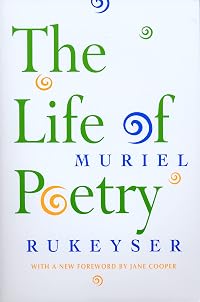
The Life of Poetry
by Muriel Rukeyser
On This Page
Description
Observing that poetry is a natural part of our pastimes and rituals, Muriel Rukeyser opposes elitist attitudes and confronts Americans' fear of feeling. Multicultural and interdisciplinary, this collection of essays and speeches makes an irrefutable case for the centrality of poetry in American life.Tags
Recommendations






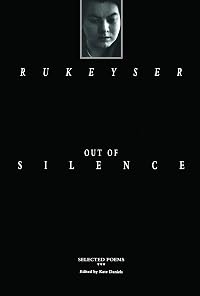




Member Reviews
I am fascinated by Rukeyser's personal story & her engagement with history. Although her thinking in these essays is sometimes fuzzy & her use of abstractions, such as truth, reality, imagination, consciousness & even language, is often contradictory (she says one thing & then, shortly thereafter, seems to say its opposite), she repeatedly won me over when her poet's voice sneaks into her prose. For example, when she characterizes Emily Dickenson's style as one of a "slang of strictness" or when she talks about poetry as a "transfer of human energy." I loved Chapter Twelve, "Out of Childhood," which is composed of impressionistic vignettes (film stills)that summarize & encapsulate the author's childhood & coming to maturity, both as a show more person & a writer. Compressed, evocative & vastly informative in their succinctness. Worth the price of the book. show less
When I was 15 I started reading this in the bathtub and stayed in there until I got pruney and the water turned cold and then slowly drained out, and I really felt that she had the right idea about the anti-touch people and the anti-poetry people and how they ruin everything and the fear of poetry is the fear. The ideaology didn't hold up very well, and I hold that against this book, maybe unfairly.
What it's like to be a poet in America; diffuse as a good poem and powerful as a fine essay.
Ratings
Members
- Recently Added By
Author Information

40+ Works 1,034 Members
During her five-decade literary career, Rukeyser provoked varying critical response; yet her passionate contribution to the contemporary literary and political scene cannot be doubted. An outspoken "spokespoet," she was always where the political action was. As a young reporter from Vassar, she covered the 1932 Scottsboro Trial; some forty years show more later, she was jailed for her anti-Vietnam protests in Washington, D.C. So closely aligned is her activism to her art that several reviewers believe that the history of midcentury America can be garnered from her poetry. Yet, along with her outrage, Rukeyser's poetry is marked by optimism in a way that is reminiscent of Walt Whitman's verse. It is as though she believed that out of the pain of conflict will come a healing and transforming revelation. During her career, Rukeyser moved from a reliance on simple declaratives to a more sophisticated, private use of language; and, though she continued to deal with politics all her life, later poems also treat personal subjects---her role as mother and daughter, her sexual feelings for women and men, the illness that led to her death. From beginning to end, she was honored for her contribution to poetry: with the Yale Younger Poets Prize in 1935 for Theory of Flight to the tribute paid her at the annual New York Quarterly Poetry Day in 1977. (Bowker Author Biography) show less
Some Editions
Awards and Honors
Awards
Common Knowledge
- Canonical title
- The Life of Poetry
- Original publication date
- 1949
- People/Characters
- Muriel Rukeyser
- Dedication
- To Henrietta Durham
- Blurbers
- Rich, Adrienne; Walker, Alice; Allison, Dorothy
Classifications
- Genres
- Poetry, Fiction and Literature, Literature Studies and Criticism
- DDC/MDS
- 811.009 — Literature & rhetoric American literature in English American poetry Specific kinds of poetry {only by more than one author} Modified standard subdivisions History, description, critical appraisal of American poetry
- LCC
- PN1031 .R75 — Language and Literature Literature (General) Literature (General) Poetry Theory, philosophy, relations, etc.
- BISAC
Statistics
- Members
- 222
- Popularity
- 147,772
- Reviews
- 3
- Rating
- (4.19)
- Languages
- English
- Media
- Paper
- ISBNs
- 2
- ASINs
- 3