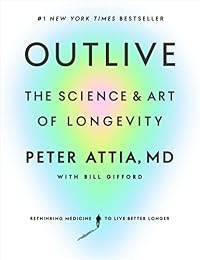
Outlive: The Science and Art of Longevity
by Peter Attia
On This Page
Description
Drawing on the latest science and challenging mainstream medicine, a visionary physician and leading longevity expert presents a well-founded strategic and tactical approach to extending lifespan while also improving physical, cognitive, and emotional health.Tags
Recommendations


Member Reviews
Contrary to appearances, this book is not about living longer. It's about living better and so, as a result, living longer. But Outlive isn't even really about living better, because it concludes with a question that makes everything that precedes it pale in comparison: What's the point of living better, or longer, if you don't enjoy it? What's the point if, in the end, no one has a nice word to say about you, or you don't have one to say about yourself?
The many practical lessons of this book (and there are so, so many)—about taking care of yourself and others, about finding what makes living better and more enjoyable—would apply even if you had just one more day to live. That's what it means to "outlive." Not dying at an age older show more than the average, but living a life that exceeds bare longevity—in health and enjoyment and love. show less
The many practical lessons of this book (and there are so, so many)—about taking care of yourself and others, about finding what makes living better and more enjoyable—would apply even if you had just one more day to live. That's what it means to "outlive." Not dying at an age older show more than the average, but living a life that exceeds bare longevity—in health and enjoyment and love. show less
This is one of those books that could change your life. I don't know if it will change mine: at 78, I'm a little old to initiate new long behaviours intended to add to my life span. But it may. His message is that exercise, nutrition, sleep, and emotional health can profoundly affect your lifespan, and even more important, your healthspan -- the number of years you remain independent and can do things you love. This is bolstered by extensive description and analysis of the diseases of old age that kill most of us, and by extensive explanation and description of what you can do about it. His prescriptions for action are daunting, demanding lots of time and lots of discipline. But I think they will actually change my behavior. One reason show more that this book is so powerful is that it is so personal, which is one reason why it is such a fascinating read. I can't recommend it too highly. show less
Let me begin my review in the middle of Outlive. The author asks us to list the ten tasks we want to do for the rest of our lives. He calls this list the centenarian decathlon. Here’s the top of the list for me: hike up to Third Burroughs Mountain. It’s 9 miles (14 km) in Mount Rainier National Park with 2500 feet (760 m.) of elevation gain. Why? I’m a hiker, and this is my favorite hike worldwide.
I’ve spent a fair amount of time thinking about how to keep hiking as I get older. I turned 65 in 2022; I would like to keep exploring mountains as long as possible, this is just the book to help me achieve my goal. Let me explain why.
First, Attia starts with the concept of healthspan – how well you live. There’s a tight coupling show more between healthspan and lifespan. As we age, we have left less of each. One difference is that lifespan is a discrete quantity; one day, you are alive, and the next, you are not. In contrast, our healthspan gradually diminishes over time. The author details three vectors (components) of healthspan: physical, cognitive, and emotional. The good news is that we can usually improve these components and our overall healthspan. How we do so is the core of the book.
The book’s first part outlines our current situation and a target goal. The most important lesson I learned: “Tactics without strategy is the noise before defeat.” a quote from Sun Tzu, an ancient Chinese military strategist. Been there, done that, got the T-shirt. So, how can I do better? The author has a great framework: first, objectives, then strategy, and finally, tactics. The author trained as an engineer, became a physician, and has worked in business consulting; his background shows throughout the book. I touched on objectives in the discussion of the centenarian decathlon; how about strategy?
The second part of Outlive is the science that can help you develop a strategy. There is a chapter on the science of centenarians; I think of this as a boundary condition. What are the factors that helped get someone to their 100th birthday? (I have a hiking friend who still gets out on walks at 101, I want to follow in her footsteps.) Next is a chapter on the details of how nutrition affects longevity. The last four chapters cover the science of how most of us die: metabolic disorders such as diabetes, heart disease, cancer, and neurodegenerative diseases. Understanding these problems will help you develop tactics to mitigate some issues. There are no magic bullets in these chapters; instead, it’s a well-researched survey of what we know as of 2022. Now that we know objectives and strategies, what tactics can we employ?
The final part of Outlive lays out four tactics:
Exercise (cardio, strength, and stability)
Nutrition
Sleep
Emotional health.
At 260 pages, this is the longest part of the book. It was detailed and beneficial to me. Rather than outline each section, let me list some tactics I am adding to my strategy:
Work on stability, specifically starting with a yoga class.
Use a continuous glucose monitor for a few months to optimize my diet.
Ensure I am getting enough protein intake of lysine, leucine, and methionine.
The last chapter on emotional health was the most impactful in the book. Attia opens up to the reader about his emotional health through the lens of a patient rather than a physician. It touched me deeply; I had some trauma in my teen years when my mom died. Fifty years later, I realized I should address some of these issues rather than wall them off.
Outlive is a book I will read several times. The book is challenging; I spent four weeks reading the book.
I made a ton of margin notes and back-of-the-book scrawling. There’s a lot to digest, and there are many references. For example, I want to read the paper Hallmarks of Aging by Carlos López-Otín and colleagues. This book catalyzed some great conversations with my friend Bill about healthspan. I will recommend Outlive to anyone interested in taking action to improve their healthspan.
One closing thought; there’s a missing chapter in the book. I believe social interaction and engagement can improve healthspan’s cognitive and emotional components. My experience is that forty years of marriage have improved my emotional health. I decided to ask ChatGPT: What studies have shown that social interaction and engagement can improve cognitive function and reduce the risk of cognitive decline and dementia in older adults? Here’s the answer:
“There have been several studies that have shown a positive correlation between social interaction and cognitive function in older adults. For example:
The Rush Memory and Aging Project: This study found that older adults who had higher levels of social activity experienced a slower rate of cognitive decline than those who were less socially active.
The MacArthur Study of Successful Aging: This study found that older adults who were more socially engaged were less likely to experience declines in cognitive function over time.
The Women’s Health Initiative Memory Study: This study found that women who reported higher levels of social engagement had a lower risk of developing cognitive impairment than those who were less socially engaged.
Overall, these studies suggest that social interaction and engagement can play an important role in maintaining cognitive function and reducing the risk of cognitive decline and dementia in older adults.” show less
I’ve spent a fair amount of time thinking about how to keep hiking as I get older. I turned 65 in 2022; I would like to keep exploring mountains as long as possible, this is just the book to help me achieve my goal. Let me explain why.
First, Attia starts with the concept of healthspan – how well you live. There’s a tight coupling show more between healthspan and lifespan. As we age, we have left less of each. One difference is that lifespan is a discrete quantity; one day, you are alive, and the next, you are not. In contrast, our healthspan gradually diminishes over time. The author details three vectors (components) of healthspan: physical, cognitive, and emotional. The good news is that we can usually improve these components and our overall healthspan. How we do so is the core of the book.
The book’s first part outlines our current situation and a target goal. The most important lesson I learned: “Tactics without strategy is the noise before defeat.” a quote from Sun Tzu, an ancient Chinese military strategist. Been there, done that, got the T-shirt. So, how can I do better? The author has a great framework: first, objectives, then strategy, and finally, tactics. The author trained as an engineer, became a physician, and has worked in business consulting; his background shows throughout the book. I touched on objectives in the discussion of the centenarian decathlon; how about strategy?
The second part of Outlive is the science that can help you develop a strategy. There is a chapter on the science of centenarians; I think of this as a boundary condition. What are the factors that helped get someone to their 100th birthday? (I have a hiking friend who still gets out on walks at 101, I want to follow in her footsteps.) Next is a chapter on the details of how nutrition affects longevity. The last four chapters cover the science of how most of us die: metabolic disorders such as diabetes, heart disease, cancer, and neurodegenerative diseases. Understanding these problems will help you develop tactics to mitigate some issues. There are no magic bullets in these chapters; instead, it’s a well-researched survey of what we know as of 2022. Now that we know objectives and strategies, what tactics can we employ?
The final part of Outlive lays out four tactics:
Exercise (cardio, strength, and stability)
Nutrition
Sleep
Emotional health.
At 260 pages, this is the longest part of the book. It was detailed and beneficial to me. Rather than outline each section, let me list some tactics I am adding to my strategy:
Work on stability, specifically starting with a yoga class.
Use a continuous glucose monitor for a few months to optimize my diet.
Ensure I am getting enough protein intake of lysine, leucine, and methionine.
The last chapter on emotional health was the most impactful in the book. Attia opens up to the reader about his emotional health through the lens of a patient rather than a physician. It touched me deeply; I had some trauma in my teen years when my mom died. Fifty years later, I realized I should address some of these issues rather than wall them off.
Outlive is a book I will read several times. The book is challenging; I spent four weeks reading the book.
I made a ton of margin notes and back-of-the-book scrawling. There’s a lot to digest, and there are many references. For example, I want to read the paper Hallmarks of Aging by Carlos López-Otín and colleagues. This book catalyzed some great conversations with my friend Bill about healthspan. I will recommend Outlive to anyone interested in taking action to improve their healthspan.
One closing thought; there’s a missing chapter in the book. I believe social interaction and engagement can improve healthspan’s cognitive and emotional components. My experience is that forty years of marriage have improved my emotional health. I decided to ask ChatGPT: What studies have shown that social interaction and engagement can improve cognitive function and reduce the risk of cognitive decline and dementia in older adults? Here’s the answer:
“There have been several studies that have shown a positive correlation between social interaction and cognitive function in older adults. For example:
The Rush Memory and Aging Project: This study found that older adults who had higher levels of social activity experienced a slower rate of cognitive decline than those who were less socially active.
The MacArthur Study of Successful Aging: This study found that older adults who were more socially engaged were less likely to experience declines in cognitive function over time.
The Women’s Health Initiative Memory Study: This study found that women who reported higher levels of social engagement had a lower risk of developing cognitive impairment than those who were less socially engaged.
Overall, these studies suggest that social interaction and engagement can play an important role in maintaining cognitive function and reducing the risk of cognitive decline and dementia in older adults.” show less
Dr. Peter Attia is an oncology surgeon, a data guy, and an extreme athlete with trauma in his past. That all plays into his approach to longevity: lots and lots of screening, monitoring, and "training" for old age as if you were training for a sporting event.
The chapters on exercise and nutrition were fantastic. My favorite quote: "Cardio or weights? Low-carb or plant-based? Olive oil or beef tallow? I don't know. Must we really take sides?" This is NOT a book telling you the One True Secret to long life; it all depends. Some certainties though: Exercise is the best medicine. If your metabolism is not functioning well, make it a priority to get that under control. Screen for everything, screen early, screen often.
Then come chapters on show more sleep and emotional health. I had really been looking forward to the chapter on sleep, as it's kind of a bugaboo for me. I had grown to feel I could trust his opinions, and I wanted know what he thought about better sleep through pharmaceuticals. He had stated in an early chapter that he had nothing against using medications in general where appropriate, such as statins; so it felt promising that I wouldn't get some knee-jerk anti-medication attitude.
I started reading the chapter one night shortly before bedtime, and didn't get up to any of the advice; just lots of emphatic "Sleep is crucial! Quality, uninterrupted sleep! It's a must! You risk Alzheimer's if you don't get it!" Nice scary nightmares to put a random chronic insomniac to sleep with.
The next night I delved in further. Alas, he's anti-Ambien. Ambien sleep isn't REAL sleep and yadda yadda yadda. However to give him credit, he had positive things to say about trazodone.
The whole sleep chapter was disappointing and did not feel nearly as data-driven as the previous chapters. It just felt like he got it in his head that sleep was very important to health and decided it warranted a whole chapter on a par with exercise & nutrition, but he didn't want to put any work into it.
For the emotional health chapter, I commend him for telling so much of his personal story. This chapter was driven by his own experience and that was OK.
I guess the real overarching theme of the book, though, was that everyone is different, and you must find what works for YOU. Your exercise ability, your own metabolic reactions - these are going to determine the "right" exercise and diet for you. He could have been a LITTLE more understanding about chronic insomnia, though, and respected that different things work (and don't work) for different people. As I said, a bit of a bugaboo for me… show less
The chapters on exercise and nutrition were fantastic. My favorite quote: "Cardio or weights? Low-carb or plant-based? Olive oil or beef tallow? I don't know. Must we really take sides?" This is NOT a book telling you the One True Secret to long life; it all depends. Some certainties though: Exercise is the best medicine. If your metabolism is not functioning well, make it a priority to get that under control. Screen for everything, screen early, screen often.
Then come chapters on show more sleep and emotional health. I had really been looking forward to the chapter on sleep, as it's kind of a bugaboo for me. I had grown to feel I could trust his opinions, and I wanted know what he thought about better sleep through pharmaceuticals. He had stated in an early chapter that he had nothing against using medications in general where appropriate, such as statins; so it felt promising that I wouldn't get some knee-jerk anti-medication attitude.
I started reading the chapter one night shortly before bedtime, and didn't get up to any of the advice; just lots of emphatic "Sleep is crucial! Quality, uninterrupted sleep! It's a must! You risk Alzheimer's if you don't get it!" Nice scary nightmares to put a random chronic insomniac to sleep with.
The next night I delved in further. Alas, he's anti-Ambien. Ambien sleep isn't REAL sleep and yadda yadda yadda. However to give him credit, he had positive things to say about trazodone.
The whole sleep chapter was disappointing and did not feel nearly as data-driven as the previous chapters. It just felt like he got it in his head that sleep was very important to health and decided it warranted a whole chapter on a par with exercise & nutrition, but he didn't want to put any work into it.
For the emotional health chapter, I commend him for telling so much of his personal story. This chapter was driven by his own experience and that was OK.
I guess the real overarching theme of the book, though, was that everyone is different, and you must find what works for YOU. Your exercise ability, your own metabolic reactions - these are going to determine the "right" exercise and diet for you. He could have been a LITTLE more understanding about chronic insomnia, though, and respected that different things work (and don't work) for different people. As I said, a bit of a bugaboo for me… show less
Last November, as I lay in my bed recovering from foot surgery, my husband came home from a doctor's appointment and told me that he needed surgery, too. A quadruple bypass. He's 52. Needless to say, this experience has lit a fire under our asses to re-examine our diet and habits. Part of our effort has been educating ourselves about moving into our fifties and sixties without losing strength, mobility, and most importantly, our lives.
Look, we're all gonna die. I don't have dreams of living forever. But at my age, it's becoming abundantly clear that if I don't invest our time, energy, and money into maintaining our health and preventing disease, it can overtake us quickly. I saw a rapid decline in my own health as I recovered from food show more surgery and found myself unable to do many of the physical activities I rely on to stay healthy (and sane). Which is to say, the shit can go downhill pretty fast when you're in your fifties and not using your body well.
Enter: Outlive, a book by a doctor named Peter Attia. My husband bought and read this, and then encouraged me to read it, too. I'm glad I did. I might read 1-2 books a year on health/fitness - it's not a topic I enjoy reading about - but I found it helpful. Outlive offers a respectable amount of information on science and medicine, engaging anecdotes on Attia's experience as a patient and a doctor, and a simple structure for thinking about preventative medicine. And really, that's the crux of the book: preventing disease.
Attia doesn't beat around the bush - if we want to maintain our health in our golden years, we must begin early and make space in our busy lives to understand our bodies and how our healthcare system works. No one else will do it for us. He structures the first part of the book around the pathologies inherent to the 'four horsemen' of disease in America: cancer, diabetes, cardiovascular disease, and Alzheimer’s/dementia. Then, he explains in detail how each of these can be influenced (positively or negatively) by our choices starting in our 20s and 30s, and how important it is for us at any age to pay attention to our risk factors.
The book is good, but it's too long. This information could be condensed into something far more readable and accessible to the average person. The hardcover clocks in at 496 pages, which became a slog after a while (again, it's not my favorite topic to read about - if you enjoy this topic, the book might be more enjoyable for you). I found myself skimming some of the more technical information. I suppose a book on medicine written by a doctor should be substantial enough to command respect in the marketplace. I get that. Still, it's a commitment to read this thing, and I don’t think most people who need to read it will. show less
Look, we're all gonna die. I don't have dreams of living forever. But at my age, it's becoming abundantly clear that if I don't invest our time, energy, and money into maintaining our health and preventing disease, it can overtake us quickly. I saw a rapid decline in my own health as I recovered from food show more surgery and found myself unable to do many of the physical activities I rely on to stay healthy (and sane). Which is to say, the shit can go downhill pretty fast when you're in your fifties and not using your body well.
Enter: Outlive, a book by a doctor named Peter Attia. My husband bought and read this, and then encouraged me to read it, too. I'm glad I did. I might read 1-2 books a year on health/fitness - it's not a topic I enjoy reading about - but I found it helpful. Outlive offers a respectable amount of information on science and medicine, engaging anecdotes on Attia's experience as a patient and a doctor, and a simple structure for thinking about preventative medicine. And really, that's the crux of the book: preventing disease.
Attia doesn't beat around the bush - if we want to maintain our health in our golden years, we must begin early and make space in our busy lives to understand our bodies and how our healthcare system works. No one else will do it for us. He structures the first part of the book around the pathologies inherent to the 'four horsemen' of disease in America: cancer, diabetes, cardiovascular disease, and Alzheimer’s/dementia. Then, he explains in detail how each of these can be influenced (positively or negatively) by our choices starting in our 20s and 30s, and how important it is for us at any age to pay attention to our risk factors.
The book is good, but it's too long. This information could be condensed into something far more readable and accessible to the average person. The hardcover clocks in at 496 pages, which became a slog after a while (again, it's not my favorite topic to read about - if you enjoy this topic, the book might be more enjoyable for you). I found myself skimming some of the more technical information. I suppose a book on medicine written by a doctor should be substantial enough to command respect in the marketplace. I get that. Still, it's a commitment to read this thing, and I don’t think most people who need to read it will. show less
The author bills the science presented as Medicine 3.0, but at every turn my intuition screamed that what was being presented was at best Medicine 2.1. Not bad if Medicine 3.0 wasn't actually out there, but I feel that it is. You should still read “Outlive”. You should read all such books, popular health or popular medicine, I guess we call it, popular as much for an ability to speak with accessibility to the general populous as having any actual popularity.
We are in an age of embarrassing riches, no more so than with the feast of high quality, well-researched, well-meaning, thoughtful, and nuanced texts presented by such highly qualified individuals. It is to our detriment that we ignore even the scantest evidence where our show more greatest resource, our health, is concerned. For Peter Attia, I would say that although you can take the doctor out of the training, it's much more difficult to take the training out of the doctor. You really must read it to decide for yourself as I only have my gut instincts to go on. The science is infinitely complex and there is little agreement among the professionals about what it all means. At a certain point we have to trust the deeper parts of our intelligence to take over, synthesizing mountains of data and the various interpretations of those data. Intuition gets short shrift in our society.
Peter Attia seems in the throws of the paradigms he's struggling against, still very much attuned to a mid- to a late 2oth century mindset, a practice still bounded by old understandings despite an ostensibly cheery prognosis overall.
I'm hesitant to give specifics and argue against professional training, but the areas that pinged my radar the highest were his advice on exercise, his reliance on numbers and extreme testing, and his underestimation of the power of fasting. It all seems a bit out of balance to me.
Compare and contrast (for yourself) this book against books like Richard Johnson's “Nature Wants Us to Be Fat” (2022), Daniel Lieberman's “Exercised: Why Something We Never Evolved to Do Is Healthy and Rewarding” (2021), and Steve Hendricks “The Oldest Cure in the World: Adventures in the Art and Science of Fasting” (2022). There are many areas where these books are in agreement with Attia's advice, but worrying in the ways they disagree, sometime sharply. This list of books of course is in no way exhaustive, with new science coming at us every day. We are foolish if we don't at least try to make sense of it all. The stakes are ridiculously high. The price too precious. show less
We are in an age of embarrassing riches, no more so than with the feast of high quality, well-researched, well-meaning, thoughtful, and nuanced texts presented by such highly qualified individuals. It is to our detriment that we ignore even the scantest evidence where our show more greatest resource, our health, is concerned. For Peter Attia, I would say that although you can take the doctor out of the training, it's much more difficult to take the training out of the doctor. You really must read it to decide for yourself as I only have my gut instincts to go on. The science is infinitely complex and there is little agreement among the professionals about what it all means. At a certain point we have to trust the deeper parts of our intelligence to take over, synthesizing mountains of data and the various interpretations of those data. Intuition gets short shrift in our society.
Peter Attia seems in the throws of the paradigms he's struggling against, still very much attuned to a mid- to a late 2oth century mindset, a practice still bounded by old understandings despite an ostensibly cheery prognosis overall.
I'm hesitant to give specifics and argue against professional training, but the areas that pinged my radar the highest were his advice on exercise, his reliance on numbers and extreme testing, and his underestimation of the power of fasting. It all seems a bit out of balance to me.
Compare and contrast (for yourself) this book against books like Richard Johnson's “Nature Wants Us to Be Fat” (2022), Daniel Lieberman's “Exercised: Why Something We Never Evolved to Do Is Healthy and Rewarding” (2021), and Steve Hendricks “The Oldest Cure in the World: Adventures in the Art and Science of Fasting” (2022). There are many areas where these books are in agreement with Attia's advice, but worrying in the ways they disagree, sometime sharply. This list of books of course is in no way exhaustive, with new science coming at us every day. We are foolish if we don't at least try to make sense of it all. The stakes are ridiculously high. The price too precious. show less
This book scared the heck out of me. I saw the author’s interview on the Huberman podcast, and was originally planning to skim through it, but the content hooked me right in. The book beseeches you to take control of your health, using data from standard tests to show you where you personally stand, and then making recommendations along four pillars - exercise, nutrition, sleep and emotional health.
The one major issue is that the relevant usable info is scattered all over the book - you will need to take notes if you want to action on any of the suggestions, or ingest books and other recommended sources. However, there is enough to get started, and if you really want to start taking care of your health, this is a really good place to show more start show less
The one major issue is that the relevant usable info is scattered all over the book - you will need to take notes if you want to action on any of the suggestions, or ingest books and other recommended sources. However, there is enough to get started, and if you really want to start taking care of your health, this is a really good place to show more start show less
Members
- Recently Added By
Published Reviews
ThingScore 100
"Outlive" delves into the science behind longevity, providing valuable insights into the factors that contribute to a longer and healthier life. The narrator's engaging voice and clear delivery made it easy to absorb the wealth of information presented in the book.....
added by Almatar
Lists

Globe and Mail | Canadian Non-Fiction: April 15, 2023
10 works; 1 member

Globe and Mail | Canadian Non-Fiction: May 25, 2024
10 works; 1 member

Globe and Mail | Canadian Non-Fiction: July 27, 2024
10 works; 1 member
Globe and Mail | Canadian Non-Fiction: July 20, 2024
10 works; 1 member
Globe and Mail | Canadian Non-Fiction: July 13, 2024
10 works; 1 member
Globe and Mail | Canadian Non-Fiction: July 6, 2024
10 works; 1 member
Globe and Mail | Canadian Non-Fiction: June 29, 2024
10 works; 1 member

Globe and Mail | Canadian Non-Fiction: June 22, 2024
10 works; 1 member
Globe and Mail | Canadian Non-Fiction: June 15, 2024
10 works; 1 member
Globe and Mail | Canadian Non-Fiction: June 1, 2024
10 works; 1 member
Globe and Mail | Canadian Non-Fiction: May 18, 2024
10 works; 1 member
Globe and Mail | Canadian Non-Fiction: August 10, 2024
10 works; 1 member
Globe and Mail | Canadian Non-Fiction: May 11, 2024
10 works; 1 member
Globe and Mail | Canadian Non-Fiction: May 4, 2024
10 works; 1 member
Globe and Mail | Canadian Non-Fiction: April 27, 2024
9 works; 1 member

Globe and Mail | Canadian Non-Fiction: April 20, 2024
10 works; 1 member

Globe and Mail | Canadian Non-Fiction: April 13, 2024
10 works; 1 member
Globe and Mail | Canadian Non-Fiction: April 6, 2024
10 works; 1 member
Globe and Mail | Canadian Non-Fiction: March 30, 2024
10 works; 1 member

Globe and Mail | Canadian Non-Fiction: March 23, 2024
10 works; 1 member
Globe and Mail | Canadian Non-Fiction: March 16, 2024
10 works; 1 member
Globe and Mail | Canadian Non-Fiction: August 3, 2024
10 works; 1 member
Globe and Mail | Canadian Non-Fiction: August 17, 2024
10 works; 1 member
Globe and Mail | Canadian Non-Fiction: March 2, 2024
10 works; 1 member

Globe and Mail | Canadian Non-Fiction: January 11, 2025
10 works; 1 member

Globe and Mail | Canadian Non-Fiction: August 2, 2025
10 works; 1 member
Globe and Mail | Canadian Non-Fiction: July 19, 2025
10 works; 1 member

Globe and Mail | Canadian Non-Fiction: March 8, 2025
10 works; 1 member
Globe and Mail | Canadian Non-Fiction: March 1, 2025
10 works; 1 member

Globe and Mail | Canadian Non-Fiction: February 22, 2025
10 works; 1 member
Globe and Mail | Canadian Non-Fiction: February 8, 2025
10 works; 1 member

Globe and Mail | Canadian Non-Fiction: January 25, 2025
10 works; 1 member

Globe and Mail | Canadian Non-Fiction: January 18, 2025
10 works; 1 member
Globe and Mail | Canadian Non-Fiction: Year End, 2024
10 works; 1 member
Globe and Mail | Canadian Non-Fiction: August 24, 2024
10 works; 1 member

Globe and Mail | Canadian Non-Fiction: December 21, 2024
10 works; 1 member
Globe and Mail | Canadian Non-Fiction: December 14, 2024
10 works; 1 member
Globe and Mail | Canadian Non-Fiction: December 7, 2024
10 works; 1 member

Globe and Mail | Canadian Non-Fiction: October 5, 2024
10 works; 1 member

Globe and Mail | Canadian Non-Fiction: September 28, 2024
10 works; 1 member
Globe and Mail | Canadian Non-Fiction: September 21, 2024
10 works; 1 member

Globe and Mail | Canadian Non-Fiction: September 14, 2024
10 works; 1 member

Globe and Mail | Canadian Non-Fiction: September 7, 2024
10 works; 1 member
Globe and Mail | Canadian Non-Fiction: August 31, 2024
10 works; 1 member
Globe and Mail | Canadian Non-Fiction: March 9, 2024
10 works; 1 member
Globe and Mail | Canadian Non-Fiction: February 24, 2024
10 works; 1 member
Globe and Mail | Canadian Non-Fiction: April 22, 2023
10 works; 1 member
Globe and Mail | Canadian Non-Fiction: July 15, 2023
10 works; 1 member
Globe and Mail | Canadian Non-Fiction: September 9, 2023
10 works; 1 member

Globe and Mail | Canadian Non-Fiction: September 2, 2023
10 works; 2 members
Globe and Mail | Canadian Non-Fiction: August 26, 2023
10 works; 1 member
Globe and Mail | Canadian Non-Fiction: August 19, 2023
10 works; 1 member
Globe and Mail | Canadian Non-Fiction: August 12, 2023
10 works; 1 member
Globe and Mail | Canadian Non-Fiction: August 5, 2023
10 works; 1 member
Globe and Mail | Canadian Non-Fiction: July, 29, 2023
10 works; 1 member
Globe and Mail | Canadian Non-Fiction: July 22, 2023
10 works; 1 member
Globe and Mail | Canadian Non-Fiction: July 8, 2023
10 works; 1 member

Globe and Mail | Canadian Non-Fiction: September 23, 2023
10 works; 1 member
Globe and Mail | Canadian Non-Fiction: July 1, 2023
10 works; 1 member
Globe and Mail | Canadian Non-Fiction: June 24, 2023
10 works; 1 member

Globe and Mail | Canadian Non-Fiction: June 17, 2023
10 works; 1 member
Globe and Mail | Canadian Non-Fiction: June 10, 2023
10 works; 1 member
Globe and Mail | Canadian Non-Fiction: June 3, 2023
10 works; 1 member
Globe and Mail | Canadian Non-Fiction: May 27, 2023
10 works; 1 member
Globe and Mail | Canadian Non-Fiction: May 20, 2023
10 works; 1 member

Globe and Mail | Canadian Non-Fiction: May 5, 2023
10 works; 1 member
Globe and Mail | Canadian Non-Fiction: April 29, 2023
10 works; 1 member
Globe and Mail | Canadian Non-Fiction: September 16, 2023
10 works; 1 member
Globe and Mail | Canadian Non-Fiction: September 30, 2023
10 works; 1 member
Globe and Mail | Canadian Non-Fiction: February 17, 2024
10 works; 1 member

Globe and Mail | Canadian Non-Fiction: December 16, 2023
10 works; 1 member
Globe and Mail | Canadian Non-Fiction: February 10, 2024
10 works; 2 members

Globe and Mail | Canadian Non-Fiction: February 3, 2024
10 works; 1 member
Globe and Mail | Canadian Non-Fiction: January 27, 2024
10 works; 1 member
Globe and Mail | Canadian Non-Fiction: January 20, 2024
10 works; 1 member
Globe and Mail | Canadian Non-Fiction: January 13, 2024
10 works; 1 member
Globe and Mail | Canadian Non-Fiction: January 6, 2024
10 works; 1 member
Globe and Mail | Canadian Non-Fiction: Year End, 2023
10 works; 1 member

Globe and Mail | Canadian Non-Fiction: December 23, 2023
10 works; 1 member
Globe and Mail | Canadian Non-Fiction: December 9, 2023
10 works; 1 member
Globe and Mail | Canadian Non-Fiction: October 7, 2023
10 works; 1 member
Globe and Mail | Canadian Non-Fiction: December 2, 2023
10 works; 1 member
Globe and Mail | Canadian Non-Fiction: November 25, 2023
10 works; 1 member
Globe and Mail | Canadian Non-Fiction: November 18, 2023
10 works; 1 member
Globe and Mail | Canadian Non-Fiction: November 11, 2023
10 works; 1 member
Globe and Mail | Canadian Non-Fiction: November 4, 2023
10 works; 1 member
Globe and Mail | Canadian Non-Fiction: October 28, 2023
10 works; 1 member
Globe and Mail | Canadian Non-Fiction: October 21, 2023
10 works; 1 member

Goodreads Choice Award 2023
26 works; 1 member

Globe and Mail | Canadian Non-Fiction: October 14, 2023
10 works; 1 member

Globe and Mail | Canadian Non-Fiction: November 8, 2025
10 works; 1 member
Author Information

4 Works 1,486 Members
All Editions
Awards and Honors
Distinctions
Notable Lists
Common Knowledge
- Dedication
- For my patients.
And for Jill, Olivia, Reese, and Ayrton...for your patience. - First words
- Introduction: In the dream, I'm trying to catch the falling eggs.
Chapter 1: I'll never forget the first patient whom I ever saw die. - Last words
- (Click to show. Warning: May contain spoilers.)Here's to staying young, even as we grow older.
Classifications
- Genres
- Health & Wellness, General Nonfiction, Nonfiction, Science & Nature
- DDC/MDS
- 612.6 — Technology Medicine & health Human physiology Reproduction; Development; Maturation
- LCC
- RA776.75 .A885 — Medicine Public aspects of medicine Public aspects of medicine Public health. Hygiene. Preventive medicine Personal health and hygiene
- BISAC
Statistics
- Members
- 1,478
- Popularity
- 15,641
- Reviews
- 27
- Rating
- (4.03)
- Languages
- 5 — Chinese, English, German, Portuguese, Swedish
- Media
- Paper, Audiobook, Ebook
- ISBNs
- 17
- ASINs
- 6