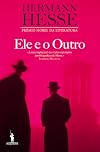
Klein and Wagner
by Hermann Hesse
On This Page
Description
"The most ruthless of Hesse's many self-exposures." Joseph Mileck Klein and Wagner tells the story of Friedrich Klein, a middle-aged clerk who has embezzled from his employer and escaped to Italy. However, Klein is not a common criminal, but rather a self-alienated, tormented bourgeois in search of peace and self-fulfillment. While pondering his fate, Klein recognizes that his primary motivation was a compulsion and urge to murder his wife and children, which he could only avoid by entirely show more abandoning his old life. This dark drive is associated with the name Wagner, which alludes to the famous composer and also to an actual German schoolteacher who in September 1913 had killed his wife and children. In spite of his flight, Klein fails to transcend his pain: instead of feeling liberated, he regards himself as a victim of his own thoughts, his brain a kaleidoscope in which the shifting images were directed by somebody else's hand. Throughout the story, Klein repeatedly ponders suicide. In this desperate situation he meets Teresina, a young blonde courtesan who mingles with the local art crowd. He is increasingly drawn to her, although his stance remains ambivalent. To Klein, something about Teresina symbolized vitality as well as a connection to the eternal feminine. But when Teresina asks him about his background, he refuses to give a straight answer. Among the most obvious features of Klein and Wagner are the striking autobiographical parallels. By 1919, Hesse's first wife Mia had been diagnosed as mentally ill. The author was still uncertain whether to seek a divorce. In addition, he feared the responsibility for raising their three sons, Bruno, Heiner, and Martin. In the Spring of 1919, Hesse finally succumbed to his urge to escape, left Bern for Ticino and settled down in the mountain village of Montagnola, where he wrote this story. Whereas the character Klein remains trapped in his identification with Wagner, writing down his story proved instrumental for Hesse in overcoming his deep personal crisis. To Hesse, writing Klein and Wagner fulfilled a clear therapeutic purpose: "Klein is a part of Hesse and will always be; without him, without the transference of my suffering into this mirror, I would not have been able to bear this suffering. It was my salvation that I escaped into solitude and lived completely, day and night, in my writing." Strongly influenced by Expressionism, Klein and Wagner is a modern "psychodrama" that introduces key themes and motifs that dominates Hesse's writing during the following decade, including some striking connections to Steppenwolf. show lessTags
Recommendations



















Member Reviews
Klein is a man who flees from his past to the South, to the land of his childhood dream. Formally, he flees because he has committed a crime: a stamp, a cashier’s window, a revolver, forged documents — all of this appears as fragments of memory. But something else matters far more: he is fleeing from his own bourgeois “respectability,” which turns out to be a mask of moral decency that hides his true, secret thoughts. Beneath it there is a second layer — unpleasant, envious, lustful, and cruel; a layer he has for years refused, and feared, to acknowledge in himself. From this grows the hero’s main horror: visions and the feeling of a need to kill his family and himself along with them. That is why the story of the teacher show more Wagner resonates so strongly with him — Klein recognizes himself in Wagner and understands that his outrage was insincere; it was dictated by his mask and by fear of what sits inside Klein.
The text is built not around action, but around the character’s inner experience. Almost no concrete details of events are given; instead of “what happened,” Hesse focuses on “what the hero’s thoughts are like”. This can be compared to remembering a trauma: a coherent picture of the action does not remain, only separate scraps of phrases and actions that replay in our heads and trigger emotions. In this sense, the text feels more like a personal diary, in which a person does not record the details of what happened, but instead puts full emphasis on every thought. At the same time, the text is not dry: in moments when Klein feels inwardly full, the world becomes painfully alive — southern air, bright light, movement, music. In such moments the hero seems to have returned to the child’s womb and sees this enchanting world for the first time, and it is precisely this flash of life that contrasts with his inner darkness.
The turning point in Klein’s life is not so much the crime he has committed as his encounter with a yellow-haired girl, Teresina. At first she appears as an accidental figure, but she instantly grips him precisely because after a fleeting meeting with her he feels pathetic and has to justify himself in his own head, defending himself with the words of his wife, his colleagues, and an old moral set — and it immediately becomes clear that these arguments no longer work. Later Klein sees how Teresina is transformed in dance: for a moment roles and duties disappear, and she simply gives herself over to life. This becomes their point of kinship — not an “ideal match of personalities,” but the recognition in another person of someone who also lives behind a mask and sometimes takes it off. Notably, Klein insists on understanding without words: he feels that conversation easily turns the living into something flat and vulgar, and that explanation becomes a way to avoid the present.
In the end, Klein arrives at a harsh conclusion: the only way to tear off this mask is through overcoming fear — not in the sense of “becoming brave,” but of stopping the clinging to supports and deciding to take a step into the unknown. His resolution is not “live lightly,” but “decide to fall”: to surrender, to trust, to stop holding on to precautions as the only way to exist.
“Wonderful thought: a life without fear! To overcome fear — that is bliss, that is deliverance. How he had suffered all his life from fear, and now, when death had already seized him by the throat, he felt neither fear nor terror, only a smile, only deliverance, only consent to what was happening. He suddenly understood what fear is, understood that only the one who has known it can overcome it. You feared a thousand things — feared pain, judges, your own heart, feared sleep, awakening, loneliness, cold, madness, death — especially death. But all of that was only masks, only appearances. In reality you feared only one thing — to decide to fall, to take a step into the unknown, a small step beyond all existing precautions. And whoever has surrendered even once, even a single time, whoever has shown great trust and relied on fate, has gained freedom. He no longer obeyed earthly laws; he fell into cosmic space and spun in the dance of the stars. That was how it was. It was very simple; any child could understand it, could know it.” show less
The text is built not around action, but around the character’s inner experience. Almost no concrete details of events are given; instead of “what happened,” Hesse focuses on “what the hero’s thoughts are like”. This can be compared to remembering a trauma: a coherent picture of the action does not remain, only separate scraps of phrases and actions that replay in our heads and trigger emotions. In this sense, the text feels more like a personal diary, in which a person does not record the details of what happened, but instead puts full emphasis on every thought. At the same time, the text is not dry: in moments when Klein feels inwardly full, the world becomes painfully alive — southern air, bright light, movement, music. In such moments the hero seems to have returned to the child’s womb and sees this enchanting world for the first time, and it is precisely this flash of life that contrasts with his inner darkness.
The turning point in Klein’s life is not so much the crime he has committed as his encounter with a yellow-haired girl, Teresina. At first she appears as an accidental figure, but she instantly grips him precisely because after a fleeting meeting with her he feels pathetic and has to justify himself in his own head, defending himself with the words of his wife, his colleagues, and an old moral set — and it immediately becomes clear that these arguments no longer work. Later Klein sees how Teresina is transformed in dance: for a moment roles and duties disappear, and she simply gives herself over to life. This becomes their point of kinship — not an “ideal match of personalities,” but the recognition in another person of someone who also lives behind a mask and sometimes takes it off. Notably, Klein insists on understanding without words: he feels that conversation easily turns the living into something flat and vulgar, and that explanation becomes a way to avoid the present.
In the end, Klein arrives at a harsh conclusion: the only way to tear off this mask is through overcoming fear — not in the sense of “becoming brave,” but of stopping the clinging to supports and deciding to take a step into the unknown. His resolution is not “live lightly,” but “decide to fall”: to surrender, to trust, to stop holding on to precautions as the only way to exist.
“Wonderful thought: a life without fear! To overcome fear — that is bliss, that is deliverance. How he had suffered all his life from fear, and now, when death had already seized him by the throat, he felt neither fear nor terror, only a smile, only deliverance, only consent to what was happening. He suddenly understood what fear is, understood that only the one who has known it can overcome it. You feared a thousand things — feared pain, judges, your own heart, feared sleep, awakening, loneliness, cold, madness, death — especially death. But all of that was only masks, only appearances. In reality you feared only one thing — to decide to fall, to take a step into the unknown, a small step beyond all existing precautions. And whoever has surrendered even once, even a single time, whoever has shown great trust and relied on fate, has gained freedom. He no longer obeyed earthly laws; he fell into cosmic space and spun in the dance of the stars. That was how it was. It was very simple; any child could understand it, could know it.” show less
Ein etwas seltener gelesenes Buch von Hermann Hesse, das dennoch recht interessant ist. Nicht nur Schüler können Amok laufen, nein: auch Lehrer! Die Geschichte basiert auf einem authentischen Fall aus dem Jahre 1913.
Feb 19, 2010German
Ratings
Members
- Recently Added By
Author Information

Hermann Hesse (July 2, 1877 -- August 9, 1962) was a German poet, novelist, essayist and painter. His best-known works included Steppenwolf, Siddhartha, and The Glass Bead Game, each of which explores an individual's search for authenticity, self-knowledge and spirituality. In 1946, he received the Nobel Prize in Literature. Hess publicly show more announced his views on the savagery of World War I, and was considered a traitor. He moved to Switzerland where he eventually became a naturalized citizen. He warned of the advent of World War II, predicting that cultureless efficiency would destroy the modern world. His theme was usually the conflict between the elements of a person's dual nature and the problem of spiritual loneliness. His first novel, Peter Camenzind, was published in 1904. His masterpiece, Death and the Lover (1930), contrasts a scholarly abbot and his beloved pupil, who leaves the monastery for the adventurous world. Steppenwolf (1927), a European bestseller, was published when defeated Germany had begun to plan for another war. It is the story of Haller, who recognizes in himself the blend of the human and wolfish traits of the completely sterile scholarly project. During the 1960s Hesse became a favorite writer of the counter culture, especially in the United States, though his critical reputation has never equaled his popularity. Hermann Hesse died in 1962. (Bowker Author Biography) show less
Series
Belongs to Publisher Series
suhrkamp taschenbuch (0116)
Centopaginemillelire (46)
Work Relationships
Is contained in
Common Knowledge
- Canonical title
- Klein and Wagner
Classifications
- Genres
- Fiction and Literature, General Fiction
- DDC/MDS
- 833.912 — Literature & rhetoric German & related literatures German fiction 1900- 1900-1990 1900-1945
- LCC
- PT2617.1564 .H477 — Language and Literature German, Dutch and Scandinavian literatures German literature Individual authors or works 1860/70-1960
- BISAC
Statistics
- Members
- 123
- Popularity
- 264,219
- Reviews
- 2
- Rating
- (3.73)
- Languages
- 6 — English, German, Italian, Portuguese, Spanish, Turkish
- Media
- Paper, Audiobook, Ebook
- ISBNs
- 11
- ASINs
- 7