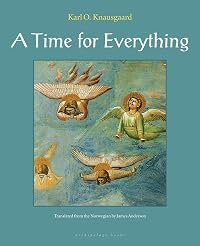
A Time for Everything
by Karl Ove Knausgård
On This Page
Description
In the sixteenth century, Antinous Bellori, a boy of eleven, is lost in a dark forest and stumbles upon two glowing beings, one carrying a spear, the other a flaming torch … This event is decisive in Bellori’s life, and he thereafter devotes himself to the pursuit and study of angels, the intermediaries of the divine. Beginning in the Garden of Eden and soaring through to the present, A Time for Everything reimagines pivotal encounters between humans and angels: the glow of the cherubim show more watching over Eden; the profound love between Cain and Abel despite their differences; Lot’s shame in Sodom; Noah’s isolation before the flood; Ezekiel tied to his bed, prophesying ferociously; the death of Christ; and the emergence of sensual, mischievous cherubs in the seventeenth century. Alighting upon these dramatic scenes – from the Bible and beyond – Knausgaard’s imagination takes flight: the result is a dazzling display of storytelling at its majestic, spellbinding best. Incorporating and challenging tradition, legend, and the Apocrypha, these penetrating glimpses hazard chilling questions: can the nature of the divine undergo change, and can the immortal perish? show lessTags
Recommendations



























Member Recommendations

JuliaMaria Das Ringen um den Roman "Alles hat seine Zeit" wird im autobiografischen Werk "Lieben" beschrieben.
Member Reviews
Lyrical, moving, chilling...infuriating. I came across my Dad’s notes as I was reading and think they give a good picture of the maddening, enthralling nature of this book:
“Knausgaard’s strange way of writing forces attention. Only now and again are the actual things he writes about interesting, like the descriptions of the nephilim – his strength is rather in what might follow. In other words his writing is dull but one feels that it is leading to something important...one is led on. Unfortunately sometimes one gets the feeling that there will not be any resolution And therefore that one is wasting his time reading it. But the feeling of promise persists!..
All this stuff seems to me to be more autobiographical than biblical, in show more spite of the names. Reminiscent, for instance, of many a meal round the kitchen table of the Knausgaard’s in Sweden (sic) during the author’s childhood, perhaps. Gone is the fictitious Italian writer Bellori, gone the cherubim guarding the way to the tree of life. We wish a return to the biography of the angels!..
If the novel or Bellori’s description of angels is supposed to tell you something why, oh why does it waste dull seemingly inconsequential pages of apparent autobiographical stuff on family life? Why after building up interest on Noah’s meeting with God and the building of the Ark then lapsing into a flashback for many pages into Noah’s family life and the oh (!) so boring description of Anna’s love life, to an equally dull parting whilst forgetting entirely anything to do with angels? – or for that matter the impending flood?
The force of the attraction of the reading is impossible to deny...”
GR Clarke 2009
Indeed. So we are bourn along through many longueurs, presumably intended to contrast the earthy mundanity of human existence with the nature of the divine. Never, however, do we consider putting the book aside, not before Knausgaard reveals the exact nature of the catastrophe and the appalling fate of the cherubim and their like. As I read the lacerating Coda I was shaken by the shriek of a lonely seagull outside my open window. To know why you would need to read this very strange volume in its entirety. show less
“Knausgaard’s strange way of writing forces attention. Only now and again are the actual things he writes about interesting, like the descriptions of the nephilim – his strength is rather in what might follow. In other words his writing is dull but one feels that it is leading to something important...one is led on. Unfortunately sometimes one gets the feeling that there will not be any resolution And therefore that one is wasting his time reading it. But the feeling of promise persists!..
All this stuff seems to me to be more autobiographical than biblical, in show more spite of the names. Reminiscent, for instance, of many a meal round the kitchen table of the Knausgaard’s in Sweden (sic) during the author’s childhood, perhaps. Gone is the fictitious Italian writer Bellori, gone the cherubim guarding the way to the tree of life. We wish a return to the biography of the angels!..
If the novel or Bellori’s description of angels is supposed to tell you something why, oh why does it waste dull seemingly inconsequential pages of apparent autobiographical stuff on family life? Why after building up interest on Noah’s meeting with God and the building of the Ark then lapsing into a flashback for many pages into Noah’s family life and the oh (!) so boring description of Anna’s love life, to an equally dull parting whilst forgetting entirely anything to do with angels? – or for that matter the impending flood?
The force of the attraction of the reading is impossible to deny...”
GR Clarke 2009
Indeed. So we are bourn along through many longueurs, presumably intended to contrast the earthy mundanity of human existence with the nature of the divine. Never, however, do we consider putting the book aside, not before Knausgaard reveals the exact nature of the catastrophe and the appalling fate of the cherubim and their like. As I read the lacerating Coda I was shaken by the shriek of a lonely seagull outside my open window. To know why you would need to read this very strange volume in its entirety. show less
A cliched final scene in a zombie movie might go something like this: the embattled, rag-tag crew thinks they are in the clear, their 4x4 armor plated truck speeding down a highway littered with abandoned vehicles. A swell of optimistic music signals the credits are about to roll. Suddenly, there is a chilling reveal that one of their number has been bitten, and the inexorable transformation into flesh-hungry living dead is already underway. The end.
I had this feeling towards the end of this extremely weird book, although maybe I shouldn’t have been so surprised. Passage after passage would go by without much happening, perhaps idyllic descriptions of forested landscapes and rugged coastlines, or minor incidents in the life of a show more family. Then all the sudden, in just a few lines, the whole vibe would shift, throwing you into a vividly graphic scene of violence, desperation, death. I still don’t think this could have signaled what would be revealed in the final few pages of the first part of the book, which contain what has to be one the most hilariously underwhelming twist endings I’ve ever come across. After spending several hours making my through the biography of an angelologist and two novella length adaptations of biblical texts, for this story to end up where it did felt like an elaborate and scampish “fuck you”. All that is not to say I didn’t enjoy it. However, I was so taken aback by the “seagulls are angels” that I gave unbidden, off the cuff reviews to several friends this week, cherishing the moment right before I revealed the ending, which sounds even more absurd when said out loud.
The real “monster was in the house all along moment” was the hard cut that was the “coda” section of the book. While still pretty nice to read, it is such a whiplash inducing change that I’m not really sure why it was included here at all, besides maybe to really drive home the point about the seagulls are angels thing. But after reading several hundred pages of this book and thinking how cool it was that the guy who would go on to write My Struggle was able to create characters and plots that somewhat resembled a typical novel, the coda jerks us into a kind of proto-Struggle, what I can only assume is a lightly fictionalized version of a real life experience that could have fit comfortably in that later work. Why is this part of the book here? Beats me. The first interpretation that comes to mind isn’t a sympathetic one, namely that this writer who later became world famous for a book which defies any editor that dares raise a pen against it, hadn’t yet found the right format for his idiosyncratic style. Perhaps here we are seeing several different meandering segments tied together with vague connections in order to make a book? If so, I’d have to say it’s done about as well as it could be. The main reason that My Struggle might succeed in that space where, for me, A Time for Everything doesn’t quite make it, is that with the former there is no impression that we are going anywhere in particular, the digressions are the point, and muddling through the tedious in order to bump into the sublime is the key thrill of the work. The problem with this book here is that the stories are actually interesting, and especially given the subject matter, we can’t help but think that it’s all going to culminate in some kind of… culmination. Instead it ends on an intentionally, aggressively sour note.
One thing I had forgotten about in the ~10 years since I read the first couple My Struggle books is how hilariously awkward Knausgaard’s dialogue is. He uses a lot of exclamation points and all caps, which always strikes me as the way a child would show that someone in a story is angry. I guess it’s not so strange that someone so good at tracing the grueling circuit of a thought through time and space would kinda suck at actually making his characters talk. show less
I had this feeling towards the end of this extremely weird book, although maybe I shouldn’t have been so surprised. Passage after passage would go by without much happening, perhaps idyllic descriptions of forested landscapes and rugged coastlines, or minor incidents in the life of a show more family. Then all the sudden, in just a few lines, the whole vibe would shift, throwing you into a vividly graphic scene of violence, desperation, death. I still don’t think this could have signaled what would be revealed in the final few pages of the first part of the book, which contain what has to be one the most hilariously underwhelming twist endings I’ve ever come across. After spending several hours making my through the biography of an angelologist and two novella length adaptations of biblical texts, for this story to end up where it did felt like an elaborate and scampish “fuck you”. All that is not to say I didn’t enjoy it. However, I was so taken aback by the “seagulls are angels” that I gave unbidden, off the cuff reviews to several friends this week, cherishing the moment right before I revealed the ending, which sounds even more absurd when said out loud.
The real “monster was in the house all along moment” was the hard cut that was the “coda” section of the book. While still pretty nice to read, it is such a whiplash inducing change that I’m not really sure why it was included here at all, besides maybe to really drive home the point about the seagulls are angels thing. But after reading several hundred pages of this book and thinking how cool it was that the guy who would go on to write My Struggle was able to create characters and plots that somewhat resembled a typical novel, the coda jerks us into a kind of proto-Struggle, what I can only assume is a lightly fictionalized version of a real life experience that could have fit comfortably in that later work. Why is this part of the book here? Beats me. The first interpretation that comes to mind isn’t a sympathetic one, namely that this writer who later became world famous for a book which defies any editor that dares raise a pen against it, hadn’t yet found the right format for his idiosyncratic style. Perhaps here we are seeing several different meandering segments tied together with vague connections in order to make a book? If so, I’d have to say it’s done about as well as it could be. The main reason that My Struggle might succeed in that space where, for me, A Time for Everything doesn’t quite make it, is that with the former there is no impression that we are going anywhere in particular, the digressions are the point, and muddling through the tedious in order to bump into the sublime is the key thrill of the work. The problem with this book here is that the stories are actually interesting, and especially given the subject matter, we can’t help but think that it’s all going to culminate in some kind of… culmination. Instead it ends on an intentionally, aggressively sour note.
One thing I had forgotten about in the ~10 years since I read the first couple My Struggle books is how hilariously awkward Knausgaard’s dialogue is. He uses a lot of exclamation points and all caps, which always strikes me as the way a child would show that someone in a story is angry. I guess it’s not so strange that someone so good at tracing the grueling circuit of a thought through time and space would kinda suck at actually making his characters talk. show less
As a young boy in the early 16th century, Antonious Bellori came across two angels. These angels were not beatific; they were grotesque and frightening, with claws and ashen faces, and they were greedily gnawing on raw fish. The encounter compelled Bellori to devote the rest of his life to the study of angels, and to seek an answer to the question 'Where did the angels go?' After a lifetime of research, he published The Nature of Angels in 1584.
After describing Bellori's encounter with the angels, the middle portion of the novel consists of retellings of several stories from the Bible in which angels engage with humans. Most prominent are the story of Cain and Abel and the story of Noah and the Flood, each of which is in and of itself show more novella length. Knausgaard's versions, however, are like no Bible stories you've ever read.
The Cain and Abel story's setting is akin to 19th century Norway, and is filtered through the lens of a modern psychological viewpoint. In this version, the reader questions which of the two brothers deserves to die.
The story of Noah's Ark is told almost entirely from the viewpoint of Noah's sister, It's not a spoiler to say that in the end she dies. In Knausgaard's reimagining she stands shoulder-deep in water holding her grandchild above her head watching the ark sail away. Noah, too ashamed to face his sister's pleas for help, is hiding below deck.
The next part of the book returns to Bellori's life and his final days. He continues to contemplate and to resolve his theories relating to the existence of angels. He also continues to seek contacts with them, with some unsettling results. The final 50 or so pages of the book involve a morose man, living on an isolated island in modern day Norway, who is seeking salvation for an undisclosed crime, and who has some theories about angels himself.
This is a unique book. There are some theological ponderings, but they are bearable, and don't interrupt the flow of the story. The surprising conclusions reached about the existence and nature of angels may disturb some believers. However, I highly recommend this book.
4 1/2 stars show less
After describing Bellori's encounter with the angels, the middle portion of the novel consists of retellings of several stories from the Bible in which angels engage with humans. Most prominent are the story of Cain and Abel and the story of Noah and the Flood, each of which is in and of itself show more novella length. Knausgaard's versions, however, are like no Bible stories you've ever read.
The Cain and Abel story's setting is akin to 19th century Norway, and is filtered through the lens of a modern psychological viewpoint. In this version, the reader questions which of the two brothers deserves to die.
The story of Noah's Ark is told almost entirely from the viewpoint of Noah's sister, It's not a spoiler to say that in the end she dies. In Knausgaard's reimagining she stands shoulder-deep in water holding her grandchild above her head watching the ark sail away. Noah, too ashamed to face his sister's pleas for help, is hiding below deck.
The next part of the book returns to Bellori's life and his final days. He continues to contemplate and to resolve his theories relating to the existence of angels. He also continues to seek contacts with them, with some unsettling results. The final 50 or so pages of the book involve a morose man, living on an isolated island in modern day Norway, who is seeking salvation for an undisclosed crime, and who has some theories about angels himself.
This is a unique book. There are some theological ponderings, but they are bearable, and don't interrupt the flow of the story. The surprising conclusions reached about the existence and nature of angels may disturb some believers. However, I highly recommend this book.
4 1/2 stars show less
An intensely weird yet memorable book. I didnt get all of it. As a person with an interest in the Bible, I was intrigued to read this as it dealt with the nephilim or fallen angels of Noah's day.
The whole narrative starts with a fictional 16th century Italian who sees two angels while out walking. Forget harps and haloes...
"Their faces are white and skull-like, their eye sockets deep, cheekbones high, lips bloodless. They have long fair hair, thin necks, slender wrists, claw-like fingers. And theyre shaking. One of them has hands that shake. Just then the other one tilts its head back, opens its mouth and lets out a scream. Wils and lamenting, it reverberates up the walls of the ravine. No human being is meant to hear that cry. An show more angel's depair is unbearable and almost crushed by terror and compassion."
Fast forward on to passages on the Bible and other writings...and then on to re-imaginings of OT sories featuring angels.
Don't expect historical accuracy; Knausgaard portrays these early characters as living in a place more reminiscent of a fairly modern Norwegian village, the men in trousers, black suits, the houses featuring window panes...and who makes up the small village where Cain and Abel are dwelling with their parents??
I was beguiled by the lovely thought of Adam after the Fall living close to Eden and seeing the distant glow in the sky of the seraphim guarding the Tree of Life.... Cain - a curmudgeonly misfit- is rather more sympathetic than the seriously odd golden boy Abel...
And then on to Noah...and here the story is mainly that of his sister. A pleasant enough middle aged woman living a few miles away with her family, they observe the endless rainy weather, and make their way to higher ground as rivers burst their banks and buildings get submerged. Again, Noah is a strange unknowable recluse. As the Ark takes float and some of the remaining human try to climb aboard, we have the image of one of Noah's sons bringing down a cudgel on their heads to prevent them....
And on to Ezekiel's angelic vision...more ponderings on religion...more of the story of our Italian angel hunter....And a strange final section that seemed unrelated to the rest. Here a modern day Norwegian man- he seems similar to the troubled hero of his later autobiographical "My Struggle"- gives into self-harming and contemplates the seagulls being evolved angels....
It's really hard to give a conclusion. It's like nothing I've ever readn, it's full of pretty implausible (but who knows?) takes on the Scriptures. Theres a lot of quite erudite musings on the nature of angelic beings. It's magical and horrible...and it's an absolute one-off. show less
The whole narrative starts with a fictional 16th century Italian who sees two angels while out walking. Forget harps and haloes...
"Their faces are white and skull-like, their eye sockets deep, cheekbones high, lips bloodless. They have long fair hair, thin necks, slender wrists, claw-like fingers. And theyre shaking. One of them has hands that shake. Just then the other one tilts its head back, opens its mouth and lets out a scream. Wils and lamenting, it reverberates up the walls of the ravine. No human being is meant to hear that cry. An show more angel's depair is unbearable and almost crushed by terror and compassion."
Fast forward on to passages on the Bible and other writings...and then on to re-imaginings of OT sories featuring angels.
Don't expect historical accuracy; Knausgaard portrays these early characters as living in a place more reminiscent of a fairly modern Norwegian village, the men in trousers, black suits, the houses featuring window panes...and who makes up the small village where Cain and Abel are dwelling with their parents??
I was beguiled by the lovely thought of Adam after the Fall living close to Eden and seeing the distant glow in the sky of the seraphim guarding the Tree of Life.... Cain - a curmudgeonly misfit- is rather more sympathetic than the seriously odd golden boy Abel...
And then on to Noah...and here the story is mainly that of his sister. A pleasant enough middle aged woman living a few miles away with her family, they observe the endless rainy weather, and make their way to higher ground as rivers burst their banks and buildings get submerged. Again, Noah is a strange unknowable recluse. As the Ark takes float and some of the remaining human try to climb aboard, we have the image of one of Noah's sons bringing down a cudgel on their heads to prevent them....
And on to Ezekiel's angelic vision...more ponderings on religion...more of the story of our Italian angel hunter....And a strange final section that seemed unrelated to the rest. Here a modern day Norwegian man- he seems similar to the troubled hero of his later autobiographical "My Struggle"- gives into self-harming and contemplates the seagulls being evolved angels....
It's really hard to give a conclusion. It's like nothing I've ever readn, it's full of pretty implausible (but who knows?) takes on the Scriptures. Theres a lot of quite erudite musings on the nature of angelic beings. It's magical and horrible...and it's an absolute one-off. show less
We were made into the likeness of God. Our ways and nature had been much investigated by thinkers and storytellers since the old days. Yet no one fully understood God, the divine. There were just too much assumptions and uncertainties involved in the contemplation. One of the ways the nature of the divine can be explored was through a study of an intermediate being, someone between man and God. The angels – less than God, more than men – could hold the key to an understanding of the nature of the divine. What angels are like was intermittently depicted in the Bible and in church murals. The fertile ground of literature was also used in dramatizing the acts of the angels.
A systematics of the angelic orders, based on the above show more premise, was what the Norwegian novelist Karl O. Knausgaard attempted in A Time for Everything (in UK: A Time to Every Purpose Under Heaven). The literary imagination, along with its unlimited sympathy and generosity, was a robust stage in which to construct from available materials the conditions and assumptions on the angels as the direct link between the human and the divine. The manifold riches of a modern novel, unshackled by dogma, could approximate the variety of life experiences and their daily miracles. Its prose and form could hold up large vistas of physical and spiritual landscapes. The religious order of readers was constantly inducted into the novel's power to mesmerize, to quicken the senses and open up selves to radical ideas and identities.
Knausgaard did for the selected stories of the Bible – mainly from the Genesis – what José Saramago did to the gospels in The Gospel According to Jesus Christ. The stories were familiar to us such that they had acquired the status of the "definitive, official version". Yet for Knausgaard, the Biblical stories must be calling for a creative adaptation.
"The only things that have always been remembered are the story of the first people who were driven out of paradise and into the valley, the story of the two brothers Cain and Abel, and the story of the great flood. But all the details about these people and the world they lived in were gradually erased. And as each new age is convinced that it constitutes what is normal, that it represents the true condition of things, the people of a new age soon began to imagine the people of the previous one as an exact replica of themselves, in exactly the same setting. Thus Cain and Abel became nomadlike figures who lived and operated in a flat, burning hot, sand-filled world, of olive and fig trees, oases, camels, asses, robes, tents, and little whitewashed stone houses. Gone were all the pine trees, all the fjords and mountains, all the snow and rain, all the lynxes and bears, wolves and elk. In addition, all the infinitely delicate nuances in the relationship between the brothers were lost over time, such that only the bare details remained: Abel was good, Cain bad, Abel was a shepherd, Cain a tiller of the soil."
And so Knausgaard recreated some "lost" details in the Old Testament, retouching the obscured details like an art restorer working on a fresco that has faded from the accumulation of dirt and grime. He wanted to capture the "infinitely delicate nuances" (emphasized above) of the stories of the creation, of rival brothers Cain and Abel, of Noah and the great flood, of Christ on the cross, etc. This time the stories were not just centered on the fury of God but on human and angelic struggles.
The selected characters acquired subtlety and realism beyond (or against) their traditional portrayals. The fount of these stories was God, the Author, but he probably will not appreciate the telling.
"It is clear the whole time that the human condition is not something he has experienced. If he knows anything about it, it isn't from within. Only someone who lacks insight into the human condition could despair over its evilness, as the Lord does time and time again throughout the Old Testament. Perhaps he knew mankind, but he couldn't have understood them – or he wouldn't have been so surprised that they ate from the tree of knowledge, despite his emphatic prohibition, or that they could kill their own brothers, or that they built a tower almost up to heaven."
God, the narrator of the novel was implying, was not a good novelist. Being an inquiry into the angelic orders, the framework chosen to approach the divine must necessarily imbue the composition with an anthropocentric (novelistic) concreteness, tangibility, portents and omens, and subversion.
The story was framed by the figure of Antinous Bellori, an eccentric sixteenth century theologian who wrote On the Nature of Angels (1584). Bellori was a melancholic figure in the mold of Sir Thomas Browne – presumably there are two lines in Sir Thomas Browne's Pseudodoxia epidemica of 1646 that referenced Bellori's book – and Robert Walser, with Bellori's specialized system of microscopic handwriting similar to Walser's "microscripts". The structure of Bellori's book was loosely that of the present novel.
"On the Nature of Angels consists of three parts. The first contains a catalog of all 189 angelic manifestations in the Bible, and the second discusses what conclusions can be drawn about the angels from these. The third, which initially looks at angels' non-Biblical appearances, ends in a discussion about the question that is the work's main theme: Can the nature of the divine undergo change?"
It was a plausible structure to ascertain the (changing) nature of the divine. The third part ultimately led to the exposition of Bellori's thesis on the mutability, and hence fallibility, of the divine, and it was closely tied to how the novelist fulfilled the requirements of the structure. How exactly the evidences to support Bellori's thesis was teased out by the narrator/commentator (a writer figure that conveniently distanced the novelist from the story) was a pleasure to behold. The conclusion was already provocative but the "proof" was a daring combination of logic, scientific deduction, art criticism, and literary speculation. It necessitated the evaluation of the concept of the divine through variegated narrative registers. Absolute categories were interrogated; official versions were glossed over; and the religious abstractions, viewed from a new prism of understanding.
Knausgaard's brand of prose, similar to that of his protagonist Antinous Bellori, was closely related to "his religious speculations": "While writing On the Nature of Angels, (Bellori) studied every conceivable and inconceivable text in which angels figured, and thus formalized his intuitive insight into angelic mutability". The product of this rigorous research was reflected in the book's hyperrealist prose: the descriptions were individually particularized in space and time, making every detail not only "a detail" but this detail:
"Bellori contemplated everything he saw. Whether it was fish, waterfalls, trees, mountains, birds, insects, or flowers, he saw only the unique. If one reads his notes consecutively, from beginning to end, a feeling is gradually fostered of the infinity of the world. Not "trees" nor even "a tree" but this particular tree right here, now, as it is. Not "fish" nor even "a fish" but this unique fish right here, now, as it darts suddenly across the sandy bottom through the clear, sun-spangled water. Its tail's rapid movement from side to side, the stream of water through its gills, the flat shadow gliding over the bottom beneath it ..."
The particularities of details were evident in the sumptuous landscapes and character sketches. Against the fleeting moment of time and the constrictions of space, those details seemed to float in the reimagined pastoral landscape of the Bible. The novel was a sobering call for curiosity and open-mindedness in an age of uprightness and morality. Skepticism could be a form of enlightenment if it did not compromise unconditional beliefs for something hardly understood. Lamech, Noah's father, contemplated a single piece of advice to give to another son of his. What he came up with was simple enough: Always ask yourself: what if it's the complete opposite?
A Time for Everything is an intelligent novel that dared to think the opposite of things and to rethink the dogmatic abstractions of the divine. With the passage of time, God had become an abstract God and the idea had become unassailable. The reverse, in fact, was always an option (emphasis added):
"It is hard to imagine, as Bellori said, that God and his divine creatures would exist without any sort of link with the human, raised completely over matter, as Thomas Aquinas and like minds maintained. As far as they were concerned, God in all his forms was absolute – absolute purity, absolute enlightenment, absolute perfection – but just what that absolute really was, or how it really developed, apart from being like light, is unknown. But because God in this way is defined as everything man is not, and never can be, it's easy to accept it and believe that things really are that way, and that this abstract God is the true God, when really it's the opposite: the abstract God is the more human, precisely because it equates with mankind's concept of what the most beautiful, the most elevated, and the most perfect is."
Despite such grand pronouncements, the book's intellectual rigor was not solemnized but rather metafictionally weighed. The fascinating story and religious speculations of Bellori, the adapted Bible stories, and the narrator's psychology at the end were all welded together by traditional suspense and vaulting improvisation. Each narrative block was a stunning set piece and, collectively, they carried Bellori's theory on the fall of the angels. What was brilliant about the whole thing was how within the novel's broad structure (borrowed from Bellori's fictional book) which the narrator was loosely mapping, the biblical stories were intricately tracing out the basic thesis through their own internal structures. The story of Noah, for instance, demonstrated a suspension of the linear narrative through successive digressions. As each digression closed its loop, the characters were revealed as chastised by the momentous events in their lives or shaken to the core by their encounters with angels – divine proxy – in any of their mystical forms. Readers might yet surface into the world with a more nuanced perception of God. And Bellori's mantra of negation might as well see us through: We know nothing. Nor is there anything to know. show less
A systematics of the angelic orders, based on the above show more premise, was what the Norwegian novelist Karl O. Knausgaard attempted in A Time for Everything (in UK: A Time to Every Purpose Under Heaven). The literary imagination, along with its unlimited sympathy and generosity, was a robust stage in which to construct from available materials the conditions and assumptions on the angels as the direct link between the human and the divine. The manifold riches of a modern novel, unshackled by dogma, could approximate the variety of life experiences and their daily miracles. Its prose and form could hold up large vistas of physical and spiritual landscapes. The religious order of readers was constantly inducted into the novel's power to mesmerize, to quicken the senses and open up selves to radical ideas and identities.
Knausgaard did for the selected stories of the Bible – mainly from the Genesis – what José Saramago did to the gospels in The Gospel According to Jesus Christ. The stories were familiar to us such that they had acquired the status of the "definitive, official version". Yet for Knausgaard, the Biblical stories must be calling for a creative adaptation.
"The only things that have always been remembered are the story of the first people who were driven out of paradise and into the valley, the story of the two brothers Cain and Abel, and the story of the great flood. But all the details about these people and the world they lived in were gradually erased. And as each new age is convinced that it constitutes what is normal, that it represents the true condition of things, the people of a new age soon began to imagine the people of the previous one as an exact replica of themselves, in exactly the same setting. Thus Cain and Abel became nomadlike figures who lived and operated in a flat, burning hot, sand-filled world, of olive and fig trees, oases, camels, asses, robes, tents, and little whitewashed stone houses. Gone were all the pine trees, all the fjords and mountains, all the snow and rain, all the lynxes and bears, wolves and elk. In addition, all the infinitely delicate nuances in the relationship between the brothers were lost over time, such that only the bare details remained: Abel was good, Cain bad, Abel was a shepherd, Cain a tiller of the soil."
And so Knausgaard recreated some "lost" details in the Old Testament, retouching the obscured details like an art restorer working on a fresco that has faded from the accumulation of dirt and grime. He wanted to capture the "infinitely delicate nuances" (emphasized above) of the stories of the creation, of rival brothers Cain and Abel, of Noah and the great flood, of Christ on the cross, etc. This time the stories were not just centered on the fury of God but on human and angelic struggles.
The selected characters acquired subtlety and realism beyond (or against) their traditional portrayals. The fount of these stories was God, the Author, but he probably will not appreciate the telling.
"It is clear the whole time that the human condition is not something he has experienced. If he knows anything about it, it isn't from within. Only someone who lacks insight into the human condition could despair over its evilness, as the Lord does time and time again throughout the Old Testament. Perhaps he knew mankind, but he couldn't have understood them – or he wouldn't have been so surprised that they ate from the tree of knowledge, despite his emphatic prohibition, or that they could kill their own brothers, or that they built a tower almost up to heaven."
God, the narrator of the novel was implying, was not a good novelist. Being an inquiry into the angelic orders, the framework chosen to approach the divine must necessarily imbue the composition with an anthropocentric (novelistic) concreteness, tangibility, portents and omens, and subversion.
The story was framed by the figure of Antinous Bellori, an eccentric sixteenth century theologian who wrote On the Nature of Angels (1584). Bellori was a melancholic figure in the mold of Sir Thomas Browne – presumably there are two lines in Sir Thomas Browne's Pseudodoxia epidemica of 1646 that referenced Bellori's book – and Robert Walser, with Bellori's specialized system of microscopic handwriting similar to Walser's "microscripts". The structure of Bellori's book was loosely that of the present novel.
"On the Nature of Angels consists of three parts. The first contains a catalog of all 189 angelic manifestations in the Bible, and the second discusses what conclusions can be drawn about the angels from these. The third, which initially looks at angels' non-Biblical appearances, ends in a discussion about the question that is the work's main theme: Can the nature of the divine undergo change?"
It was a plausible structure to ascertain the (changing) nature of the divine. The third part ultimately led to the exposition of Bellori's thesis on the mutability, and hence fallibility, of the divine, and it was closely tied to how the novelist fulfilled the requirements of the structure. How exactly the evidences to support Bellori's thesis was teased out by the narrator/commentator (a writer figure that conveniently distanced the novelist from the story) was a pleasure to behold. The conclusion was already provocative but the "proof" was a daring combination of logic, scientific deduction, art criticism, and literary speculation. It necessitated the evaluation of the concept of the divine through variegated narrative registers. Absolute categories were interrogated; official versions were glossed over; and the religious abstractions, viewed from a new prism of understanding.
Knausgaard's brand of prose, similar to that of his protagonist Antinous Bellori, was closely related to "his religious speculations": "While writing On the Nature of Angels, (Bellori) studied every conceivable and inconceivable text in which angels figured, and thus formalized his intuitive insight into angelic mutability". The product of this rigorous research was reflected in the book's hyperrealist prose: the descriptions were individually particularized in space and time, making every detail not only "a detail" but this detail:
"Bellori contemplated everything he saw. Whether it was fish, waterfalls, trees, mountains, birds, insects, or flowers, he saw only the unique. If one reads his notes consecutively, from beginning to end, a feeling is gradually fostered of the infinity of the world. Not "trees" nor even "a tree" but this particular tree right here, now, as it is. Not "fish" nor even "a fish" but this unique fish right here, now, as it darts suddenly across the sandy bottom through the clear, sun-spangled water. Its tail's rapid movement from side to side, the stream of water through its gills, the flat shadow gliding over the bottom beneath it ..."
The particularities of details were evident in the sumptuous landscapes and character sketches. Against the fleeting moment of time and the constrictions of space, those details seemed to float in the reimagined pastoral landscape of the Bible. The novel was a sobering call for curiosity and open-mindedness in an age of uprightness and morality. Skepticism could be a form of enlightenment if it did not compromise unconditional beliefs for something hardly understood. Lamech, Noah's father, contemplated a single piece of advice to give to another son of his. What he came up with was simple enough: Always ask yourself: what if it's the complete opposite?
A Time for Everything is an intelligent novel that dared to think the opposite of things and to rethink the dogmatic abstractions of the divine. With the passage of time, God had become an abstract God and the idea had become unassailable. The reverse, in fact, was always an option (emphasis added):
"It is hard to imagine, as Bellori said, that God and his divine creatures would exist without any sort of link with the human, raised completely over matter, as Thomas Aquinas and like minds maintained. As far as they were concerned, God in all his forms was absolute – absolute purity, absolute enlightenment, absolute perfection – but just what that absolute really was, or how it really developed, apart from being like light, is unknown. But because God in this way is defined as everything man is not, and never can be, it's easy to accept it and believe that things really are that way, and that this abstract God is the true God, when really it's the opposite: the abstract God is the more human, precisely because it equates with mankind's concept of what the most beautiful, the most elevated, and the most perfect is."
Despite such grand pronouncements, the book's intellectual rigor was not solemnized but rather metafictionally weighed. The fascinating story and religious speculations of Bellori, the adapted Bible stories, and the narrator's psychology at the end were all welded together by traditional suspense and vaulting improvisation. Each narrative block was a stunning set piece and, collectively, they carried Bellori's theory on the fall of the angels. What was brilliant about the whole thing was how within the novel's broad structure (borrowed from Bellori's fictional book) which the narrator was loosely mapping, the biblical stories were intricately tracing out the basic thesis through their own internal structures. The story of Noah, for instance, demonstrated a suspension of the linear narrative through successive digressions. As each digression closed its loop, the characters were revealed as chastised by the momentous events in their lives or shaken to the core by their encounters with angels – divine proxy – in any of their mystical forms. Readers might yet surface into the world with a more nuanced perception of God. And Bellori's mantra of negation might as well see us through: We know nothing. Nor is there anything to know. show less
It's difficult to discuss this book without mention of the 'My Struggle' sequence that would follow it. 'A Time to Every Purpose' is a great book in its own right, but the shadow of the larger work looms large over it. While the style and technique is similar, 'A Time to Every Purpose…' lacks the cohesion of the later work. The book has three approximate areas of action: one that explores the life of Antinous Bellori in the 16th century, one that retells stories from the Bible that relate to angels, and contemporary scenes from the life of the book's 'author'. This last comes surprisingly close to the material in 'My Struggle'. The book's longest and most engaging section is Knausgaard's amplification of scriptural stories. His show more character studies of Cain and Abel are masterful, while his lengthy, tragic retelling of the great flood forms the emotional heart of the book. show less
Members
- Recently Added By
Published Reviews
En tid for alt begynner med å fortelle englenes historie, slik den aldri tidligere er blitt fortalt. I før-bibelsk tid levde englene på jorden sammen med menneskene. Og slik utfolder denne romanen seg på svimlende måter: i skyggen av kjente, bibelske fortellinger reiser andre historier seg, som peker mot en annen mulig verden, en annen historieforståelse. Dermed blir dette også en roman show more om forholdet mellom det menneskelige og det guddommelige. Nesten umerkelig beveger fortellingen seg frem til vår tid, og til Norge, der den kulminerer med en hjerterå og overraskende historie. En tid for alt er en ekspanderende fortelling med et sterkt episk sug, fortalt med stor språklig assosiasjonskraft.
For En tid for alt ble Karl Ove Knausgård tildelt P2-lytternes romanpris og Sørlandets litteraturpris. Boken ble også nominert til Kritikerprisen og Nordisk Råds litteraturpris. En tid for alt ble kåret til en av de 25 beste norske bøkene de siste 25 år av Dagbladet sommeren 2006. show less
For En tid for alt ble Karl Ove Knausgård tildelt P2-lytternes romanpris og Sørlandets litteraturpris. Boken ble også nominert til Kritikerprisen og Nordisk Råds litteraturpris. En tid for alt ble kåret til en av de 25 beste norske bøkene de siste 25 år av Dagbladet sommeren 2006. show less
added by kirstenlund
Lists

Books Read in 2022
5,226 works; 115 members
Author Information

67+ Works 12,646 Members
Karl Ove Knausgaard is a Norwegian author known for his six autobiographical novels called "My Struggle". His debut novel Out of This World won the Norwegian Critics Prize and his A Time for Everything was a finalist for the Nordic Council Prize. My Struggle: Book One was a New Yorker Book of the Year and Book Two was listed among the Wall Street show more Journal's 2013 Books of the Year. In 2014, Book Three was named a New York Times Notable Book of the Year. His new autobiographical quartet is based on the four seasons. Autumn was relased in August 2017. (Bowker Author Biography) show less
Some Editions
Awards and Honors
Awards
Notable Lists
Common Knowledge
- Canonical title*
- Alles hat seine Zeit
- Original title
- En Tid For Alt
- Alternate titles
- A Time for Everything (English) (English)
- Original publication date
- 2004
- People/Characters
- Cain; Abel; Lot; Noah; Antinous Bellori; Henrik Vankel
- First words
- For some reason the cherubim, those chubby, rosy-cheeked little boys that throng the paintings of the late Renaissance and Baroque period, have stuck in our consciousness as the true image of angels.
- Last words
- (Click to show. Warning: May contain spoilers.)The blue waves that washed up the beach just below.
- Original language
- Norwegian
*Some information comes from Common Knowledge in other languages. Click "Edit" for more information.
Classifications
- Genres
- Fiction and Literature, General Fiction
- DDC/MDS
- 839.82 — Literature & rhetoric German & related literatures Other Germanic literatures Danish and Norwegian literatures Norwegian literature
- LCC
- PT8951.21 .N38 .T5313 — Language and Literature German, Dutch and Scandinavian literatures Norwegian literature Individual authors or works 1961-2000
- BISAC
Statistics
- Members
- 445
- Popularity
- 68,812
- Reviews
- 18
- Rating
- (3.95)
- Languages
- 8 — Danish, Dutch, English, Finnish, German, Norwegian (Bokmål), Norwegian, Swedish
- Media
- Paper, Ebook
- ISBNs
- 24
- ASINs
- 2