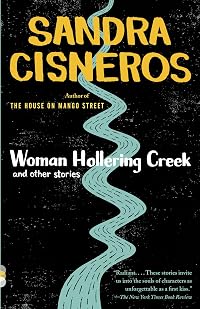
Woman Hollering Creek: And Other Stories
by Sandra Cisneros
On This Page
Description
A collection of stories by Sandra Cisneros, the winner of the 2019 PEN/Nabokov Award for Achievement in International Literature.The lovingly drawn characters of these stories give voice to the vibrant and varied life on both sides of the Mexican border with tales of pure discovery, filled with moments of infinite and intimate wisdom.
Tags
Recommendations









Member Reviews
When I think about a married woman and the impression of these two words, the first thing that comes to my mind is happiness; however, after I finished reading Sandra Cisneros’s short story, Woman Hollering Creek, I want to change the word happiness to flaw. The story is told through a woman’s perspective on marriage and the contrast between the ideals of marriage and its reality. Cleofilas Enriqueta DeLeon Hernandez is aware that one of the greatest aspects of a marriage is passion and ironically, passion is one of the many things that her marriage is lacking. This is quite obvious by her constant comparison of her being to the characters in telenovelas. Although in her mind, she thinks that those types of marriages can be show more attainable, she knows that with her current state, nothing is ever going to progress. To me, it seems as if she’s always looking for change or an improvement that will perhaps make her position of being a wife to be more presentable; however, this doesn’t change the fact that her marriage is completely flawed. For instance, towards the end of the story Cleofilas encounters Felice who essentially serves as her alter-ego. Felice’s character is simply a reflection to Cleofilas for she can only dream of being in Felice’s shoes rather than her own. It is pretty humorous to know that Cleofilas, a mother, a daughter, and a wife can be envious of a single woman that drives a pickup truck and yells when she passes the creek. Although her husband is not a bad man, she still gets beaten by him and even with a child; she realizes that she cannot acquire happiness. Cleoflias has to remind herself why she loves her husband and of course, a marriage cannot be successful if one of the partners constantly has to do the reminding. By forcing love upon a marriage, she will be setting herself and marriage to potential destruction. Even then, she continued to laugh, mingle, and show her husband affection. Her attempt of pushing the reality into being a perfect wife eventually failed when she realizes that hoping for passion in a marriage does not mean she’ll obtain it. As a matter of fact, her marriage (like a lot of other marriages) is drowned by expectations and flaws. These flaws are presented through Cisneros’s usage of short sentences such as “Not that he isn’t a good man.” And “Well, he’s always been husky” in order to declare a clear statement. Overall, I find this story to be extremely intriguing. As a woman, Cisneros made it really easy for me to understand the position of the main character. I learn how flawed a marriage can be and even though I’m not placing this label on every marriage out there, I know that the one that Cleoflias possess will eventually go down the drain. show less
Cisnero's style for these stories melds poetry and prose very effectively. Quite a few of the stories here are only 2 or 3 pages, in fact, and more prose poems than short stories. The collection as a whole adds up to a rewarding journey into the life of a Mexican American woman in the late 20th century. The stories deal with the joys and pains of love, of the difficulties of having the sort of duel ethnicity that sometimes leaves you wondering where you stand. Rather than being "both," sometimes it seems you're not either. At least that's how Cisnero portrays it. And then there are the varying joys and challenges of being a woman, in Mexican culture, in Mexican American culture, and in "mainstream" American culture. I guess though, what show more makes this collection rewarding after all, is Cisnero's wonderful writing, and the fact that at the root of it all, these stories are really about the joys and challenges of being human on the planet.
The only quibble I have is that I wished some of the short-short stories had continued on longer. There were some lovely ideas floating around that I wanted Cisneros to explore more deeply. show less
The only quibble I have is that I wished some of the short-short stories had continued on longer. There were some lovely ideas floating around that I wanted Cisneros to explore more deeply. show less
It took several months to finish this, partly because I couldn't identify with the section where the narrator seems to be a young woman searching for her life in a lover. Wonderful imagery; in some stories the images are all there is.
'Salvador Early or Late' touched my heart with this portrayal of a young boy who is responsible for his younger siblings, growing up too fast, "grows small and smaller to the eye, dissolves into the bright horizons, flutters in the air before disappearing like a memory of kites." (p.11). I could feel the freedom in the woman who always shouted as she crossed Hollering Woman Creek, and the dawning of new possibilities in Felice, listening to her. But it is a long journey for the many women portrayed to get show more to the story where Lupe, living "with those two regrets like twin grains of sand embedded in my oyster heart, until one night listening to Carlos Gardel sing, 'Life is an absurd wound,' I realized I had it wrong" (p160) and took as her model "Those Women. The ones I've known everywhere except on TV, in books and magazines...Passionate and powerful, tender and volatile, brave. And, above all, fierce."(p.161) show less
'Salvador Early or Late' touched my heart with this portrayal of a young boy who is responsible for his younger siblings, growing up too fast, "grows small and smaller to the eye, dissolves into the bright horizons, flutters in the air before disappearing like a memory of kites." (p.11). I could feel the freedom in the woman who always shouted as she crossed Hollering Woman Creek, and the dawning of new possibilities in Felice, listening to her. But it is a long journey for the many women portrayed to get show more to the story where Lupe, living "with those two regrets like twin grains of sand embedded in my oyster heart, until one night listening to Carlos Gardel sing, 'Life is an absurd wound,' I realized I had it wrong" (p160) and took as her model "Those Women. The ones I've known everywhere except on TV, in books and magazines...Passionate and powerful, tender and volatile, brave. And, above all, fierce."(p.161) show less
Cleofilas Hernandez, the main character of Sandra Cisneros’ “Woman Hollering Creek,” is strong-willed yet deluded by the idea of a having a happy ending. Cleofilas leaves her family and siblings in Mexico to move to the United States and marry Juan Pedro. But what she doesn’t realize is just how different her life will be once she moves and how her life will be nothing like her favorite “telenovelas.”
Through the text, Cisneros is able to reveal to her readers how the life of a Mexican immigrant is extremely difficult. People constantly come to America in the hopes of living the “American Dream” and to gain true freedom. Cleofilas believes her life will start to mean something when she comes to America, but instead she show more lives a miserable life and her husband could care less about her and her well being. Juan Pedro abuses her constantly and even cheats on her, and things like this aren’t supposed to happen to people in America, or so Cleofilas thinks.
Being in America, Cleofilas should have a life filled with opportunities but that is not the case. She ends up having to return home, but at her own choice. Felice, the woman who picks her up, takes her back to her hometown and on the drive back they pass over a creek called Woman Hollering Creek. The creek is meant to symbolize all the possible hardships that women must face and how they get through them. They can choose to either stay back or to face their fears. In Cleofilas case, she thankfully made it out alive and is able to start over. But that means she must leave the country where “everything is possible.” Although she may not have gotten the perfect ending she wanted, Cleofilas was able to get away from a life that could have been anything but happy. show less
Through the text, Cisneros is able to reveal to her readers how the life of a Mexican immigrant is extremely difficult. People constantly come to America in the hopes of living the “American Dream” and to gain true freedom. Cleofilas believes her life will start to mean something when she comes to America, but instead she show more lives a miserable life and her husband could care less about her and her well being. Juan Pedro abuses her constantly and even cheats on her, and things like this aren’t supposed to happen to people in America, or so Cleofilas thinks.
Being in America, Cleofilas should have a life filled with opportunities but that is not the case. She ends up having to return home, but at her own choice. Felice, the woman who picks her up, takes her back to her hometown and on the drive back they pass over a creek called Woman Hollering Creek. The creek is meant to symbolize all the possible hardships that women must face and how they get through them. They can choose to either stay back or to face their fears. In Cleofilas case, she thankfully made it out alive and is able to start over. But that means she must leave the country where “everything is possible.” Although she may not have gotten the perfect ending she wanted, Cleofilas was able to get away from a life that could have been anything but happy. show less
Amazing. "And every bird in the universe chittering, jabbering, clucking, chirruping, squawking, gurgling, going crazy because God-bless-it another day has ended, as if it never had yesterday and never will again tomorrow. Just because it's today, today. With no thought of the future or past. Today. Hurray. Hurray!
A book about being a woman, mostly, and also about Mexican-American culture.
A book about being a woman, mostly, and also about Mexican-American culture.
The women of Cisneros’s stories are flawed creatures; that is what makes them so real. Unlike traditional heroines, they don’t always win. The narrator and her comadres are women that readers from varying cultural backgrounds can relate to. Cisneros expands the virgin-whore dichotomy to illustrate other types of women. Some of her characters praise men, others blame men, but they all assert their woman-ness proudly.
More at http://annotationnation.wordpress.com/2009/05/28/woman-hollering-creek/
More at http://annotationnation.wordpress.com/2009/05/28/woman-hollering-creek/
I enjoyed some of these stories a lot, though it was a mixed bag and I like others less. I did appreciate the tone and voice of the stories reflecting Cisneros’ culture; the stories felt like ones I’ve heard my Mexican co-workers tell.
The title story was probably my favorite, though “Remember the Alamo” was the one that had the most impact on me. Very poignant.
The title story was probably my favorite, though “Remember the Alamo” was the one that had the most impact on me. Very poignant.
Members
- Recently Added By
Lists

Latin American Literature
50 works; 11 members

This is the Canon: Decolonize Your Bookshelf in 50 Books
51 works; 5 members

Literary Witches
86 works; 4 members
Author Information

30+ Works 19,172 Members
Sandra Cisneros was born in Chicago, Illinois on December 20, 1954. She received a B.A. in English from Loyola University of Chicago in 1976 and a M.F.A. in creative writing from the University of Iowa in 1978. She has worked as a college recruiter, an arts administrator, a teacher to high school dropouts, and a poet. She has also visited numerous show more colleges around the country as a visiting writer. She has written numerous books including The House on Mango Street, Caramelo, Loose Woman, Have You Seen Marie?, and A House of My Own: Stories from My Life. She has received numerous awards including the MacArthur Fellowship, two National Endowment for the Arts Fellowships, the Lannan Literary Award, the American Book Award, and the Thomas Wolfe Prize. (Bowker Author Biography) show less
Some Editions
Awards and Honors
Awards
Notable Lists
Work Relationships
Is contained in
Contains
Has as a student's study guide
Common Knowledge
- Original publication date
- 1991
- Important places
- Mexico; Texas, USA
- Dedication
- For my mama,
Elvira Cordero Anguiano,
who gave me the fierce language.
Y para mi papa,
Alfredo Cisneros Del Moral,
quien me dio el lenguage de la ternura.
Estos cuentos se los dedico
con tod... (show all)o mi corazon. - First words
- Lucy Anguiano, Texas girl who smells like corn, like Frito Bandito chips, like tortillas, something like that warm smell of nixtamal or bread the way her head smells when she's leaning close to you over a paper-cut doll or on... (show all) the porch when we are squatting over marbles trading this pretty crystal that leaves a blue star on your hand for that giant cat-eye with a grasshopper green spiral in the center like the juice of bugs on the windshield when you drive to the border, like the yellow blood of butterflies.
- Quotations
- We drag these bodies around with us, these bodies that have nothing at all to do with you, with me, with who we really are, these bodies that give us pleasure and pain.
- Last words
- (Click to show. Warning: May contain spoilers.)Today. Hurray. Hurray!
- Blurbers
- Beattie, Ann
- Canonical DDC/MDS
- 813.54
- Canonical LCC
- PS3553.I78
Classifications
Statistics
- Members
- 2,063
- Popularity
- 10,073
- Reviews
- 36
- Rating
- (3.93)
- Languages
- 5 — Dutch, English, German, Italian, Spanish
- Media
- Paper, Ebook
- ISBNs
- 20
- ASINs
- 10