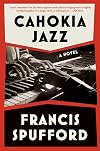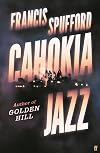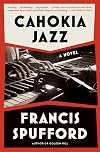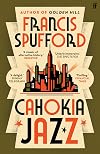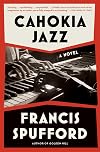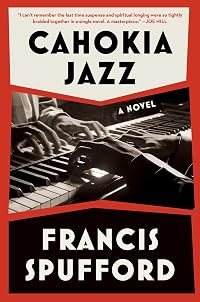
Cahokia Jazz
by Francis Spufford
On This Page
Description
"Like Golden Hill, Cahokia Jazz inhabits a different version of America, and like Golden Hill it has a propulsive and brilliantly twisty plot set within a fully imagined world. Only this world is full of fog, cigarette smoke, dubious motives, danger, and dark deeds. And in the main character of Joe Barrow, we have a hero of truly heroic proportions, and a troubled soul to fall in love with. One snowy night at the end of winter, Barrow and his partner find a body on the roof of a skyscraper. show more Down below, streetcar bells ring, factory whistles blow, Americans drink in speakeasies and dance to the tempo of modern times. But this is Cahokia, the ancient indigenous city beside the Mississippi living on as a teeming industrial metropolis containing every race and creed. Among them, peace holds. Just about. But the corpse on the roof will spark a week of drama in which this altered world will spill its secrets and be brought, against a soundtrack of wailing clarinets, either to destruction or to rebirth"-- show lessTags
Recommendations






Member Reviews
It's been a while since I read such an accomplished contemporary novel. This is an object-lesson in worldbuilding. Unlike many similar stories, 1920's Cahokia doesn't feel like trompe l'oeil trickery; it feels real and lived-in. For every ounce of exposition you sense a slew of alt-history dreamt up by the author but held in reserve. And it's equally convincing as a period piece: the America of our timeline that still more or less exists to the north and east of this one is unerringly evoked.
The 20's setting and themes of robber-baron capitalism, false-flag shenanigans and racist populism are grist for the book club mill. But what stood out to me were the sheer quality of the writing (e.g. a half-page description of river fog that show more Dickens would have envied) and the way the procedural was as much a vehicle for the characters as for the plot. I'm a sucker for a big lummoxy lunks of a protagonist and Joe Barrow charmed me from the start. Everyone comes with a streak of ambiguity (something Dickens wouldn't have appreciated). It's a grown-up book.
It's odd how jazz, a kind of music I mostly don't like, is the only kind of music I seem to enjoy reading descriptions of. The jazz writing and extended musical imagery in this novel are fucking phenomenal. show less
The 20's setting and themes of robber-baron capitalism, false-flag shenanigans and racist populism are grist for the book club mill. But what stood out to me were the sheer quality of the writing (e.g. a half-page description of river fog that show more Dickens would have envied) and the way the procedural was as much a vehicle for the characters as for the plot. I'm a sucker for a big lummoxy lunks of a protagonist and Joe Barrow charmed me from the start. Everyone comes with a streak of ambiguity (something Dickens wouldn't have appreciated). It's a grown-up book.
It's odd how jazz, a kind of music I mostly don't like, is the only kind of music I seem to enjoy reading descriptions of. The jazz writing and extended musical imagery in this novel are fucking phenomenal. show less
Spufford imagines the U.S. in 1922 with 3 fewer states than ours in that year, though still with Prohibition, and Jazz, and a Red Scare helping shape Federal politics. Harding is President. A recent war in France, seemingly broadly similar to ours, but also an active war in Novaya Siburskaya Territorii, to which our veteran protagonists Burrow and Drummond are threatened with being sent by Federal agents. No Nevada, no Idaho, no Utah: instead, the independent Republic of Deseret looms between Colorado and California, and together with the traditional Navajo home of Dinetah, this new American West signals all that has gone differently. Careful examination of the included map reveals other changes, never fully explained. And in the middle show more of that map, surprisingly low profile given all it represents, the very large State of Cahokia fills the space below Illinois, while in place of Oklahoma is found a state labeled SQ, suggesting Sequoyah but never (?) mentioned in the story at all.
A close examination of Spufford's imagined world, reflecting the myriad ways it interrogates ours, would be well worth writing. Spufford's world is nuanced enough and detailed to support a discussion capable of sharpening understanding of our own world, its pitfalls and its untapped possibility.
But such a discussion would largely bypass the story, which itself offers insight. None of Spufford's worldbuilding is foregrounded in the novel: the plot moves along and explicit diversions from our timeline are glimpsed mostly to one side or another, on the walls around the room, in the faces and conversations of onlookers and bystanders. This is to the novel's good. After all, the unfamiliar U.S. is setting, not story. And Spufford tells an engaging story, with interesting if uncomplicated characters, so figuring out just what the angles are (there always are angles to be figured in a noir) easily sustains interest even after the last page is read. And yet: when reflecting on the story's significance, a question niggled. Why this particular story, in this particular world? Why not historical fiction rather than alternate history? Why a crime noir and not, say, a family drama?
Good questions, not answered simply. The novel is not only crime fiction, and not merely alternate history. There is a fair amount of family drama, and history, and politics on offer. Spufford's mystery really could not have worked in any but this setting. But it was only while thinking of how each (the world, the story) insists on being considered seriously when assessing this novel overall, how each leans upon the other, and looking into Spufford's other published works, that I recognized a third aspect of the novel, a red thread not really covered by either of the other two: an abiding evangelism.
Spufford signposts this red thread through reference to the Jesuits: their past works rate mention in his imagined history, Jesuit characters drop in and out of the plot. In light of Spufford's other work, however, this Christian theme seems distinct from other facets of his alternate history. Other readers suggest (and Spufford in interviews to some extent acknowledges) a prevailing interest in different perspectives on Christianity, and specifically the utility of such inquiry for a Christian -- as opposed to new perspectives on secular American culture, or directed to indigenous individuals living here. Perhaps most suggestive, if this interest indeed predominates the story, is the denouement: Burrow's decision (to father a child, but not be its father); Drummond's soliloquy ("We're not awake, Joe. Fact, I'm not sure we're even alive ..." [429]); the final chapter's stigmata theater.
Alternate history to inform today's evangelist! -- such a possibility arrived as something of a surprise, despite the straightforward inclusion of Jesuit characters and missions, and yet as a more fitting summary of the novel than any other occurring to me. This unexpected fittingness also demonstrates the relative heft of the novel compared to many other alternate history stories out there. Probably worth a second reading. show less
A close examination of Spufford's imagined world, reflecting the myriad ways it interrogates ours, would be well worth writing. Spufford's world is nuanced enough and detailed to support a discussion capable of sharpening understanding of our own world, its pitfalls and its untapped possibility.
But such a discussion would largely bypass the story, which itself offers insight. None of Spufford's worldbuilding is foregrounded in the novel: the plot moves along and explicit diversions from our timeline are glimpsed mostly to one side or another, on the walls around the room, in the faces and conversations of onlookers and bystanders. This is to the novel's good. After all, the unfamiliar U.S. is setting, not story. And Spufford tells an engaging story, with interesting if uncomplicated characters, so figuring out just what the angles are (there always are angles to be figured in a noir) easily sustains interest even after the last page is read. And yet: when reflecting on the story's significance, a question niggled. Why this particular story, in this particular world? Why not historical fiction rather than alternate history? Why a crime noir and not, say, a family drama?
Good questions, not answered simply. The novel is not only crime fiction, and not merely alternate history. There is a fair amount of family drama, and history, and politics on offer. Spufford's mystery really could not have worked in any but this setting. But it was only while thinking of how each (the world, the story) insists on being considered seriously when assessing this novel overall, how each leans upon the other, and looking into Spufford's other published works, that I recognized a third aspect of the novel, a red thread not really covered by either of the other two: an abiding evangelism.
Spufford signposts this red thread through reference to the Jesuits: their past works rate mention in his imagined history, Jesuit characters drop in and out of the plot. In light of Spufford's other work, however, this Christian theme seems distinct from other facets of his alternate history. Other readers suggest (and Spufford in interviews to some extent acknowledges) a prevailing interest in different perspectives on Christianity, and specifically the utility of such inquiry for a Christian -- as opposed to new perspectives on secular American culture, or directed to indigenous individuals living here. Perhaps most suggestive, if this interest indeed predominates the story, is the denouement: Burrow's decision (to father a child, but not be its father); Drummond's soliloquy ("We're not awake, Joe. Fact, I'm not sure we're even alive ..." [429]); the final chapter's stigmata theater.
Alternate history to inform today's evangelist! -- such a possibility arrived as something of a surprise, despite the straightforward inclusion of Jesuit characters and missions, and yet as a more fitting summary of the novel than any other occurring to me. This unexpected fittingness also demonstrates the relative heft of the novel compared to many other alternate history stories out there. Probably worth a second reading. show less
Spufford has equalled his excellent novel of old New York, Golden Hill, with a tale set in a 1920s America whose Native American people, never decimated by disease as in our world, maintained their civilizations and came to a significantly different accommodation with the European invaders. The former nation of Cahokia, its capital city across the river from the tiny village of St. Louis, chose to enter the Union as a state in the nineteenth century and is now a bustling center of commerce and a crossroads to the Western states. Detective Joe Barrow, an Indian but an outsider with origins in a Nebraska orphanage, and his white partner Phineas Drummond come across the body of a white man “sacrificed” in grisly fashion at the top of show more the city’s tallest skyscraper. Was it the work of radical Native nationalists? Or of a cabal of white supremacists stoking the flames of racial tension?
Barrow and Drummond’s investigation has them interviewing everyone from wealthy industrialists to witch doctors, from Klan members to hereditary (but now ceremonial) royalty. All have both open and secret agendas, and no one is entirely who they seem to be. Can the murder be solved before the KKK marches into the central plaza and the city breaks down into chaos?
This being by Spufford, the noir setup frames a story about the individual and his responsibility to respond to the moral failings of his time. In Golden Hill, the issue was the slave trade. In Cahokia Jazz, the issue, put most simply, is race—but more broadly, the balance one must find between loyalty to individuals and loyalty to one’s people. It’s difficult to describe how rich this book is in world-building detail, how emotionally convincing, how vivid in painting a Jazz Age metropolis that’s like Chicago but also like nothing we’ve seen: a city that makes the real-life cultural fusion of New Orleans seem simple by comparison.
Spufford keeps writing the books that I would try to write if I were a writer, and writing them better than anyone could humanly expect. show less
Barrow and Drummond’s investigation has them interviewing everyone from wealthy industrialists to witch doctors, from Klan members to hereditary (but now ceremonial) royalty. All have both open and secret agendas, and no one is entirely who they seem to be. Can the murder be solved before the KKK marches into the central plaza and the city breaks down into chaos?
This being by Spufford, the noir setup frames a story about the individual and his responsibility to respond to the moral failings of his time. In Golden Hill, the issue was the slave trade. In Cahokia Jazz, the issue, put most simply, is race—but more broadly, the balance one must find between loyalty to individuals and loyalty to one’s people. It’s difficult to describe how rich this book is in world-building detail, how emotionally convincing, how vivid in painting a Jazz Age metropolis that’s like Chicago but also like nothing we’ve seen: a city that makes the real-life cultural fusion of New Orleans seem simple by comparison.
Spufford keeps writing the books that I would try to write if I were a writer, and writing them better than anyone could humanly expect. show less
I have read one other Francis Spufford novel, and it was a terrrific historical novel - I'm very particular about historical novels. This one is a bit different, as it is set in 1922 but in an alternate timeline in which there is a state of Cahokia, capital city Cahokia, that is majority American Indian, and where Indians have more political and economic power than they ever had in our timeline. For some reason, they are also mostly devout Roman Catholics. There is racism here, but it runs three ways - black, white, and Indian. The KKK is here, too, as awful as you expect them to be. Spufford makes this place very real, as he has done with historical fiction. I don't know any Indian languages beyond a few Pennsylvania place names, but show more the casual terms that are thrown around in Anopa (the local Indian language) was pretty convincing. The protagonist, policeman Joe Barrow, was raised in an orphanage. While he looks Indian, he knows nothing about Indian language or traditions. He finds himself with loyalties divided between his duties as a policeman, his growing attachment to his Indian heritage, and his desire to be a jazz pianist. Spufford somehow manages to pull all this off, make us care for his characters and their moral conundrums, and believe in this strange but very recognizable place. show less
Francis Spufford’s imagination astounds!
I first had read his I May Be Some Time: Ice and the English Imagination, which I savoured for its gorgeous writing and its insight. Then, he wrote the novel On Golden Hill in the style of 18th c novels by Henry Fielding and his sister Sarah. Then he astounded with Perpetual Light, imagining the lives children would have lived had they not been killed in a horrible accident.
Now, he has given us an alternate history/noir novel with Cahokia Jazz.
Spufford imagines a New World visited first by a less deadly smallpox virus, leaving the indigenous population immunized. With a healthy Native American presence they were able to establish their own state in the middle of the continent where native, show more black, and white are equal. The Jesuits converted the Native Americans by overlaying Christian ideas on the native myths. The land is not privately owned, with limited time leases for its use. And, there are the figureheads of a king and his princess sister.
The white immigrants from the North come for jobs but bring their racial prejudices, and the Klan is a strong organization.
The novel begins with the horrific murder of a white man, found with his heart torn out in imitation of ancient Aztec ritual killings. The whites flee the state, and those who remain are ready to riot against the Native American government.
Detective Barrow, a Native American who grew up in an orphanage, is on the case. Identified as Thrown-Away Boy, a hero in native legend, he is given access to the royal palace, and encountering the beautiful princess, falls in love.
It is a novel rich in detail and character, a great mystery, if not a fast reading page-turner, with interesting red herrings and twists. Its immensely entertaining in the way a murder mystery or alternative history can be, but also reflects our contemporary world’s ills. (One character suggests that the Klan army marching to attack the seat of government were really Jesuits out to stir up trouble!) Plus there is a love story! And scenes in a jazz lounge, with Barrow pounding out Jelly Roll Morton’s “Kansas City Stomp”. And a spunky secretary who staples the hand of a man who goosed her one time too many.
Then, there is the great noir style writing. “His voice was a Boston Brahmin Drawl, with vowels as aristocratically deformed as if an ottoman has been dragged on top of them.” “Muscle work was a stupid thing for a pianist to get involved in.” “Their money was so old that it underlay the United States like geology.”
My faith in Spufford reinforced, I will read anything the man writes.
Thanks to the publisher for a free book. show less
I first had read his I May Be Some Time: Ice and the English Imagination, which I savoured for its gorgeous writing and its insight. Then, he wrote the novel On Golden Hill in the style of 18th c novels by Henry Fielding and his sister Sarah. Then he astounded with Perpetual Light, imagining the lives children would have lived had they not been killed in a horrible accident.
Now, he has given us an alternate history/noir novel with Cahokia Jazz.
Spufford imagines a New World visited first by a less deadly smallpox virus, leaving the indigenous population immunized. With a healthy Native American presence they were able to establish their own state in the middle of the continent where native, show more black, and white are equal. The Jesuits converted the Native Americans by overlaying Christian ideas on the native myths. The land is not privately owned, with limited time leases for its use. And, there are the figureheads of a king and his princess sister.
The white immigrants from the North come for jobs but bring their racial prejudices, and the Klan is a strong organization.
The novel begins with the horrific murder of a white man, found with his heart torn out in imitation of ancient Aztec ritual killings. The whites flee the state, and those who remain are ready to riot against the Native American government.
Detective Barrow, a Native American who grew up in an orphanage, is on the case. Identified as Thrown-Away Boy, a hero in native legend, he is given access to the royal palace, and encountering the beautiful princess, falls in love.
It is a novel rich in detail and character, a great mystery, if not a fast reading page-turner, with interesting red herrings and twists. Its immensely entertaining in the way a murder mystery or alternative history can be, but also reflects our contemporary world’s ills. (One character suggests that the Klan army marching to attack the seat of government were really Jesuits out to stir up trouble!) Plus there is a love story! And scenes in a jazz lounge, with Barrow pounding out Jelly Roll Morton’s “Kansas City Stomp”. And a spunky secretary who staples the hand of a man who goosed her one time too many.
Then, there is the great noir style writing. “His voice was a Boston Brahmin Drawl, with vowels as aristocratically deformed as if an ottoman has been dragged on top of them.” “Muscle work was a stupid thing for a pianist to get involved in.” “Their money was so old that it underlay the United States like geology.”
My faith in Spufford reinforced, I will read anything the man writes.
Thanks to the publisher for a free book. show less
I love a counterfactual history in which colonialism didn't grind down so much of the world! Upon finding out that Francis Spufford, whose writing I consistently enjoy, had written such a novel I was very excited. And [b:Cahokia Jazz|75584918|Cahokia Jazz|Francis Spufford|https://i.gr-assets.com/images/S/compressed.photo.goodreads.com/books/1687530730l/75584918._SY75_.jpg|100913371] lived up to my high expectations. Although the plot was exciting and I wanted to know what happened, I found myself spacing out my reading in order to stay in the fascinating city of Cahokia for as long as possible. While events in the novel combine murder mystery with mythic archetypes to excellent effect, the whole thing is wonderfully drenched in noir show more tropes. Very few writers manage to channel Raymond Chandler so well without descending into parody:
The protagonist Joe Barrow is a police detective rather than a private dick, investigating a gruesome murder that sparks off Klu Klux Klan rioting in a city where Takouma (native American), Taklousa (black African-American), and Takata (white European-Americans) coexist in relative peace. I loved the atmosphere, world-building, and action. Cahokia really comes to life as Barrow travels around by tram, car, and on foot encountering millionaire industrialists, the Takouma royal family, speakeasy jazz bands, hired goons, journalists, other untrustworthy types, and attractive women who all want to sleep with him. I'll allow that last one as it's a noir tradition and is handled gracefully here. The female characters all have their reasons for liking Barrow (who does indeed come off as appealing) so it isn't just the Protagonist Effect. He fact that he's ambivalent about being a cop and much better at being a jazz pianist helps. The narrative's pacing is also excellent, as the narrative spans a particularly eventful week and each day is given a chapter.
At the beginning of the book there are two maps, always a good sign. The first allows the reader to visualise Barrow's travels through the city and the second to locate Cahokia within North America, so I was delighted with them. I looked up a current map of US states to compare. Nevada, Utah, and Idaho are the mormon 'Republic of Deseret'. Washington is British Oregon. Alaska is Novasibirskaya Territorii. And between Arkansas, Missouri, Illinois, Kentucky, Tenessee, and Mississippi is an additional state, Cahokia. In an afterword, Spufford reveals where Cahokia's history diverged from ours and refers to events after the novel's ending, which added to this alternate history's great charm.
While the world-building was undoubtedly the most pleasurable part of [b:Cahokia Jazz|75584918|Cahokia Jazz|Francis Spufford|https://i.gr-assets.com/images/S/compressed.photo.goodreads.com/books/1687530730l/75584918._SY75_.jpg|100913371], I was also very impressed with the characterisation and plot. The ending has a gorgeously inevitable symmetry; indeed the novel has a beautifully tidy structure.Barrow's death at the end, sacrificing himself in order to prevent his former partner assassinating Cahokia's figurehead, is tragic yet magnificent. He has fallen into a mythic story from which he cannot escape by leaving to be a jazz pianist and becomes a sacrifice to allow Cahokia a peaceful future. Such is the wonderful vividness of the city that the reader can understand why Barrow would willingly do this. Barrow isn't the main character at all; the city of Cahokia is. It's a beguiling place that will linger in my mind for a long time. There are very few writers who appear equally adept at writing nonfiction history, historical fiction, and alternative history fiction. Spufford is the only example I can think of and I found [b:Cahokia Jazz|75584918|Cahokia Jazz|Francis Spufford|https://i.gr-assets.com/images/S/compressed.photo.goodreads.com/books/1687530730l/75584918._SY75_.jpg|100913371] an absolute joy to read. show less
Barrow tried to light a cigarette and discovered that he already had one alight in his mouth.
"What the hell is happening out there?" he said.
"Take a breath, son," said Doyle. "Everyone's got people they care about at risk, today."
The protagonist Joe Barrow is a police detective rather than a private dick, investigating a gruesome murder that sparks off Klu Klux Klan rioting in a city where Takouma (native American), Taklousa (black African-American), and Takata (white European-Americans) coexist in relative peace. I loved the atmosphere, world-building, and action. Cahokia really comes to life as Barrow travels around by tram, car, and on foot encountering millionaire industrialists, the Takouma royal family, speakeasy jazz bands, hired goons, journalists, other untrustworthy types, and attractive women who all want to sleep with him. I'll allow that last one as it's a noir tradition and is handled gracefully here. The female characters all have their reasons for liking Barrow (who does indeed come off as appealing) so it isn't just the Protagonist Effect. He fact that he's ambivalent about being a cop and much better at being a jazz pianist helps. The narrative's pacing is also excellent, as the narrative spans a particularly eventful week and each day is given a chapter.
At the beginning of the book there are two maps, always a good sign. The first allows the reader to visualise Barrow's travels through the city and the second to locate Cahokia within North America, so I was delighted with them. I looked up a current map of US states to compare. Nevada, Utah, and Idaho are the mormon 'Republic of Deseret'. Washington is British Oregon. Alaska is Novasibirskaya Territorii. And between Arkansas, Missouri, Illinois, Kentucky, Tenessee, and Mississippi is an additional state, Cahokia. In an afterword, Spufford reveals where Cahokia's history diverged from ours and refers to events after the novel's ending, which added to this alternate history's great charm.
While the world-building was undoubtedly the most pleasurable part of [b:Cahokia Jazz|75584918|Cahokia Jazz|Francis Spufford|https://i.gr-assets.com/images/S/compressed.photo.goodreads.com/books/1687530730l/75584918._SY75_.jpg|100913371], I was also very impressed with the characterisation and plot. The ending has a gorgeously inevitable symmetry; indeed the novel has a beautifully tidy structure.
This is a noir murder mystery, set in the 1920s in an alternate history where the Native American city of Cahokia was never abandoned, and was also never fully integrated into the United States. The city is still ruled by Native Americans. The main character is detective Barrow, a large Native American man who is initially known more for his brawl than his brains, but circumstances require him to put his intelligence to use. He did not grow up in Cahokia, so a lot of Cahokia's ways are foreign to him, which makes him a good character for the reader to follow, so that we can learn about Cahokia's culture as he does.
As a noir mystery, this book is fantastic: the mystery is truly surprising, with lots of twists and turns that end up show more involving a lot of powerful people. On top of that, the world-building is thoughtful, thorough, and adds extra dimensions to the mystery. The characters are well-developed and lively. Parts of the book get a little bit sappy, but that's fitting with the noir genre. This is one of those delightful books that is not only very entertaining and engaging, but also very well-written. show less
As a noir mystery, this book is fantastic: the mystery is truly surprising, with lots of twists and turns that end up show more involving a lot of powerful people. On top of that, the world-building is thoughtful, thorough, and adds extra dimensions to the mystery. The characters are well-developed and lively. Parts of the book get a little bit sappy, but that's fitting with the noir genre. This is one of those delightful books that is not only very entertaining and engaging, but also very well-written. show less
Members
- Recently Added By
Published Reviews
ThingScore 67
I worry that Cahokia Jazz may be too subtle for many. I loved the book for many reasons, but on the other hand, it was definitely written to appeal to someone like me. I’m no connoisseur of noir or detective tales, and I have read very few alternative histories. However, I am a historian of Native America. I am Chickasaw, and words from our language show up throughout the novel in the show more constructed language of Anopa. I’m a historian of the Mississippi River Valley, and this novel takes that area seriously, like few since Mark Twain have—even if this-place-that-never-was is a very different place from the one I study. show less
added by elenchus
Ultimately Cahokia Jazz is most notable for the thought that’s gone into its thought-experiment. It demands the reader’s trust and faith as it unpacks its characters, plot, and ideas, and it invites debate about its choices. Cahokia is no utopia. It is a human society and it makes compromises, and what Barrow and Drummond’s investigation demonstrates is that an inarguable good at the show more level of a world might still create an intolerable crisis at the level of an individual. But whether you walk away in the face of that crisis or, as N.K. Jemisin’s fiction has more recently argued, stay and fight, Cahokia Jazz is clear that the one thing you mustn’t do with the problem of Omelas is ignore it. show less
added by elenchus
And so Cahokia Jazz proves surprisingly uninterested in the history of its own alternative past. [...] The effect of this coyness is to place the novel’s spotlight not on the breadth of its posited Indigenous past, but on a specific element of it—and that element is its interaction with the Jesuits. I said that Spufford distrusts utopias, and I think this is true in the informal sense of show more the word—as an imagined place of wonder. But in the formal sense of the word—as a no-place in which to conduct thought experiments—I think he’s rather fond of them. The Jonbar point that leads to this Cahokia is so under-emphasised because it isn’t at all the point. Cahokia exists because Spufford needs it to: he isn’t exploring Indigenous history at all; rather, he is using it to make an argument with it. “What if the United States had instead been maybe a bit like Canada or New Zealand,” he asks in an interview with Slate, “in which there had continued to be an Indigenous presence that was just too big to be pushed to the margins like that? What would it be like?” Now, the premise of this what-if does not entirely reflect my understanding of the colonial histories of either Canada or New Zealand; but, either way, note the angle of the focus: on the effect of Indigenous survival upon the US.
[...]
But again: to what end? Here we should read some prior Spufford. In his defense of his Christianity, Unapologetic: Why, Despite Everything Christianity Can Still Make Surprising Emotional Sense (2012), Spufford makes the case that religion is about feeling—that its truth can be found in its capacity to provide successful interpretative frames for human passions. “And so it makes emotional sense to proceed as if He’s there; to dare the conditional,” the book concludes. “And not timid death-fearing emotional sense, or cowering craven master-seeking sense, or censorious holier-than-thou sense, either. Hopeful sense. Realistic sense. Battered-about-but-still-trying sense” (p. 240). Attentive readers will see Barrow in this: hopeful, realistic, battered. They’d be right to. Here’s Spufford in Church Times, on Cahokia Jazz: “As well as being pulp fiction and speculative history, it’s also intended to be doing something theological,” he says of the novel. “Whether I set out to, consciously or not, I seem to be endlessly tracing over the invisible shape of the gospel underneath the paper I’m writing on, telling sin-and-redemption stories, because that’s just the shape I perceive reality to be.” show less
[...]
But again: to what end? Here we should read some prior Spufford. In his defense of his Christianity, Unapologetic: Why, Despite Everything Christianity Can Still Make Surprising Emotional Sense (2012), Spufford makes the case that religion is about feeling—that its truth can be found in its capacity to provide successful interpretative frames for human passions. “And so it makes emotional sense to proceed as if He’s there; to dare the conditional,” the book concludes. “And not timid death-fearing emotional sense, or cowering craven master-seeking sense, or censorious holier-than-thou sense, either. Hopeful sense. Realistic sense. Battered-about-but-still-trying sense” (p. 240). Attentive readers will see Barrow in this: hopeful, realistic, battered. They’d be right to. Here’s Spufford in Church Times, on Cahokia Jazz: “As well as being pulp fiction and speculative history, it’s also intended to be doing something theological,” he says of the novel. “Whether I set out to, consciously or not, I seem to be endlessly tracing over the invisible shape of the gospel underneath the paper I’m writing on, telling sin-and-redemption stories, because that’s just the shape I perceive reality to be.” show less
added by elenchus
Lists

Books to watch out for.
3 works; 1 member

2024 Hugo Awards -- Eligible Works -- Novels
44 works; 6 members

TBR of Books I Don't Own
132 works; 1 member

Books Read in 2025
4,091 works; 97 members

The Five Books That Represent Us
391 works; 148 members
Author Information

16+ Works 5,818 Members
Francis Spufford is also the author of I May Be Some Time. He was named Sunday Times (London) Young Writer of the Year and received the 1997 Somerset Maugham and Writers' Guild awards. He lives in London
Some Editions
Awards and Honors
Awards
Distinctions
Common Knowledge
- Canonical title
- Cahokia Jazz
- Original publication date
- 2023
- People/Characters
- Joe Barrow; Phineas Drummond
- Epigraph
- When the men with the brands approached me, I said to myself the words of the Epistle of John, "Whoever fears has not reached perfection in love." But indeed I did fear to my shame, remembering the long death of Fr. Baltasar ... (show all)the night before and how his body more resembled a charred log than anything human, before his soul was suffered to depart it. But such is the grace of God towards even those most unworthy of it that He reached out to me in the very moment of my cowardice and showed me what I must do. For observing how those around me gazed at me solemnly, as if about to receive something from me, my mind was opened, and I saw that the cruel death they purposed to inflict was perceived by them to be a kind of transferring of virtue, from the victim to the whole people assembled. Words were given me, and I said in a loud voice, "How much greater a gift was it, when the son of the Great Sun of Heaven himself consented to die a slow and anguished death, to make good all the lacks of man, and to permit men to share in his greatness, and his pity, and his power, so that all they who live and who govern in his name many receive a sign of favor, in which to thrive, and to conquer?" And at this, the prince of the city waved back the men with the brands, and said: "We will hear this tale. Speak more to us concerning these things." -Sebastian Villanova, SJ, to Father Provincial of the Mexican Province, 1605
- Dedication
- In respectful memory of Professor Kroeber's daughter
- First words
- With the building dark beneath it, the skylight on the roof of the Land Trust was a pyramid of pure black. Down the smooth black of the glass, something sticky had run, black on black, all the way down the into the crust of s... (show all)oft spring snow a Barrow's feet, where it puddled in sunken loops and pools like molasses. On top, a contorted mass was somehow pinned or perched. But the moon was going down on the far side of the Mound, and dawn was an hour and more away. The whole scene on the roof was a clot of shadows, and the wind was full of wet flakes. Along the way, at the small obstacle of a couple of cops on a roof, the snow caked Barrow's coat and got in his eyes, plastered Drummond's back where he'd turned it as a windbreak. Drummond was trying for a flame from his lighter, but even with his haat shielding the flint every spark was instantly quenched. -Chapter
- Last words
- (Click to show. Warning: May contain spoilers.)The horizon swayed dizzily, the city reeled around on every side, its towers and spires like a frieze of the zodiac, like the band of pictures turning on the side of a spinning top: at the centre of it, with a gesture as casual as if he had just happened to lift his arms to stretch, the Man raised his long hands and took between his fingers blazing and bright, the sun.
- Blurbers
- Haddon, Mark; Hill, Joe; Baker, Jo; Herron, Mick
- Canonical DDC/MDS
- 823.92
- Canonical LCC
- PR6119.P84
Classifications
Statistics
- Members
- 455
- Popularity
- 67,174
- Reviews
- 19
- Rating
- (4.20)
- Languages
- English
- Media
- Paper, Audiobook, Ebook
- ISBNs
- 13
- ASINs
- 3