On This Page
Description
Although a classmate says that she cannot play Peter Pan in the school play because she is black, Grace discovers that she can do anything she sets her mind to do.Tags
Recommendations


Member Reviews
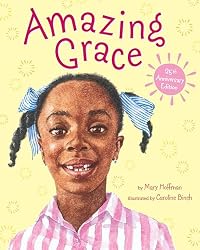
Grace was a girl who loved stories. She loved them when her Nana told them to her, she loved them when she read them herself, and she loved them when they were interpreted for her through film. Always casting herself into the story - invariably with the most exciting role! - Grace is in no doubt as to which part she wants when her teacher announces that her class will be putting on a play about Peter Pan. But when her classmates tell her she cannot play the boy who never grew up because she is a girl and is black, she is temporarily cast down. Fortunately her mother and Nana are there to pick her up, and to show her she can do anything she sets her mind to...
Originally published in 1991 in the UK, Amazing Grace has become a classic of show more the picture-book genre since then, offering a heartwarming and affirming story of an imaginative and feisty young girl who dreams big dreams, and who makes those dreams a reality in the face of some not-so-enlightened classmates. I appreciated the fact that those classmates are depicted as capable of having a change of heart - although two of them initially think that Grace can't play Peter Pan because of her sex and race, after the auditions, she is elected to the role unanimously - and that Grace herself is such a joyful, strong character. I also appreciated the family dynamic here, with the support and love that Ma and Nana give to Grace. Although not an African-American book (I have seen it described as such), this book about a young black British girl will appeal to many in the African-American community, and to many others as well.
A beautifully illustrated book, Amazing Grace boasts the gorgeous watercolor artwork of the talented Caroline Binch, who captures Grace's joy in play, her discouragement in the face of prejudice, and her triumph at making her dreams a reality with great skill in her paintings. The edition of this book that I read is the standard one, including the scene in which Grace imagines herself as Hiawatha, which some here in the USA have found objectionable. It is interesting to note that the publisher has produced a new 25th Anniversary edition as well, which changes that scene, removing the artwork and substituting an image of Grace pretending to be Aladdin. I appreciate that both versions are available, so that those who want to read the full, original edition as created by the author and artist are able to, but those distressed by the Hiawatha scene can now enjoy the story as well. show less
Originally published in 1991 in the UK, Amazing Grace has become a classic of show more the picture-book genre since then, offering a heartwarming and affirming story of an imaginative and feisty young girl who dreams big dreams, and who makes those dreams a reality in the face of some not-so-enlightened classmates. I appreciated the fact that those classmates are depicted as capable of having a change of heart - although two of them initially think that Grace can't play Peter Pan because of her sex and race, after the auditions, she is elected to the role unanimously - and that Grace herself is such a joyful, strong character. I also appreciated the family dynamic here, with the support and love that Ma and Nana give to Grace. Although not an African-American book (I have seen it described as such), this book about a young black British girl will appeal to many in the African-American community, and to many others as well.
A beautifully illustrated book, Amazing Grace boasts the gorgeous watercolor artwork of the talented Caroline Binch, who captures Grace's joy in play, her discouragement in the face of prejudice, and her triumph at making her dreams a reality with great skill in her paintings. The edition of this book that I read is the standard one, including the scene in which Grace imagines herself as Hiawatha, which some here in the USA have found objectionable. It is interesting to note that the publisher has produced a new 25th Anniversary edition as well, which changes that scene, removing the artwork and substituting an image of Grace pretending to be Aladdin. I appreciate that both versions are available, so that those who want to read the full, original edition as created by the author and artist are able to, but those distressed by the Hiawatha scene can now enjoy the story as well. show less
This was one of my FAVORITE books as a child. Being African American, my mom was always bringing home books about little black girls. The girl in the story lives through the characters of other stories. She likes to pretend and recreate the stories of movies and books. She was told that she couldn't play Peter Pan in the school play because she was a girl and she was black. Her goal was to play that character and ended up defeating the odds and being voted as the lead role of the play. It is a good book about motivation and not giving up. I have been told that I wouldn't be able to do many things because I am black and this is a really good book to show little black girls that they can be whatever the aspire to be if they work hard for it.
In my opinion this book represents a good multicultural book. The main character is a black girl who wants to be Peter Pan, which is a boy. I like this because a girl wanting to be a boy is already controversial so to make that a black girl, especially since Peter Pan is white, evokes more emotion and complication with the subject. In the beginning of the book, she talks about how she likes to act out stories and if she doesn't have friends to play with, she'll play all the parts. I like this because it promotes imagination and self play, which is important especially for young children. Later, her friends tell her she can't be Peter Pan because of the gender issue. However through her families support, she sees she can be whatever she show more wants and whoever she wants. The book teaches the importance of confidence and individuality. show less
I absolutely adored this book. Grace is a precious black girl who loves life. She is ecstatic to hear that her school is doing the play "Peter Pan". She wants to audition for the lead. However, her fellow students say that she can't play the lead because she's not a boy and black. Her family explains to her that she can do whatever she puts her mind to, and she eventually gets the lead. It's a beautiful story that shows that no matter what race or gender you are, you can overcome boundaries.
In many ways, Amazing Grace written by Mary Hoffman and illustrated by Caroline Binch, is a truly wonderful story for all children, with an inspiring text and evocative, descriptive illustrations. It has an important, affirming message that anyone can be anything he/she desires to be (any role, any job, any position), regardless of race, gender, social status etc.
I also find it both refreshing and encouraging that when it comes to the actual voting period, everyone in class votes for Grace to play Peter Pan, including Raj and Natalie (who had previously made prejudiced comments about Grace not fitting the role because she is not a boy and is African-American). Natalie even whispers to Grace that she did a wonderful job at the audition, show more which not only demonstrates that Natalie has learned a lesson, but that she voted for Grace because Grace showed the most talent, that the fact that Grace is a girl and African-American did not much matter to anyone in the end; all that mattered was Grace's ability and talent.
However, I do have a rather major problem with one part of this book. This is supposed to be a picture book about tolerance and fighting prejudice and stereotyping, and by extension, it should therefore also be culturally sensitive (or it should at least not describe or illustrate scenes that could be deemed as being culturally insensitive). With that in mind, I have a huge problem with the fact that Grace is not only described as playing Hiawatha, but that she is also illustrated as an Indian chief in full tribal regalia, as many Native American and First Nations individuals find the mere idea of people (including children) playing "Indian" culturally insensitive and insulting to both their culture and religion.
I think that Amazing Grace would have been a much better, much more global, and definitely a much more culturally sensitive book without that little addition. It leaves a somewhat bitter taste in my mouth, and also makes me wonder, why we are still so loath, or so unable to consider the sensitivities of our Native Americans/First Nations, even at a time when we are becoming more attuned to the sensitivities of other visible and invisible minorities. The description and depiction of Grace playing "Indian" also makes me strongly hesitant to even remotely consider recommending this otherwise excellent picture book to Native American or First Nations children (which is a pity, because the book does have an inspiring, important message that should be for everyone). Maybe I am being a bit hyper-critical here, but this did and continues to bother me quite a bit, especially since the author and the illustrator could so easily have made use of a less culturally insensitive example, a less potentially problematic character for Grace to imagine herself being and playing. show less
I also find it both refreshing and encouraging that when it comes to the actual voting period, everyone in class votes for Grace to play Peter Pan, including Raj and Natalie (who had previously made prejudiced comments about Grace not fitting the role because she is not a boy and is African-American). Natalie even whispers to Grace that she did a wonderful job at the audition, show more which not only demonstrates that Natalie has learned a lesson, but that she voted for Grace because Grace showed the most talent, that the fact that Grace is a girl and African-American did not much matter to anyone in the end; all that mattered was Grace's ability and talent.
However, I do have a rather major problem with one part of this book. This is supposed to be a picture book about tolerance and fighting prejudice and stereotyping, and by extension, it should therefore also be culturally sensitive (or it should at least not describe or illustrate scenes that could be deemed as being culturally insensitive). With that in mind, I have a huge problem with the fact that Grace is not only described as playing Hiawatha, but that she is also illustrated as an Indian chief in full tribal regalia, as many Native American and First Nations individuals find the mere idea of people (including children) playing "Indian" culturally insensitive and insulting to both their culture and religion.
I think that Amazing Grace would have been a much better, much more global, and definitely a much more culturally sensitive book without that little addition. It leaves a somewhat bitter taste in my mouth, and also makes me wonder, why we are still so loath, or so unable to consider the sensitivities of our Native Americans/First Nations, even at a time when we are becoming more attuned to the sensitivities of other visible and invisible minorities. The description and depiction of Grace playing "Indian" also makes me strongly hesitant to even remotely consider recommending this otherwise excellent picture book to Native American or First Nations children (which is a pity, because the book does have an inspiring, important message that should be for everyone). Maybe I am being a bit hyper-critical here, but this did and continues to bother me quite a bit, especially since the author and the illustrator could so easily have made use of a less culturally insensitive example, a less potentially problematic character for Grace to imagine herself being and playing. show less
I love depictions of kids being free to be whomever they want to be. This book, Amazing Grace, shows just that. Grace is a little girl with a big imagination. She loves stories in all formats and enjoys acting them out. One day, she wants to audition for the part of peter pan in her school play. Kids at school try and tell her she can't because she is a girl but her nana and mama tell her she can be peter pan and anyone else she wants. I love the way they shot down a gender norm of boys playing boy parts and girl playing girl parts. In theater, may the best actor/actress get the part! no gender necessary. Proceeding, she auditions for and gets the part. This shows Grace, and any kid reading this book, that if you put your mind to it you show more can do anything in this world you heart desires. In my drama class, i'd hope to breed kids with a mind of Grace's. Caroline Binch's watercolor illustrations were very pleasing tot he eye. show less
Wonderful picture book about a kid confronting gender and race stereotypes in school theater. Grace is a creative and imaginative kid with a lot of energy, who was drawn to Peter Pan, but was told by a classmate that she couldn't be Peter Pan because he was a boy, and a white boy besides.
This book is a classic, and deservedly so. The illustrations are beautiful, with popping color, and the characterizations and dilemmas the protagonist faces are very real. I read this to my daughter while in preschool, but we'll be revisiting it periodically through early elementary.
This book is a classic, and deservedly so. The illustrations are beautiful, with popping color, and the characterizations and dilemmas the protagonist faces are very real. I read this to my daughter while in preschool, but we'll be revisiting it periodically through early elementary.
Members
- Recently Added By
Lists

Children's picture books with kids of color
129 works; 15 members

Reading Rainbow
193 works; 10 members

Banned or Challenged Books
400 works; 40 members

Youth: BLM
265 works; 1 member

Female Protagonist
1,056 works; 56 members
Author Information

167+ Works 16,579 Members
Children's author and reviewer Mary Hoffman was born in 1945. She attended Newnham College to study English literature and University College London to study linguistics. She started writing in 1970 and has written about eighty children's books including the picture book Amazing Grace, the Stravaganza series, and the anti-war anthology Lines in show more the Sand. She is also the editor of the children's book review magazine Armadillo, which comes out four times a year. (Bowker Author Biography) show less
All Editions
Some Editions
Awards and Honors
Awards
Distinctions
Notable Lists
Series

Belongs to Publisher Series
Work Relationships
Is contained in
Common Knowledge
- Canonical title
- Amazing Grace
- Original publication date
- 1991
- Related movies
- Amazing Grace (1994)
- Dedication
- For Buchi Emecheta -- M.H.
For Joe -- C.B. - First words
- Grace was a girl who loved stories.
- Last words
- (Click to show. Warning: May contain spoilers.)"Yes," said Nana. "If Grace put her mind to it, she can do anything she want."
- Original language
- English
Classifications
Statistics
- Members
- 5,453
- Popularity
- 2,449
- Reviews
- 257
- Rating
- (4.27)
- Languages
- Dutch, English, German, Spanish
- Media
- Paper, Audiobook, Ebook
- ISBNs
- 55
- ASINs
- 16