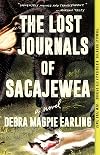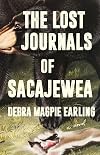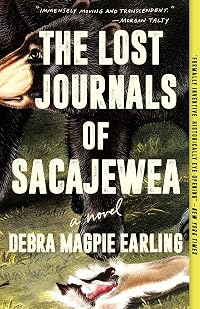
The Lost Journals of Sacajewea
by Debra Magpie Earling
On This Page
Description
From the award-winning author of Perma Red comes a devastatingly beautiful novel that challenges prevailing historical narratives of Sacajewea."In my seventh winter, when my head only reached my Appe's rib, a White Man came into camp. Bare trees scratched sky. Cold was endless. He moved through trees like strikes of sunlight. My Bia said he came with bad intentions, like a Water Baby's cry."Among the most memorialized women in American history, Sacajewea served as interpreter and guide for show more Lewis and Clark's Corps of Discovery. In this visionary novel, acclaimed Indigenous author Debra Magpie Earling brings this mythologized figure vividly to life, casting unsparing light on the men who brutalized her and recentering Sacajewea as the arbiter of her own history.Raised among the Lemhi Shoshone, in this telling the young Sacajewea is bright and bold, growing strong from the hard work of "learning all ways to survive": gathering berries, water, roots, and wood; butchering buffalo, antelope, and deer; catching salmon and snaring rabbits; weaving baskets and listening to the stories of her elders. When her village is raided and her beloved Appe and Bia are killed, Sacajewea is kidnapped and then gambled away to Charbonneau, a French Canadian trapper.Heavy with grief, Sacajewea learns how to survive at the edge of a strange new world teeming with fur trappers and traders. When Lewis and Clark's expedition party arrives, Sacajewea knows she must cross a vast and brutal terrain with her newborn son, the white man who owns her, and a company of men who wish to conquer and commodify the world she loves.Written in lyrical, dreamlike prose, The Lost Journals of Sacajewea is an astonishing work of art and a powerful tale of perseverance-the Indigenous woman's story that hasn't been told. show lessTags
Recommendations







Member Reviews
If you're American, you grew up with the story of the brave Indian maid who helped out Lewis and Clark on their journey across the western half of the American continent. What usually isn't included in the children's tale is that she was taken along as the enslaved chattel of their interpreter and that she was so, so young. Debra Magpie Earling tells the more complicated story here.
The book begins with Sacajawea's childhood, where her parents teach her about the world around her. Earling is doing something very interesting and difficult here -- her protagonist is from a society that is pre-literate and that has its own complicated spirituality based on nature. To recount Sacajewea's experiences in her own words is to enter a place where show more language is used differently, and while there is a note explaining what is intended, it was an effort for me to understand what is going on in beginning of the book. As Sacajawea grows up and as events in her life lead her into contact with both other tribes and with white men, her language changes accordingly, which was easier to follow, but also heartbreaking. This is not a happy story; it's full of beauty and poetry, but also full of pain as she is first kidnapped by a hostile tribe and then traded to a French Canadian when she is still a child. I admire what Earling has accomplished here, but I am not going to reread this one. show less
The book begins with Sacajawea's childhood, where her parents teach her about the world around her. Earling is doing something very interesting and difficult here -- her protagonist is from a society that is pre-literate and that has its own complicated spirituality based on nature. To recount Sacajewea's experiences in her own words is to enter a place where show more language is used differently, and while there is a note explaining what is intended, it was an effort for me to understand what is going on in beginning of the book. As Sacajawea grows up and as events in her life lead her into contact with both other tribes and with white men, her language changes accordingly, which was easier to follow, but also heartbreaking. This is not a happy story; it's full of beauty and poetry, but also full of pain as she is first kidnapped by a hostile tribe and then traded to a French Canadian when she is still a child. I admire what Earling has accomplished here, but I am not going to reread this one. show less
I usually have problems with real historical people having fictional words put into their mouth. But here we have one of the most marginalized, yet mythologized historical figures that was barely mentioned in even the accounts of Lewis & Clark, who apparently needed her around for their benefit. But since Sacajewea was hardly allowed her own story, I'm willing to read a fictionalized story of Sacajewea written from a Native perspective, as this author is. Here, Sacajewea spends the early part of the book as a child with her family, but then is kidnapped by enemies and is forced to marry a white man. She stays in her husband's lodge until Lewis & Clark arrive. But this summary just makes it sound like the narrative is following the show more generic myth of Sacajewea. It is so much more. The book is difficult to read in all the ways, like making your way through a river of dead buffalo. I did not expect a historical person like Sacajewea to have a modern vernacular, and I appreciate the inventiveness of the writer here, but reading this is always work, at times it was a bit TOO confusing, with sometimes a few puzzling things even within one sentence. (I still haven't figured out what the "Ogres" represent...) But a narrative like this shouldn't be easy, by any means, for any of the reasons. For all its harshness and brutality, there is also a ton of beauty. If you can pick apart some of this, I don't think it could possibly be richer or fuller. If it were simpler, it might lean into cliche by default, no matter the skill of the writer. I ended up loving the confusion of what was spirit and what was not. There is a ton of memorable beautiful imagery here, but also some horrifying, miserable imagery as well. But I can see the reason: this isn't supposed to be the sugarcoated/myth/history book version from school. This is realistic. With this writer's power, she can make Sacajewea live in your heart. And I think that was the entire point.
*Book #147/340 I have read of the shortlisted Morning News Tournament of Books show less
*Book #147/340 I have read of the shortlisted Morning News Tournament of Books show less
In the beginning Sacajewea describes herself as a young girl in the Lemhi Shoshone tribe, living a happy childhood, learning the skills, traditions and spiritual beliefs of her people and dreaming of the man she plans to marry.
Then she is stolen away by a raiding tribe. Her family members are killed; she herself is raped, brutalized and turned into a slave. After some years she is gambled away to a French-Canadian trapper named Charbonneau, who continues to treat her as a slave. When Charbonneau is engaged by the Lewis & Clark expedition, Sacajewea is taken along and her myth is created.
This was a truly challenging read. As a “journal” it’s written in a stream of consciousness which, begins as a young child in abbreviated show more language. As Sacajewea matures, so does her thinking, vocabulary and knowledge. But even as the language improves and becomes easier to read, the brutality against her is told in graphic terms. We are used to seeing the statues of Sacajewea standing triumphantly with her child strapped to her back and pointing the direction with her outstretched arm. This is as much a white-man fiction as the happy slaves on southern plantations.
I had the privilege of hearing Debra Earling speak soon after this book was published. She said the story was ‘given’ to her almost in its entirety. And while it follows much of the standard story of Sacajewea, I really liked the ending – and as hard as it was to read, I like very much the woman and history it portrays. show less
Then she is stolen away by a raiding tribe. Her family members are killed; she herself is raped, brutalized and turned into a slave. After some years she is gambled away to a French-Canadian trapper named Charbonneau, who continues to treat her as a slave. When Charbonneau is engaged by the Lewis & Clark expedition, Sacajewea is taken along and her myth is created.
This was a truly challenging read. As a “journal” it’s written in a stream of consciousness which, begins as a young child in abbreviated show more language. As Sacajewea matures, so does her thinking, vocabulary and knowledge. But even as the language improves and becomes easier to read, the brutality against her is told in graphic terms. We are used to seeing the statues of Sacajewea standing triumphantly with her child strapped to her back and pointing the direction with her outstretched arm. This is as much a white-man fiction as the happy slaves on southern plantations.
I had the privilege of hearing Debra Earling speak soon after this book was published. She said the story was ‘given’ to her almost in its entirety. And while it follows much of the standard story of Sacajewea, I really liked the ending – and as hard as it was to read, I like very much the woman and history it portrays. show less
A bright, observant Shoshone girl, Sacajewea is only nine when she's taken from her home, and must navigate a brutal world.
In a poetic rendering of a first-person journal, Earling reimagines Sacajewea's story, weaving in the few historical details of her life, and refuses to whitewash or gentle what must have been a really hard and frightening experiences. A difficult read at times, but well worth engaging.
In a poetic rendering of a first-person journal, Earling reimagines Sacajewea's story, weaving in the few historical details of her life, and refuses to whitewash or gentle what must have been a really hard and frightening experiences. A difficult read at times, but well worth engaging.
I wanted to like this book, but it was so much work to understand. I haven’t been so relieved to finish a book in a long time.
The book is written as if in a dream state, trying, I assume, to present the state of consciousness of a young Native American woman of that era. Events are described obliquely, and occasionally poetically, but almost never directly. Whether characters had died or lived became a point of confusion for me at times.
I was so mentally invested in trying to follow the plot and keep track of the characters and mythologies that I no energy left for emotional connection.
It did leave me wanting to know more about Native American culture and the events and characters of the Lewis and Clark expedition, so the author show more stimulated my curiosity if not my admiration for her creative choices. show less
The book is written as if in a dream state, trying, I assume, to present the state of consciousness of a young Native American woman of that era. Events are described obliquely, and occasionally poetically, but almost never directly. Whether characters had died or lived became a point of confusion for me at times.
I was so mentally invested in trying to follow the plot and keep track of the characters and mythologies that I no energy left for emotional connection.
It did leave me wanting to know more about Native American culture and the events and characters of the Lewis and Clark expedition, so the author show more stimulated my curiosity if not my admiration for her creative choices. show less
I wanted this to be a journal showing how smart Sacajewea was and how much she knew over the white men, but in this rendition, the speech is short and choppy and IMHO doesn't make her look intelligent. She does manage to learn a lot of English, but she keeps the knowledge to herself and uses her insights to figure out the plans, but never really to guide the exploration. She has a tough life, kidnapped and made pregnant by white men, stolen from her husband and people. This is a rough read, and maybe that is the whole point. Her reality sucked.
I couldn't get into this. I really respect what Earling is doing, but I found it very difficult to read. First of all, she uses a lot of words that are never defined, so it's really hard to tell if a word is referring to a person or a concept or an object. I think I ultimately would have liked that, and would have liked to be forced to question whether the categories of "person", "concept", and "object" are meaningful, except it made it very difficult to understand what was going on. The bigger problem for me was that a lot of the book is written in a very choppy sentence structure, which to me ended up sounding like the Hollywood stereotype of "How, me Big Injun, smoke peace pipe, how." I gave up about 10% into the book.
Members
- Recently Added By
Lists

2024 Tournament of Books
18 works; 9 members

Fiction Based on Lives of Historical Women
17 works; 1 member
Author Information

3+ Works 488 Members
Awards and Honors
Awards
Common Knowledge
- Canonical title
- The Lost Journals of Sacajewea
Classifications
Statistics
- Members
- 195
- Popularity
- 168,585
- Reviews
- 11
- Rating
- (3.69)
- Languages
- English
- Media
- Paper, Audiobook, Ebook
- ISBNs
- 5
- ASINs
- 2