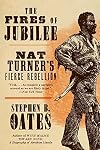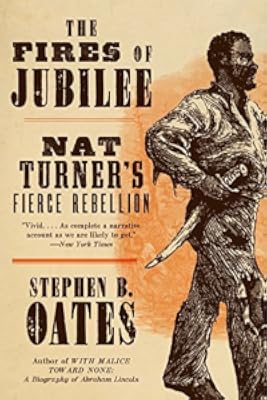
The Fires of Jubilee: Nat Turner's Fierce Rebellion
by Stephen B. Oates
On This Page
Description
"A penetrating reconstruction of the most disturbing and crucial slave uprising in America's history." —New York TimesThe definitive account of the most infamous slave rebellion in history and the aftermath that brought America one step closer to civil war—newly reissued to include the text of the original 1831 court document "The Confessions of Nat Turner"
The fierce slave rebellion led by Nat Turner in Virginia in 1831 and the savage reprisals that followed shattered beyond repair the show more myth of the contented slave and the benign master, and intensified the forces of change that would plunge America into the bloodbath of the Civil War. Stephen B. Oates, the celebrated biographer of Abraham Lincoln and Martin Luther King, Jr., presents a gripping and insightful narrative of the rebellion—the complex, gifted, and driven man who led it, the social conditions that produced it, and the legacy it left.
A classic, here is the dramatic re-creation of the turbulent period that marked a crucial turning point in America's history.
. show less
Tags
Recommendations


















Member Reviews
Between the foreword and the prologue of The Fires of Jubilee: Nat Turner's Fierce Rebellion, author Stephen Oates inserts a couple of quotations, one by Bruce Catton, which well describes the nature and the quality of this book: For a history book to have any final value, it must be written “not only with the historian's competence but also with the skill, the insight and the demanding conscience of the literary artist.” In this slim volume (154 pages not counting reference notes, index, and appendices), Oates shows himself not only a competent and accomplished historian but also a writer of consummate skill.
I found the book of considerable interest both because of the history within it and because of the page-turning narrative show more with which the author relates that history. Certainly, I had read of Nat Turner's 1831 slave uprising in more general American history books, but none had the detailed recounting of the insurrection that Oates' book contains. Beyond the bloody and methodical massacre of around sixty white slave owners, their wives, children and infants in Southampton County, Virginia, The Fires of Jubilee draws readers a clear picture of the social, cultural, and political milieu of the nation three decades before outbreak of the Civil War. It also covers some of the aftermath of the rebellion, including the deaths of about two hundred Blacks, some following legal trials and hangings and many others at the hands of vigilante groups bent on revenge.
The impact on subsequent state laws of Turner's short-lived but exceptionally lethal war against whites gets a mention in the book, too, with draconian legislation designed to prevent any repetition of the uprising, blame for its occurrence ranging widely from Black preachers to Northern abolitionists. Perhaps, however, it occurred because of one man's charisma and messianic complex, and Turner's psyche and unusual abilities are frequently in Oates' spotlight.
On the larger stage, the national debate between states' rights versus authority of the Federal government was still in full swing when Turner made his violent entrance only 55 years after the Declaration of Independence was written and 48 years after the American Revolution ended. Remembering that the Constitution was rampant with compromises necessary to achieve ratification, the extent of state versus Federal authority was still far from settled, with states claiming the right to nullify Federally-imposed tariffs which they feared would limit their economic development. The impact of such contentious debates and economic factors on Southern attitudes toward slavery also makes an appearance in the book.
In short, Oates presents a complete and encompassing picture of American culture and the place of slavery within it in surprisingly few pages. The explosion of Nat Turner's rebellion shocked not only Virginian but all of Southern white society and generated a reaction that reverberates to this day even among some who are ignorant of the events of 1831. Stephen Oates has produced a book important in its history and highly readable in its presentation. It is surely nothing less than a five-star read. show less
I found the book of considerable interest both because of the history within it and because of the page-turning narrative show more with which the author relates that history. Certainly, I had read of Nat Turner's 1831 slave uprising in more general American history books, but none had the detailed recounting of the insurrection that Oates' book contains. Beyond the bloody and methodical massacre of around sixty white slave owners, their wives, children and infants in Southampton County, Virginia, The Fires of Jubilee draws readers a clear picture of the social, cultural, and political milieu of the nation three decades before outbreak of the Civil War. It also covers some of the aftermath of the rebellion, including the deaths of about two hundred Blacks, some following legal trials and hangings and many others at the hands of vigilante groups bent on revenge.
The impact on subsequent state laws of Turner's short-lived but exceptionally lethal war against whites gets a mention in the book, too, with draconian legislation designed to prevent any repetition of the uprising, blame for its occurrence ranging widely from Black preachers to Northern abolitionists. Perhaps, however, it occurred because of one man's charisma and messianic complex, and Turner's psyche and unusual abilities are frequently in Oates' spotlight.
On the larger stage, the national debate between states' rights versus authority of the Federal government was still in full swing when Turner made his violent entrance only 55 years after the Declaration of Independence was written and 48 years after the American Revolution ended. Remembering that the Constitution was rampant with compromises necessary to achieve ratification, the extent of state versus Federal authority was still far from settled, with states claiming the right to nullify Federally-imposed tariffs which they feared would limit their economic development. The impact of such contentious debates and economic factors on Southern attitudes toward slavery also makes an appearance in the book.
In short, Oates presents a complete and encompassing picture of American culture and the place of slavery within it in surprisingly few pages. The explosion of Nat Turner's rebellion shocked not only Virginian but all of Southern white society and generated a reaction that reverberates to this day even among some who are ignorant of the events of 1831. Stephen Oates has produced a book important in its history and highly readable in its presentation. It is surely nothing less than a five-star read. show less
Ratings
Members
- Recently Added By
Author Information

26+ Works 3,349 Members
Stephen B. Oates was a Civil War historian and biographer. He was born in Pampa, Texas on January 6, 1936. He attended the University of Texas at Austin, receiving a bachelor's degree (1958), earned a Master of Arts degree (1960), and was awarded a Doctor of Philosophy (1969). From 1968 to 1997, he taught history and biography at the University of show more Massachusetts, Amherst. He wrote over 17 books which included, To Purge This Land with Blood: A Biography of John Brown (1970); The Fires of Jubilee: Nat Turner's Fierce Rebellion (1975); With Malice Toward None: A Life of Abraham Lincoln (1977); Let the Trumpet Sound: The Life of Martin Luther King, Jr. (1982); and A Woman of Valor: Clara Barton and the Civil War (1994). Dr. Oates was an adviser for the Ken Burn's Civil War series (1990). Stephen B. Oates died from pancreatic cancer on August 20, 2021 at his home in Amherst, Massachusetts. He was 85. (Bowker Author Biography) show less
Common Knowledge
- Original publication date
- 1975
- People/Characters
- Nat Turner; John C. Calhoun; Richard Eppes; John Floyd; Nathaniel Francis; Will Francis (slave) (show all 16); William Lloyd Garrison; William C. Parker; John Hampden Pleasants; Henry Porter; Cherry Reese; Jack Reese; Hark Travis; Joseph Travis; Sally Francis Travis; Nelson Williams
- Important places
- Southampton County, Virginia, USA
- Important events
- Nat Turner's rebellion (1831)
- Epigraph
- At this moment, I saw more clearly than ever the brutalizing effects of slavery upon both slave and slaveowner.
--Frederick Douglass - Dedication
- For my mother and my father
- First words
- PROLOGUE:
SOUTHAMPTON COUNTY, 1831
Some seventy miles below Richmond, in the southeastern part of Virginia along the North Carolina border, lay a little-known backwater called Southampton County. - Last words
- (Click to show. Warning: May contain spoilers.)He gave my check to the teller as we parted. "Come back and see us, hear now?"
- Blurbers
- Brodie, Fawn; Lederer, NOrman
Classifications
- Genres
- Nonfiction, History, General Nonfiction, Biography & Memoir
- DDC/MDS
- 975.55503092 — History & geography History of North America Southeastern United States (South Atlantic states) Virginia
- LCC
- F232 .S7 .O22 — Local History of the United States, Canada and Latin America United States local history Virginia
- BISAC
Statistics
- Members
- 346
- Popularity
- 91,282
- Reviews
- 1
- Rating
- (3.63)
- Languages
- English
- Media
- Paper, Audiobook, Ebook
- ISBNs
- 14
- ASINs
- 9