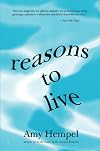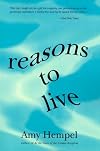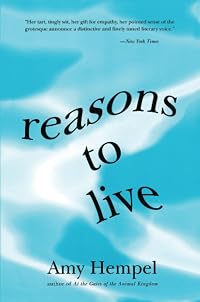
Reasons to Live
by Amy Hempel
On This Page
Description
Presents a collection of fifteen short stories featuring complex characters by twentieth-century American author Amy Hempel.Tags
Recommendations














Member Reviews
La Hempel nei suoi racconti più riusciti, soprattutto in quelli brevi di poche facciate, è riuscita a toccare nel profondo, a ulcerare. Le ragioni per vivere che danno il titolo alla raccolta in fondo sono solo piccoli, insignificanti, tenerissimi espedienti. Apprezzabilissima anche la sensibilità nei confronti degli animali.
Curiosamente, ma probabilmente è che sono bacato io, quasi sempre nei panni della protagonista mi figuravo la Kathy Bates di 'Pomodori verdi fritti', avete presente? :-)
Curiosamente, ma probabilmente è che sono bacato io, quasi sempre nei panni della protagonista mi figuravo la Kathy Bates di 'Pomodori verdi fritti', avete presente? :-)
I read this collection after reading Chuck Palahniuk's essay "Not Chasing Amy" in HIS collection of essays, Stranger Than Fiction. His discussion of her work enticed me and I found exactly what he described and more. These stories are seemingly sparse, but somehow, after each story, I felt like a truck hit me. The beauty and realism of her work inspires me to write, and at the same time, I know I could never write like this.
The Doctor couldn't make it to the picnics or to the skating--so he didn't show up in the pictures, either. The effect was of him saying after the flood: What I lose will always be lost.
"His problem is the past," Grey said about his father. "He says only do things you have done before and liked. Whereas me, what's coming is the thing I'm looking out for."
I thought the present was a safer bet. We can only die in the future, I thought; right now we are always alive.
This collection could as easily have been called something like Stories for When You Want to Lie Down and Die. It's a very living with death and deterioration kind of book. And that is wonderful. I admit I was hoping for some Magical Realism, but it was not to be: this is show more straight up realism. Even so, there are a few gems in here that will surely stay with me for a long, long time. Half the book is a little too spare, too sparse for its own good though. Some of the pictures don't quite have enough brushstrokes to fully arrive in the mind's eye. The disappointment is that the writing is good, and the good stories are great, so you know you've been cheated when things don't quite work. Nonetheless, it's a good collection, and even though the 1001 people are off their rockers about a lot of things, I'm glad they brought this little work to my attention. (Now I just wish they'd admit more short story collections belong on their list.)
Stories:
In a Tub: ★★★☆☆ A contemplation of a pulse.
Tonight Is a Favor to Holly: ★★★★☆ On ignoring an omen.
Celia Is Back: ★☆☆☆☆ A father teaches his kids about sweepstakes and contests.
Nashville Gone to Ashes: ★★★★★ A widow, a grief, and his pets.
San Francisco: ★☆☆☆☆ I don't even know what this was about. Earthquakes, maybe.
In the Cemetary Where Al Jolson Is Buried. ★★★★★ A friend fails a final test.
Beg, Sl Tog, Inc, Cont, Rep: ★★★★★ A woman grieves her abortion by taking care of a pregnant friend and learning to knit.
Going: ★★★★☆ A young man is in the hospital after a wreck.
Pool Night: ★★★★★ On fires and floods.
Three Popes Walk into a Bar: ★★☆☆☆ A comedian, fear, sex, and love.
The Man in Bogota: ★☆☆☆☆ A story not actually told to a woman on a ledge.
When It's Human Instead of When It's Dog: ★★★☆☆ A cleaning lady and a stain.
Why I'm Here: ★★★☆☆ Taking a career interests test in midlife.
Breathing Jesus: ★★☆☆☆ A carnival attraction and a lost dog.
Today Will Be a Quiet Day: ★★☆☆☆ A father, his kids, and a drive. show less
The writing in this collection is so simple, lacking any sense of pretension, but at the same time it's 100% moving and memorable and wonderful. "Nashville Gone to Ashes"; "Beg, Sl Tog, Inc, Cont, Rep"; and "The Man in Bogotá" were probably my favorites, but each story has at least one line that is truly remarkable.
Amy Hempel's short fiction collection titled reasons to live are stories of tragedies that happen. As you might say "life happens". This collection was published in 1985, maybe she would title it "life happens" if she was picking a name today. I liked many of the stories but other readers have disliked the fact that the characters are without name and very minimal detail. I think this makes it easier to insert self. Many of the stories seem to struggle with loss or a tragedy. The one titled "Nashville Gone to Ashes" is about a widow trying to tend to her deceased veterinarian husband's pets both living and deceased (ashes). She lies in his bed so the bed she sees is her own, so she can avoid seeing that she is alone. The one titled show more "Going" reminded me that memories are often retained by our senses; smells, sounds, color. These are stories of coping, focusing on detail rather than the bigger problem. It deals with grief. It really is about surviving. The emotional feel of the book is sadness. show less
Some brilliant stories, and some that suffered from Hempel's clipped style. Hempel's one fault is that her stories come across formulaic and overly constructed. The thoughts and sentences are beautiful, but it never feels like a real world in the way of, say, Carver. Instead it feels like I'm reading the fiction of a very clever 30-year old. I guess my point is that the stories FEEL like stories, all written by the same woman. In fact, a few of the most acclaimed stories in the collection---San Francisco---came across as nothing more than a scene. I get her technical point. You're supposed to glean a greater series of events from a few little details, and it is a neat technique employed by others like Carver or Robison, but some of show more these stories come across as a little too obvious. It's as if Hempel's entire purpose is to plant these tiny facts, so that the reader goes, Wow, this character ha issue with her sister. For instance, in San Fran, a story about an earthquake, the details of the catastrophe are spliced with little hints that the sisters were fighting for their dying father's possessions. As a writerly technique, this approach is brilliant (if not overdone in the last 25 years); however, the stories do not bloom at all, and feel as if their entire purpose is to allow the writer a space to tease out the borderline details of a traditional narrative. The problem is that most of the time the stories came across as thinly-veiled attempts to create a mystery that wasn't there. The true beauty of minimalism is through the interplay of withheld information and a traditional plot (see Hannah, Carver, etc..), but here Hempel usually provides only the peripheral details. The stories were beautiful in places,
Another detracting aspect is Hempel's literary voice. It seems as if each story is being told by the same woman (even the stories about men), in the same voice and style. The effect is one 'sameness' between all the stories that sort of exacerbates the technical minimalism I mentioned earlier. Remember that this was her first collection, and her later works seem to be fleshed out just a little more, which gives the impression of seeing only part of someone's life (a voyeuristic thrill), whereas here, it feels more like a writer trying to be coy/quirky. show less
Another detracting aspect is Hempel's literary voice. It seems as if each story is being told by the same woman (even the stories about men), in the same voice and style. The effect is one 'sameness' between all the stories that sort of exacerbates the technical minimalism I mentioned earlier. Remember that this was her first collection, and her later works seem to be fleshed out just a little more, which gives the impression of seeing only part of someone's life (a voyeuristic thrill), whereas here, it feels more like a writer trying to be coy/quirky. show less
A book of short stories that are very easy to read and very engaging. I would probably read this again if I came across it again. Sadly, I had no time to give this more of the minutes it deserved; I was reading through all the 1001 books I could get hold of from my library at work before I left forever just a couple of months after reading this.
One of the reasons for wanting to re-read it is her particular use of characterisation. There’s a lot more going on under the surface than it seems.
This seems astonishing when you consider that some of the stories are just 2 – 3 pages long. And yet, within that tiny span, she can, like Borges, draw you right in. However, unlike him, she never loses you or makes you feel like you don’t have show more a brain.
Lots of the stories have deal with loss and how we cope with that. This is the titular reasons to live. When others have died and you carry their memroies with you, it can be hard to live out each day.
The writing is quite poignant but because it’s so short both in totality and episode, it never gets as far as being moving. You never really get close enough for that. I felt like there was a bit of distance between me and those being described.
The fact that Hempel doesn’t names her protagonists adds to this. Some are almost totally anonymous and you only really get the barest details about their lives. I wonder why she felt this necessary.
Hempel has never written a full-length novel which seems a shame. I think a novel from her would be a wonderful piece of writing to savour. There’s still time for that. For now though, her little short story gems will have to do. show less
One of the reasons for wanting to re-read it is her particular use of characterisation. There’s a lot more going on under the surface than it seems.
This seems astonishing when you consider that some of the stories are just 2 – 3 pages long. And yet, within that tiny span, she can, like Borges, draw you right in. However, unlike him, she never loses you or makes you feel like you don’t have show more a brain.
Lots of the stories have deal with loss and how we cope with that. This is the titular reasons to live. When others have died and you carry their memroies with you, it can be hard to live out each day.
The writing is quite poignant but because it’s so short both in totality and episode, it never gets as far as being moving. You never really get close enough for that. I felt like there was a bit of distance between me and those being described.
The fact that Hempel doesn’t names her protagonists adds to this. Some are almost totally anonymous and you only really get the barest details about their lives. I wonder why she felt this necessary.
Hempel has never written a full-length novel which seems a shame. I think a novel from her would be a wonderful piece of writing to savour. There’s still time for that. For now though, her little short story gems will have to do. show less
Members
- Recently Added By
Lists

1001 Books You Must Read Before You Die
1,448 works; 1,134 members

1,001 BYMRBYD Concensus
723 works; 27 members

to get
244 works; 2 members
Author Information

15+ Works 3,337 Members
Amy Hempel teaches in the Graduate Writing Program at Bennington College.
Awards and Honors
Common Knowledge
- Original publication date
- 1985
- Quotations
- In these times, a lack of concern for others is a hallmark of mental illness.
Classifications
Statistics
- Members
- 659
- Popularity
- 43,705
- Reviews
- 18
- Rating
- (3.84)
- Languages
- 5 — English, French, German, Italian, Spanish
- Media
- Paper, Ebook
- ISBNs
- 10
- ASINs
- 3