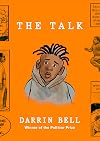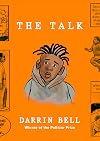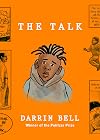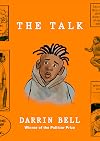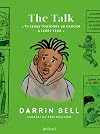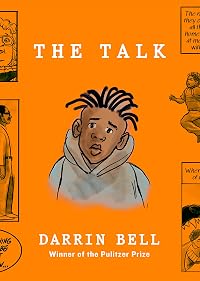
The Talk
by Darrin Bell
On This Page
Description
"This graphic memoir by a winner of the Pulitzer Prize for Editorial Cartooning offers a deeply personal meditation on the "the talk" parents must have with Black children about racism and the brutality that often accompanies it, a ritual attempt to keep kids safe and prepare them for a world that-to paraphrase Toni Morrison-does not love them. Darrin Bell was six years old when his mother told him he couldn't play with a white friend's realistic water gun. "She told me I'm a lot more likely show more to be shot by police than my friend was if they saw me with it, because police tend to think little Black boys-even light-skinned ones-are older than they really are, and less innocent than they really are." Bell examines how "the talk" has shaped nearly every moment of his life into adulthood and fatherhood. Through evocative original illustrations, The Talk is a meditation on this coming-of-age-as Bell becomes painfully aware of being regarded as dangerous by white teachers, neighbors, and strangers, and thus of his mortality. Drawing attention to the brutal murders of African Americans like Trayvon Martin and Eric Garner, and showcasing his award-winning cartoons along the way, Bell takes us up to the very moment of reckoning when people took to the streets protesting the murders of George Floyd and Breonna Taylor and when he must have "the talk" with a six-year-old son of his own"-- show lessTags
Recommendations




Member Reviews
Centered around "The Talk" his mother had with him as a child and "The Talk" that looms before him with his own son, cartoonist Darrin Bell reflects on a life buffeted by blatant racism and constant microaggressions even as several white people assure him he is "one of the good ones."
Another sad and enraging reminder of how far we have to go.
The book skips between vignettes from Bell's life, and I was often frustrated by not knowing what happened in the gaps between as we're given tantalizing sketches of other members of his family and his own career that never get the full development they seem to deserve. So I guess I'm complaining that this thick graphic novel isn't twice as long . . .
Another sad and enraging reminder of how far we have to go.
The book skips between vignettes from Bell's life, and I was often frustrated by not knowing what happened in the gaps between as we're given tantalizing sketches of other members of his family and his own career that never get the full development they seem to deserve. So I guess I'm complaining that this thick graphic novel isn't twice as long . . .
graphic nonfiction, memoir - cartoonist relates moments over his lifetime, from growing up as a biracial kid (Jewish/white mom, Black dad) in 1980s/90s Los Angeles, to his time as a UC Berkeley student, to the political cartoon he drew post-9/11 that unintentionally (but notably) contributed to hate against Sikhs, Muslims and Arabs, to the present day (2023) when he needs to explain racism to his young son.
All the praise and positive press is well deserved--I do not give out more than three stars lightly and this book easily warrants all five. Bell is a highly skilled storyteller, cartoonist, and explainer of complicated things. It is a fast read, but each page and each image is also packed with meaning -- please read and share widely.
All the praise and positive press is well deserved--I do not give out more than three stars lightly and this book easily warrants all five. Bell is a highly skilled storyteller, cartoonist, and explainer of complicated things. It is a fast read, but each page and each image is also packed with meaning -- please read and share widely.
(Full disclosure: I received a free e-ARC for review through Netgalley. Content warning for racism.)
Born in Los Angeles in 1975, Darrin Bell is the first Black editorial cartoonist to win the Pulitzer Prize, as well as the first Black comic strip creator to have two strips syndicated nationally (Candorville and Rudy Park). He started drawing at a young age - three, at his grandfather's kitchen table - and, while still a student at UC Berkeley, launched a career as a freelance editorial cartoonist. His parents - a Black man and a white Jewish woman - divorced when Derrin was in elementary school, and he was primarily raised by his mother.
Bookended by "the talk" his Black father failed to have with him at the age of six, and the talk show more Bell and his wife Makeda had with their oldest son Zazu after the murder of George Floyd, THE TALK is a memoir that examines Bell's experiences as a biracial kid growing up in California in the '80s and '90s. The Challenger explosion, the beating of Rodney King, the 2000 (and 2008 and 2016) elections, 9/11, the kidnapping of Elian Gonzalez, the murder of Trayvon Martin, and, finally, culminating with COVID-19 and lockdown (and how the two helped to catapult the George Floyd protests into the "Aether") - Bell touches upon a number of culturally significant moments. (For this Gen X-er, it was like jumping into a time machine.)
We also get a glimpse of what it was like for him to experience these moments as a Black man - and, more specifically, a Black man whose job it was to provide cultural commentary by way of political cartoons. When a cartoon drawn hastily in the days following 9/11 is met with pained criticism by Sikh and Muslim readers, Bell decides to stop drawing political cartoons altogether - only to come out of retirement some ten years later, after the murder of Trayvon Martin and the resulting trial of George Zimmerman coincides with the birth of his first child, a son named Zazu. ("I know that if someone like Zimmerman were to one day murder my baby boy, half the country would say my son had it coming.")
Bell also interrogates the "smaller," more "mundane" microaggressions he endures, particularly as a Black man existing in majority-white spaces. Some of the most satisfying panels are when he calls out his vice principal (who takes credit for "scaring" Bell "straight," after a year spent harassing him) and college professor (a liberal white lady who accuses him of plagiarism without a shred of evidence).
THE TALK is a powerful and compelling graphic memoir, brimming with memorable panels and
penetrating observations. My favorite might be Bell's discussion of electromagnetic waves and the unprovable Aether, and how the latter is an apt metaphor for white supremacy. show less
Born in Los Angeles in 1975, Darrin Bell is the first Black editorial cartoonist to win the Pulitzer Prize, as well as the first Black comic strip creator to have two strips syndicated nationally (Candorville and Rudy Park). He started drawing at a young age - three, at his grandfather's kitchen table - and, while still a student at UC Berkeley, launched a career as a freelance editorial cartoonist. His parents - a Black man and a white Jewish woman - divorced when Derrin was in elementary school, and he was primarily raised by his mother.
Bookended by "the talk" his Black father failed to have with him at the age of six, and the talk show more Bell and his wife Makeda had with their oldest son Zazu after the murder of George Floyd, THE TALK is a memoir that examines Bell's experiences as a biracial kid growing up in California in the '80s and '90s. The Challenger explosion, the beating of Rodney King, the 2000 (and 2008 and 2016) elections, 9/11, the kidnapping of Elian Gonzalez, the murder of Trayvon Martin, and, finally, culminating with COVID-19 and lockdown (and how the two helped to catapult the George Floyd protests into the "Aether") - Bell touches upon a number of culturally significant moments. (For this Gen X-er, it was like jumping into a time machine.)
We also get a glimpse of what it was like for him to experience these moments as a Black man - and, more specifically, a Black man whose job it was to provide cultural commentary by way of political cartoons. When a cartoon drawn hastily in the days following 9/11 is met with pained criticism by Sikh and Muslim readers, Bell decides to stop drawing political cartoons altogether - only to come out of retirement some ten years later, after the murder of Trayvon Martin and the resulting trial of George Zimmerman coincides with the birth of his first child, a son named Zazu. ("I know that if someone like Zimmerman were to one day murder my baby boy, half the country would say my son had it coming.")
Bell also interrogates the "smaller," more "mundane" microaggressions he endures, particularly as a Black man existing in majority-white spaces. Some of the most satisfying panels are when he calls out his vice principal (who takes credit for "scaring" Bell "straight," after a year spent harassing him) and college professor (a liberal white lady who accuses him of plagiarism without a shred of evidence).
THE TALK is a powerful and compelling graphic memoir, brimming with memorable panels and
penetrating observations. My favorite might be Bell's discussion of electromagnetic waves and the unprovable Aether, and how the latter is an apt metaphor for white supremacy. show less
In The Talk, political cartoonist and artist Darrin Bell recounts his childhood experiences of racism and the conflicting messages he received from family, teachers, and loved ones that led him to understand the ways in which racism weave throughout U.S. society. As a mixed race child, he never quite felt that he fit in either white or Black communities, but he had to deal with how people from each community viewed him. Worse, the messages he received from popular culture conflicted with what opportunities were available to him and he eventually learned that those messages were largely tailored for white audiences and the fact that people of color enjoyed them was incidental to their creators. Bell slowly began to develop his voice and show more learn how he could use it in middle and high school, finding the power of political cartoons to convey complex ideas with his high school newspaper. His cartoons became a career, giving him a sense of control in a world that limited his power due to his identity. The Movement for Black Lives refocused his work, leading to this book in which he tries to explain racism to his son in a better way than it was explained to him so that his son doesn’t have to learn these lessons the hard way. A great, all too relevant book, Bell flexes his artistic talents throughout and continues to show the power of image to convey complex issues while connecting with all audiences. show less
The Talk is the graphic novel memoir of Darrin Bell as he recounts his childhood and growing up as a Black man as he decides how to best give his own son The Talk.
This novel goes from Bell’s coming of age story where he finds his voice through cartooning and becomes well aware of just how dangerous his teachers, neighbors, and police see him. He also talks about how much his mom advocated for him as well as trying as hard as she could to protect him; his dad on the other hand had failed to teach him how to be a Black man in America.
There’s a lot to process in this book - a lot that Black Americans have to go through just to live their day to day lives. It’s honest. It’s raw. It’s very moving.
This novel goes from Bell’s coming of age story where he finds his voice through cartooning and becomes well aware of just how dangerous his teachers, neighbors, and police see him. He also talks about how much his mom advocated for him as well as trying as hard as she could to protect him; his dad on the other hand had failed to teach him how to be a Black man in America.
There’s a lot to process in this book - a lot that Black Americans have to go through just to live their day to day lives. It’s honest. It’s raw. It’s very moving.
At age 6, Darrin's white mother has The Talk with him when he wants a realistic-looking water pistol. As an adult, Darrin has to have The Talk with his own son. In between, Darrin encounters microaggressions and outright racism from teachers, police, and even the governor of California, but he sees some progress and hopes for "critical mass." He uses his powers of observation to write comic strips (Candorville, Rudy Park) and editorial cartoons, some of which are included in The Talk.
Quotes/notes
When you're bused to school, you live in four different worlds, with four different pecking orders. [Home, Classroom, Neighborhood Streets, Schoolyard] (beginning of chapter 4)
Some of what the governor said ["You're one of the good ones"] show more bothers me, but I don't want to think about why. (from chapter 8)
That's when I understood power...and that the true allure of power...is in having the authority to decide when to wield it, and when NOT to. (chapter 11)
"Son...Sometimes grown-ups...are not nice."
"Not nice?"
"And that's when Papa draws a cartoon."
"And then they're nice?" (chapter 18)
"They say change happens very slowly, and then all at once....I saw it happen once [gay marriage]. I don't know if I'll live long enough to see it happen again, but it will happen. When concern for Black lives reaches critical mass...even if it takes 400 more years...it will suddenly happen all at once." (end of chapter 18/beginning chapter 19). show less
Quotes/notes
When you're bused to school, you live in four different worlds, with four different pecking orders. [Home, Classroom, Neighborhood Streets, Schoolyard] (beginning of chapter 4)
Some of what the governor said ["You're one of the good ones"] show more bothers me, but I don't want to think about why. (from chapter 8)
That's when I understood power...and that the true allure of power...is in having the authority to decide when to wield it, and when NOT to. (chapter 11)
"Son...Sometimes grown-ups...are not nice."
"Not nice?"
"And that's when Papa draws a cartoon."
"And then they're nice?" (chapter 18)
"They say change happens very slowly, and then all at once....I saw it happen once [gay marriage]. I don't know if I'll live long enough to see it happen again, but it will happen. When concern for Black lives reaches critical mass...even if it takes 400 more years...it will suddenly happen all at once." (end of chapter 18/beginning chapter 19). show less
I really enjoyed this book and did not expect to. I did not expect to because I'm a bad person who's really tired of reading about racism. I also tend to think graphic novels are gimmicky. But this was wonderful and I wished there was more of it.
Members
- Recently Added By
Lists

Best Graphic Novel Nonfiction
199 works; 101 members

Top Five Books of 2023
767 works; 317 members

2024 Notable Books for Adults
26 works; 1 member

Youth: BLM
265 works; 1 member
Author Information
11 Works 264 Members
Awards and Honors
Awards
Distinctions
Notable Lists
Common Knowledge
- Canonical title
- The Talk
- Original publication date
- 2023
- People/Characters
- Darrin Bell; Steven Bell (brother of Darrin Bell); Karen Bell (mother of Darrin Bell); Emmett Bell, Jr. (father of Darrin Bell); Emmett Roscoe Bell, Sr. (grandfather of Darrin Bell); Luke Skywalker (show all 49); Yoda; Boba Fett; Han Solo; Chris (bully); Mrs. Cass (teacher); Mr. Potato Head; Virgil Tibbs; George Jefferson; Freddy "Rerun" Stubbs; Roger "Raj" Thomas; Fred Sanford; Lamont Sanford; Mrs. Coutts (teacher); Tae Won; Douglass; Mayim Bialik; Evan Wolfson; Paul Kim; Sung Min Suh; Janae; Pete Wilson; Eazy-E (rapper Eric Lynn Wright); James Clerk Maxwell; Heinrich Hertz; Jesse Jackson; Ann Brenoff; Crizella; Susan Garcia; Laura Bustamante; Laura Barbosa; Aristotle, 384-322; Darth Vader; Barack Obama; Lemont Brown (Candorville); Trayvon Martin; George Zimmerman; Makeda Rashidi (wife of Darrin Bell); Zazu Bell (Emyree Zazu Bell, son of Darrin Bell and Makeda Rashidi); Ehani Zia Bell (daughter of Darrin Bell and Makeda Rashidi); Ethel Kennedy; Donald Trump; George Floyd; Derek Chauvin
- Important places
- East Los Angeles, Los Angeles, California, USA; Los Angeles, California, USA; San Gabriel, California, USA; University of California, Berkeley, California, USA; Berkeley, California, USA; San Francisco, California, USA
- Dedication
- For my sons and daughters
- First words
- S . . . S . . . S–Steven?
East Los Angeles
1981
Darrin . . . Don't move. - Last words
- (Click to show. Warning: May contain spoilers.)Well, son . . . white people could have that feeling too. How could they have that feeling?
By not lying anymore.
(Click to show. Warning: May contain spoilers.)Elysian Park
Los Angeles
GRRRRR
GRRRRR
[Epilogue] - Blurbers
- LaValle, Victor; Bechdel, Alison; Knight, Keith; Alcaraz, Lalo
- Original language
- English
Classifications
- Genres
- Graphic Novels & Comics, Teen
- DDC/MDS
- 305.896 — Society, government, & culture Social sciences, sociology & anthropology Social group - Age, Gender, Ethnicity Ethnic and national groups Other ethnic and national groups Africans and people of African descent; Blacks of African origin
- LCC
- E185.86 .B37797 — History of the United States United States Elements in the population Afro-Americans Status and development since emancipation
- BISAC
Statistics
- Members
- 205
- Popularity
- 159,916
- Reviews
- 14
- Rating
- (4.53)
- Languages
- English, French
- Media
- Paper, Audiobook, Ebook
- ISBNs
- 8
- ASINs
- 1